The U.S. Securities and Exchange Commission (SEC) is expected to approve the first Hedera and Litecoin exchange-traded funds (ETFs), according to Bloomberg analyst Eric Balchunas, who confirmed that listing notices for Bitwise Solana, Canary Litecoin, and Canary HBAR have been posted and are scheduled to go live on October 28. The development marks an important milestone for the digital asset industry in 2025, showing growing acceptance of blockchain networks with real-world use cases and institutional-grade infrastructure. A Milestone for Regulated Digital Asset Access Gregg Bell, Chief Business Officer at the Hedera Foundation, describes the approval as a watershed moment for both investors and the broader ecosystem. “With Hedera’s ETF filing approved, a new chapter opens for our ecosystem and the industry at large,” Bell said. “For the first time, investors can gain regulated access to HBAR, a network powering real-world use cases at scale — from tokenized assets to sustainability markets. Supported by the Hedera Governing Council of Fortune 500 organizations, this milestone isn’t just about financial exposure; it’s about showcasing Hedera’s role as critical infrastructure for the future of global finance and accelerating adoption across both institutional and retail markets,” explains Bell. Hedera’s governing body includes major global enterprises such as Google, IBM, Standard Bank, and Boeing, giving it one of the strongest enterprise governance frameworks in the blockchain industry. The introduction of an HBAR ETF provides a regulated gateway for institutional investors to gain exposure to a network already facilitating enterprise-grade tokenization, carbon credit tracking, and digital identity solutions. Industry Reaction: A Broader Shift in Institutional Access The ETF approvals are part of a wider wave of regulated digital asset products entering traditional markets. Thomas Uhm, Chief Commercial Officer at the Jito Foundation, said the move represents a turning point for institutional crypto access. “We’ve been sitting on the precipice of this moment, and I’m immensely proud we’re finally here. The approval of staked Solana ETFs is a significant step for institutional access to crypto. What most people see as success is a mountain of work under the surface,” explains Uhm. Uhm added that JitoSOL’s early groundwork — including integration with custodians, building exchange liquidity, and addressing compliance challenges — has positioned it to serve institutional demand for yield-bearing digital assets. The Beginning of a New Market Phase With multiple crypto ETFs — including Solana, Litecoin, and Hedera — now set to launch, analysts anticipate a surge in institutional participation across the digital asset market. These developments collectively expand regulated exposure beyond Bitcoin and Ethereum, creating diversified pathways for investors seeking compliance-ready blockchain exposure. As Bell puts it, “The approval of the HBAR ETF is more than validation — it’s the start of a new chapter for onchain finance.” HBAR Surges 17% as SEC ETF Approval Nears The price of Hedera (HBAR) surged 17.4% in the past 24 hours, trading at $0.2096 as traders priced in anticipation of the first HBAR ETF approval. Hedera’s market capitalization rose to $8.9 billion, up 17.4%, while 24-hour trading volume skyrocketed 425% to nearly $1 billion — one of the largest daily increases in its history. The fully diluted valuation (FDV) now sits above $10.4 billion, reflecting renewed investor confidence in Hedera’s role within enterprise and institutional blockchain infrastructure. The approval of an HBAR ETF would give institutional investors — who were previously restricted by compliance barriers — direct, regulated access to the asset. Market participants expect new inflows as asset managers and ETFs begin accumulating HBAR to back their fundsThe U.S. Securities and Exchange Commission (SEC) is expected to approve the first Hedera and Litecoin exchange-traded funds (ETFs), according to Bloomberg analyst Eric Balchunas, who confirmed that listing notices for Bitwise Solana, Canary Litecoin, and Canary HBAR have been posted and are scheduled to go live on October 28. The development marks an important milestone for the digital asset industry in 2025, showing growing acceptance of blockchain networks with real-world use cases and institutional-grade infrastructure. A Milestone for Regulated Digital Asset Access Gregg Bell, Chief Business Officer at the Hedera Foundation, describes the approval as a watershed moment for both investors and the broader ecosystem. “With Hedera’s ETF filing approved, a new chapter opens for our ecosystem and the industry at large,” Bell said. “For the first time, investors can gain regulated access to HBAR, a network powering real-world use cases at scale — from tokenized assets to sustainability markets. Supported by the Hedera Governing Council of Fortune 500 organizations, this milestone isn’t just about financial exposure; it’s about showcasing Hedera’s role as critical infrastructure for the future of global finance and accelerating adoption across both institutional and retail markets,” explains Bell. Hedera’s governing body includes major global enterprises such as Google, IBM, Standard Bank, and Boeing, giving it one of the strongest enterprise governance frameworks in the blockchain industry. The introduction of an HBAR ETF provides a regulated gateway for institutional investors to gain exposure to a network already facilitating enterprise-grade tokenization, carbon credit tracking, and digital identity solutions. Industry Reaction: A Broader Shift in Institutional Access The ETF approvals are part of a wider wave of regulated digital asset products entering traditional markets. Thomas Uhm, Chief Commercial Officer at the Jito Foundation, said the move represents a turning point for institutional crypto access. “We’ve been sitting on the precipice of this moment, and I’m immensely proud we’re finally here. The approval of staked Solana ETFs is a significant step for institutional access to crypto. What most people see as success is a mountain of work under the surface,” explains Uhm. Uhm added that JitoSOL’s early groundwork — including integration with custodians, building exchange liquidity, and addressing compliance challenges — has positioned it to serve institutional demand for yield-bearing digital assets. The Beginning of a New Market Phase With multiple crypto ETFs — including Solana, Litecoin, and Hedera — now set to launch, analysts anticipate a surge in institutional participation across the digital asset market. These developments collectively expand regulated exposure beyond Bitcoin and Ethereum, creating diversified pathways for investors seeking compliance-ready blockchain exposure. As Bell puts it, “The approval of the HBAR ETF is more than validation — it’s the start of a new chapter for onchain finance.” HBAR Surges 17% as SEC ETF Approval Nears The price of Hedera (HBAR) surged 17.4% in the past 24 hours, trading at $0.2096 as traders priced in anticipation of the first HBAR ETF approval. Hedera’s market capitalization rose to $8.9 billion, up 17.4%, while 24-hour trading volume skyrocketed 425% to nearly $1 billion — one of the largest daily increases in its history. The fully diluted valuation (FDV) now sits above $10.4 billion, reflecting renewed investor confidence in Hedera’s role within enterprise and institutional blockchain infrastructure. The approval of an HBAR ETF would give institutional investors — who were previously restricted by compliance barriers — direct, regulated access to the asset. Market participants expect new inflows as asset managers and ETFs begin accumulating HBAR to back their funds

SEC Poised to Approve HBAR ETF — Hedera’s Gregg Bell Calls It ‘New Chapter’ for Regulated Crypto Access

The U.S. Securities and Exchange Commission (SEC) is expected to approve the first Hedera and Litecoin exchange-traded funds (ETFs), according to Bloomberg analyst Eric Balchunas, who confirmed that listing notices for Bitwise Solana, Canary Litecoin, and Canary HBAR have been posted and are scheduled to go live on October 28.

The development marks an important milestone for the digital asset industry in 2025, showing growing acceptance of blockchain networks with real-world use cases and institutional-grade infrastructure.

A Milestone for Regulated Digital Asset Access

Gregg Bell, Chief Business Officer at the Hedera Foundation, describes the approval as a watershed moment for both investors and the broader ecosystem. “With Hedera’s ETF filing approved, a new chapter opens for our ecosystem and the industry at large,” Bell said.

“For the first time, investors can gain regulated access to HBAR, a network powering real-world use cases at scale — from tokenized assets to sustainability markets. Supported by the Hedera Governing Council of Fortune 500 organizations, this milestone isn’t just about financial exposure; it’s about showcasing Hedera’s role as critical infrastructure for the future of global finance and accelerating adoption across both institutional and retail markets,” explains Bell.

Hedera’s governing body includes major global enterprises such as Google, IBM, Standard Bank, and Boeing, giving it one of the strongest enterprise governance frameworks in the blockchain industry.

The introduction of an HBAR ETF provides a regulated gateway for institutional investors to gain exposure to a network already facilitating enterprise-grade tokenization, carbon credit tracking, and digital identity solutions.

Industry Reaction: A Broader Shift in Institutional Access

The ETF approvals are part of a wider wave of regulated digital asset products entering traditional markets. Thomas Uhm, Chief Commercial Officer at the Jito Foundation, said the move represents a turning point for institutional crypto access.

“We’ve been sitting on the precipice of this moment, and I’m immensely proud we’re finally here. The approval of staked Solana ETFs is a significant step for institutional access to crypto. What most people see as success is a mountain of work under the surface,” explains Uhm.

Uhm added that JitoSOL’s early groundwork — including integration with custodians, building exchange liquidity, and addressing compliance challenges — has positioned it to serve institutional demand for yield-bearing digital assets.

The Beginning of a New Market Phase

With multiple crypto ETFs — including Solana, Litecoin, and Hedera — now set to launch, analysts anticipate a surge in institutional participation across the digital asset market.

These developments collectively expand regulated exposure beyond Bitcoin and Ethereum, creating diversified pathways for investors seeking compliance-ready blockchain exposure.

As Bell puts it, “The approval of the HBAR ETF is more than validation — it’s the start of a new chapter for onchain finance.”

HBAR Surges 17% as SEC ETF Approval Nears

The price of Hedera (HBAR) surged 17.4% in the past 24 hours, trading at $0.2096 as traders priced in anticipation of the first HBAR ETF approval.
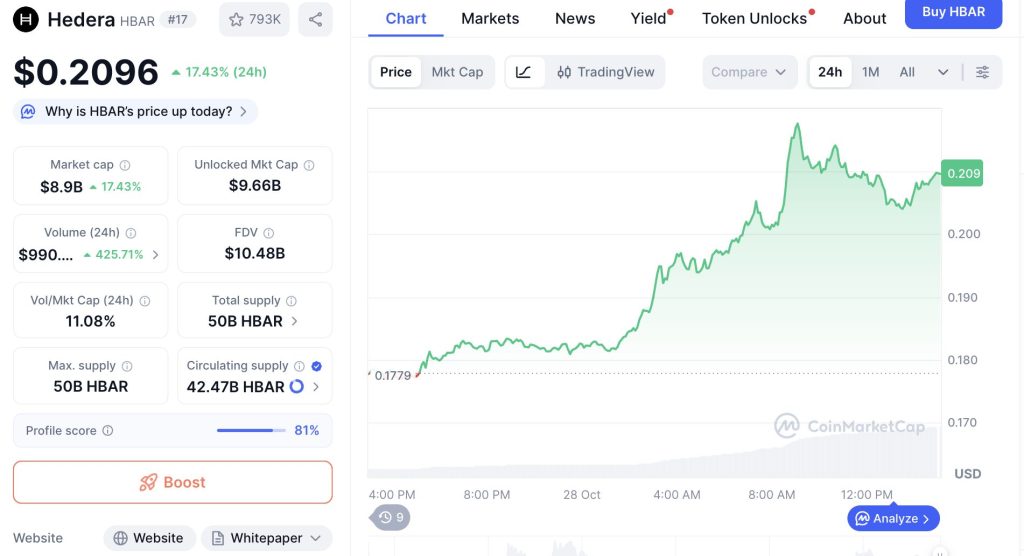
Hedera’s market capitalization rose to $8.9 billion, up 17.4%, while 24-hour trading volume skyrocketed 425% to nearly $1 billion — one of the largest daily increases in its history. The fully diluted valuation (FDV) now sits above $10.4 billion, reflecting renewed investor confidence in Hedera’s role within enterprise and institutional blockchain infrastructure.

The approval of an HBAR ETF would give institutional investors — who were previously restricted by compliance barriers — direct, regulated access to the asset. Market participants expect new inflows as asset managers and ETFs begin accumulating HBAR to back their funds.


Market Opportunity
Hedera Logo
Hedera Price(HBAR)
$0.10558
$0.10558$0.10558
-0.40%
USD
Hedera (HBAR) Live Price Chart
Disclaimer: The articles reposted on this site are sourced from public platforms and are provided for informational purposes only. They do not necessarily reflect the views of MEXC. All rights remain with the original authors. If you believe any content infringes on third-party rights, please contact service@support.mexc.com for removal. MEXC makes no guarantees regarding the accuracy, completeness, or timeliness of the content and is not responsible for any actions taken based on the information provided. The content does not constitute financial, legal, or other professional advice, nor should it be considered a recommendation or endorsement by MEXC.

You May Also Like

The Channel Factories We’ve Been Waiting For

The Channel Factories We’ve Been Waiting For

The post The Channel Factories We’ve Been Waiting For appeared on BitcoinEthereumNews.com. Visions of future technology are often prescient about the broad strokes while flubbing the details. The tablets in “2001: A Space Odyssey” do indeed look like iPads, but you never see the astronauts paying for subscriptions or wasting hours on Candy Crush.  Channel factories are one vision that arose early in the history of the Lightning Network to address some challenges that Lightning has faced from the beginning. Despite having grown to become Bitcoin’s most successful layer-2 scaling solution, with instant and low-fee payments, Lightning’s scale is limited by its reliance on payment channels. Although Lightning shifts most transactions off-chain, each payment channel still requires an on-chain transaction to open and (usually) another to close. As adoption grows, pressure on the blockchain grows with it. The need for a more scalable approach to managing channels is clear. Channel factories were supposed to meet this need, but where are they? In 2025, subnetworks are emerging that revive the impetus of channel factories with some new details that vastly increase their potential. They are natively interoperable with Lightning and achieve greater scale by allowing a group of participants to open a shared multisig UTXO and create multiple bilateral channels, which reduces the number of on-chain transactions and improves capital efficiency. Achieving greater scale by reducing complexity, Ark and Spark perform the same function as traditional channel factories with new designs and additional capabilities based on shared UTXOs.  Channel Factories 101 Channel factories have been around since the inception of Lightning. A factory is a multiparty contract where multiple users (not just two, as in a Dryja-Poon channel) cooperatively lock funds in a single multisig UTXO. They can open, close and update channels off-chain without updating the blockchain for each operation. Only when participants leave or the factory dissolves is an on-chain transaction…
Share
BitcoinEthereumNews2025/09/18 00:09
OpenVPP accused of falsely claiming partnership with ComEd

OpenVPP accused of falsely claiming partnership with ComEd

According to PANews on September 18th, on-chain sleuth ZachXBT reported that OpenVPP allegedly falsely claimed a partnership with US electric utility Commonwealth Edison ( ComEd ). ComEd responded, stating, "We have not partnered with them and have no intention of doing so."
Share
PANews2025/09/19 00:00
Haier Shines at Australian Open 2026: Official Partner Elevates the Game with Smart Innovation and Purpose

Haier Shines at Australian Open 2026: Official Partner Elevates the Game with Smart Innovation and Purpose

MELBOURNE, Australia, Jan. 25, 2026 /PRNewswire/ — Haier, the world’s No.1 major home appliance brand, continues its strategic partnership with the Australian Open
Share
AI Journal2026/01/26 11:30