South Korea’s central bank has issued a stark warning over the growing risks of won-pegged stablecoins, cautioning that private issuers could threaten monetary stability if safeguards are not established. The Bank of Korea (BOK) said in a new report titled “Currency in the Digital Age: Harmony of Innovation and Trust” that the rapid expansion of stablecoin activity poses systemic vulnerabilities, including potential depegging events and illicit capital flows.Source: Bank of Korea The central bank’s concerns come at a time when South Korea is actively debating how to regulate stablecoins. Can South Korea Balance Stablecoin Innovation With Monetary Stability? The BOK, led by Governor Rhee Chang-yong, reiterated its position that only regulated financial institutions, preferably banks, should issue such assets, arguing that “non-bank issuers could undermine monetary control and capital management.” The central bank’s latest analysis emphasized that the severity of reserve asset volatility could directly affect the domestic financial market, warning that improper collateral management may lead to depegging risks similar to those seen with foreign dollar-backed stablecoins. The report highlighted risks to monetary stability from privately issued stablecoins, particularly those that might fail to maintain a one-to-one reserve ratio with the Korean won. The BOK cautioned that improper reserve management, foreign capital outflows, and speculative trading could trigger a loss of peg confidence, echoing the failures seen in algorithmic stablecoins such as TerraUSD in 2022. The report shows that stablecoins, while potentially improving payment efficiency and supporting financial innovation, could also undermine the effectiveness of monetary policy and disrupt foreign exchange management. It called for robust reserve audits, issuance caps, and central oversight to prevent liquidity shocks. The statement follows months of mounting tension between the BOK and the government. In June, South Korea’s ruling Democratic Party proposed the Digital Asset Basic Act, which would allow local firms to issue stablecoins with a minimum capital requirement of 500 million won ($367,000) while ensuring full redemption guarantees. The bill, backed by President Lee Jae-myung’s pro-crypto administration, seeks to increase transparency and competition in the local digital asset market. However, the Bank of Korea has consistently opposed letting non-bank entities issue won-pegged stablecoins. At the time, Governor Rhee insisted that any digital currency backed by the won should remain under the central bank’s purview. “Allowing private companies to issue won-denominated stablecoins without adequate supervision could weaken monetary control,” Rhee said earlier this month. The Stablecoin Race Is On — and Korea’s Banks Aren’t Waiting. Despite central bank opposition, commercial banks have been preparing for a gradual rollout. In June, eight major banks, including KB Kookmin, Shinhan, Woori, and Nonghyup, formed a consortium to develop a joint won-linked stablecoin. The consortium plans to pilot two issuance models: a trust-based system, where customer deposits are held separately as reserves, and a deposit-linked system, where stablecoins mirror customer deposits on a one-to-one basis. The banks say the initiative aims to “secure independence and competitiveness” amid fears that foreign dollar-backed stablecoins could dominate the domestic market. The consortium’s creation marks a shift in South Korea’s financial sector, which has historically maintained distance from digital assets. Bank executives privately acknowledge a “shared sense of crisis” that foreign dollar-pegged stablecoins could dominate the domestic market if local issuance lags behind. Meanwhile, the Financial Intelligence Unit (FIU) is restructuring its anti-money laundering (AML) protocols to address the upcoming “institutionalization” of stablecoins. The agency has commissioned research on risk mitigation and is drafting new AML guidelines for stablecoin issuers to be completed by December. Officials said the findings will form the foundation for updated oversight rules under the amended Specific Financial Information Act next year. South Korea’s Stablecoin Bills Stall in Parliament as Agencies Vie for Control Notably, the government is also tightening coordination across agencies. While President Lee previously proposed dismantling the Financial Services Commission (FSC), it remains active in crypto oversight and is expected to serve as the main licensing authority for KRW-pegged stablecoins. Pending bills from both ruling and opposition lawmakers would give the FSC power to approve issuers, enforce redemption standards, and impose emergency orders in case of market disruption. Political debate has slowed progress, however. Four separate draft bills are stalled in the National Assembly as lawmakers and regulators clash over whether fintech and IT firms should be allowed to issue stablecoins. The BOK argues that such permission could lead to the emergence of “private currencies” controlled by large tech conglomerates like Naver and Kakao, potentially challenging the central bank’s monetary authority. Despite the gridlock, the stablecoin sector continues to attract global attention. In August, Circle CEO Heath Tarbert met with Governor Rhee and executives from major Korean banks and crypto exchanges to discuss cooperation on stablecoin infrastructure and regulatory frameworks. Also, Solana Foundation partnered with Korean blockchain infrastructure company Wavebridge to build a “compliance-ready” KRW-pegged stablecoin. The debate unfolds against a backdrop of declining domestic crypto activity. According to the BOK’s Financial Stability Report, the Korean crypto market lost nearly $24 billion in value in the first half of 2025, with daily trading volumes falling 80% to 3.2 trillion won. Retail investors have shifted to local equities amid stronger currency performance and growing regulatory uncertainty.Source: YNA Still, South Korea remains one of the most active crypto markets in Asia, with over 10.8 million trading accounts, roughly 20% of its populationSouth Korea’s central bank has issued a stark warning over the growing risks of won-pegged stablecoins, cautioning that private issuers could threaten monetary stability if safeguards are not established. The Bank of Korea (BOK) said in a new report titled “Currency in the Digital Age: Harmony of Innovation and Trust” that the rapid expansion of stablecoin activity poses systemic vulnerabilities, including potential depegging events and illicit capital flows.Source: Bank of Korea The central bank’s concerns come at a time when South Korea is actively debating how to regulate stablecoins. Can South Korea Balance Stablecoin Innovation With Monetary Stability? The BOK, led by Governor Rhee Chang-yong, reiterated its position that only regulated financial institutions, preferably banks, should issue such assets, arguing that “non-bank issuers could undermine monetary control and capital management.” The central bank’s latest analysis emphasized that the severity of reserve asset volatility could directly affect the domestic financial market, warning that improper collateral management may lead to depegging risks similar to those seen with foreign dollar-backed stablecoins. The report highlighted risks to monetary stability from privately issued stablecoins, particularly those that might fail to maintain a one-to-one reserve ratio with the Korean won. The BOK cautioned that improper reserve management, foreign capital outflows, and speculative trading could trigger a loss of peg confidence, echoing the failures seen in algorithmic stablecoins such as TerraUSD in 2022. The report shows that stablecoins, while potentially improving payment efficiency and supporting financial innovation, could also undermine the effectiveness of monetary policy and disrupt foreign exchange management. It called for robust reserve audits, issuance caps, and central oversight to prevent liquidity shocks. The statement follows months of mounting tension between the BOK and the government. In June, South Korea’s ruling Democratic Party proposed the Digital Asset Basic Act, which would allow local firms to issue stablecoins with a minimum capital requirement of 500 million won ($367,000) while ensuring full redemption guarantees. The bill, backed by President Lee Jae-myung’s pro-crypto administration, seeks to increase transparency and competition in the local digital asset market. However, the Bank of Korea has consistently opposed letting non-bank entities issue won-pegged stablecoins. At the time, Governor Rhee insisted that any digital currency backed by the won should remain under the central bank’s purview. “Allowing private companies to issue won-denominated stablecoins without adequate supervision could weaken monetary control,” Rhee said earlier this month. The Stablecoin Race Is On — and Korea’s Banks Aren’t Waiting. Despite central bank opposition, commercial banks have been preparing for a gradual rollout. In June, eight major banks, including KB Kookmin, Shinhan, Woori, and Nonghyup, formed a consortium to develop a joint won-linked stablecoin. The consortium plans to pilot two issuance models: a trust-based system, where customer deposits are held separately as reserves, and a deposit-linked system, where stablecoins mirror customer deposits on a one-to-one basis. The banks say the initiative aims to “secure independence and competitiveness” amid fears that foreign dollar-backed stablecoins could dominate the domestic market. The consortium’s creation marks a shift in South Korea’s financial sector, which has historically maintained distance from digital assets. Bank executives privately acknowledge a “shared sense of crisis” that foreign dollar-pegged stablecoins could dominate the domestic market if local issuance lags behind. Meanwhile, the Financial Intelligence Unit (FIU) is restructuring its anti-money laundering (AML) protocols to address the upcoming “institutionalization” of stablecoins. The agency has commissioned research on risk mitigation and is drafting new AML guidelines for stablecoin issuers to be completed by December. Officials said the findings will form the foundation for updated oversight rules under the amended Specific Financial Information Act next year. South Korea’s Stablecoin Bills Stall in Parliament as Agencies Vie for Control Notably, the government is also tightening coordination across agencies. While President Lee previously proposed dismantling the Financial Services Commission (FSC), it remains active in crypto oversight and is expected to serve as the main licensing authority for KRW-pegged stablecoins. Pending bills from both ruling and opposition lawmakers would give the FSC power to approve issuers, enforce redemption standards, and impose emergency orders in case of market disruption. Political debate has slowed progress, however. Four separate draft bills are stalled in the National Assembly as lawmakers and regulators clash over whether fintech and IT firms should be allowed to issue stablecoins. The BOK argues that such permission could lead to the emergence of “private currencies” controlled by large tech conglomerates like Naver and Kakao, potentially challenging the central bank’s monetary authority. Despite the gridlock, the stablecoin sector continues to attract global attention. In August, Circle CEO Heath Tarbert met with Governor Rhee and executives from major Korean banks and crypto exchanges to discuss cooperation on stablecoin infrastructure and regulatory frameworks. Also, Solana Foundation partnered with Korean blockchain infrastructure company Wavebridge to build a “compliance-ready” KRW-pegged stablecoin. The debate unfolds against a backdrop of declining domestic crypto activity. According to the BOK’s Financial Stability Report, the Korean crypto market lost nearly $24 billion in value in the first half of 2025, with daily trading volumes falling 80% to 3.2 trillion won. Retail investors have shifted to local equities amid stronger currency performance and growing regulatory uncertainty.Source: YNA Still, South Korea remains one of the most active crypto markets in Asia, with over 10.8 million trading accounts, roughly 20% of its population

Stablecoin Fear Spreads: South Korea’s Central Bank Warns of Depeg Threat, Urges Bank Safeguards

2025/10/29 04:45
5 min read
For feedback or concerns regarding this content, please contact us at crypto.news@mexc.com

South Korea’s central bank has issued a stark warning over the growing risks of won-pegged stablecoins, cautioning that private issuers could threaten monetary stability if safeguards are not established.

The Bank of Korea (BOK) said in a new report titled “Currency in the Digital Age: Harmony of Innovation and Trust” that the rapid expansion of stablecoin activity poses systemic vulnerabilities, including potential depegging events and illicit capital flows.
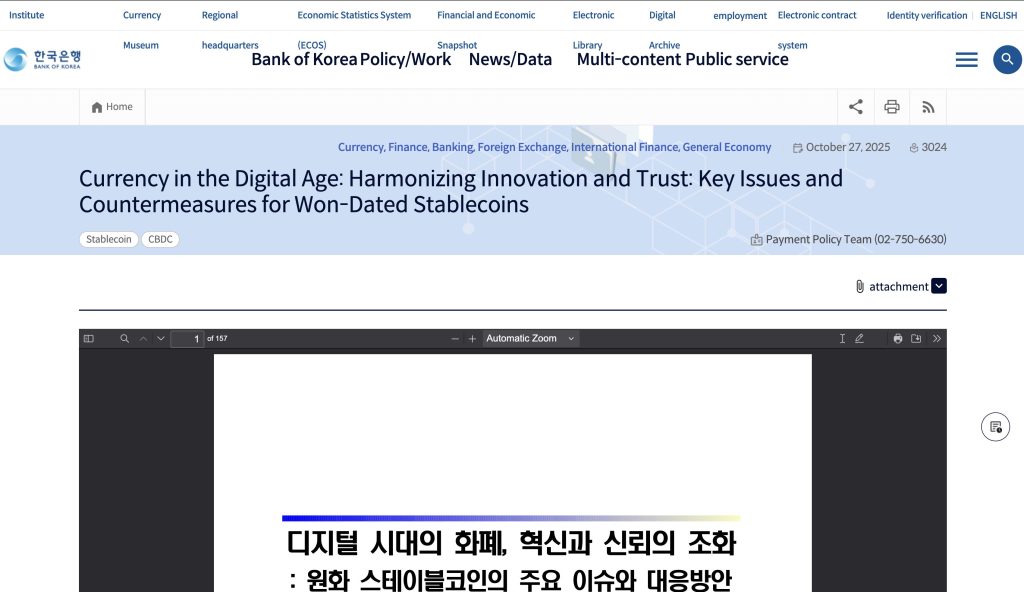
Source: Bank of Korea

The central bank’s concerns come at a time when South Korea is actively debating how to regulate stablecoins.

Can South Korea Balance Stablecoin Innovation With Monetary Stability?

The BOK, led by Governor Rhee Chang-yong, reiterated its position that only regulated financial institutions, preferably banks, should issue such assets, arguing that “non-bank issuers could undermine monetary control and capital management.”

The central bank’s latest analysis emphasized that the severity of reserve asset volatility could directly affect the domestic financial market, warning that improper collateral management may lead to depegging risks similar to those seen with foreign dollar-backed stablecoins.

The report highlighted risks to monetary stability from privately issued stablecoins, particularly those that might fail to maintain a one-to-one reserve ratio with the Korean won.

The BOK cautioned that improper reserve management, foreign capital outflows, and speculative trading could trigger a loss of peg confidence, echoing the failures seen in algorithmic stablecoins such as TerraUSD in 2022.

The report shows that stablecoins, while potentially improving payment efficiency and supporting financial innovation, could also undermine the effectiveness of monetary policy and disrupt foreign exchange management.

It called for robust reserve audits, issuance caps, and central oversight to prevent liquidity shocks.

The statement follows months of mounting tension between the BOK and the government.

In June, South Korea’s ruling Democratic Party proposed the Digital Asset Basic Act, which would allow local firms to issue stablecoins with a minimum capital requirement of 500 million won ($367,000) while ensuring full redemption guarantees.

The bill, backed by President Lee Jae-myung’s pro-crypto administration, seeks to increase transparency and competition in the local digital asset market.

However, the Bank of Korea has consistently opposed letting non-bank entities issue won-pegged stablecoins.

At the time, Governor Rhee insisted that any digital currency backed by the won should remain under the central bank’s purview.

“Allowing private companies to issue won-denominated stablecoins without adequate supervision could weaken monetary control,” Rhee said earlier this month.

The Stablecoin Race Is On — and Korea’s Banks Aren’t Waiting.

Despite central bank opposition, commercial banks have been preparing for a gradual rollout.

In June, eight major banks, including KB Kookmin, Shinhan, Woori, and Nonghyup, formed a consortium to develop a joint won-linked stablecoin.

The consortium plans to pilot two issuance models: a trust-based system, where customer deposits are held separately as reserves, and a deposit-linked system, where stablecoins mirror customer deposits on a one-to-one basis.

The banks say the initiative aims to “secure independence and competitiveness” amid fears that foreign dollar-backed stablecoins could dominate the domestic market.

The consortium’s creation marks a shift in South Korea’s financial sector, which has historically maintained distance from digital assets.

Bank executives privately acknowledge a “shared sense of crisis” that foreign dollar-pegged stablecoins could dominate the domestic market if local issuance lags behind.

Meanwhile, the Financial Intelligence Unit (FIU) is restructuring its anti-money laundering (AML) protocols to address the upcoming “institutionalization” of stablecoins.

The agency has commissioned research on risk mitigation and is drafting new AML guidelines for stablecoin issuers to be completed by December.

Officials said the findings will form the foundation for updated oversight rules under the amended Specific Financial Information Act next year.

South Korea’s Stablecoin Bills Stall in Parliament as Agencies Vie for Control

Notably, the government is also tightening coordination across agencies.

While President Lee previously proposed dismantling the Financial Services Commission (FSC), it remains active in crypto oversight and is expected to serve as the main licensing authority for KRW-pegged stablecoins.

Pending bills from both ruling and opposition lawmakers would give the FSC power to approve issuers, enforce redemption standards, and impose emergency orders in case of market disruption.

Political debate has slowed progress, however. Four separate draft bills are stalled in the National Assembly as lawmakers and regulators clash over whether fintech and IT firms should be allowed to issue stablecoins.

The BOK argues that such permission could lead to the emergence of “private currencies” controlled by large tech conglomerates like Naver and Kakao, potentially challenging the central bank’s monetary authority.

Despite the gridlock, the stablecoin sector continues to attract global attention.

In August, Circle CEO Heath Tarbert met with Governor Rhee and executives from major Korean banks and crypto exchanges to discuss cooperation on stablecoin infrastructure and regulatory frameworks.

Also, Solana Foundation partnered with Korean blockchain infrastructure company Wavebridge to build a “compliance-ready” KRW-pegged stablecoin.

The debate unfolds against a backdrop of declining domestic crypto activity.

According to the BOK’s Financial Stability Report, the Korean crypto market lost nearly $24 billion in value in the first half of 2025, with daily trading volumes falling 80% to 3.2 trillion won.

Retail investors have shifted to local equities amid stronger currency performance and growing regulatory uncertainty.

Source: YNA

Still, South Korea remains one of the most active crypto markets in Asia, with over 10.8 million trading accounts, roughly 20% of its population.


Market Opportunity
Lorenzo Protocol Logo
Lorenzo Protocol Price(BANK)
$0.03959
$0.03959$0.03959
+3.99%
USD
Lorenzo Protocol (BANK) Live Price Chart
Disclaimer: The articles reposted on this site are sourced from public platforms and are provided for informational purposes only. They do not necessarily reflect the views of MEXC. All rights remain with the original authors. If you believe any content infringes on third-party rights, please contact crypto.news@mexc.com for removal. MEXC makes no guarantees regarding the accuracy, completeness, or timeliness of the content and is not responsible for any actions taken based on the information provided. The content does not constitute financial, legal, or other professional advice, nor should it be considered a recommendation or endorsement by MEXC.

You May Also Like

Crypto News: Donald Trump-Aligned Fed Governor To Speed Up Fed Rate Cuts?

Crypto News: Donald Trump-Aligned Fed Governor To Speed Up Fed Rate Cuts?

The post Crypto News: Donald Trump-Aligned Fed Governor To Speed Up Fed Rate Cuts? appeared on BitcoinEthereumNews.com. In recent crypto news, Stephen Miran swore in as the latest Federal Reserve governor on September 16, 2025, slipping into the board’s last open spot right before the Federal Open Market Committee kicks off its two-day rate discussion. Traders are betting heavily on a 25-basis-point trim, which would bring the federal funds rate down to 4.00%-4.25%, based on CME FedWatch Tool figures from September 15, 2025. Miran, who’s been Trump’s top economic advisor and a supporter of his trade ideas, joins a seven-member board where just three governors come from Democratic picks, according to the Fed’s records updated that same day. Crypto News: Miran’s Background and Quick Path to Confirmation The Senate greenlit Miran on September 15, 2025, with a tight 48-47 vote, following his nomination on September 2, 2025, as per a recent crypto news update. His stint runs only until January 31, 2026, stepping in for Adriana D. Kugler, who stepped down in August 2025 for reasons not made public. Miran earned his economics Ph.D. from Harvard and worked at the Treasury back in Trump’s first go-around. Afterward, he moved to Hudson Bay Capital Management as an economist, then looped back to the White House in December 2024 to head the Council of Economic Advisers. There, he helped craft Trump’s “reciprocal tariffs” approach, aimed at fixing trade gaps with China and the EU. He wouldn’t quit his White House gig, which irked Senator Elizabeth Warren at the September 7, 2025, confirmation hearings. That limited time frame means Miran gets to cast a vote straight away at the FOMC session starting September 16, 2025. The full board now features Chair Jerome H. Powell (Trump pick, term ends 2026), Vice Chair Philip N. Jefferson (Biden, to 2036), and folks like Lisa D. Cook (Biden, to 2028) and Michael S. Barr…
Share
BitcoinEthereumNews2025/09/18 03:14
FCA, crackdown on crypto

FCA, crackdown on crypto

The post FCA, crackdown on crypto appeared on BitcoinEthereumNews.com. The regulation of cryptocurrencies in the United Kingdom enters a decisive phase. The Financial Conduct Authority (FCA) has initiated a consultation to set minimum standards on transparency, consumer protection, and digital custody, in order to strengthen market confidence and ensure safer operations for exchanges, wallets, and crypto service providers. The consultation was published on May 2, 2025, and opened a public discussion on operational responsibilities and safeguarding requirements for digital assets (CoinDesk). The goal is to make the rules clearer without hindering the sector’s evolution. According to the data collected by our regulatory monitoring team, in the first weeks following the publication, the feedback received from professionals and operators focused mainly on custody, incident reporting, and insurance requirements. Industry analysts note that many responses require technical clarifications on multi-sig, asset segregation, and recovery protocols, as well as proposals to scale obligations based on the size of the operator. FCA Consultation: What’s on the Table The consultation document clarifies how to apply rules inspired by traditional finance to the crypto perimeter, balancing innovation, market integrity, and user protection. In this context, the goal is to introduce minimum standards for all firms under the supervision of the FCA, an essential step for a more transparent and secure sector, with measurable benefits for users. The proposed pillars Obligations towards consumers: assessment on the extension of the Consumer Duty – a requirement that mandates companies to provide “good outcomes” – to crypto services, with outcomes for users that are traceable and verifiable. Operational resilience: introduction of continuity requirements, incident response plans, and periodic testing to ensure the operational stability of platforms even in adverse scenarios. Financial Crime Prevention: strengthening AML/CFT measures through more stringent transaction monitoring and structured counterpart checks. Custody and safeguarding: definition of operational methods for the segregation of client assets, secure…
Share
BitcoinEthereumNews2025/09/18 05:40
Why XRP Could Be More Important Than Anyone Realised: DTCC, Mastercard and DBS Explained

Why XRP Could Be More Important Than Anyone Realised: DTCC, Mastercard and DBS Explained

The post Why XRP Could Be More Important Than Anyone Realised: DTCC, Mastercard and DBS Explained appeared first on Coinpedia Fintech News XRP is trading at $1.
Share
CoinPedia2026/03/14 00:54