Dogecoin’s early November bounce appears weak, despite the modest 1.2% gain. DOGE price is still down 5.9% over the past week and nearly 27% this month. And now, on-chain data signals a deepening sell trend. The key question now: can Dogecoin’s $0.17 floor— which has held strong since October 11, even during the last bearish crossover — survive as long-term holders start to exit? Cost Basis Heatmap Marks The Last Line Of Defense On-chain cost basis data highlights Dogecoin’s strongest short-term support cluster between $0.177 and $0.179, where nearly 3.78 billion DOGE were last accumulated. First Cluster Protecting The Floor: Glassnode This range represents the heaviest long-term holder supply, acting as a key buffer during past sell-offs. Want more token insights like this? Sign up for Editor Harsh Notariya’s Daily Crypto Newsletter here. The cost basis heatmap shows where most investors last bought their tokens. It highlights the price zones with heavy long-term holder concentration that act as support or resistance. Bigger Dogecoin Support Cluster: Glassnode That buffer is weakening fast. According to Glassnode, Hodler Net Position Change — which tracks whether long-term wallets are adding or selling — flipped sharply negative on October 31. It dropped from an inflow of +8.2 million DOGE to an outflow of –22 million DOGE in just 24 hours. That’s a 367% reversal in holder behavior. Long-Term DOGE Holders Keep Selling: Glassnode This swing confirms that even older wallets are offloading their holdings. If this continues, it could thin out the $0.177–$0.179 cluster and expose Dogecoin’s strongest base since early October to further downside risk. Below $0.17, the next significant cost-basis cluster doesn’t appear until $0.14, leaving a wide gap for potential losses. But more on that in the next section. Looming Death Cross Could Accelerate the DOGE Price Breakdown The DOGE price structure now reinforces the bearish on-chain story. After the 50-day exponential moving average (EMA) crossed below the 200-day EMA in late October, Dogecoin extended its decline — marking the first leg of its current downtrend. The EMA is a trend indicator that smooths out price data to show market direction. Now, a second, stronger death cross is forming as the 100-day EMA approaches a drop below the 200-day EMA. Unlike the earlier crossover, this one carries more weight because both averages represent longer timeframes, reflecting sustained weakness rather than short-term volatility. If this crossover confirms, it would signal deepening downside momentum and strengthen the bearish structure already in place. In that case, Dogecoin’s strongest support zone near $0.17, highlighted by its cost basis heatmap, could finally give way — opening the door to a fall toward $0.14. That would be a near 6% dip. DOGE Price Analysis: TradingView Currently, DOGE trades near $0.18, capped by immediate resistances at $0.20 and $0.21. A daily close above $0.21, which hasn’t been tested since October 13, would be needed to invalidate this bearish bias.Dogecoin’s early November bounce appears weak, despite the modest 1.2% gain. DOGE price is still down 5.9% over the past week and nearly 27% this month. And now, on-chain data signals a deepening sell trend. The key question now: can Dogecoin’s $0.17 floor— which has held strong since October 11, even during the last bearish crossover — survive as long-term holders start to exit? Cost Basis Heatmap Marks The Last Line Of Defense On-chain cost basis data highlights Dogecoin’s strongest short-term support cluster between $0.177 and $0.179, where nearly 3.78 billion DOGE were last accumulated. First Cluster Protecting The Floor: Glassnode This range represents the heaviest long-term holder supply, acting as a key buffer during past sell-offs. Want more token insights like this? Sign up for Editor Harsh Notariya’s Daily Crypto Newsletter here. The cost basis heatmap shows where most investors last bought their tokens. It highlights the price zones with heavy long-term holder concentration that act as support or resistance. Bigger Dogecoin Support Cluster: Glassnode That buffer is weakening fast. According to Glassnode, Hodler Net Position Change — which tracks whether long-term wallets are adding or selling — flipped sharply negative on October 31. It dropped from an inflow of +8.2 million DOGE to an outflow of –22 million DOGE in just 24 hours. That’s a 367% reversal in holder behavior. Long-Term DOGE Holders Keep Selling: Glassnode This swing confirms that even older wallets are offloading their holdings. If this continues, it could thin out the $0.177–$0.179 cluster and expose Dogecoin’s strongest base since early October to further downside risk. Below $0.17, the next significant cost-basis cluster doesn’t appear until $0.14, leaving a wide gap for potential losses. But more on that in the next section. Looming Death Cross Could Accelerate the DOGE Price Breakdown The DOGE price structure now reinforces the bearish on-chain story. After the 50-day exponential moving average (EMA) crossed below the 200-day EMA in late October, Dogecoin extended its decline — marking the first leg of its current downtrend. The EMA is a trend indicator that smooths out price data to show market direction. Now, a second, stronger death cross is forming as the 100-day EMA approaches a drop below the 200-day EMA. Unlike the earlier crossover, this one carries more weight because both averages represent longer timeframes, reflecting sustained weakness rather than short-term volatility. If this crossover confirms, it would signal deepening downside momentum and strengthen the bearish structure already in place. In that case, Dogecoin’s strongest support zone near $0.17, highlighted by its cost basis heatmap, could finally give way — opening the door to a fall toward $0.14. That would be a near 6% dip. DOGE Price Analysis: TradingView Currently, DOGE trades near $0.18, capped by immediate resistances at $0.20 and $0.21. A daily close above $0.21, which hasn’t been tested since October 13, would be needed to invalidate this bearish bias.

DOGE Price On Thin Ice As Long-Term Holders Continue to Sell

Dogecoin’s early November bounce appears weak, despite the modest 1.2% gain. DOGE price is still down 5.9% over the past week and nearly 27% this month. And now, on-chain data signals a deepening sell trend.

The key question now: can Dogecoin’s $0.17 floor— which has held strong since October 11, even during the last bearish crossover — survive as long-term holders start to exit?

Cost Basis Heatmap Marks The Last Line Of Defense

On-chain cost basis data highlights Dogecoin’s strongest short-term support cluster between $0.177 and $0.179, where nearly 3.78 billion DOGE were last accumulated.
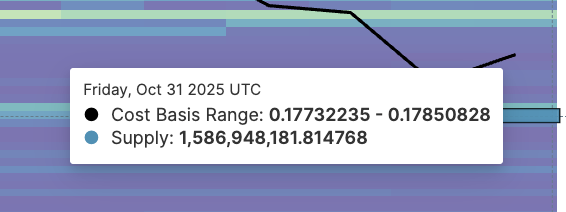
First Cluster Protecting The FloorFirst Cluster Protecting The Floor: Glassnode

This range represents the heaviest long-term holder supply, acting as a key buffer during past sell-offs.

Want more token insights like this? Sign up for Editor Harsh Notariya’s Daily Crypto Newsletter here.

The cost basis heatmap shows where most investors last bought their tokens. It highlights the price zones with heavy long-term holder concentration that act as support or resistance.
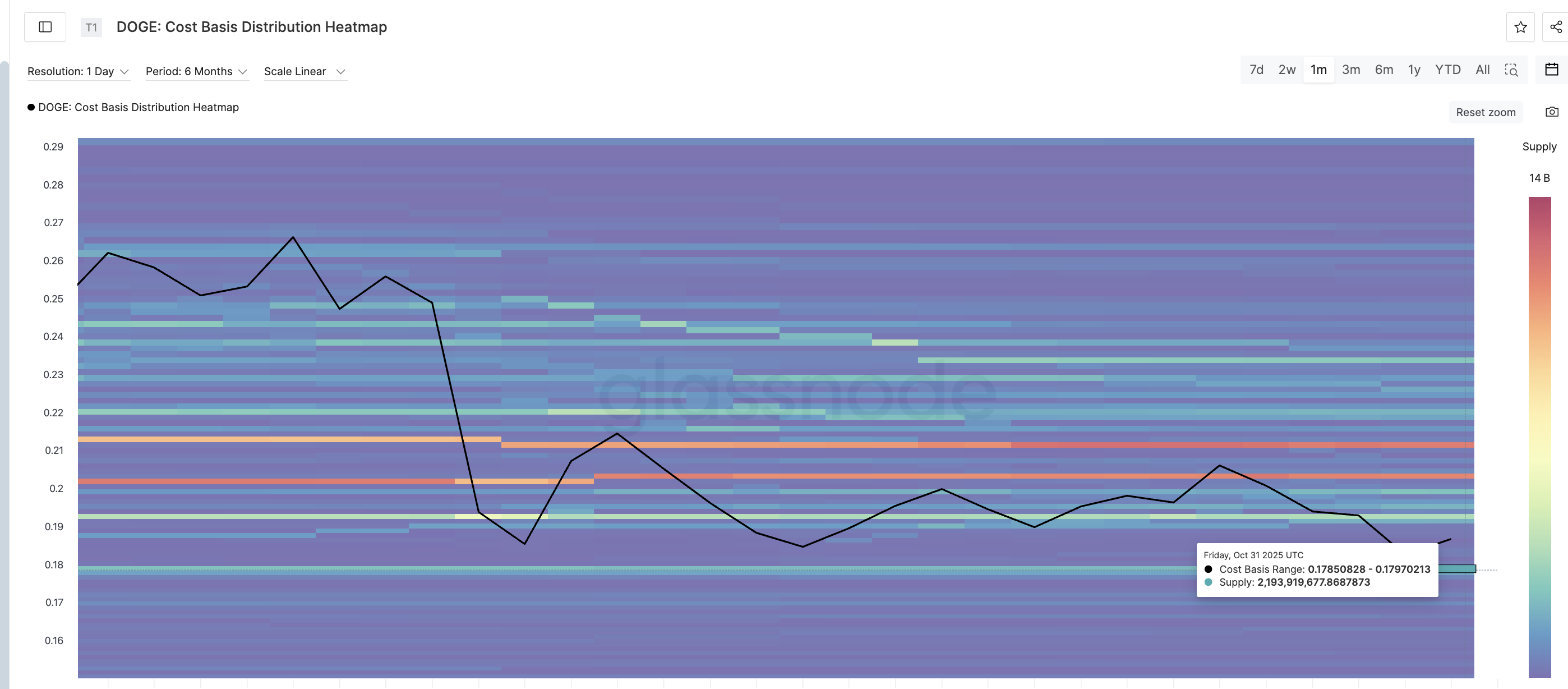
Bigger Dogecoin Support ClusterBigger Dogecoin Support Cluster: Glassnode

That buffer is weakening fast. According to Glassnode, Hodler Net Position Change — which tracks whether long-term wallets are adding or selling — flipped sharply negative on October 31. It dropped from an inflow of +8.2 million DOGE to an outflow of –22 million DOGE in just 24 hours. That’s a 367% reversal in holder behavior.
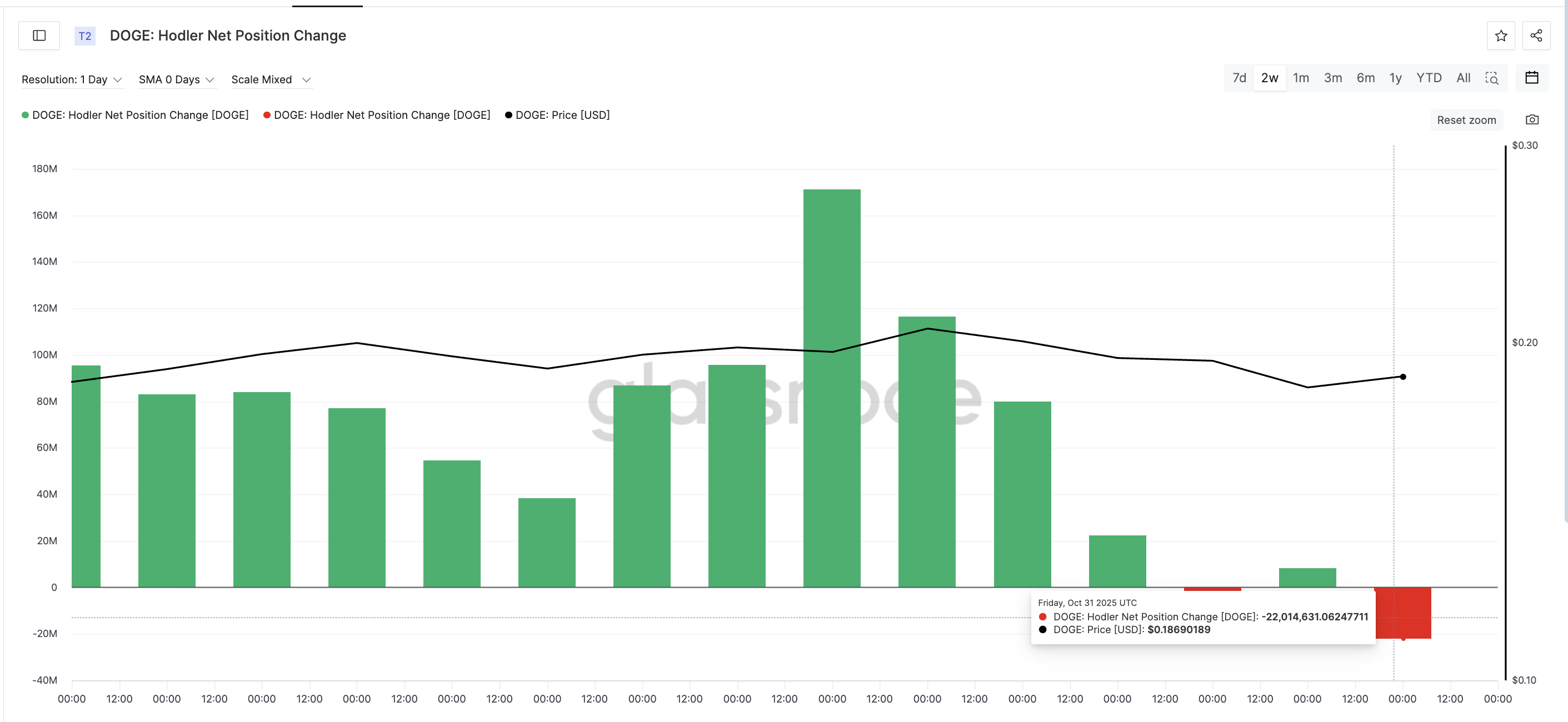
Long-Term DOGE Holders Keep SellingLong-Term DOGE Holders Keep Selling: Glassnode

This swing confirms that even older wallets are offloading their holdings. If this continues, it could thin out the $0.177–$0.179 cluster and expose Dogecoin’s strongest base since early October to further downside risk.

Below $0.17, the next significant cost-basis cluster doesn’t appear until $0.14, leaving a wide gap for potential losses. But more on that in the next section.

Looming Death Cross Could Accelerate the DOGE Price Breakdown

The DOGE price structure now reinforces the bearish on-chain story. After the 50-day exponential moving average (EMA) crossed below the 200-day EMA in late October, Dogecoin extended its decline — marking the first leg of its current downtrend. The EMA is a trend indicator that smooths out price data to show market direction.

Now, a second, stronger death cross is forming as the 100-day EMA approaches a drop below the 200-day EMA. Unlike the earlier crossover, this one carries more weight because both averages represent longer timeframes, reflecting sustained weakness rather than short-term volatility.

If this crossover confirms, it would signal deepening downside momentum and strengthen the bearish structure already in place. In that case, Dogecoin’s strongest support zone near $0.17, highlighted by its cost basis heatmap, could finally give way — opening the door to a fall toward $0.14. That would be a near 6% dip.
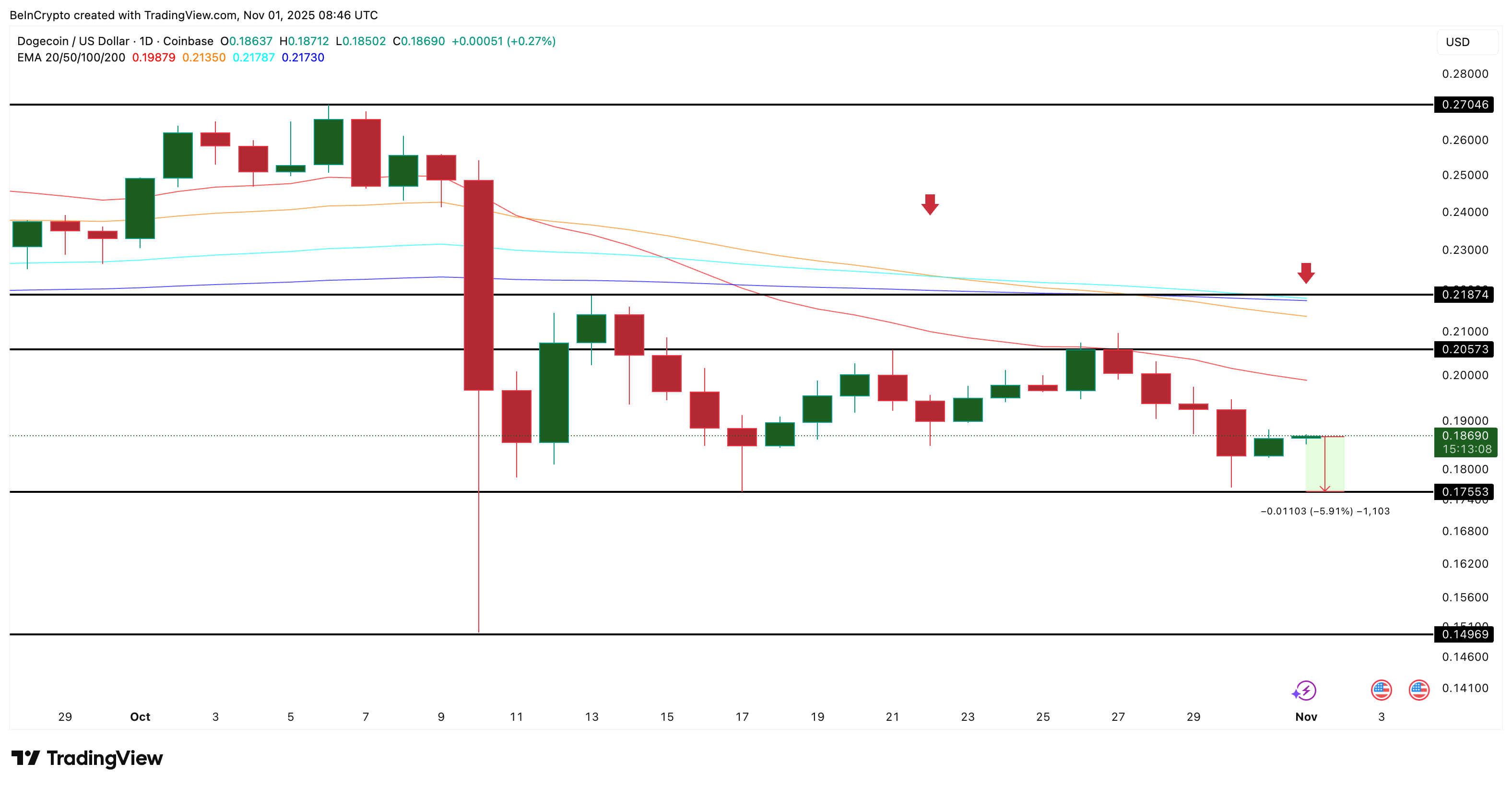
DOGE Price AnalysisDOGE Price Analysis: TradingView

Currently, DOGE trades near $0.18, capped by immediate resistances at $0.20 and $0.21. A daily close above $0.21, which hasn’t been tested since October 13, would be needed to invalidate this bearish bias.


Market Opportunity
DOGE Logo
DOGE Price(DOGE)
$0.13899
$0.13899$0.13899
+0.35%
USD
DOGE (DOGE) Live Price Chart
Disclaimer: The articles reposted on this site are sourced from public platforms and are provided for informational purposes only. They do not necessarily reflect the views of MEXC. All rights remain with the original authors. If you believe any content infringes on third-party rights, please contact service@support.mexc.com for removal. MEXC makes no guarantees regarding the accuracy, completeness, or timeliness of the content and is not responsible for any actions taken based on the information provided. The content does not constitute financial, legal, or other professional advice, nor should it be considered a recommendation or endorsement by MEXC.

You May Also Like

Pump.fun-linked address deposits $148M in USDC and USDT to Kraken

Pump.fun-linked address deposits $148M in USDC and USDT to Kraken

A large on-chain transfer linked to Pump.fun has put fresh focus on how the memecoin launchpad is handling the proceeds of its token sale. A wallet associated with
Share
Crypto.news2026/01/13 11:18
BlackRock Increases U.S. Stock Exposure Amid AI Surge

BlackRock Increases U.S. Stock Exposure Amid AI Surge

The post BlackRock Increases U.S. Stock Exposure Amid AI Surge appeared on BitcoinEthereumNews.com. Key Points: BlackRock significantly increased U.S. stock exposure. AI sector driven gains boost S&P 500 to historic highs. Shift may set a precedent for other major asset managers. BlackRock, the largest asset manager, significantly increased U.S. stock and AI sector exposure, adjusting its $185 billion investment portfolios, according to a recent investment outlook report.. This strategic shift signals strong confidence in U.S. market growth, driven by AI and anticipated Federal Reserve moves, influencing significant fund flows into BlackRock’s ETFs. The reallocation increases U.S. stocks by 2% while reducing holdings in international developed markets. BlackRock’s move reflects confidence in the U.S. stock market’s trajectory, driven by robust earnings and the anticipation of Federal Reserve rate cuts. As a result, billions of dollars have flowed into BlackRock’s ETFs following the portfolio adjustment. “Our increased allocation to U.S. stocks, particularly in the AI sector, is a testament to our confidence in the growth potential of these technologies.” — Larry Fink, CEO, BlackRock The financial markets have responded favorably to this adjustment. The S&P 500 Index recently reached a historic high this year, supported by AI-driven investment enthusiasm. BlackRock’s decision aligns with widespread market speculation on the Federal Reserve’s next moves, further amplifying investor interest and confidence. AI Surge Propels S&P 500 to Historic Highs At no other time in history has the S&P 500 seen such dramatic gains driven by a single sector as the recent surge spurred by AI investments in 2023. Experts suggest that the strategic increase in U.S. stock exposure by BlackRock may set a precedent for other major asset managers. Historically, shifts of this magnitude have influenced broader market behaviors as others follow suit. Market analysts point to the favorable economic environment and technological advancements that are propelling the AI sector’s momentum. The continued growth of AI technologies is…
Share
BitcoinEthereumNews2025/09/18 02:49
Fed Acts on Economic Signals with Rate Cut

Fed Acts on Economic Signals with Rate Cut

In a significant pivot, the Federal Reserve reduced its benchmark interest rate following a prolonged ten-month hiatus. This decision, reflecting a strategic response to the current economic climate, has captured attention across financial sectors, with both market participants and policymakers keenly evaluating its potential impact.Continue Reading:Fed Acts on Economic Signals with Rate Cut
Share
Coinstats2025/09/18 02:28