Intellectual property (IP) is quietly becoming one of blockchain’s most practical frontiers — not as digital art, but as programmable infrastructure linking AI, gaming, and creative rights. BeInCrypto spoke with Andrea Muttoni, President and Chief Product Officer of Story, an on-chain IP platform building the rails for global licensing and royalty automation. In this interview, Muttoni explains why adoption may arrive as a cultural moment rather than a technical milestone, how the $IP token aligns value with creative activity, and what legal interoperability means for the next decade of digital rights. The Rise of Programmable IP and the Architecture Behind Story Story Protocol, the company behind the Story Network, launched in February 2025 and aims to become the “IP layer of the Internet.” After raising $54 million in 2023 and another $80 million in 2024, led by a16z, the team launched a purpose-built layer-1 blockchain. It enables IP Assets (tokenized works), Programmable IP Licenses (PILs), and a Royalty Module for real-time, on-chain revenue distribution. “We built Story to make intellectual property programmable across mediums,” Muttoni said. “Whether it’s AI-generated data, virtual assets, or film IP, creators should have a transparent way to license and monetize their work.” Supporters view this architecture as a foundation for transparent provenance and composable licensing. Critics question whether smart-contract licenses can hold up in court without legal recognition. The Evolving Inflection Point for On-Chain IP With over $80 trillion in creative assets globally, on-chain IP is emerging as a market layer linking creators, enterprises, and AI platforms. Story already hosts more than 200 teams and 20 million IP registrations across entertainment, gaming, and data applications. Benefits of Tokenization of IP Assets | SoluLab “There won’t be a single inflection point for on-chain IP because intellectual property keeps evolving,” Muttoni said. “We’ve built Story to evolve in parallel — with integrations across AI, gaming, and Hollywood — so creators can track and license works directly.” “The real inflection point may not be raw numbers but a cultural moment — like a remix of BTS art turned into a game with automated revenue sharing via Story,” he added. “When millions use on-chain IP without realizing it’s Web3, that’s when the shift has happened.” This view aligns with WIPO’s 2024 World Intellectual Property Report, which notes that global IP capacity remains concentrated in fewer than ten economies. Digital IP markets, it adds, still rely on institutional rather than technical integration. The inflection point for tokenized IP may depend as much on policy harmonization as product adoption. Efficiency and New Royalty Rails on Story Traditional royalty systems such as ASCAP pay creators quarterly through layers of intermediaries. Story aims to modernize that process. “Today, royalties flow through opaque intermediaries and take months to reach creators,” he said. “On Story, programmable royalties settle in seconds, not months — and move globally without friction. That’s transformative for independent artists and emerging markets.” Yet, as the IMF’s 2025 Fintech Note warns, real-time tokenized settlement can heighten systemic risk if oversight and liquidity buffers lag. Instant payout is powerful — but without safeguards, it can outpace regulation. Story’s long-term success may depend on integration with regulated financial rails. Incentives and Integration Across the IP Economy “Our current IP system is broken,” Muttoni said. “Creators and enterprises are fighting AI companies, but what’s needed is a tech-native framework where IP can be freely licensed and protected at scale. Story provides the rails rights organizations can integrate into — not compete with.” Legal battles between AI developers and rights holders expose a structural gap: the internet outpaced infrastructure protecting creative work. The World Economic Forum’s 2025 tokenization report notes that such markets evolve “non-linearly and in phases.” Adoption usually starts within permissioned, regulated environments — not open networks. Story’s claim of “legal interoperability” may thus require a phased rollout aligned with data privacy and jurisdictional norms. UX Simplification and Creator Retention “Licensing and rights management have long been reserved for studios with lawyers,” Muttoni said. “Through our IP Portal, anyone can register IP on-chain in minutes — no lawyers, no intermediaries, no platform fees. The goal is to make licensing intuitive, not bureaucratic.” Still, the US Patent and Copyright Offices’ 2024 Report to Congress stresses that blockchain transfers don’t alter IP law. Copyright and trademark assignments still need written, signed agreements. For now, Story’s on-chain licenses act as metadata layers, not binding instruments, until smart-contract enforceability is codified. Reflexivity and Story Token Governance “Reflexivity is normal in crypto markets,” Muttoni said. “But IP registered on Story is tied to real-world use cases. The $IP token powers licensing, staking, and governance — a productive asset linked to creative activity, not speculation.” The CFA Institute’s 2024 analysis offers a more reserved view: tokenization may unlock new asset classes but faces valuation opacity and custody risk. Institutional investors, it argues, will treat IP tokens as infrastructure evolution, not speculative plays — a stance that could temper hype around Story’s $IP token. Data as a Market Signal As AI’s need for rights-cleared data grows, new metrics may define IP value — licensing volume, royalty accruals, and provenance velocity. “Some of the most valuable IP will be assets licensed for AI training,” Muttoni said. “AI’s bottleneck isn’t compute — it’s rights-cleared data. Poseidon, a project on Story, lets anyone license real-world data as IP, creating measurable value between data providers, AI developers, and users.” This mirrors comments from Rayhaneh Sharif-Askary, Head of Product & Research at Grayscale, who described Story as “linking blockchain coordination to AI model training.” She noted that Poseidon’s model could turn everyday human activity into tokenized, rights-cleared data for machine learning. Her remarks show how programmable IP might unite creative economies and AI development within one infrastructure. The overlap between IP and AI underscores a broader policy debate. The WIPO 2024 report notes that innovation thrives when law, research, and commerce evolve together. Story’s long-term success may depend less on token mechanics and more on whether global IP governance keeps pace with technology. Conclusion Programmable IP is shifting from concept to infrastructure. Story’s mix of automation, governance, and interoperability places it at the crossroads of culture and code. Yet as reports from WIPO, IMF, WEF, CFA, and the US Copyright Office emphasize, progress will be gradual and compliance-driven. If successful, Story could redefine how creative rights move through the global economy; if not, it may remain a prototype awaiting regulatory alignment.Intellectual property (IP) is quietly becoming one of blockchain’s most practical frontiers — not as digital art, but as programmable infrastructure linking AI, gaming, and creative rights. BeInCrypto spoke with Andrea Muttoni, President and Chief Product Officer of Story, an on-chain IP platform building the rails for global licensing and royalty automation. In this interview, Muttoni explains why adoption may arrive as a cultural moment rather than a technical milestone, how the $IP token aligns value with creative activity, and what legal interoperability means for the next decade of digital rights. The Rise of Programmable IP and the Architecture Behind Story Story Protocol, the company behind the Story Network, launched in February 2025 and aims to become the “IP layer of the Internet.” After raising $54 million in 2023 and another $80 million in 2024, led by a16z, the team launched a purpose-built layer-1 blockchain. It enables IP Assets (tokenized works), Programmable IP Licenses (PILs), and a Royalty Module for real-time, on-chain revenue distribution. “We built Story to make intellectual property programmable across mediums,” Muttoni said. “Whether it’s AI-generated data, virtual assets, or film IP, creators should have a transparent way to license and monetize their work.” Supporters view this architecture as a foundation for transparent provenance and composable licensing. Critics question whether smart-contract licenses can hold up in court without legal recognition. The Evolving Inflection Point for On-Chain IP With over $80 trillion in creative assets globally, on-chain IP is emerging as a market layer linking creators, enterprises, and AI platforms. Story already hosts more than 200 teams and 20 million IP registrations across entertainment, gaming, and data applications. Benefits of Tokenization of IP Assets | SoluLab “There won’t be a single inflection point for on-chain IP because intellectual property keeps evolving,” Muttoni said. “We’ve built Story to evolve in parallel — with integrations across AI, gaming, and Hollywood — so creators can track and license works directly.” “The real inflection point may not be raw numbers but a cultural moment — like a remix of BTS art turned into a game with automated revenue sharing via Story,” he added. “When millions use on-chain IP without realizing it’s Web3, that’s when the shift has happened.” This view aligns with WIPO’s 2024 World Intellectual Property Report, which notes that global IP capacity remains concentrated in fewer than ten economies. Digital IP markets, it adds, still rely on institutional rather than technical integration. The inflection point for tokenized IP may depend as much on policy harmonization as product adoption. Efficiency and New Royalty Rails on Story Traditional royalty systems such as ASCAP pay creators quarterly through layers of intermediaries. Story aims to modernize that process. “Today, royalties flow through opaque intermediaries and take months to reach creators,” he said. “On Story, programmable royalties settle in seconds, not months — and move globally without friction. That’s transformative for independent artists and emerging markets.” Yet, as the IMF’s 2025 Fintech Note warns, real-time tokenized settlement can heighten systemic risk if oversight and liquidity buffers lag. Instant payout is powerful — but without safeguards, it can outpace regulation. Story’s long-term success may depend on integration with regulated financial rails. Incentives and Integration Across the IP Economy “Our current IP system is broken,” Muttoni said. “Creators and enterprises are fighting AI companies, but what’s needed is a tech-native framework where IP can be freely licensed and protected at scale. Story provides the rails rights organizations can integrate into — not compete with.” Legal battles between AI developers and rights holders expose a structural gap: the internet outpaced infrastructure protecting creative work. The World Economic Forum’s 2025 tokenization report notes that such markets evolve “non-linearly and in phases.” Adoption usually starts within permissioned, regulated environments — not open networks. Story’s claim of “legal interoperability” may thus require a phased rollout aligned with data privacy and jurisdictional norms. UX Simplification and Creator Retention “Licensing and rights management have long been reserved for studios with lawyers,” Muttoni said. “Through our IP Portal, anyone can register IP on-chain in minutes — no lawyers, no intermediaries, no platform fees. The goal is to make licensing intuitive, not bureaucratic.” Still, the US Patent and Copyright Offices’ 2024 Report to Congress stresses that blockchain transfers don’t alter IP law. Copyright and trademark assignments still need written, signed agreements. For now, Story’s on-chain licenses act as metadata layers, not binding instruments, until smart-contract enforceability is codified. Reflexivity and Story Token Governance “Reflexivity is normal in crypto markets,” Muttoni said. “But IP registered on Story is tied to real-world use cases. The $IP token powers licensing, staking, and governance — a productive asset linked to creative activity, not speculation.” The CFA Institute’s 2024 analysis offers a more reserved view: tokenization may unlock new asset classes but faces valuation opacity and custody risk. Institutional investors, it argues, will treat IP tokens as infrastructure evolution, not speculative plays — a stance that could temper hype around Story’s $IP token. Data as a Market Signal As AI’s need for rights-cleared data grows, new metrics may define IP value — licensing volume, royalty accruals, and provenance velocity. “Some of the most valuable IP will be assets licensed for AI training,” Muttoni said. “AI’s bottleneck isn’t compute — it’s rights-cleared data. Poseidon, a project on Story, lets anyone license real-world data as IP, creating measurable value between data providers, AI developers, and users.” This mirrors comments from Rayhaneh Sharif-Askary, Head of Product & Research at Grayscale, who described Story as “linking blockchain coordination to AI model training.” She noted that Poseidon’s model could turn everyday human activity into tokenized, rights-cleared data for machine learning. Her remarks show how programmable IP might unite creative economies and AI development within one infrastructure. The overlap between IP and AI underscores a broader policy debate. The WIPO 2024 report notes that innovation thrives when law, research, and commerce evolve together. Story’s long-term success may depend less on token mechanics and more on whether global IP governance keeps pace with technology. Conclusion Programmable IP is shifting from concept to infrastructure. Story’s mix of automation, governance, and interoperability places it at the crossroads of culture and code. Yet as reports from WIPO, IMF, WEF, CFA, and the US Copyright Office emphasize, progress will be gradual and compliance-driven. If successful, Story could redefine how creative rights move through the global economy; if not, it may remain a prototype awaiting regulatory alignment.

How Story Protocol Aims to Rewrite the Economics of Intellectual Property

Intellectual property (IP) is quietly becoming one of blockchain’s most practical frontiers — not as digital art, but as programmable infrastructure linking AI, gaming, and creative rights. BeInCrypto spoke with Andrea Muttoni, President and Chief Product Officer of Story, an on-chain IP platform building the rails for global licensing and royalty automation.

In this interview, Muttoni explains why adoption may arrive as a cultural moment rather than a technical milestone, how the $IP token aligns value with creative activity, and what legal interoperability means for the next decade of digital rights.

The Rise of Programmable IP and the Architecture Behind Story

Story Protocol, the company behind the Story Network, launched in February 2025 and aims to become the “IP layer of the Internet.”

After raising $54 million in 2023 and another $80 million in 2024, led by a16z, the team launched a purpose-built layer-1 blockchain. It enables IP Assets (tokenized works), Programmable IP Licenses (PILs), and a Royalty Module for real-time, on-chain revenue distribution.

Supporters view this architecture as a foundation for transparent provenance and composable licensing. Critics question whether smart-contract licenses can hold up in court without legal recognition.

The Evolving Inflection Point for On-Chain IP

With over $80 trillion in creative assets globally, on-chain IP is emerging as a market layer linking creators, enterprises, and AI platforms. Story already hosts more than 200 teams and 20 million IP registrations across entertainment, gaming, and data applications.
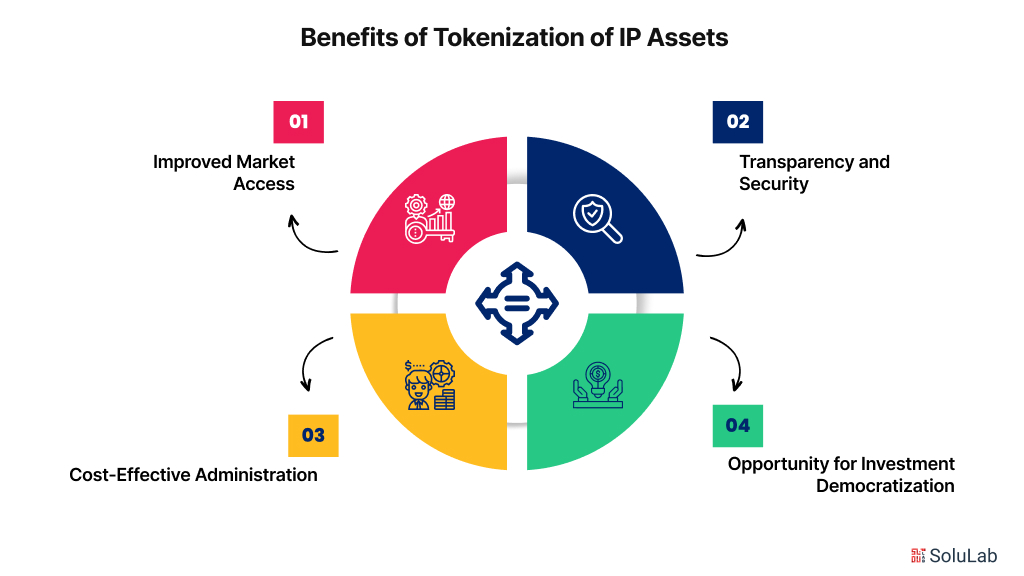
Benefits of Tokenization of IP Assets | SoluLab

This view aligns with WIPO’s 2024 World Intellectual Property Report, which notes that global IP capacity remains concentrated in fewer than ten economies. Digital IP markets, it adds, still rely on institutional rather than technical integration. The inflection point for tokenized IP may depend as much on policy harmonization as product adoption.

Efficiency and New Royalty Rails on Story

Traditional royalty systems such as ASCAP pay creators quarterly through layers of intermediaries. Story aims to modernize that process.

Yet, as the IMF’s 2025 Fintech Note warns, real-time tokenized settlement can heighten systemic risk if oversight and liquidity buffers lag. Instant payout is powerful — but without safeguards, it can outpace regulation. Story’s long-term success may depend on integration with regulated financial rails.

Incentives and Integration Across the IP Economy

Legal battles between AI developers and rights holders expose a structural gap: the internet outpaced infrastructure protecting creative work. The World Economic Forum’s 2025 tokenization report notes that such markets evolve “non-linearly and in phases.” Adoption usually starts within permissioned, regulated environments — not open networks. Story’s claim of “legal interoperability” may thus require a phased rollout aligned with data privacy and jurisdictional norms.

UX Simplification and Creator Retention

Still, the US Patent and Copyright Offices’ 2024 Report to Congress stresses that blockchain transfers don’t alter IP law. Copyright and trademark assignments still need written, signed agreements. For now, Story’s on-chain licenses act as metadata layers, not binding instruments, until smart-contract enforceability is codified.

Reflexivity and Story Token Governance

The CFA Institute’s 2024 analysis offers a more reserved view: tokenization may unlock new asset classes but faces valuation opacity and custody risk. Institutional investors, it argues, will treat IP tokens as infrastructure evolution, not speculative plays — a stance that could temper hype around Story’s $IP token.

Data as a Market Signal

As AI’s need for rights-cleared data grows, new metrics may define IP value — licensing volume, royalty accruals, and provenance velocity.

This mirrors comments from Rayhaneh Sharif-Askary, Head of Product & Research at Grayscale, who described Story as “linking blockchain coordination to AI model training.” She noted that Poseidon’s model could turn everyday human activity into tokenized, rights-cleared data for machine learning. Her remarks show how programmable IP might unite creative economies and AI development within one infrastructure.

The overlap between IP and AI underscores a broader policy debate. The WIPO 2024 report notes that innovation thrives when law, research, and commerce evolve together. Story’s long-term success may depend less on token mechanics and more on whether global IP governance keeps pace with technology.

Conclusion

Programmable IP is shifting from concept to infrastructure. Story’s mix of automation, governance, and interoperability places it at the crossroads of culture and code. Yet as reports from WIPO, IMF, WEF, CFA, and the US Copyright Office emphasize, progress will be gradual and compliance-driven. If successful, Story could redefine how creative rights move through the global economy; if not, it may remain a prototype awaiting regulatory alignment.


Market Opportunity
Story Logo
Story Price(IP)
$2.647
$2.647$2.647
-1.67%
USD
Story (IP) Live Price Chart
Disclaimer: The articles reposted on this site are sourced from public platforms and are provided for informational purposes only. They do not necessarily reflect the views of MEXC. All rights remain with the original authors. If you believe any content infringes on third-party rights, please contact service@support.mexc.com for removal. MEXC makes no guarantees regarding the accuracy, completeness, or timeliness of the content and is not responsible for any actions taken based on the information provided. The content does not constitute financial, legal, or other professional advice, nor should it be considered a recommendation or endorsement by MEXC.

You May Also Like

Zero Knowledge Proof Auction Limits Large Buyers to $50K: Experts Forecast 200x to 10,000x ROI

Zero Knowledge Proof Auction Limits Large Buyers to $50K: Experts Forecast 200x to 10,000x ROI

In most token sales, the fastest and richest participants win. Large buyers jump in early, take most of the supply, and control the market before regular people
Share
LiveBitcoinNews2026/01/19 08:00
IP Hits $11.75, HYPE Climbs to $55, BlockDAG Surpasses Both with $407M Presale Surge!

IP Hits $11.75, HYPE Climbs to $55, BlockDAG Surpasses Both with $407M Presale Surge!

The post IP Hits $11.75, HYPE Climbs to $55, BlockDAG Surpasses Both with $407M Presale Surge! appeared on BitcoinEthereumNews.com. Crypto News 17 September 2025 | 18:00 Discover why BlockDAG’s upcoming Awakening Testnet launch makes it the best crypto to buy today as Story (IP) price jumps to $11.75 and Hyperliquid hits new highs. Recent crypto market numbers show strength but also some limits. The Story (IP) price jump has been sharp, fueled by big buybacks and speculation, yet critics point out that revenue still lags far behind its valuation. The Hyperliquid (HYPE) price looks solid around the mid-$50s after a new all-time high, but questions remain about sustainability once the hype around USDH proposals cools down. So the obvious question is: why chase coins that are either stretched thin or at risk of retracing when you could back a network that’s already proving itself on the ground? That’s where BlockDAG comes in. While other chains are stuck dealing with validator congestion or outages, BlockDAG’s upcoming Awakening Testnet will be stress-testing its EVM-compatible smart chain with real miners before listing. For anyone looking for the best crypto coin to buy, the choice between waiting on fixes or joining live progress feels like an easy one. BlockDAG: Smart Chain Running Before Launch Ethereum continues to wrestle with gas congestion, and Solana is still known for network freezes, yet BlockDAG is already showing a different picture. Its upcoming Awakening Testnet, set to launch on September 25, isn’t just a demo; it’s a live rollout where the chain’s base protocols are being stress-tested with miners connected globally. EVM compatibility is active, account abstraction is built in, and tools like updated vesting contracts and Stratum integration are already functional. Instead of waiting for fixes like other networks, BlockDAG is proving its infrastructure in real time. What makes this even more important is that the technology is operational before the coin even hits exchanges. That…
Share
BitcoinEthereumNews2025/09/18 00:32
ZKP Narrows Its Entry Window in Phase I! ARB Releases 96 Million Tokens & ICP Prepares a 70% Cut

ZKP Narrows Its Entry Window in Phase I! ARB Releases 96 Million Tokens & ICP Prepares a 70% Cut

Discover how Arbitrum faces unlock pressure, how Internet Computer plans a major inflation cut, and how Zero Knowledge Proof (ZKP) runs a live presale auction with
Share
CoinLive2026/01/19 08:00