This section defines a new, practical Instance-Incremental Learning (IIL) problem setting focused on cost-effective model promotion in deployed systems.This section defines a new, practical Instance-Incremental Learning (IIL) problem setting focused on cost-effective model promotion in deployed systems.

New IIL Setting: Enhancing Deployed Models with Only New Data

2025/11/05 23:00
2 min read

Abstract and 1 Introduction

  1. Related works

  2. Problem setting

  3. Methodology

    4.1. Decision boundary-aware distillation

    4.2. Knowledge consolidation

  4. Experimental results and 5.1. Experiment Setup

    5.2. Comparison with SOTA methods

    5.3. Ablation study

  5. Conclusion and future work and References

    \

Supplementary Material

  1. Details of the theoretical analysis on KCEMA mechanism in IIL
  2. Algorithm overview
  3. Dataset details
  4. Implementation details
  5. Visualization of dusted input images
  6. More experimental results

3. Problem setting

Illustration of the proposed IIL setting is shown in Fig. 1. As can be seen, data is generated continually and unpredictably in the data stream. Generally in real application, people incline to collect enough data first and train a strong model M0 for deployment. No matter how strong the model is, it inevitably will encounter out-of-distribution data and fail on it. These failed cases and other low-score new observations will be annotated to train the model from time to time. Retraining the model with all cumulate data every time leads to higher and higher cost in time and resource. Therefore, the new IIL aims to enhance the existing model with only the new data each time.

\
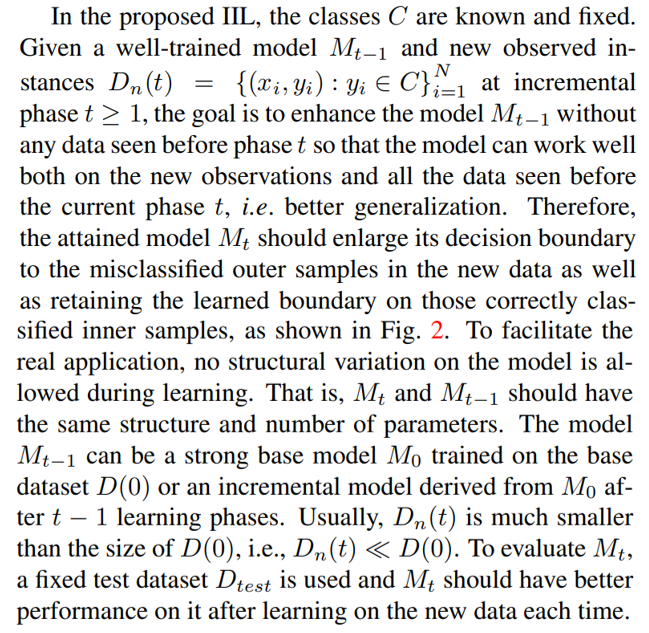
\ Figure 2. Decision boundaries (DB): (a) DB learned from old data and new data, respectively. With respect to the old DB, new data can be categorized into inner samples and outer samples. (b) ideal DB by jointly training on the old data and new data. (c) fine-tuning the model on the new data with one-hot labels suffers to CF. (d) learning with distillation on prototype exemplars causes overfitting to these exemplars and DB collapsing. (e) the DB achieved using our decision boundary-aware distillation (DBD).
\

:::info Authors:

(1) Qiang Nie, Hong Kong University of Science and Technology (Guangzhou);

(2) Weifu Fu, Tencent Youtu Lab;

(3) Yuhuan Lin, Tencent Youtu Lab;

(4) Jialin Li, Tencent Youtu Lab;

(5) Yifeng Zhou, Tencent Youtu Lab;

(6) Yong Liu, Tencent Youtu Lab;

(7) Qiang Nie, Hong Kong University of Science and Technology (Guangzhou);

(8) Chengjie Wang, Tencent Youtu Lab.

:::


:::info This paper is available on arxiv under CC BY-NC-ND 4.0 Deed (Attribution-Noncommercial-Noderivs 4.0 International) license.

:::

\

Disclaimer: The articles reposted on this site are sourced from public platforms and are provided for informational purposes only. They do not necessarily reflect the views of MEXC. All rights remain with the original authors. If you believe any content infringes on third-party rights, please contact crypto.news@mexc.com for removal. MEXC makes no guarantees regarding the accuracy, completeness, or timeliness of the content and is not responsible for any actions taken based on the information provided. The content does not constitute financial, legal, or other professional advice, nor should it be considered a recommendation or endorsement by MEXC.

You May Also Like

Siren Token Sheds 16.4% After 54% Retreat From All-Time High

Siren Token Sheds 16.4% After 54% Retreat From All-Time High

Siren token experienced a sharp 16.4% decline in the past 24 hours, trading at $0.247 as the market cap contracted by $34.4 million. Our analysis of on-chain metrics
Share
Blockchainmagazine2026/03/02 05:03
Privacy is ‘Constant Battle’ Between Blockchain Stakeholders and State

Privacy is ‘Constant Battle’ Between Blockchain Stakeholders and State

The post Privacy is ‘Constant Battle’ Between Blockchain Stakeholders and State appeared on BitcoinEthereumNews.com. Blockchain industry participants and regulators continue wrangling over privacy rights as the European Union’s sweeping Anti-Money Laundering (AML) rules look set to ban privacy-preserving tokens and anonymous crypto accounts starting in 2027. Credit institutions, financial institutions and crypto asset service providers (CASPs) will be prohibited from maintaining anonymous accounts or handling privacy-preserving cryptocurrencies under the EU’s new Anti-Money Laundering Regulation (AMLR) that will go into effect in 2027, Cointelegraph reported in May. Maintaining the right to access privacy-preserving coins like Monero (XMR) has been a “constant battle” between blockchain industry stakeholders and regulators, according to Anja Blaj, an independent legal consultant and policy expert at the European Crypto Initiative. “Once you think of how the states want to play out their policies, they want to establish control. They want to understand who the parties are that transact among themselves,” said Blaj, speaking during Cointelegraph’s daily live X spaces show on Sept. 3. “[The state] wants to understand that to be able to prevent whatever crime and scamming is happening, and we want to enforce the policies that we create as a society.” Her comments came as the EU ramped up its regulatory oversight of the crypto industry, building on the bloc’s Markets in Crypto-Assets Regulation (MiCA). Related: Swiss banks complete first blockchain-based legally binding payment Room for negotiation remains While the AML framework is final, regulatory experts still see potential for negotiation until it rolls out in 2027. Policymaking is a “continuous conversation,” meaning that “nothing is set in stone, even if the regulation is already out,” said Blaj. “There are still ways to either talk to the regulators, see how it’s going to play out, how it’s going to be enforced.” While there’s always room for negotiations with policymakers, the regulation concerning privacy-preserving cryptocurrencies and accounts is becoming “more…
Share
BitcoinEthereumNews2025/09/18 12:45
Santander’s Openbank Enables Bitcoin, Litecoin, POL, Ethereum, and Altcoin Trading for German Customers

Santander’s Openbank Enables Bitcoin, Litecoin, POL, Ethereum, and Altcoin Trading for German Customers

Santander’s digital bank has launched crypto trading in Germany, letting customers buy, sell, and hold these assets. At launch, Openbank customers in Germany can get their hands on Bitcoin, Ethereum, Cardano, Litecoin, and Polygon. Openbank, the digital arm of Banco Santander, has just rolled out a new crypto trading service for its retail customers in [...]]]>
Share
Crypto News Flash2025/09/18 04:00




