Bitcoin price is cooling after its October peak, and the market is now watching whether buyers will defend the key $91,000–$97,000 support zone. Bitcoin is trading near $102,292, down 1.3% over the past day. The market has softened over the…Bitcoin price is cooling after its October peak, and the market is now watching whether buyers will defend the key $91,000–$97,000 support zone. Bitcoin is trading near $102,292, down 1.3% over the past day. The market has softened over the…

Bitcoin price eyes possible retest of $91K–$97K range as MVRV hints at buyer fatigue

2025/11/07 14:12

Bitcoin price is cooling after its October peak, and the market is now watching whether buyers will defend the key $91,000–$97,000 support zone.

Summary
  • Bitcoin is easing lower after a strong October peak, now trading near key support levels.
  • On-chain metrics show a potential test of the $91K–$97K “profit floor,” where buyers have repeatedly stepped in this cycle.
  • Trend remains intact, but momentum has softened.

Bitcoin is trading near $102,292, down 1.3% over the past day. The market has softened over the week, now down about 7% in seven days and roughly 16% over the past month. The price currently sits about 18% below the record high of $126,080 reached in early October.

With a spot volume of about $69.5 billion over the last 24 hours, up 14.8% from the day before, trading activity has somewhat increased. In futures, total trading volume rose 8% to $107.5 billion, and open interest increased 1.4% to $69.6 billion.

When open interest rises while price slips, it usually means traders are adding positions rather than stepping away, which can extend the current trend.

MVRV shows cooling momentum, not a full reversal

A Nov. 6 analysis from CryptoQuant contributor Sunny Mom highlights a developing divergence in the Bitcoin’s (BTC) MVRV ratio, which tracks unrealized profit across the network.

The MVRV ratio has continuously found support in the range of 1.7 to 1.8 during this cycle. Since early 2024, that area has served as the market’s “profit floor.” Usually, the market stabilizes after selling pressure subsides. If price and sentiment were to retest that region, it would align closely with the $91,800–$97,200 price area. 

Technical weight is added by the fact that the range also overlaps with a sizable, unfilled CME gap close to $92,000. Although prices increased earlier in the cycle, unrealized profit margins have been compressing, as indicated by the current bearish MVRV divergence.

This suggests buyers are becoming more cautious, but it does not signal a confirmed cycle top. A similar divergence appeared in 2017 before Bitcoin’s final parabolic move.

Meanwhile, recent data shows corporate Bitcoin accumulation slowed in October. Firms purchased around 14,400 BTC, down sharply from September’s 38,035 BTC. The market capitalization of Bitcoin-holding companies has also decreased in relation to their holdings, indicating that investors have grown more cautious during the recent decline.

Bitcoin price technical analysis

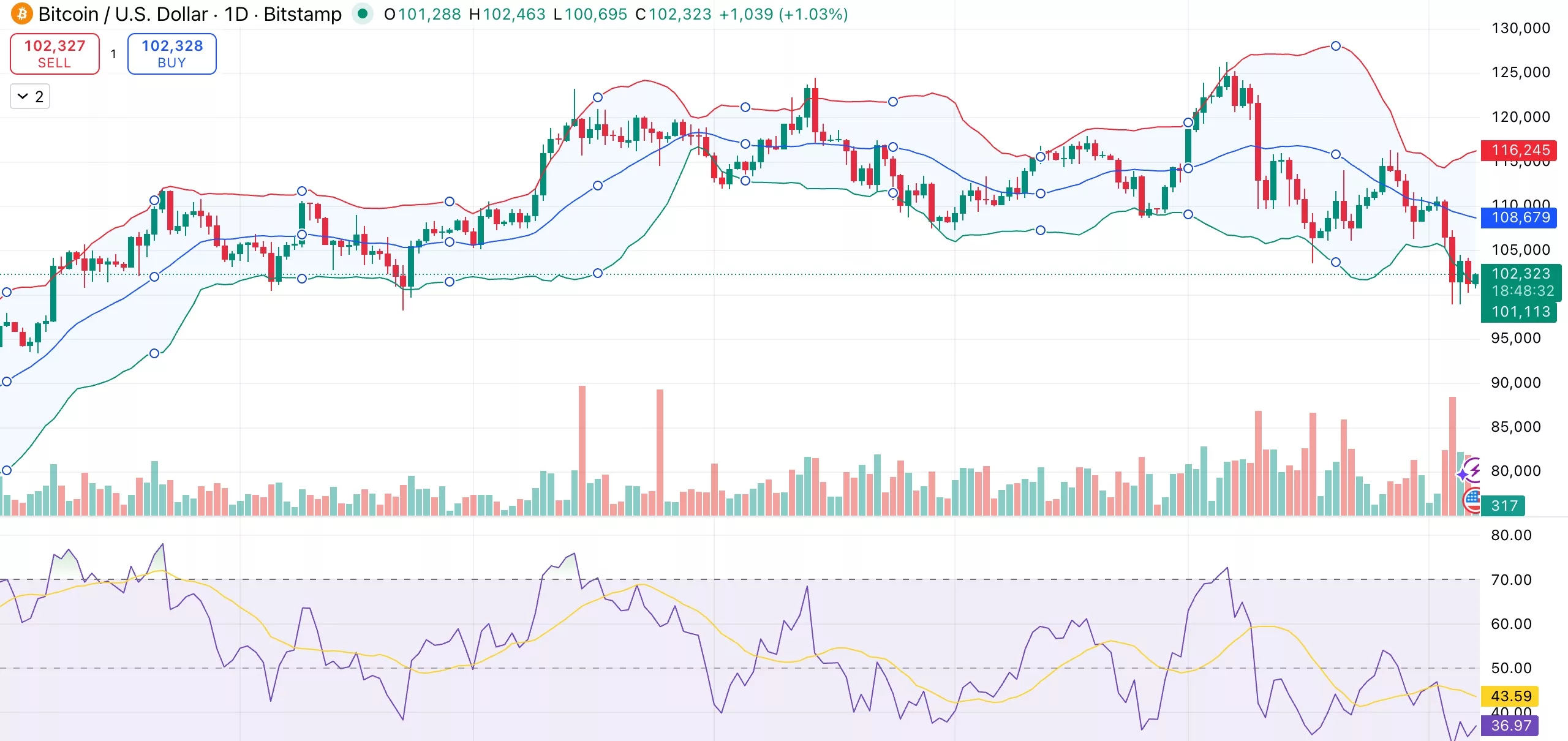
A cautious short-term outlook is reinforced by the fact that Bitcoin is still trading below all significant short- and long-term moving averages. Instead of oversold exhaustion, the cooling market is reflected by the relative strength index, which is close to 37.
Bitcoin price eyes possible retest of $91K–$97K range as MVRV hints at buyer fatigue - 1

The commodity channel index and momentum readings suggest some early signs of stabilizing or value-based buying at current levels. At the same time, MACD remains negative and most short- and long-term moving averages still sit above price, which shows that trend pressure is still guiding downward in the near term.

A break above $105,800 could restore upside momentum, while failure to hold above $97,000 would open the path toward the CME gap region around $92,000.


Disclaimer: The articles reposted on this site are sourced from public platforms and are provided for informational purposes only. They do not necessarily reflect the views of MEXC. All rights remain with the original authors. If you believe any content infringes on third-party rights, please contact service@support.mexc.com for removal. MEXC makes no guarantees regarding the accuracy, completeness, or timeliness of the content and is not responsible for any actions taken based on the information provided. The content does not constitute financial, legal, or other professional advice, nor should it be considered a recommendation or endorsement by MEXC.

You May Also Like

US Dollar Index (DXY) hovers near multi-week low ahead of US PCE data

US Dollar Index (DXY) hovers near multi-week low ahead of US PCE data

The post US Dollar Index (DXY) hovers near multi-week low ahead of US PCE data appeared on BitcoinEthereumNews.com. The US Dollar Index (DXY), which tracks the Greenback against a basket of currencies, struggles to capitalize on the overnight bounce from its lowest level since late October and trades with a mild negative bias during the Asian session on Friday. The index is currently placed around the 99.00 mark, down less than 0.10% for the day, as traders now await the crucial US inflation data before placing fresh directional bets. The September US Personal Consumption Expenditure (PCE) Price Index will be published later today and will be scrutinized for more cues about the Federal Reserve’s (Fed) future rate-cut path. This, in turn, will play a key role in determining the next leg of a directional move for the Greenback. In the meantime, dovish US Federal Reserve (Fed) expectations overshadow Thursday’s upbeat US labor market reports and continue to act as a headwind for the buck. Recent comments from several Fed officials suggested that another interest rate cut in December is all but certain. The CME Group’s FedWatch Tool indicates an over 85% probability of a move next week. Furthermore, reports suggest that White House National Economic Council Director Kevin Hassett is seen as the frontrunner to become the next Fed Chair and is expected to enact US President Donald Trump’s calls for lower rates, which, in turn, favors the USD bears. Nevertheless, the DXY remains on track to register losses for the second straight week, and the fundamental backdrop suggests that the path of least resistance for the index remains to the downside. Hence, any attempted recovery is more likely to get sold into and remain limited. US Dollar Price Last 7 Days The table below shows the percentage change of US Dollar (USD) against listed major currencies last 7 days. US Dollar was the strongest against the Swiss…
Share
BitcoinEthereumNews2025/12/05 13:43
SSP Stock Surges 11% On FY25 Earnings And European Rail Review

SSP Stock Surges 11% On FY25 Earnings And European Rail Review

The post SSP Stock Surges 11% On FY25 Earnings And European Rail Review appeared on BitcoinEthereumNews.com. SSP Group stock rebounded strongly today. (Photo Illustration by Pavlo Gonchar/SOPA Images/LightRocket via Getty Images) SOPA Images/LightRocket via Getty Images Shares in travel food retailer SSP Group rose sharply today after the company posted solid FY25 results, highlighting good growth in two of its four regional divisions, and a decision to review its under‑performing Continental European rail business. The food and beverage (F&B) company’s stock closed 11.3% up in London on the back of a revenue rise of 7.8% (at constant currency) to £3.6 billion ($4.8 billion) in the 12 months to September. Operating profit jumped by 12.7% to £223 million ($298 million). Under statutory IFRS reporting, however, operating profit fell 58% to £86 million, which SSP said in a statement “reflected £183 million of non‑underlying expenses and impairment charges.” The decision to review its rail business in Continental Europe—the biggest of the F&B giant’s four divisions by revenue at £1,205 million ($1,607 million)—was welcomed by the market, given its weak performance of 2% like-for-like (LFL) growth. A carrot was also dangled— a reward to shareholders arising from the July IPO of SSP’s Indian joint venture Travel Food Services (TFS) with K Hospitality, India’s largest privately held F&B company. SSP Group CEO Patrick Coveney said in a statement: “We acknowledge there is more to do to strengthen our operational performance, most notably in Continental Europe, where we have now reset our team, model, and balance sheet, and have a range of initiatives underway. In addition, we are launching a wide-ranging review of our rail business in Continental Europe. We are also considering options to realise value for our shareholders in line with the delivery of the TFS free float requirement.” SSP currently retains a 50.01% stake in TFS and said: “We believe that India’s market potential, combined with TFS’s attractive…
Share
BitcoinEthereumNews2025/12/05 13:37
What Advisors Should Know as the Market Matures

What Advisors Should Know as the Market Matures

The post What Advisors Should Know as the Market Matures appeared on BitcoinEthereumNews.com. In today’s “Crypto for Advisors” newsletter, Gregory Mall from Lionsoul Global breaks down crypto yield, highlighting its maturity, along with its role in a portfolio. We look at why yield may ultimately become crypto’s most durable bridge to mainstream portfolios. Then, in “Ask an Expert,” Kevin Tam highlights key investments from the recent 13F filings, including the news that combined United Arab Emirates sovereign exposure hit $1.08 billion, making them the fourth-largest global holder. Yield in Digital Assets: What Advisors Should Know as the Market Matures For most of its history, crypto has been defined by directional bets: buy, hold, and hope the next cycle delivers. But a quieter transformation has been unfolding beneath the surface. As the digital asset ecosystem has matured, one of its most important and misunderstood developments has been the emergence of yield: systematic, programmatic, and increasingly institutional. The story begins with infrastructure. Bitcoin introduced self-custody and scarcity; Ethereum extended that foundation with smart contracts, turning blockchains into programmable platforms capable of running financial services. Over the past five years, this architecture has given rise to a parallel, transparent credit and trading ecosystem known as decentralized finance (DeFi). While still niche relative to traditional markets, DeFi has grown from under $1 million of total value locked in 2018 to well over $100 billion at peak (DefiLlama). Even after the 2022 downturn, activity has rebounded sharply. For advisors, this expansion matters because it has unlocked something crypto rarely offered in its early years: cash-flow-based returns, not reliant on speculation. But the complexity behind those yields and the risks beneath the surface require careful navigation. Where Crypto Yield Comes From Yield in digital assets does not come from a single source but from three broad categories of market activity. 1. Trading and liquidity provision Automated market makers (AMMs)…
Share
BitcoinEthereumNews2025/12/05 13:14






