Ethereum has officially broken below key support levels, and market sentiment is rapidly deteriorating as major assets across the crypto landscape continue to slide. Analysts are increasingly calling for the arrival of a new bear market, noting that both Bitcoin and the leading altcoins have lost critical technical zones that previously held the broader structure together. ETH, now trading at multi-month lows, is feeling the full weight of cascading liquidations, strong sell-side volume, and evaporating investor confidence. Related Reading: Bitcoin OG Owen Gunden Deposits Final 2,499 BTC ($228M) to Kraken – Details Adding to the growing uncertainty, Lookonchain reports a striking development: in just 10 days, more than $61 million in profit has disappeared for a well-known market participant often referred to as the Anti-CZ Whale. This trader previously gained attention for aggressively opening shorts immediately after CZ purchased ASTER — a move that paid off handsomely until the recent violent downturn reversed his fortunes. The Anti-CZ Whale’s Unrealized Profit Collapse Adds Pressure According to Lookonchain, the trader known as the Anti-CZ Whale has taken a massive hit during the latest market downturn — and Ethereum sits at the center of the damage. Just 10 days ago, this whale had accumulated nearly $100 million in total profit on Hyperliquid, largely fueled by aggressive positions built during periods of high volatility. However, as the crypto market sharply corrected, his oversized ETH and XRP longs turned against him. The result has been a brutal drawdown: his total profit has now fallen to just $38.4 million, wiping out more than 60% of gains in less than two weeks. This dramatic reversal reflects more than one trader’s misfortune — it signals the extent of the pressure weighing on Ethereum. As ETH continues to decline and investor sentiment deteriorates, even the most seasoned actors are struggling to navigate the volatility. The whale’s rapid profit erosion highlights how quickly bullish conviction can shift when key support levels fail. For Ethereum, holding the current zone is crucial. Price action has already inflicted significant pain across longs, short-term holders, and leveraged players. If ETH loses this support decisively, the next wave of forced selling could deepen losses and accelerate the broader market capitulation. Related Reading: Bitcoin Mean Reversion Oscillator Prints First Green Oversold Bar in Months – A Classic Bull-Market Bottom Signal ETH Price Analysis: Testing a Major Weekly Support Zone Ethereum has entered a critical phase on the weekly timeframe, with price pulling back sharply toward the $2,680 region — a level that now acts as the last meaningful support before a deeper market breakdown. The chart shows a strong rejection from the $4,500 zone earlier this quarter, followed by a sustained series of lower highs and lower lows, confirming a medium-term downtrend. The 50-week moving average has been lost decisively, and ETH is now sitting directly on top of the 100-week MA, a level that has historically acted as a key pivot during major market corrections. Volume has expanded during the recent drop, highlighting an environment driven by fear and forced selling rather than controlled profit-taking. This aligns with broader market conditions, where liquidity is thin and volatility remains elevated across majors. A clean break below $2,650 would open the door for a retest of the $2,300–$2,400 zone, which served as strong accumulation during previous cycles. Related Reading: Bitcoin Capitulation Deepens Around $90K Level: Classic Late-Stage Fear Structure Emerging However, the weekly chart also shows that ETH is entering a historically oversold area, similar to mid-2022 and late-2023, where reversals eventually formed after weeks of compression. For now, Ethereum must hold above this weekly support to avoid a deeper retrace and preserve the structure needed for a potential recovery. Featured image from ChatGPT, chart from TradingView.comEthereum has officially broken below key support levels, and market sentiment is rapidly deteriorating as major assets across the crypto landscape continue to slide. Analysts are increasingly calling for the arrival of a new bear market, noting that both Bitcoin and the leading altcoins have lost critical technical zones that previously held the broader structure together. ETH, now trading at multi-month lows, is feeling the full weight of cascading liquidations, strong sell-side volume, and evaporating investor confidence. Related Reading: Bitcoin OG Owen Gunden Deposits Final 2,499 BTC ($228M) to Kraken – Details Adding to the growing uncertainty, Lookonchain reports a striking development: in just 10 days, more than $61 million in profit has disappeared for a well-known market participant often referred to as the Anti-CZ Whale. This trader previously gained attention for aggressively opening shorts immediately after CZ purchased ASTER — a move that paid off handsomely until the recent violent downturn reversed his fortunes. The Anti-CZ Whale’s Unrealized Profit Collapse Adds Pressure According to Lookonchain, the trader known as the Anti-CZ Whale has taken a massive hit during the latest market downturn — and Ethereum sits at the center of the damage. Just 10 days ago, this whale had accumulated nearly $100 million in total profit on Hyperliquid, largely fueled by aggressive positions built during periods of high volatility. However, as the crypto market sharply corrected, his oversized ETH and XRP longs turned against him. The result has been a brutal drawdown: his total profit has now fallen to just $38.4 million, wiping out more than 60% of gains in less than two weeks. This dramatic reversal reflects more than one trader’s misfortune — it signals the extent of the pressure weighing on Ethereum. As ETH continues to decline and investor sentiment deteriorates, even the most seasoned actors are struggling to navigate the volatility. The whale’s rapid profit erosion highlights how quickly bullish conviction can shift when key support levels fail. For Ethereum, holding the current zone is crucial. Price action has already inflicted significant pain across longs, short-term holders, and leveraged players. If ETH loses this support decisively, the next wave of forced selling could deepen losses and accelerate the broader market capitulation. Related Reading: Bitcoin Mean Reversion Oscillator Prints First Green Oversold Bar in Months – A Classic Bull-Market Bottom Signal ETH Price Analysis: Testing a Major Weekly Support Zone Ethereum has entered a critical phase on the weekly timeframe, with price pulling back sharply toward the $2,680 region — a level that now acts as the last meaningful support before a deeper market breakdown. The chart shows a strong rejection from the $4,500 zone earlier this quarter, followed by a sustained series of lower highs and lower lows, confirming a medium-term downtrend. The 50-week moving average has been lost decisively, and ETH is now sitting directly on top of the 100-week MA, a level that has historically acted as a key pivot during major market corrections. Volume has expanded during the recent drop, highlighting an environment driven by fear and forced selling rather than controlled profit-taking. This aligns with broader market conditions, where liquidity is thin and volatility remains elevated across majors. A clean break below $2,650 would open the door for a retest of the $2,300–$2,400 zone, which served as strong accumulation during previous cycles. Related Reading: Bitcoin Capitulation Deepens Around $90K Level: Classic Late-Stage Fear Structure Emerging However, the weekly chart also shows that ETH is entering a historically oversold area, similar to mid-2022 and late-2023, where reversals eventually formed after weeks of compression. For now, Ethereum must hold above this weekly support to avoid a deeper retrace and preserve the structure needed for a potential recovery. Featured image from ChatGPT, chart from TradingView.com

Anti-CZ Whale Loses Big: $61M in Profit Wiped Out As Ethereum and XRP Longs Collapse

2025/11/22 11:00

Ethereum has officially broken below key support levels, and market sentiment is rapidly deteriorating as major assets across the crypto landscape continue to slide. Analysts are increasingly calling for the arrival of a new bear market, noting that both Bitcoin and the leading altcoins have lost critical technical zones that previously held the broader structure together. ETH, now trading at multi-month lows, is feeling the full weight of cascading liquidations, strong sell-side volume, and evaporating investor confidence.

Adding to the growing uncertainty, Lookonchain reports a striking development: in just 10 days, more than $61 million in profit has disappeared for a well-known market participant often referred to as the Anti-CZ Whale.

This trader previously gained attention for aggressively opening shorts immediately after CZ purchased ASTER — a move that paid off handsomely until the recent violent downturn reversed his fortunes.

The Anti-CZ Whale’s Unrealized Profit Collapse Adds Pressure

According to Lookonchain, the trader known as the Anti-CZ Whale has taken a massive hit during the latest market downturn — and Ethereum sits at the center of the damage. Just 10 days ago, this whale had accumulated nearly $100 million in total profit on Hyperliquid, largely fueled by aggressive positions built during periods of high volatility.
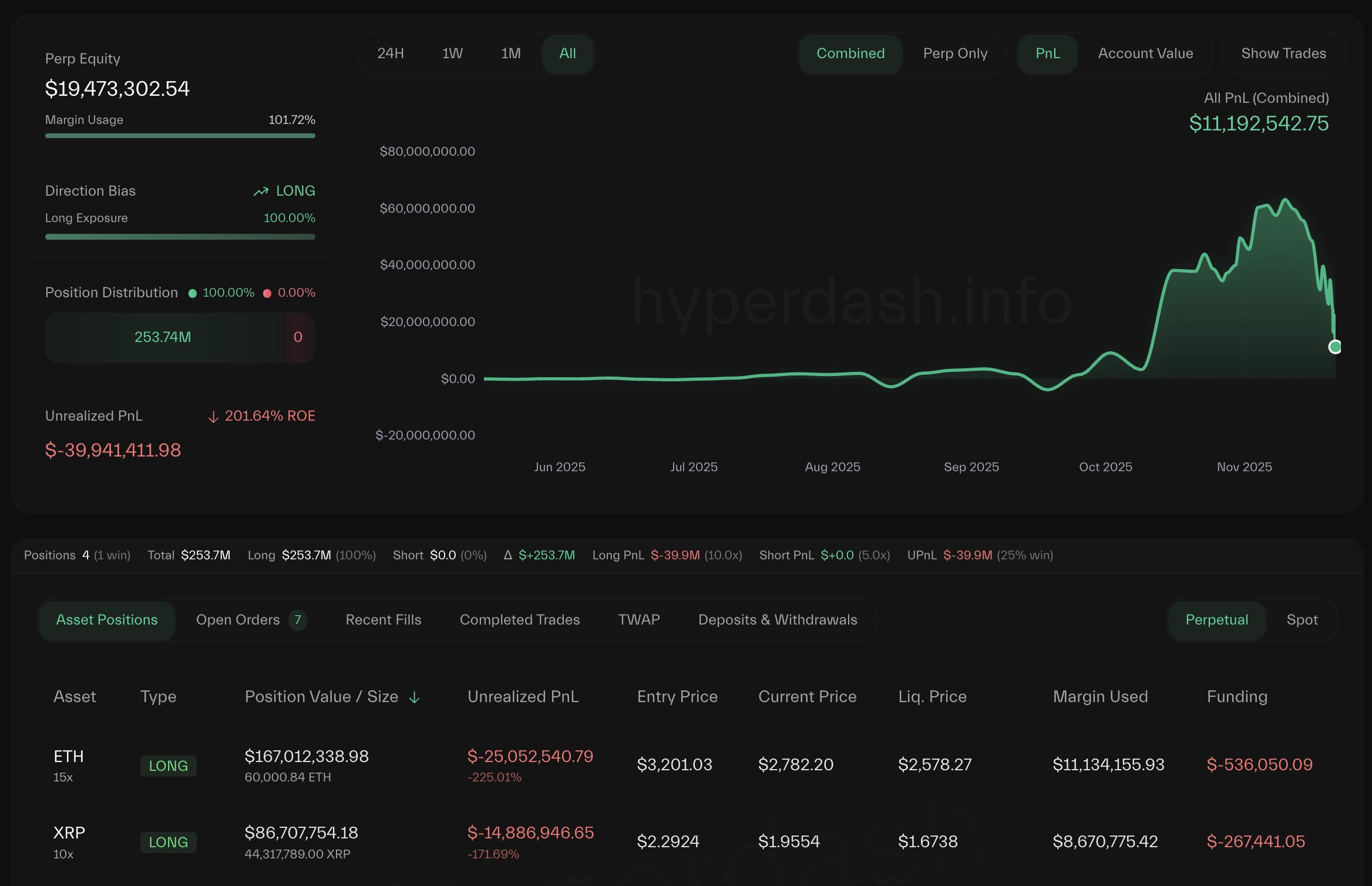
Anti-CZ Whale Ethereum and XRP Positions | Source: Lookonchain

However, as the crypto market sharply corrected, his oversized ETH and XRP longs turned against him. The result has been a brutal drawdown: his total profit has now fallen to just $38.4 million, wiping out more than 60% of gains in less than two weeks.

This dramatic reversal reflects more than one trader’s misfortune — it signals the extent of the pressure weighing on Ethereum. As ETH continues to decline and investor sentiment deteriorates, even the most seasoned actors are struggling to navigate the volatility. The whale’s rapid profit erosion highlights how quickly bullish conviction can shift when key support levels fail.

For Ethereum, holding the current zone is crucial. Price action has already inflicted significant pain across longs, short-term holders, and leveraged players. If ETH loses this support decisively, the next wave of forced selling could deepen losses and accelerate the broader market capitulation.

ETH Price Analysis: Testing a Major Weekly Support Zone

Ethereum has entered a critical phase on the weekly timeframe, with price pulling back sharply toward the $2,680 region — a level that now acts as the last meaningful support before a deeper market breakdown. The chart shows a strong rejection from the $4,500 zone earlier this quarter, followed by a sustained series of lower highs and lower lows, confirming a medium-term downtrend.

The 50-week moving average has been lost decisively, and ETH is now sitting directly on top of the 100-week MA, a level that has historically acted as a key pivot during major market corrections.
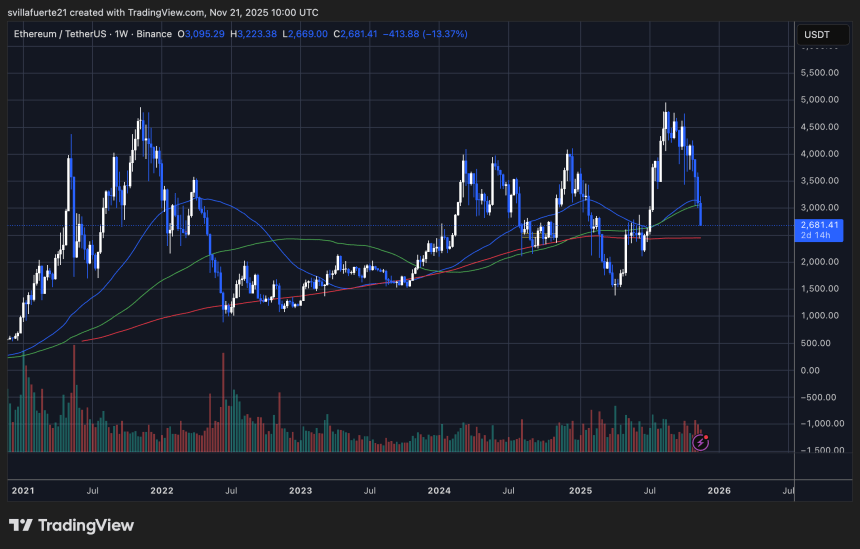
ETH setting fresh lows | Source: ETHUSDT chart on TradingView

Volume has expanded during the recent drop, highlighting an environment driven by fear and forced selling rather than controlled profit-taking. This aligns with broader market conditions, where liquidity is thin and volatility remains elevated across majors. A clean break below $2,650 would open the door for a retest of the $2,300–$2,400 zone, which served as strong accumulation during previous cycles.

However, the weekly chart also shows that ETH is entering a historically oversold area, similar to mid-2022 and late-2023, where reversals eventually formed after weeks of compression. For now, Ethereum must hold above this weekly support to avoid a deeper retrace and preserve the structure needed for a potential recovery.

Featured image from ChatGPT, chart from TradingView.com

Market Opportunity
XRP Logo
XRP Price(XRP)
$1,8933
$1,8933$1,8933
-2,13%
USD
XRP (XRP) Live Price Chart
Disclaimer: The articles reposted on this site are sourced from public platforms and are provided for informational purposes only. They do not necessarily reflect the views of MEXC. All rights remain with the original authors. If you believe any content infringes on third-party rights, please contact service@support.mexc.com for removal. MEXC makes no guarantees regarding the accuracy, completeness, or timeliness of the content and is not responsible for any actions taken based on the information provided. The content does not constitute financial, legal, or other professional advice, nor should it be considered a recommendation or endorsement by MEXC.

You May Also Like

XRP faces far more negative social media commentary than average

XRP faces far more negative social media commentary than average

The post XRP faces far more negative social media commentary than average appeared on BitcoinEthereumNews.com. XRP is drawing unusually high levels of negative
Share
BitcoinEthereumNews2025/12/23 19:23
Xcimer Energy Delivers Technical Update to U.S. Energy Sec. Chris Wright and U.S. Rep. Gabe Evans in Denver Laser Bay

Xcimer Energy Delivers Technical Update to U.S. Energy Sec. Chris Wright and U.S. Rep. Gabe Evans in Denver Laser Bay

High-level visit, also including Chancellor of Colorado State University System Dr. Tony Frank, comes after Xcimer begins testing of one of the highest-energy KrF
Share
AI Journal2025/12/23 19:16
Crucial US Stock Market Update: What Wednesday’s Mixed Close Reveals

Crucial US Stock Market Update: What Wednesday’s Mixed Close Reveals

BitcoinWorld Crucial US Stock Market Update: What Wednesday’s Mixed Close Reveals The financial world often keeps us on our toes, and Wednesday was no exception. Investors watched closely as the US stock market concluded the day with a mixed performance across its major indexes. This snapshot offers a crucial glimpse into current investor sentiment and economic undercurrents, prompting many to ask: what exactly happened? Understanding the Latest US Stock Market Movements On Wednesday, the closing bell brought a varied picture for the US stock market. While some indexes celebrated gains, others registered slight declines, creating a truly mixed bag for investors. The Dow Jones Industrial Average showed resilience, climbing by a notable 0.57%. This positive movement suggests strength in some of the larger, more established companies. Conversely, the S&P 500, a broader benchmark often seen as a barometer for the overall market, experienced a modest dip of 0.1%. The technology-heavy Nasdaq Composite also saw a slight retreat, sliding by 0.33%. This particular index often reflects investor sentiment towards growth stocks and the tech sector. These divergent outcomes highlight the complex dynamics currently at play within the American economy. It’s not simply a matter of “up” or “down” for the entire US stock market; rather, it’s a nuanced landscape where different sectors and company types are responding to unique pressures and opportunities. Why Did the US Stock Market See Mixed Results? When the US stock market delivers a mixed performance, it often points to a tug-of-war between various economic factors. Several elements could have contributed to Wednesday’s varied closings. For instance, positive corporate earnings reports from certain industries might have bolstered the Dow. At the same time, concerns over inflation, interest rate policies by the Federal Reserve, or even global economic uncertainties could have pressured growth stocks, affecting the S&P 500 and Nasdaq. Key considerations often include: Economic Data: Recent reports on employment, manufacturing, or consumer spending can sway market sentiment. Corporate Announcements: Strong or weak earnings forecasts from influential companies can significantly impact their respective sectors. Interest Rate Expectations: The prospect of higher or lower interest rates directly influences borrowing costs for businesses and consumer spending, affecting future profitability. Geopolitical Events: Global tensions or trade policies can introduce uncertainty, causing investors to become more cautious. Understanding these underlying drivers is crucial for anyone trying to make sense of daily market fluctuations in the US stock market. Navigating Volatility in the US Stock Market A mixed close, while not a dramatic downturn, serves as a reminder that market volatility is a constant companion for investors. For those involved in the US stock market, particularly individuals managing their portfolios, these days underscore the importance of a well-thought-out strategy. It’s important not to react impulsively to daily movements. Instead, consider these actionable insights: Diversification: Spreading investments across different sectors and asset classes can help mitigate risk when one area underperforms. Long-Term Perspective: Focusing on long-term financial goals rather than short-term gains can help weather daily market swings. Stay Informed: Keeping abreast of economic news and company fundamentals provides context for market behavior. Consult Experts: Financial advisors can offer personalized guidance based on individual risk tolerance and objectives. Even small movements in major indexes can signal shifts that require attention, guiding future investment decisions within the dynamic US stock market. What’s Next for the US Stock Market? Looking ahead, investors will be keenly watching for further economic indicators and corporate announcements to gauge the direction of the US stock market. Upcoming inflation data, statements from the Federal Reserve, and quarterly earnings reports will likely provide more clarity. The interplay of these factors will continue to shape investor confidence and, consequently, the performance of the Dow, S&P 500, and Nasdaq. Remaining informed and adaptive will be key to understanding the market’s trajectory. Conclusion: Wednesday’s mixed close in the US stock market highlights the intricate balance of forces influencing financial markets. While the Dow showed strength, the S&P 500 and Nasdaq experienced slight declines, reflecting a nuanced economic landscape. This reminds us that understanding the ‘why’ behind these movements is as important as the movements themselves. As always, a thoughtful, informed approach remains the best strategy for navigating the complexities of the market. Frequently Asked Questions (FAQs) Q1: What does a “mixed close” mean for the US stock market? A1: A mixed close indicates that while some major stock indexes advanced, others declined. It suggests that different sectors or types of companies within the US stock market are experiencing varying influences, rather than a uniform market movement. Q2: Which major indexes were affected on Wednesday? A2: On Wednesday, the Dow Jones Industrial Average gained 0.57%, while the S&P 500 edged down 0.1%, and the Nasdaq Composite slid 0.33%, illustrating the mixed performance across the US stock market. Q3: What factors contribute to a mixed stock market performance? A3: Mixed performances in the US stock market can be influenced by various factors, including specific corporate earnings, economic data releases, shifts in interest rate expectations, and broader geopolitical events that affect different market segments uniquely. Q4: How should investors react to mixed market signals? A4: Investors are generally advised to maintain a long-term perspective, diversify their portfolios, stay informed about economic news, and avoid impulsive decisions. Consulting a financial advisor can also provide personalized guidance for navigating the US stock market. Q5: What indicators should investors watch for future US stock market trends? A5: Key indicators to watch include upcoming inflation reports, statements from the Federal Reserve regarding monetary policy, and quarterly corporate earnings reports. These will offer insights into the future direction of the US stock market. Did you find this analysis of the US stock market helpful? Share this article with your network on social media to help others understand the nuances of current financial trends! To learn more about the latest stock market trends, explore our article on key developments shaping the US stock market‘s future performance. This post Crucial US Stock Market Update: What Wednesday’s Mixed Close Reveals first appeared on BitcoinWorld.
Share
Coinstats2025/09/18 05:30