Ethereum co-founder Vitalik Buterin is sounding the alarm over X’s new “show which country the account is from” transparency tag, arguing that the feature will be quickly undermined by spoofing while exposing some users to unacceptable privacy risk. X has recently expanded its “About This Account” surface, letting users see metadata such as an account’s […]Ethereum co-founder Vitalik Buterin is sounding the alarm over X’s new “show which country the account is from” transparency tag, arguing that the feature will be quickly undermined by spoofing while exposing some users to unacceptable privacy risk. X has recently expanded its “About This Account” surface, letting users see metadata such as an account’s […]

Ethereum Founder Buterin Warns Of New X Feature: Here’s Why

2025/11/25 04:00
3 min read
For feedback or concerns regarding this content, please contact us at crypto.news@mexc.com

Ethereum co-founder Vitalik Buterin is sounding the alarm over X’s new “show which country the account is from” transparency tag, arguing that the feature will be quickly undermined by spoofing while exposing some users to unacceptable privacy risk. X has recently expanded its “About This Account” surface, letting users see metadata such as an account’s country or region alongside creation details, a move the platform positions as a tool against manipulation and inauthentic behavior.

Ethereum Founder Sounds The Alarm

Buterin’s first post acknowledged near-term upside but framed the system as fragile under adversarial pressure. “In the short term it will have lots of positive effects,” he wrote. He then predicted that sophisticated operators will adapt faster than the platform can harden the signal: “the sophisticated actors will find ways to pretend to be from countries that they are not,” pointing to rentable passports, phone numbers, and IP infrastructure that can be used to manufacture plausible provenance.

His core asymmetry claim was blunt: “Getting a million accounts with fake location will be medium-hard, getting a single account with fake location, and then getting it to a million followers, will be easy.” In his view, the feature will drift from authenticity check to theater, with foreign influence accounts displaying Anglosphere tags to amplify credibility: “In six months, the actually-[random Eurasian country]-based political troll accounts with names like ‘Defend Western Civilization’ or whatever will all have ‘USA’ or ‘UK’ as their location tags.”

The Ethereum founder stressed that he was describing incentives, not endorsing them: “This is what I think will happen, not what I wish.” What he wants instead is a provenance system that yields “more visibility into how people from different communities think about different issues, in a way that is not easy to spoof,” and that defines communities through broader, emergent evidence rather than “a narrow set of highly legible credentials like countries.”

He concluded that “making such a system adversarially robust will not be easy,” a critique consistent with the crypto security view that identity signals decay once attackers can buy or synthesize them at scale.

Shortly after, the Ethereum founder sharpened his objection to consent and safety. “I thought about this more and I think responders are right that revealing the country non-consensually without offering any opt-out option (not even ‘stop using your account’) is wrong,” he wrote.

He noted that country-level disclosure is broadly non-identifying, yet warned that edge cases matter: “there are some people for whom even a few bits of leakage are risky, and they should not have their privacy retroactively rugpulled with no recourse.” Privacy advocates on X have echoed this concern, especially for users in authoritarian or conflict settings who fear location metadata can support harassment, surveillance, or legal targeting.

X has already faced questions about accuracy and implementation, with reports that some country tags appeared incorrect and the platform adjusted visibility while promising fixes. That instability reinforces the Ethereum founder’s warning: if tags are inferred from IP, app-store, or telecom data, they are vulnerable not only to deliberate spoofing but also to routine distortions like VPN use, SIM swapping, or account resales.

At press time, Ethereum traded at $2,800.
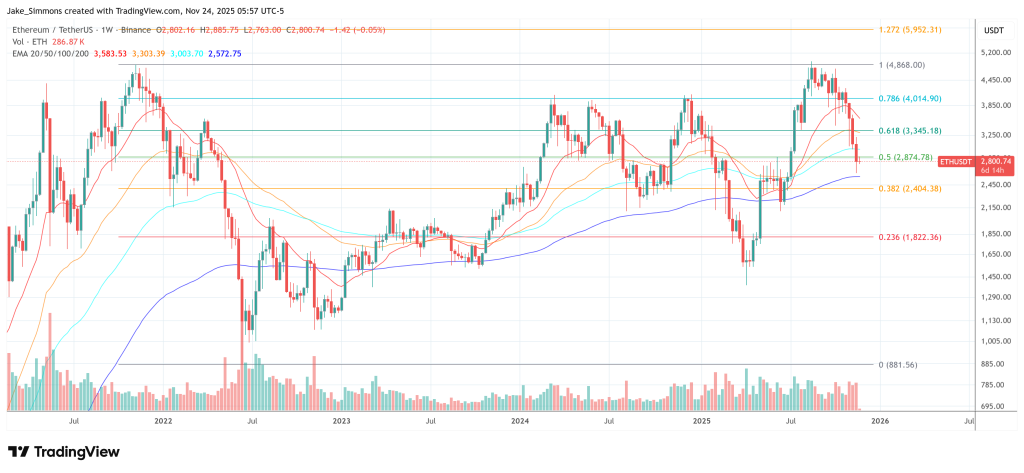
Ethereum price
Market Opportunity
Tagger Logo
Tagger Price(TAG)
$0.0005715
$0.0005715$0.0005715
-1.68%
USD
Tagger (TAG) Live Price Chart
Disclaimer: The articles reposted on this site are sourced from public platforms and are provided for informational purposes only. They do not necessarily reflect the views of MEXC. All rights remain with the original authors. If you believe any content infringes on third-party rights, please contact crypto.news@mexc.com for removal. MEXC makes no guarantees regarding the accuracy, completeness, or timeliness of the content and is not responsible for any actions taken based on the information provided. The content does not constitute financial, legal, or other professional advice, nor should it be considered a recommendation or endorsement by MEXC.

You May Also Like

Dogecoin Remains Inside Falling Channel, Bulls Target Surge Above $0.1

Dogecoin Remains Inside Falling Channel, Bulls Target Surge Above $0.1

Dogecoin is still trading in a far smaller range than long-time holders would have imagined a few months ago, and that is exactly what makes its technical setup
Share
NewsBTC2026/03/10 01:30
Wormhole Jumps 11% on Revised Tokenomics and Reserve Initiative

Wormhole Jumps 11% on Revised Tokenomics and Reserve Initiative

The post Wormhole Jumps 11% on Revised Tokenomics and Reserve Initiative appeared on BitcoinEthereumNews.com. Cross-chain bridge Wormhole plans to launch a reserve funded by both on-chain and off-chain revenues. Wormhole, a cross-chain bridge connecting over 40 blockchain networks, unveiled a tokenomics overhaul on Wednesday, hinting at updated staking incentives, a strategic reserve for the W token, and a smoother unlock schedule. The price of W jumped 11% on the news to $0.096, though the token is still down 92% since its debut in April 2024. W Chart In a blog post, Wormhole said it’s planning to set up a “Wormhole Reserve” that will accumulate on-chain and off-chain revenues “to support the growth of the Wormhole ecosystem.” The protocol also said it plans to target a 4% base yield for governance stakers, replacing the current variable APY system, noting that “yield will come from a combination of the existing token supply and protocol revenues.” It’s unclear whether Wormhole will draw from the reserve to fund this target. Wormhole did not immediately respond to The Defiant’s request for comment. Wormhole emphasized that the maximum supply of 10 billion W tokens will remain the same, while large annual token unlocks will be replaced by a bi-weekly distribution beginning Oct. 3 to eliminate “moments of concentrated market pressure.” Data from CoinGecko shows there are over 4.7 billion W tokens in circulation, meaning that more than half the supply is yet to be unlocked, with portions of that supply to be released over the next 4.5 years. Source: https://thedefiant.io/news/defi/wormhole-jumps-11-on-revised-tokenomics-and-reserve-initiative
Share
BitcoinEthereumNews2025/09/18 01:31
Bitcoin & Ethereum Inflows Hit 1-Year Low as Crypto Investors Brace for Fed Decision – BTC Eyes $120K

Bitcoin & Ethereum Inflows Hit 1-Year Low as Crypto Investors Brace for Fed Decision – BTC Eyes $120K

Bitcoin and Ethereum exchange inflows have dropped to a 1-year low indicating reduced selling pressure and investor reluctance to exit positions ahead of a potential U.S. Federal Reserve rate cut, with on-chain data revealing exchange inflows falling to a 7-day moving average of 25K BTC from 51K BTC in July.
Share
Coinstats2025/09/17 23:29