Crypto Not Included in Trump Admin’s National Security Plan
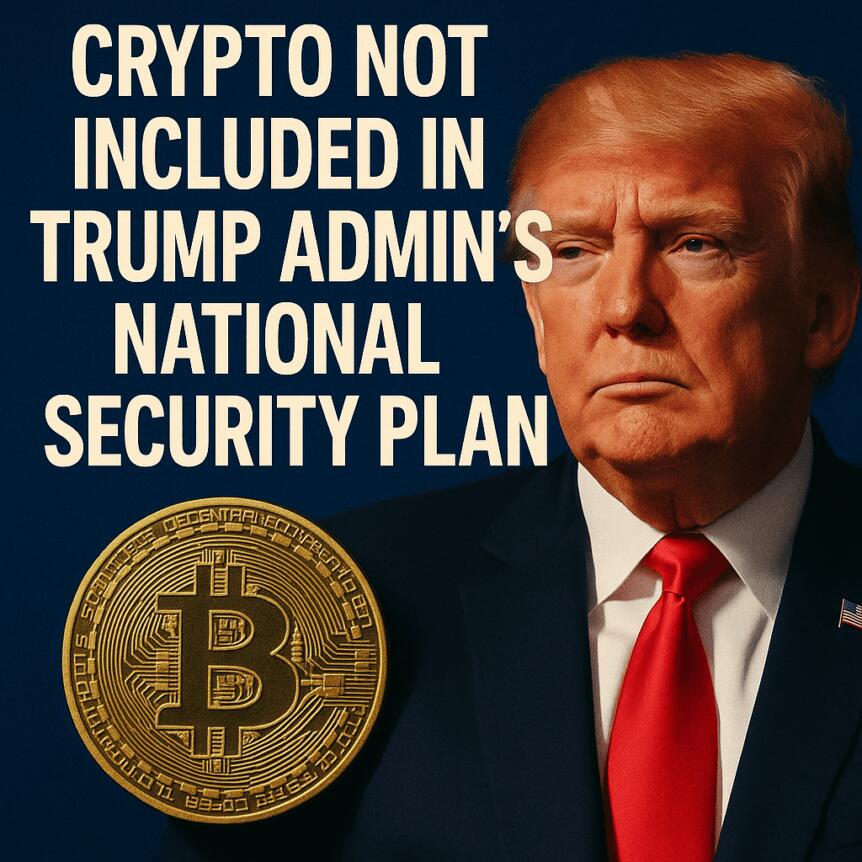
US National Security Strategy Omits Cryptocurrency Focus Amid Growing Industry Ties
The recent US national security strategy unveiled under the Trump administration notably excludes any direct references to cryptocurrency or blockchain technology, despite the industry’s increasingly significant role in global finance and the administration’s concerns about international competition. Instead, the strategy emphasizes advancements in artificial intelligence and quantum computing as the nation’s primary technological priorities.
The document states that the United States intends to leverage its leadership in AI, biotech, and quantum information sciences to drive global innovation. While crypto is absent from the main script, a notable mention hints at potential future initiatives related to the country’s financial sector.
Despite the strategic silence on crypto, former President Trump publicly articulated a desire to position the US as a leader in digital assets. Last month, in an interview with CBS’ 60 Minutes, Trump expressed a preference to prevent China from dominating the cryptocurrency space and advocated for Bitcoin mining to be confined within U.S. borders. Similarly, CIA deputy director Michael Ellis highlighted the importance of technological competition with China in the crypto realm during a May interview.
Interestingly, the strategy document alludes to preserving and expanding America’s dominance in the financial sector, emphasizing leadership in digital finance and innovation to ensure market liquidity and security. An excerpt from the document, highlighted in a whitehouse.gov publication, states, “We want to ensure that U.S. technology and U.S. standards… drive the world forward,” which could be interpreted as a subtle nod toward the potential prioritization of crypto and digital finance initiatives.
A highlighted excerpt of the document indicates the US aims to grow its “financial sector dominance.” Source: The White HouseTrump Administration Advances Cryptocurrency Policies
This year, the Trump administration has demonstrated a proactive stance toward cryptocurrency regulation, implementing policies to boost its adoption within the financial ecosystem. Notably, it played a key role in passing the GENIUS Act—focusing on stablecoin regulation—and signed executive orders to establish a crypto task force, while explicitly opposing a central bank digital currency (CBDC). Federal agencies under his leadership have also shifted away from enforcement actions that previously targeted crypto firms.
Government holdings of digital assets have increased, with the establishment of a Bitcoin reserve comprising forfeited digital assets. Efforts are underway to explore “budget-neutral” strategies to expand these reserves further. The market responded to the release of the national security strategy with Bitcoin prices dipping below $90,000, amid broader geopolitical calls for increased defense spending by US allies and NATO nations, potentially impacting inflation and monetary policy.
Crypto markets continue to be influenced by the Federal Reserve’s interest rate decisions, with market participants betting heavily on a rate cut during the upcoming meetings. The consensus anticipates a 25 basis point reduction, which historically encourages investors to increase risk exposure, benefiting cryptocurrency prices.
As the macroeconomic environment remains uncertain, the interplay between geopolitics, fiscal policy, and digital assets continues to shape the evolving landscape—highlighting the complex relationship between national security and the crypto industry.
This article was originally published as Crypto Not Included in Trump Admin’s National Security Plan on Crypto Breaking News – your trusted source for crypto news, Bitcoin news, and blockchain updates.
You May Also Like

Firelight Hits 50 Million XRP Milestone as DeFi Protection Demand Surges – Crypto News Bitcoin News

How to earn from cloud mining: IeByte’s upgraded auto-cloud mining platform unlocks genuine passive earnings