Crypto markets head into this week’s Federal Reserve meeting focused less on rate cut and more on whether Jerome Powell quietly declares the start of quantitative easing (QE). The key question on Wednesday for macro-sensitive traders is whether the Fed shifts into a bill-heavy “reserve management” regime that starts rebuilding dollar liquidity, even if it refuses to call it QE. Futures markets suggest the rate decision itself is largely a foregone conclusion. According to the CME FedWatch Tool, traders are assigning roughly 87.2% odds to a 0.25 percentage point cut, underscoring that the real uncertainty is not about the size of the move, but about what the Fed signals on reserves, T-bill purchases and the future path of its balance sheet. Former New York Fed repo specialist and current Bank of America strategist Mark Cabana has become the focal point of that debate. His latest client note argues that Powell is poised to announce a program of roughly 45 billion dollars in monthly Treasury bill purchases. For Cabana, the rate move is secondary; the balance-sheet pivot is the real event. Related Reading: Italy’s Market Watchdog Gives Crypto Firms A Clear Order: Act Or Exit Cabana’s argument is rooted in the Fed’s own “ample reserves” framework. After years of QT, he contends that bank reserves are skirting the bottom of the comfortable range. Bill purchases would be presented as technical “reserve management” to keep funding markets orderly and repo rates anchored, but in practice they would mark a turn from draining to refilling the system. That is why many in crypto describe the prospective move as “stealth QE,” even though the Fed would frame it as plumbing. What This Means For The Crypto Market James E. Thorne, Chief Market Strategist at Wellington Altus, sharpened the point in X post. “Will Powell surprise on Wednesday?” he asked, before posing the question that has been echoing across macro desks: “Is Powell about to admit on Wednesday that the Fed has drained the system too far and now has to start refilling the bathtub?” Thorne argues that this FOMC “is not just about another token rate cut; it is about whether Powell is forced to roll out a standing schedule of bill-heavy ‘reserve management’ operations precisely because the Fed has yanked too much liquidity out of the plumbing.” Thorne ties that directly to New York Fed commentary on funding markets and reserve adequacy. In his reading, “By Powell’s own framework, QT is done, reserves are skirting the bottom of the ‘ample’ range bordering on being too tight, and any new bill buying will be dressed up as a technical tweak rather than a confession of error, even though it will plainly rebuild reserves and patch the funding stress that the Fed’s own over-tightening has triggered.” That framing goes to the heart of what crypto traders care about: the direction of net liquidity rather than the official label. Macro analysts followed closely by digital-asset investors are already mapping the next phase. Milk Road Macro on X has argued that QE returns in 2026, potentially as early as the first quarter, but in a much weaker form than the crisis-era programs. Related Reading: 75% Chance Crypto Is ‘Crossing The Chasm’ Now, Says Moonrock Capital Boss They point to expectations of roughly 20 billion dollars a month in balance-sheet growth, “tiny compared to the 800bn per month in 2020,” and stress that the Fed “will be buying treasury bills, not treasury coupons.” Their distinction is blunt: “Buying treasury coupons = real QE. Buying treasury bills = slow QE.” The takeaway, in their words, is that “the overall direct effect on risk asset markets from this QE will be minimal.” That distinction explains the tension now gripping crypto markets. A bill-only, slow-paced program aimed at stabilizing short-term funding is very different from the broad-based coupon buying that previously compressed long-term yields and turbo-charged the hunt for yield across risk assets. Yet even a modest, technically framed program would mark a clear return to balance-sheet expansion. For Bitcoin and the broader crypto market, the immediate impact will depend less on Wednesday’s basis-point move and more on Powell’s language around reserves, Treasury bill purchases and future “reserve management” operations. If the Fed signals that QE is effectively starting and the bathtub is starting to be refilled, the liquidity backdrop that crypto trades against in 2026 may already be taking shape this week. At press time, the total crypto market cap was at $3.1 trillion. Featured image created with DALL.E, chart from TradingView.comCrypto markets head into this week’s Federal Reserve meeting focused less on rate cut and more on whether Jerome Powell quietly declares the start of quantitative easing (QE). The key question on Wednesday for macro-sensitive traders is whether the Fed shifts into a bill-heavy “reserve management” regime that starts rebuilding dollar liquidity, even if it refuses to call it QE. Futures markets suggest the rate decision itself is largely a foregone conclusion. According to the CME FedWatch Tool, traders are assigning roughly 87.2% odds to a 0.25 percentage point cut, underscoring that the real uncertainty is not about the size of the move, but about what the Fed signals on reserves, T-bill purchases and the future path of its balance sheet. Former New York Fed repo specialist and current Bank of America strategist Mark Cabana has become the focal point of that debate. His latest client note argues that Powell is poised to announce a program of roughly 45 billion dollars in monthly Treasury bill purchases. For Cabana, the rate move is secondary; the balance-sheet pivot is the real event. Related Reading: Italy’s Market Watchdog Gives Crypto Firms A Clear Order: Act Or Exit Cabana’s argument is rooted in the Fed’s own “ample reserves” framework. After years of QT, he contends that bank reserves are skirting the bottom of the comfortable range. Bill purchases would be presented as technical “reserve management” to keep funding markets orderly and repo rates anchored, but in practice they would mark a turn from draining to refilling the system. That is why many in crypto describe the prospective move as “stealth QE,” even though the Fed would frame it as plumbing. What This Means For The Crypto Market James E. Thorne, Chief Market Strategist at Wellington Altus, sharpened the point in X post. “Will Powell surprise on Wednesday?” he asked, before posing the question that has been echoing across macro desks: “Is Powell about to admit on Wednesday that the Fed has drained the system too far and now has to start refilling the bathtub?” Thorne argues that this FOMC “is not just about another token rate cut; it is about whether Powell is forced to roll out a standing schedule of bill-heavy ‘reserve management’ operations precisely because the Fed has yanked too much liquidity out of the plumbing.” Thorne ties that directly to New York Fed commentary on funding markets and reserve adequacy. In his reading, “By Powell’s own framework, QT is done, reserves are skirting the bottom of the ‘ample’ range bordering on being too tight, and any new bill buying will be dressed up as a technical tweak rather than a confession of error, even though it will plainly rebuild reserves and patch the funding stress that the Fed’s own over-tightening has triggered.” That framing goes to the heart of what crypto traders care about: the direction of net liquidity rather than the official label. Macro analysts followed closely by digital-asset investors are already mapping the next phase. Milk Road Macro on X has argued that QE returns in 2026, potentially as early as the first quarter, but in a much weaker form than the crisis-era programs. Related Reading: 75% Chance Crypto Is ‘Crossing The Chasm’ Now, Says Moonrock Capital Boss They point to expectations of roughly 20 billion dollars a month in balance-sheet growth, “tiny compared to the 800bn per month in 2020,” and stress that the Fed “will be buying treasury bills, not treasury coupons.” Their distinction is blunt: “Buying treasury coupons = real QE. Buying treasury bills = slow QE.” The takeaway, in their words, is that “the overall direct effect on risk asset markets from this QE will be minimal.” That distinction explains the tension now gripping crypto markets. A bill-only, slow-paced program aimed at stabilizing short-term funding is very different from the broad-based coupon buying that previously compressed long-term yields and turbo-charged the hunt for yield across risk assets. Yet even a modest, technically framed program would mark a clear return to balance-sheet expansion. For Bitcoin and the broader crypto market, the immediate impact will depend less on Wednesday’s basis-point move and more on Powell’s language around reserves, Treasury bill purchases and future “reserve management” operations. If the Fed signals that QE is effectively starting and the bathtub is starting to be refilled, the liquidity backdrop that crypto trades against in 2026 may already be taking shape this week. At press time, the total crypto market cap was at $3.1 trillion. Featured image created with DALL.E, chart from TradingView.com

Crypto Market On Alert As This Week’s Fed Decision Isn’t Just About Rates

2025/12/09 01:30

Crypto markets head into this week’s Federal Reserve meeting focused less on rate cut and more on whether Jerome Powell quietly declares the start of quantitative easing (QE). The key question on Wednesday for macro-sensitive traders is whether the Fed shifts into a bill-heavy “reserve management” regime that starts rebuilding dollar liquidity, even if it refuses to call it QE.

Futures markets suggest the rate decision itself is largely a foregone conclusion. According to the CME FedWatch Tool, traders are assigning roughly 87.2% odds to a 0.25 percentage point cut, underscoring that the real uncertainty is not about the size of the move, but about what the Fed signals on reserves, T-bill purchases and the future path of its balance sheet.

Former New York Fed repo specialist and current Bank of America strategist Mark Cabana has become the focal point of that debate. His latest client note argues that Powell is poised to announce a program of roughly 45 billion dollars in monthly Treasury bill purchases. For Cabana, the rate move is secondary; the balance-sheet pivot is the real event.

Cabana’s argument is rooted in the Fed’s own “ample reserves” framework. After years of QT, he contends that bank reserves are skirting the bottom of the comfortable range. Bill purchases would be presented as technical “reserve management” to keep funding markets orderly and repo rates anchored, but in practice they would mark a turn from draining to refilling the system. That is why many in crypto describe the prospective move as “stealth QE,” even though the Fed would frame it as plumbing.

What This Means For The Crypto Market

James E. Thorne, Chief Market Strategist at Wellington Altus, sharpened the point in X post. “Will Powell surprise on Wednesday?” he asked, before posing the question that has been echoing across macro desks: “Is Powell about to admit on Wednesday that the Fed has drained the system too far and now has to start refilling the bathtub?” Thorne argues that this FOMC “is not just about another token rate cut; it is about whether Powell is forced to roll out a standing schedule of bill-heavy ‘reserve management’ operations precisely because the Fed has yanked too much liquidity out of the plumbing.”

Thorne ties that directly to New York Fed commentary on funding markets and reserve adequacy. In his reading, “By Powell’s own framework, QT is done, reserves are skirting the bottom of the ‘ample’ range bordering on being too tight, and any new bill buying will be dressed up as a technical tweak rather than a confession of error, even though it will plainly rebuild reserves and patch the funding stress that the Fed’s own over-tightening has triggered.” That framing goes to the heart of what crypto traders care about: the direction of net liquidity rather than the official label.

Macro analysts followed closely by digital-asset investors are already mapping the next phase. Milk Road Macro on X has argued that QE returns in 2026, potentially as early as the first quarter, but in a much weaker form than the crisis-era programs.

They point to expectations of roughly 20 billion dollars a month in balance-sheet growth, “tiny compared to the 800bn per month in 2020,” and stress that the Fed “will be buying treasury bills, not treasury coupons.” Their distinction is blunt: “Buying treasury coupons = real QE. Buying treasury bills = slow QE.” The takeaway, in their words, is that “the overall direct effect on risk asset markets from this QE will be minimal.”

That distinction explains the tension now gripping crypto markets. A bill-only, slow-paced program aimed at stabilizing short-term funding is very different from the broad-based coupon buying that previously compressed long-term yields and turbo-charged the hunt for yield across risk assets. Yet even a modest, technically framed program would mark a clear return to balance-sheet expansion.

For Bitcoin and the broader crypto market, the immediate impact will depend less on Wednesday’s basis-point move and more on Powell’s language around reserves, Treasury bill purchases and future “reserve management” operations. If the Fed signals that QE is effectively starting and the bathtub is starting to be refilled, the liquidity backdrop that crypto trades against in 2026 may already be taking shape this week.

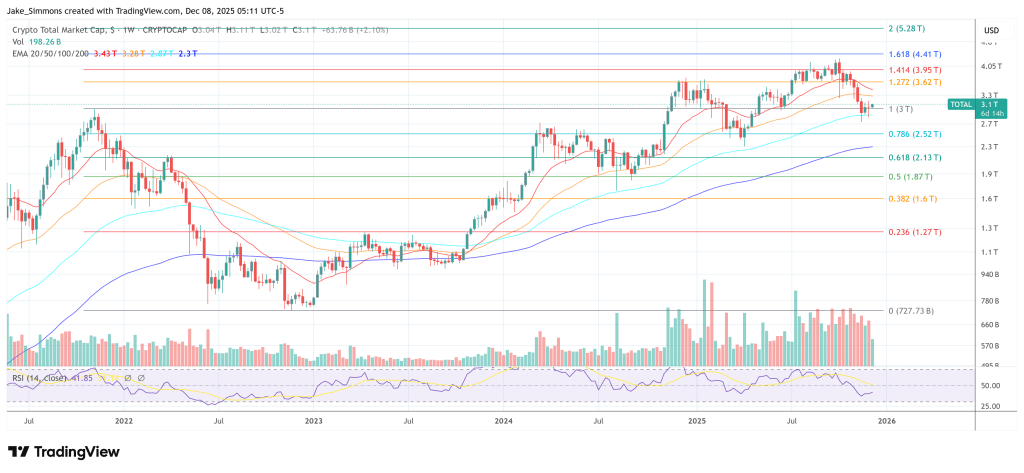
At press time, the total crypto market cap was at $3.1 trillion.

Total crypto market cap
Disclaimer: The articles reposted on this site are sourced from public platforms and are provided for informational purposes only. They do not necessarily reflect the views of MEXC. All rights remain with the original authors. If you believe any content infringes on third-party rights, please contact service@support.mexc.com for removal. MEXC makes no guarantees regarding the accuracy, completeness, or timeliness of the content and is not responsible for any actions taken based on the information provided. The content does not constitute financial, legal, or other professional advice, nor should it be considered a recommendation or endorsement by MEXC.

You May Also Like

Hyperliquid Strategies Inc. announces a $30M stock buyback program

Hyperliquid Strategies Inc. announces a $30M stock buyback program

The post Hyperliquid Strategies Inc. announces a $30M stock buyback program appeared on BitcoinEthereumNews.com. Hyperliquid Strategies Inc., a digital asset treasury company, has announced that its board approved a stock buyback of up to $30 million of the Company’s outstanding common stock, par value $0.01 per share.  The stock repurchase program will be in place for up to 12 months. The company states that repurchases will be made from time to time in open market transactions at prevailing market prices, at management’s discretion. Hyperliquid cites providing investors with access to HYPE as the initiative According to Hyperliquid, the actual timing, number, and value of shares repurchased under the program will be determined by management at its discretion. It will also depend on several factors, including the market price of HSI’s common stock, general market and economic conditions, and applicable legal requirements. Company CEO David Schamis stated that the repurchase is aimed at enhancing shareholder value and increasing the exposure of each share to Hyperliquid’s ecosystem native token HYPE through capital operations.  David Schamis stated, “We are fully committed to maximizing shareholder value through disciplined execution of our treasury strategy. Our primary objective is providing investors with efficient access to HYPE, the native token of the dominant Hyperliquid eco-system. We will use our cash to increase our shareholders’ per-share exposure to HYPE in the most efficient way possible.” However, the company cannot guarantee the final number of shares repurchased, and the repurchase program may be extended, suspended, or terminated at any time at the company’s discretion without further notice. Additionally, Hyperliquid Strategies Inc. is the core of the Hyperliquid ecosystem. Hyperion DeFi recently announced the receipt of a Kinetiq airdrop and a partnership with Native Markets. The company reports assert that these changes should make HYPE tokens more valuable and easier to trade. The company has also taken steps to expand its holdings, purchasing an…
Share
BitcoinEthereumNews2025/12/09 04:23
Gold dips under $4,200 as rising yields and Fed jitters hit bullion

Gold dips under $4,200 as rising yields and Fed jitters hit bullion

The post Gold dips under $4,200 as rising yields and Fed jitters hit bullion appeared on BitcoinEthereumNews.com. Gold (XAU/USD) retreats on Monday as traders brace for the Federal Reserve (Fed) meeting, where the central bank is expected to deliver its third consecutive rate cut, ahead of 2026. At the time of writing, XAU/USD trades at $4,195, down 0.27%, after hitting a daily high of $4,219,. US Treasury yields pressure Gold; Fed decision and geopolitics drive outlook The rise of US Treasury yields is capping bullion’s advance, with sellers driving spot prices below $4,200. A Fed cut on Wednesday could pump Gold prices up, with the non-yielding metal tending to fare well in low-interest-rate environments, meaning that further upside is seen in the near term. The outcome of the meeting could set the tone for Gold’s direction, as a ‘hawkish cut’ could cap Gold’s advance. On the other hand, the lack of progress of a peace deal between Russia and Ukraine could underpin the yellow metal, which so far is poised to end the year with gains of close to 60%. On Tuesday, the US data docket will feature the ADP Employment Change 4-week average, alongside the Job Openings and Labor Turnover (JOLTS) report for September and October. Daily digest market movers: US Treasury yields, pressure Gold prices US Treasury yields are rising. The 10-year benchmark note rate is up nearly three basis points at 4.168%. US real yields, which correlate inversely with Gold prices, are also rising three bps to 1.908%, a headwind for bullion. The US Dollar Index (DXY), which tracks the American’s currency performance against other six, is up 0.11% at 99.09 Geopolitics continued to play its role with Gold prices as newswires revealed that Ukrainian President Volodymyr Zelenskiy met with European leaders in London, as Washington pressures Kyiv to agree to a proposed peace deal with Russia. Zelenskiy said that China is not interested…
Share
BitcoinEthereumNews2025/12/09 04:17




