Ethereum’s Vitalik Buterin has disclosed that the Ethereum Foundation no longer takes P2P networking for granted, after complaining internally for years.  He stated that the Foundation has been able to work on resilience and network layer privacy, as evident in the PeerDAS’ performance.  Ethereum co-founder Vitalik Buterin has taken to X to praise the Ethereum [...]]]>Ethereum’s Vitalik Buterin has disclosed that the Ethereum Foundation no longer takes P2P networking for granted, after complaining internally for years.  He stated that the Foundation has been able to work on resilience and network layer privacy, as evident in the PeerDAS’ performance.  Ethereum co-founder Vitalik Buterin has taken to X to praise the Ethereum [...]]]>

Vitalik Buterin Says Ethereum Foundation Has Finally Solved Its P2P Networking Weakness

2025/12/09 17:15
  • Ethereum’s Vitalik Buterin has disclosed that the Ethereum Foundation no longer takes P2P networking for granted, after complaining internally for years. 
  • He stated that the Foundation has been able to work on resilience and network layer privacy, as evident in the PeerDAS’ performance. 

Ethereum co-founder Vitalik Buterin has taken to X to praise the Ethereum Foundation for solving the P2P issue that plagued the network for years. In a post, Vitalik disclosed that the team primarily focused on cryptoeconomics, BFT consensus, and blocks. However, this was at the expense of other important areas, including the P2P networking layer.
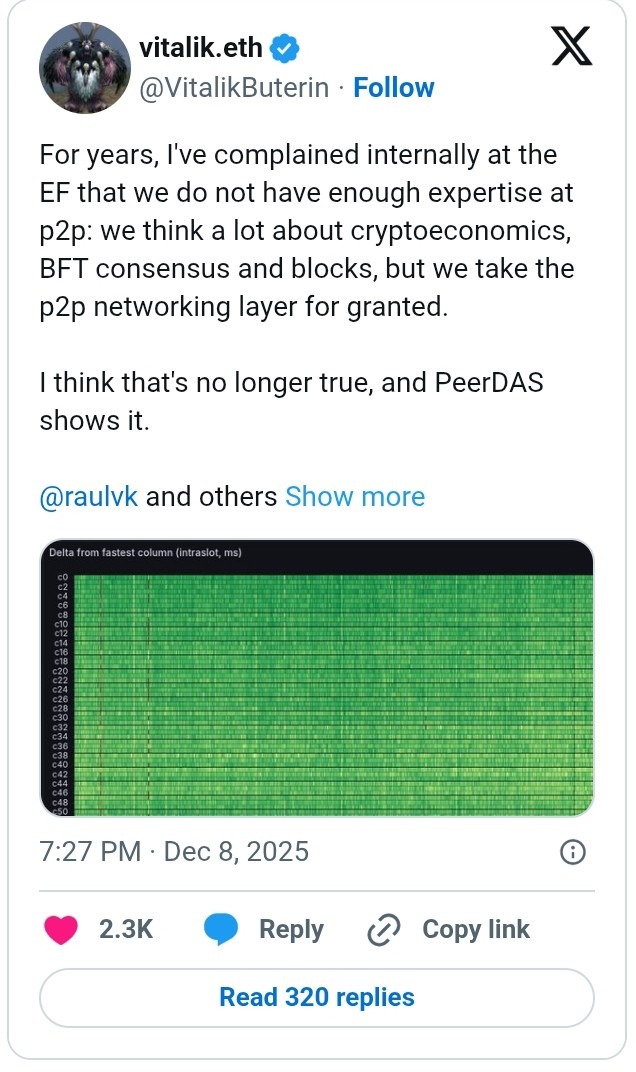
EthereumSource: Vitalik Buterin on X

Having assessed the situation again, he noted that this is no longer the case. According to him, the recent performance of PeerDAS confirms this assertion. Additionally, Vitalik lauded the effort to “set up a roadmap that increases resilience, propagation of speed, and network layer privacy at the same time.”

Vitalik’s post attracted comments from several users. Fascinatingly, one of them came from a major contributor who was tagged in the post, Raul Jordan. According to him, the work on P2P has not ended, as networking or protocol boundary is still costing them latency and throughput.

Highlighting the current development, he disclosed that they are working on “tighter integration, as well as pipelining and mechanical sympathy to completely remove inefficiencies and max out scaling and performance.” Most importantly, Jordan assured that this would be done while keeping Ethereum accessible, neutral, decentralized, and resilient.

Background of the P2P Network Issues and Other Proposals for Ethereum

Over the years, one of the major issues that has been raised against the Ethereum P2P Network is anonymity. Earlier published academic research echoed a similar sentiment, as it was able to use data collected from four nodes in just three days to locate over 15% of the validators in the Ethereum P2P Network.

According to the report, its deanonymization technique was able to provide important information on validators, including their hosting organization and geographic information. Interestingly, the impact of these results was acknowledged by the Ethereum Foundation, as it awarded a bug bounty to the researchers.

Vitalik’s commendation follows his earlier call for a good trustless on-chain gas futures market, which he believes would help people hedge against future gas prices. As featured in our previous publication, Vitalik argued that gas-free prediction would be very important for high-volume network participants, including traders, developers, institutions, and others.

According to an earlier update, CNF also highlighted that the Ethereum co-founder envisions the introduction of a universal light client to improve the network’s L2 verification and decentralization.

]]>
Disclaimer: The articles reposted on this site are sourced from public platforms and are provided for informational purposes only. They do not necessarily reflect the views of MEXC. All rights remain with the original authors. If you believe any content infringes on third-party rights, please contact service@support.mexc.com for removal. MEXC makes no guarantees regarding the accuracy, completeness, or timeliness of the content and is not responsible for any actions taken based on the information provided. The content does not constitute financial, legal, or other professional advice, nor should it be considered a recommendation or endorsement by MEXC.

You May Also Like

Avalanche and Hyperliquid Lead Crypto Rally Post-Fed Rate Cut

Avalanche and Hyperliquid Lead Crypto Rally Post-Fed Rate Cut

The post Avalanche and Hyperliquid Lead Crypto Rally Post-Fed Rate Cut appeared on BitcoinEthereumNews.com. In brief Crypto markets have posted broad gains following the Federal Reserve’s quarter-point rate cut. Hyperliquid’s USDH stablecoin has been “attracting liquidity across the board from many institutions,” according to an analyst. The momentum now hinges on project-specific catalysts, with altcoins more exposed to volatility than Bitcoin, experts told Decrypt. Avalanche (AVAX) and Hyperliquid (HYPE) led the altcoin rally on Thursday as digital assets responded positively to the Federal Reserve’s latest rate cut and project-specific developments. AVAX rocketed 10.1% to $32.59, while HYPE jumped 7.2% to $58.43 in the past 24 hours, according to CoinGecko data.  Other major altcoins followed suit, with Dogecoin (DOGE) advancing 5.4% to $0.27, Solana (SOL) climbing 4.5% to $244 and Cardano (ADA) rising 4.3% to $0.90. (ADA) rising 4.3% to $0.90.  Bitcoin (BTC) maintained its position above $117,000 with a modest 0.3% gain, while Ethereum (ETH) posted a 2.1% increase to $4,588. The rally follows the Fed’s widely anticipated quarter-point rate cut, which lowered the federal funds rate to a range of between 4.25% to 4.50%.  Bitcoin and other major digital assets largely traded flat in the immediate aftermath, as investors had already priced in the highly anticipated Fed call. “While the Fed’s rate cut buoyed broader risk sentiment, AVAX’s outperformance seems driven by Avalanche’s announcement of a $1 billion Digital Asset Treasury plan,” Min Jung, senior analyst at quantitative trading firm Presto, told Decrypt. The Avalanche Foundation is in advanced talks to raise $1 billion via a Nasdaq-listed firm backed by Hivemind and a Dragonfly-sponsored SPAC, with proceeds earmarked for discounted AVAX buybacks, according to the Financial Times. Bitwise also filed paperwork on Monday for an AVAX ETF, utilizing Coinbase to custody the digital assets, which adds to the token’s institutional adoption prospects. Jung noted the rally could “sustain in the near term…
Share
BitcoinEthereumNews2025/09/18 18:49