

Bitcoin Turns Positive for 2025, But Japanese Yield Surge Risks Loom

After being in the negative, Bitcoin is officially up over 1.2% in 2025 as investors buy back into the market post a steep drop from record highs.
Bitcoin rose back to $94,000 before paring some of those gains ahead of the Federal Reserve meeting later today.
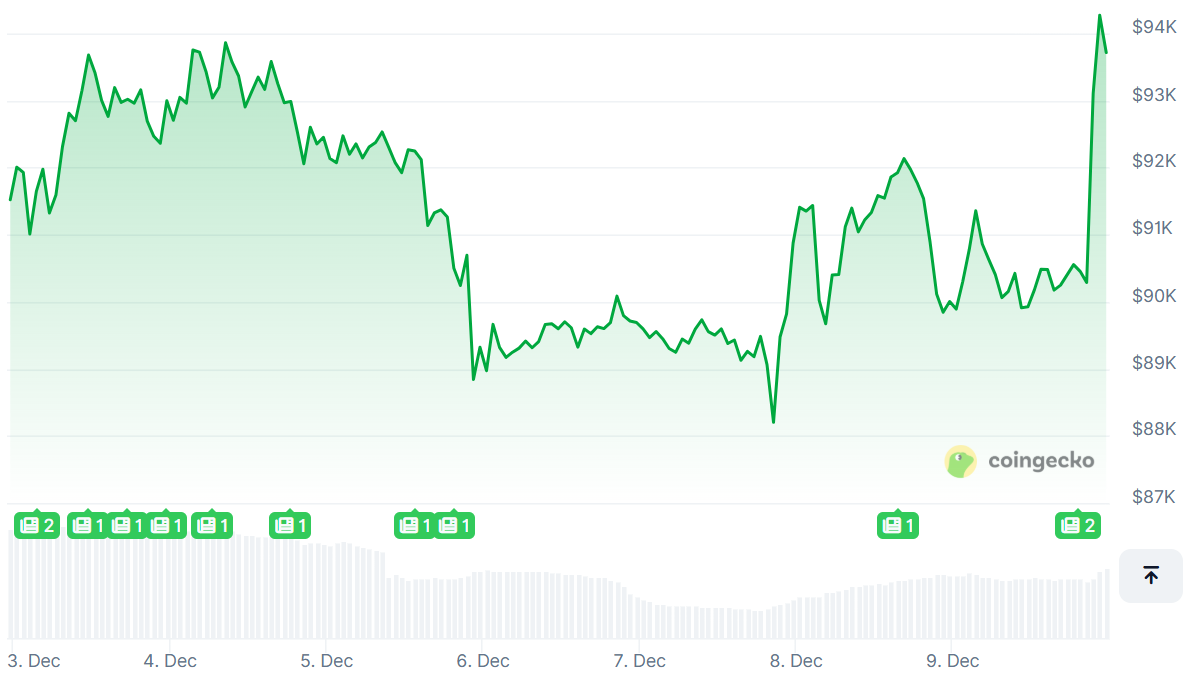 Source: CoinGecko
While the Fed is widely predicted to cut rates for the third time in a row and signal more easing next year, other risks loom for cryptos.
One that has sparked a lot of online discussion is the idea that investors may confront a similar scenario to the one on August 5, 2024, when rising Japanese yields caused the yen carry trade to unwind.
Another worrying likely development is the large-scale selling by Japanese investors who want to return their money home.
In response to remarks made by BOJ Governor Kazuo Ueda suggesting that policymakers will assess the suitability of a rate hike at their meeting this month, the yield on Japan's two-year bonds briefly reached over 1%, the highest level in 17 years.
As a result of the comments, the demand for the yen rose, and leveraged traders sold off risk positions funded by yen carry bets, which have strengthened global risk assets in 2025.
Because of how quickly the Bitcoin market reacts to changes in liquidity, this had an instant effect.
The funding circumstances associated with foreign exchange markets can worsen negative volatility, which is especially concerning given Bitcoin's high leverage on offshore platforms.
In addition, the yield on Japan's 20-year government bonds has reached 2.947%, the highest level observed since 1998.
Japan may need to bring back hundreds of billions of dollars due to rising liabilities and interest rates.
If that happens, it may impact Bitcoin, Tether, and US Treasuries.
A stimulus plan for the Japanese economy, worth about 21.3 trillion yen ($136 billion), was adopted earlier last month by the lawmakers.
Both the spending and the BoJ's easing of regulation over the country's bond market are important parts of the economic policy of the newly elected Prime Minister Sanae Takaichi.
Interest among Japanese bondholders is low due to the spending plan.
According to data from the International Monetary Fund, Japan's government debt is currently higher than that of other wealthy nations, surpassing twice the size of its yearly GDP.
US debt, on the other hand, is close to twelve times GDP.
Experts indicate that if Japanese bond yields stay above 2.9%, a drop in Bitcoin's value by 5-8% may be expected.
A hefty 263% of GDP, or about $10.2 trillion in total, is the weight of Japan's debt.
Previously, interest rates remained at zero for a long time, which allowed them to maintain this.
Debt service costs are skyrocketing as a result of the Bank of Japan raising short-term rates to 0.5% and inflation staying above 2%.
At the current rate, Japan's interest payments may surge from $162 billion to $280 billion during the next decade.
That means interest payments on the national debt would consume about 38% of tax revenue. It has never been easy for any major nation to handle such a large debt.
Why Japan's Debt Matters
Japan's portfolio of US Treasuries exceeds $1.13 trillion, making it the leading foreign holder of American debt. When factoring in currency risk, however, US bonds are no longer viable due to the rise in Japanese bond yields.
As a result, domestic investors will start putting their money back into the Japanese market.
If expert bets are anything to go by, US borrowing costs could rise even if the Fed doesn't raise interest rates because as much as $500 billion could leave global markets in the next 18 months.
Then, Japan's mounting debt would no longer remain a domestic issue; it would hit global financial markets severely.
How Will Cryptos Be Impacted?
For many years now, investors have taken advantage of what is called a yen carry trade: borrow at cheap rates in the yen and invest in risk assets or the dollar for higher returns. But with Japanese yields surging, that trade seems to be dwindling.
Previously, investors have taken advantage of Japan's low-interest loans for a long time, investing around $1.2 trillion in stocks, cryptocurrencies, and other financial opportunities.
Now, potentially setting a precedent, Japan's decision to sell its US bonds could prompt other countries to do the same.
Bitcoin is likely to be hit hard in the event that bond prices in the US fall.
We have seen similar scenarios in the past; for example, in July 2024, the value of Bitcoin fell 18% to $53,000 due to a rate hike by the BOJ, wiping out roughly $3 billion from the crypto market.
Recently, Bitcoin fell from $92,000 to $83,832 after the BOJ hinted at a possible rate hike. That bolstered the yen, hastened the unwinding of carry trades, and triggered a surge of liquidations in the crypto market amid periods of low liquidity.
The $87,000 support level would be a potential downside target for Bitcoin if Japanese rates remain above 2.9%. However, there is some safety, perhaps limiting losses to 5-8%, thanks to Trump's positive stance on Bitcoin and crypto ETFs.
Still, if Japanese yields rise, it could lead to a significant downturn for crypto as investors may seek safer havens in global markets.
Challenges emerge for the US on the timing of the surge in Japanese bond yields, with the Fed's decision to ease quantitative tightening. As a significant creditor nation adjusts its capital distribution, the US Treasury faces the necessity of unprecedented issuance to address its $1.8 trillion deficits.
The current stance of central banks, characterized by a highly accommodating approach and unprecedentedly low interest rates, has proven beneficial for Bitcoin and various other digital currencies.
Liquidity Hit to Cryptos
Crypto markets will have less access to speculative capital if liquidity moves back to Japan.
There may be a stampede for safer assets if the global bond markets undergo major changes, according to experts. This could result in massive sell-offs of all risk-related investments as investors prioritize cash and liquidity.
The exact magnitude of the Japanese yen carry trade is difficult to pin down, but according to a number of Wall Street analysts and portfolio managers, the trade's macroeconomic impact as a whole has reduced.
Some also say that the idea of higher yields on Japanese government bonds could cause a global stock market crash once they reach a specific level appears pretty implausible.
Large Japanese investors like the Government Pension Investment Fund publish their asset-allocation plans a year in advance at least. So, the decision to sell off foreign holdings would likely be gradual, taking place over the course of several years.
Still, the risk from a liquidity cutback looms for cryptos from a further potential rise in Japanese yields.
Elsewhere
 Blockhead
 Blockhead
Blockhead
Blockhead
 Blockhead
Podcast
Licensed to Shill – Why Central Asia; Why Now? ft. Anthony Howe (GFTN)
This week, the Licensed to Shill panel dives into the dynamic world of Central Asia – a region rapidly emerging as a pivotal hub for trade and innovation. Anthony Howe from the Global Finance Technology Network (GFTN) joins the panel to explore the untapped potential of this region, particularly focusing on Georgia's strategic role in the middle corridor.
Tune in at blockcast.blockhead.co or on Spotify, Apple, Amazon Music, or any major podcast platform.

Blockhead is a media partner for Consensus Hong Kong 2026. Readers can save 20% on tickets using exclusive code BLOCKDESK at this link.
You May Also Like

Thailand and Iran have reached an agreement allowing Thai oil tankers to pass through the Strait of Hormuz.

Shanghai Artificial Intelligence Laboratory Launches SafeClaw Intelligent Agent Platform


