Ethereum has pushed above the $3,350 level, injecting fresh momentum into the market after weeks of uncertainty. Yet despite this breakout, overall sentiment remains clouded by fear, with many analysts still warning that the broader structure points toward a developing bear market. Traders now find themselves at a pivotal juncture: is this the beginning of a sustained recovery, or merely a temporary rally before further downside? Related Reading: Bitcoin Exchange Reserves Fall To Lowest Levels on Record: The Bullish Signal Most Traders Are Missing According to a new CryptoQuant report, one of the most revealing indicators right now is Ethereum’s funding rate behavior across major exchanges. Unlike the explosive funding spikes seen during the two major rallies earlier this year, the current move shows a remarkably restrained funding environment. During those earlier surges, funding rates climbed aggressively into overheated territory, signaling euphoric long leverage and speculative excess — conditions that closely preceded short-term market tops. This time, however, funding remains far more subdued. The absence of aggressive long positioning suggests that the current rally is not being driven by excessive leverage, which gives the move a different character compared to earlier spikes. Whether this signals healthier accumulation or simply a lack of conviction remains the core question as Ethereum approaches the next decisive phase. Muted Funding Rates Highlight a Cautious But Potentially Constructive Rally The CryptoQuant report highlights that, unlike previous explosive rallies, Ethereum’s current funding rates remain unusually low, even after its sharp recovery from the $2.8K region. This subdued funding environment signals that the derivatives market is not yet saturated with speculative long positions. Buyers are stepping in, but modest leverage drives this move compared to past phases dominated by aggressive traders. Consequently, spot accumulation drives the current advance more than overheated futures activity. This difference carries important implications. Without a surge in speculative demand, Ethereum may struggle to ignite the kind of full bullish continuation leg seen in earlier breakout cycles. Historically, strong uptrends have required funding rates to expand meaningfully as traders chase price, forcing shorts to cover and fueling upward momentum. That behavior has not yet emerged in the current structure. However, this muted landscape is not inherently bearish. Instead, it reflects a recovering market, not an overextended one. This leaves Ethereum with room to climb further — if demand strengthens. At the same time, the lack of leverage means the rally remains vulnerable; strong resistance rejections could quickly weaken momentum unless fresh buyers step in. Related Reading: Ethereum Sees Largest Binance Inflow Since 2023 – Warning Sign? Testing Key Resistance as Momentum Builds Ethereum’s daily chart shows a notable shift in momentum as the price pushes toward $3,320, extending its rebound from the sub-$2,800 lows. This recovery phase has been steady rather than explosive, reflecting a market that is stabilizing but still facing key overhead challenges. The first major test is the 200-day moving average (red line), which ETH is now approaching after several weeks of trading below it. Historically, reclaiming this level has marked the transition from corrective phases into renewed bullish cycles, but a clean breakout is far from guaranteed. Related Reading: Smart Whales Align: Top Performers Go All-In On Ethereum Long Positions With Over $425M in Exposure The structure of the recent move highlights improving buyer confidence: ETH has formed a series of higher lows, indicating accumulation after the capitulation-like November drop. Although buyers are active, the relatively subdued volume profile suggests they lack broad-based conviction. A stronger influx of volume must flip the trend decisively bullish. The 50-day and 100-day moving averages remain above the current price and are both aligned downward, reinforcing that ETH is still technically in a broader downtrend. For momentum to extend, Ethereum must break above the $3,350–$3,400 resistance zone, where prior support turned into resistance. Featured image from ChatGPT, chart from TradingView.comEthereum has pushed above the $3,350 level, injecting fresh momentum into the market after weeks of uncertainty. Yet despite this breakout, overall sentiment remains clouded by fear, with many analysts still warning that the broader structure points toward a developing bear market. Traders now find themselves at a pivotal juncture: is this the beginning of a sustained recovery, or merely a temporary rally before further downside? Related Reading: Bitcoin Exchange Reserves Fall To Lowest Levels on Record: The Bullish Signal Most Traders Are Missing According to a new CryptoQuant report, one of the most revealing indicators right now is Ethereum’s funding rate behavior across major exchanges. Unlike the explosive funding spikes seen during the two major rallies earlier this year, the current move shows a remarkably restrained funding environment. During those earlier surges, funding rates climbed aggressively into overheated territory, signaling euphoric long leverage and speculative excess — conditions that closely preceded short-term market tops. This time, however, funding remains far more subdued. The absence of aggressive long positioning suggests that the current rally is not being driven by excessive leverage, which gives the move a different character compared to earlier spikes. Whether this signals healthier accumulation or simply a lack of conviction remains the core question as Ethereum approaches the next decisive phase. Muted Funding Rates Highlight a Cautious But Potentially Constructive Rally The CryptoQuant report highlights that, unlike previous explosive rallies, Ethereum’s current funding rates remain unusually low, even after its sharp recovery from the $2.8K region. This subdued funding environment signals that the derivatives market is not yet saturated with speculative long positions. Buyers are stepping in, but modest leverage drives this move compared to past phases dominated by aggressive traders. Consequently, spot accumulation drives the current advance more than overheated futures activity. This difference carries important implications. Without a surge in speculative demand, Ethereum may struggle to ignite the kind of full bullish continuation leg seen in earlier breakout cycles. Historically, strong uptrends have required funding rates to expand meaningfully as traders chase price, forcing shorts to cover and fueling upward momentum. That behavior has not yet emerged in the current structure. However, this muted landscape is not inherently bearish. Instead, it reflects a recovering market, not an overextended one. This leaves Ethereum with room to climb further — if demand strengthens. At the same time, the lack of leverage means the rally remains vulnerable; strong resistance rejections could quickly weaken momentum unless fresh buyers step in. Related Reading: Ethereum Sees Largest Binance Inflow Since 2023 – Warning Sign? Testing Key Resistance as Momentum Builds Ethereum’s daily chart shows a notable shift in momentum as the price pushes toward $3,320, extending its rebound from the sub-$2,800 lows. This recovery phase has been steady rather than explosive, reflecting a market that is stabilizing but still facing key overhead challenges. The first major test is the 200-day moving average (red line), which ETH is now approaching after several weeks of trading below it. Historically, reclaiming this level has marked the transition from corrective phases into renewed bullish cycles, but a clean breakout is far from guaranteed. Related Reading: Smart Whales Align: Top Performers Go All-In On Ethereum Long Positions With Over $425M in Exposure The structure of the recent move highlights improving buyer confidence: ETH has formed a series of higher lows, indicating accumulation after the capitulation-like November drop. Although buyers are active, the relatively subdued volume profile suggests they lack broad-based conviction. A stronger influx of volume must flip the trend decisively bullish. The 50-day and 100-day moving averages remain above the current price and are both aligned downward, reinforcing that ETH is still technically in a broader downtrend. For momentum to extend, Ethereum must break above the $3,350–$3,400 resistance zone, where prior support turned into resistance. Featured image from ChatGPT, chart from TradingView.com

Why Ethereum’s Rally Isn’t Overheated – And Where Demand Must Grow Next

2025/12/11 06:00
3 min read
For feedback or concerns regarding this content, please contact us at crypto.news@mexc.com

Ethereum has pushed above the $3,350 level, injecting fresh momentum into the market after weeks of uncertainty. Yet despite this breakout, overall sentiment remains clouded by fear, with many analysts still warning that the broader structure points toward a developing bear market. Traders now find themselves at a pivotal juncture: is this the beginning of a sustained recovery, or merely a temporary rally before further downside?

According to a new CryptoQuant report, one of the most revealing indicators right now is Ethereum’s funding rate behavior across major exchanges. Unlike the explosive funding spikes seen during the two major rallies earlier this year, the current move shows a remarkably restrained funding environment. During those earlier surges, funding rates climbed aggressively into overheated territory, signaling euphoric long leverage and speculative excess — conditions that closely preceded short-term market tops.

This time, however, funding remains far more subdued. The absence of aggressive long positioning suggests that the current rally is not being driven by excessive leverage, which gives the move a different character compared to earlier spikes. Whether this signals healthier accumulation or simply a lack of conviction remains the core question as Ethereum approaches the next decisive phase.

Muted Funding Rates Highlight a Cautious But Potentially Constructive Rally

The CryptoQuant report highlights that, unlike previous explosive rallies, Ethereum’s current funding rates remain unusually low, even after its sharp recovery from the $2.8K region. This subdued funding environment signals that the derivatives market is not yet saturated with speculative long positions.

Buyers are stepping in, but modest leverage drives this move compared to past phases dominated by aggressive traders. Consequently, spot accumulation drives the current advance more than overheated futures activity.

Ethereum Funding Rates | Source: CryptoQuant

This difference carries important implications. Without a surge in speculative demand, Ethereum may struggle to ignite the kind of full bullish continuation leg seen in earlier breakout cycles. Historically, strong uptrends have required funding rates to expand meaningfully as traders chase price, forcing shorts to cover and fueling upward momentum. That behavior has not yet emerged in the current structure.

However, this muted landscape is not inherently bearish. Instead, it reflects a recovering market, not an overextended one. This leaves Ethereum with room to climb further — if demand strengthens. At the same time, the lack of leverage means the rally remains vulnerable; strong resistance rejections could quickly weaken momentum unless fresh buyers step in.

Testing Key Resistance as Momentum Builds

Ethereum’s daily chart shows a notable shift in momentum as the price pushes toward $3,320, extending its rebound from the sub-$2,800 lows. This recovery phase has been steady rather than explosive, reflecting a market that is stabilizing but still facing key overhead challenges.
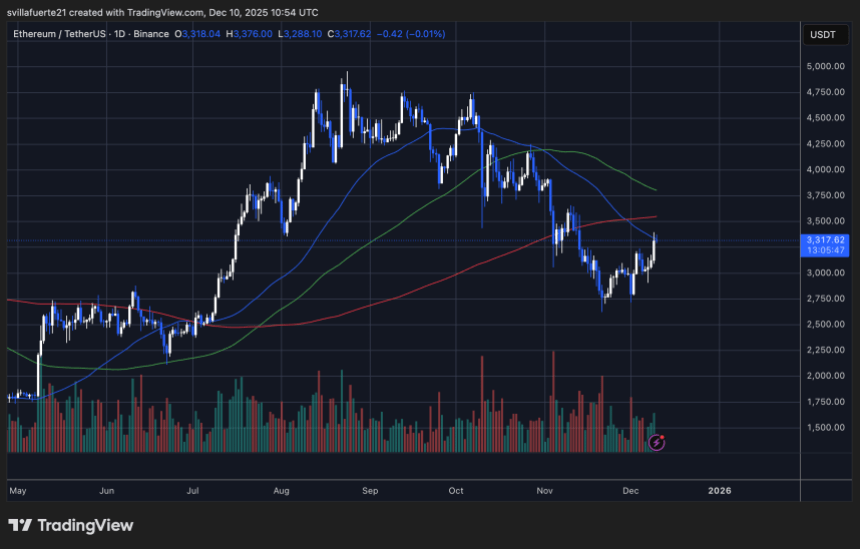
ETH testing critical resistance level | Source: ETHUSDT chart on TradingView

The first major test is the 200-day moving average (red line), which ETH is now approaching after several weeks of trading below it. Historically, reclaiming this level has marked the transition from corrective phases into renewed bullish cycles, but a clean breakout is far from guaranteed.

The structure of the recent move highlights improving buyer confidence: ETH has formed a series of higher lows, indicating accumulation after the capitulation-like November drop. Although buyers are active, the relatively subdued volume profile suggests they lack broad-based conviction. A stronger influx of volume must flip the trend decisively bullish.

The 50-day and 100-day moving averages remain above the current price and are both aligned downward, reinforcing that ETH is still technically in a broader downtrend. For momentum to extend, Ethereum must break above the $3,350–$3,400 resistance zone, where prior support turned into resistance.

Featured image from ChatGPT, chart from TradingView.com

Market Opportunity
Threshold Logo
Threshold Price(T)
$0.006488
$0.006488$0.006488
-0.67%
USD
Threshold (T) Live Price Chart
Disclaimer: The articles reposted on this site are sourced from public platforms and are provided for informational purposes only. They do not necessarily reflect the views of MEXC. All rights remain with the original authors. If you believe any content infringes on third-party rights, please contact crypto.news@mexc.com for removal. MEXC makes no guarantees regarding the accuracy, completeness, or timeliness of the content and is not responsible for any actions taken based on the information provided. The content does not constitute financial, legal, or other professional advice, nor should it be considered a recommendation or endorsement by MEXC.

You May Also Like

Shiba Inu Leader Breaks Silence on $2.4M Shibarium Exploit, Confirms Active Recovery

Shiba Inu Leader Breaks Silence on $2.4M Shibarium Exploit, Confirms Active Recovery

The lead developer of Shiba Inu, Shytoshi Kusama, has publicly addressed the Shibarium bridge exploit that occurred recently, draining $2.4 million from the network. After days of speculation about his involvement in managing the crisis, the project leader broke his silence.Kusama emphasized that a special ”war room” has been set up to restore stolen finances and enhance network security. The statement is his first official words since the bridge compromise occurred.”Although I am focusing on AI initiatives to benefit all our tokens, I remain with the developers and leadership in the war room,” Kusama posted on social media platform X. He dismissed claims that he had distanced himself from the project as ”utterly preposterous.”The developer said that the reason behind his silence at first was strategic. Before he could make any statements publicly, he must have taken time to evaluate what he termed a complex and deep situation properly. Kusama also vowed to provide further updates in the official Shiba Inu channels as the team comes up with long-term solutions.Attack Details and Immediate ResponseAs highlighted in our previous article, targeted Shibarium's bridge infrastructure through a sophisticated attack vector. Hackers gained unauthorized access to validator signing keys, compromising the network's security framework.The hackers executed a flash loan to acquire 4.6 million BONE ShibaSwap tokens. The validator power on the network was majority held by them after this purchase. They were able to transfer assets out of Shibarium with this control.The response of Shibarium developers was timely to limit the breach. They instantly halted all validator functions in order to avoid additional exploitation. The team proceeded to deposit the assets under staking in a multisig hardware wallet that is secure.External security companies were involved in the investigation effort. Hexens, Seal 911, and PeckShield are collaborating with internal developers to examine the attack and discover vulnerabilities.The project's key concerns are network stability and the protection of user funds, as underlined by the lead developer, Dhairya. The team is working around the clock to restore normal operations.In an effort to recover the funds, Shiba Inu has offered a bounty worth 5 Ether ($23,000) to the hackers. The bounty offer includes a 30-day deadline with decreasing rewards after seven days.Market Impact and Recovery IncentivesThe exploit caused serious volatility in the marketplace of Shiba Inu ecosystem tokens. SHIB dropped about 6% after the news of the attack. However, The token has bounced back and is currently trading at around $0.00001298 at the time of writing.SHIB Price Source CoinMarketCap
Share
Coinstats2025/09/18 02:25
‘Gold Pillars Crumbling?’ Strategist Questions Durability of Gold’s Geopolitical Bid

‘Gold Pillars Crumbling?’ Strategist Questions Durability of Gold’s Geopolitical Bid

Gold’s geopolitical premium may be fading as crude oil and silver eye powerful upside, with shifting global tensions and market volatility poised to redraw the
Share
Coinstats2026/03/04 10:30
Headwind Helps Best Wallet Token

Headwind Helps Best Wallet Token

The post Headwind Helps Best Wallet Token appeared on BitcoinEthereumNews.com. Google has announced the launch of a new open-source protocol called Agent Payments Protocol (AP2) in partnership with Coinbase, the Ethereum Foundation, and 60 other organizations. This allows AI agents to make payments on behalf of users using various methods such as real-time bank transfers, credit and debit cards, and, most importantly, stablecoins. Let’s explore in detail what this could mean for the broader cryptocurrency markets, and also highlight a presale crypto (Best Wallet Token) that could explode as a result of this development. Google’s Push for Stablecoins Agent Payments Protocol (AP2) uses digital contracts known as ‘Intent Mandates’ and ‘Verifiable Credentials’ to ensure that AI agents undertake only those payments authorized by the user. Mandates, by the way, are cryptographically signed, tamper-proof digital contracts that act as verifiable proof of a user’s instruction. For example, let’s say you instruct an AI agent to never spend more than $200 in a single transaction. This instruction is written into an Intent Mandate, which serves as a digital contract. Now, whenever the AI agent tries to make a payment, it must present this mandate as proof of authorization, which will then be verified via the AP2 protocol. Alongside this, Google has also launched the A2A x402 extension to accelerate support for the Web3 ecosystem. This production-ready solution enables agent-based crypto payments and will help reshape the growth of cryptocurrency integration within the AP2 protocol. Google’s inclusion of stablecoins in AP2 is a massive vote of confidence in dollar-pegged cryptocurrencies and a huge step toward making them a mainstream payment option. This widens stablecoin usage beyond trading and speculation, positioning them at the center of the consumption economy. The recent enactment of the GENIUS Act in the U.S. gives stablecoins more structure and legal support. Imagine paying for things like data crawls, per-task…
Share
BitcoinEthereumNews2025/09/18 01:27






