

Bitcoin Is Neither In A Bull Nor Bear Market: Expert Explains The Setup
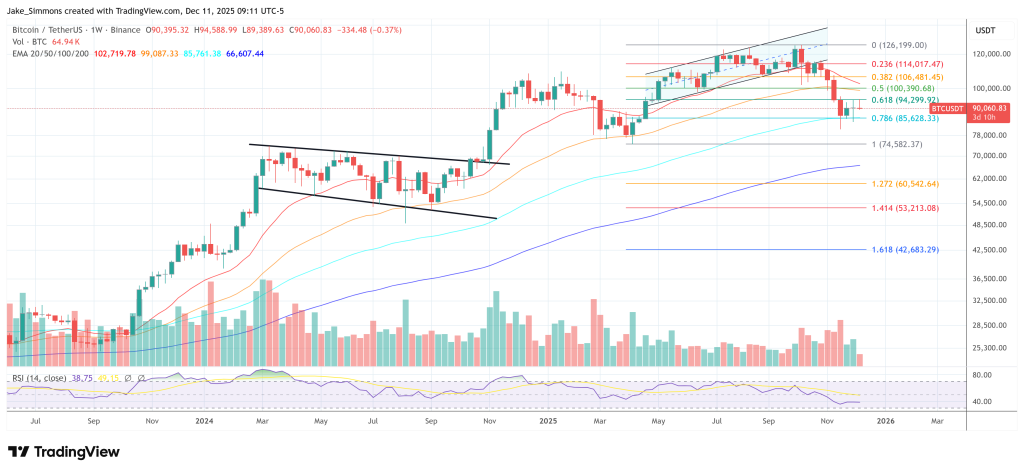
Bitcoin is trading in a world where headlines still scream “bull” or “bear” while the underlying structure quietly refuses to play along. After spiking to an all-time high in the $124,000–$126,000 zone in early October and then shedding roughly a third of its value into November, BTC now sits in the low-$90,000s, still dominant but clearly winded.
Into that confusion steps pseudonymous renowned crypto industry veteran plur daddy (@plur_daddy) who suggests the market may be in neither regime at all. “Because of the 4 year cycle, all crypto market participants are primed to view the market as either in a bull or bear phase,” he wrote on X. “What if, as a part of the market maturing, we are simply in an extended consolidation window where overhead supply is being absorbed?”
It is a simple framing shift with fairly big implications. He points to gold, which “chopped between $1,650–2,050 from April 2020 to March 2024,” and argues it is “logical to assume that as BTC evolves, it will exhibit more gold-like behaviors.” In other words: not dead, not euphoric, just… stuck in a fat, liquidity-soaked range where supply changes hands from weak to strong for longer than traders raised on clean halving cycles are emotionally prepared to tolerate.
The range dynamics are already visible at the top end. According to plur, “sellers emerged aggressively whenever price entered the $120k range.” He notes there are “strong arguments” those sellers were driven by the four-year cycle meme, but “equally good arguments” they were reacting to more prosaic considerations: age, price, liquidity, thesis change, and “emerging tail risks.” If BTC revisits that zone, he thinks it is “rational for people to front run that, which helps reinforce the range.” Classic reflexivity: people remembering the last top create the next one.
On the downside, he is not in the doom camp. “This also dovetails with my intuitive feeling that the lows may be in, or at the least not significantly lower than what we have seen, but upside also being capped,” he wrote, adding that liquidity conditions are “poised to moderately improve,” creating room for a bounce – just not necessarily a new regime. Or as he put it with some restraint, he’d “be cautious about betting on regime change.”
Bitcoin Market Puzzled: QE Or Not QE?
That “moderate improvement” is not theoretical. Yesterday’s FOMC meeting delivered a 25-basis-point rate cut, taking the Fed funds target to 3.50–3.75%, alongside a surprise announcement: roughly $40 billion a month in “reserve management purchases” (RMPs) of short-dated Treasuries, starting December 12 and guided to remain elevated for several months.
The official line is that this is a technical step to keep reserves “ample” and repo markets functioning, not a new round of QE.
Macro voices on X are, unsurprisingly, not unified on that distinction. Plur Daddy added via X: “This is different from QE because the main way that QE works is through pulling duration out of the market, forcing market participants to move up the risk curve. However, they snuck in there that they may buy up to 3 year treasury notes, which means some duration will be getting taken out. This is more bullish than expected, and helps bridge market liquidity into the new year.”
Miad Kasravi (@ZFXtrading) insists, “FED is NOT doing QE. Just expanding balance sheet via Money-market displacement,” arguing that when the Fed buys bills, the prior holder gets cash that “has to go somewhere” and “some of it seeps into credit, equities, crypto.”
LondonCryptoClub takes the gloves off. In his view, the Fed is “basically going to print money to keep funding this deficit for as long and as large as needed,” adding that “the debasement trade is on autopilot mode.” He backs Lyn Alden’s earlier remark that “it’s money printing. Whether it’s QE or not is more semantics. Fed won’t call it QE since it’s not duration and it’s not for economic stimulus.”
Peter Schiff, predictably but not entirely irrationally, commented via X: “QE by any other name is still inflation. The Fed just announced it will be buying T-bills “on an ongoing basis.” Given that long-term rates will rise on this inflationary policy shift, it won’t be long before the Fed expands and extends QE5 to longer-dated maturities. Got gold?”
So The Takeaway Is?
As Plur notes, these operations expand bank reserves and ease repo stress; the Fed will primarily buy T-bills, but “they may buy up to 3 year treasury notes, which means some duration will be getting taken out.” That edges the program closer to “QE-lite” than pure plumbing. It is supportive for risk assets and it arrives precisely during the year-end liquidity doldrums, with further balance-sheet expansion mechanisms waiting in the wings.
For Bitcoin, the uncomfortable answer right now is that both things can be true: the “debasement trade” is structurally alive, while price action behaves like a large, semi-institutional asset digesting a brutal rally and a fresh macro shock. Another six to eighteen months of rangebound churn, as plur suggests, “wouldn’t be strange at all.” Whether you label that bull, bear, or just purgatory is mostly a narrative choice. Markets, frankly, will trade it the same either way.
At press time, BTC traded at $90,060.


You May Also Like

Rumen Radev leads Bulgaria’s parliamentary election, coalition talks crucial

VP warns vs impersonation scam




