Connecticut Governor Ned Lamont has officially signed into law a comprehensive “Bitcoin Reserve Ban” that prohibits the state from accepting, holding, or investing in digital asset. The legislation, known as H.B. 7082, passed unanimously through both the state House of Representatives and Senate without a single opposing vote. Source: cga.ct.gov The new law explicitly bars Connecticut and its political subdivisions from accepting virtual currency as payment or establishing any form of digital asset reserve . This positions Connecticut as one of the most restrictive states regarding cryptocurrency adoption, contrasting sharply with the growing trend of Bitcoin reserve legislation across the United States. The timing appears particularly significant, as 26 states have introduced 47 Bitcoin reserve bills, with Texas, New Hampshire, and Arizona already having approved state-level Bitcoin reserve frameworks. Connecticut’s decision effectively removes it from the national conversation around strategic crypto adoption for public treasuries. The legislation extends beyond investment restrictions to comprehensive regulations governing the transmission of money. Crypto businesses must now provide extensive disclosures about material risks, including warnings about fraud potential, market volatility, and the irreversible nature of transactions. Additional protections require parental verification for users under 18 years old. 🚨 NEW: Connecticut Governor Ned Lamont officially signed into law the state's 'Bitcoin Reserve Ban' today. Connecticut is now prohibited from accepting, holding, or investing in digital assets. https://t.co/vIXIkprdHI — Bitcoin Laws (@Bitcoin_Laws) July 1, 2025 States Rally Around Bitcoin Adoption Despite Federal Uncertainty Crypto adoption at the state level is aggressively growing and starkly contrasts with this new Connecticut move. Texas leads the movement with Governor Greg Abbott signing Senate Bill 21 , establishing America’s first state-funded Bitcoin reserve entirely separate from the state treasury. ✅ Texas has officially joined the small but growing list of U.S. states moving toward on-chain finance, passing a bill that protects Bitcoin reserves. #Texas #Bitcoin https://t.co/kBh6nFgROs — Cryptonews.com (@cryptonews) June 22, 2025 Texas Comptroller Glenn Hegar will oversee the fund, with companion legislation HB 4488 protecting reserves from routine fund reallocations. Senator Charles Schwertner led the initiative, arguing, “ the state of Texas should have the option of evaluating the best performing asset over the last 10 years. “ New Hampshire also achieved a historic milestone by becoming the first state to pass laws allowing public funds to be invested in Bitcoin reserves . Governor Kelly Ayotte signed legislation permitting up to a 5% allocation in digital assets with a market capitalization exceeding $500 billion, effectively targeting Bitcoin exclusively. California is also not left out with its progressive adoption through Assembly Bill 1180 , which unanimously passed with 78 Assembly Members supporting pilot programs for digital asset fee payments. The Department of Financial Protection and Innovation will create frameworks for cryptocurrency-based government transactions by 2025. Arizona, however, presents a complex picture, with Governor Katie Hobbs vetoing comprehensive Bitcoin reserve legislation while simultaneously signing HB 2749, which creates frameworks for managing unclaimed digital assets. The state maintains multiple active bills, including revised HB2324, which recently passed Senate reconsideration. Corporate adoption accelerates regardless of state-level policies, with 252 entities now holding Bitcoin, representing approximately 16.57% of the total supply. Source: BitcoinTreasuries Strategy maintains the largest position at 597,325 BTC worth $63.93 billion, with the most recent purchase being 4,980 Bitcoin for $531.1 million, at an average price of approximately $106,801 per bitcoin. Source: SaylorTracker Regulatory Patchwork Creates Compliance Challenges Notably, the new Connecticut law mandates extensive compliance measures, including customer identification protocols, transaction receipt requirements, and robust risk disclosure frameworks that exceed federal minimums. Money transmission licensees must maintain virtual currency holdings equal to customer obligations while prohibiting unauthorized use of controlled assets. The legislation establishes that virtual currency held by licensees becomes property interests of claimants, creating additional legal protections for consumers. Several states have abandoned their efforts to reserve Bitcoin, creating an inconsistent national landscape. Florida withdrew House Bill 487 and Senate Bill 550 during legislative sessions, joining Wyoming , South Dakota, North Dakota , Pennsylvania, Montana, and Oklahoma in failed adoption attempts. Positively, some other states are still in the process. For instance, Michigan introduced House Bill 4087 , which allows for a 10% treasury allocation to cryptocurrencies. 🇺🇸 The Michigan House Bill was introduced by Representatives Bryan Posthumus and Ron Robinson to push for a strategic Bitcoin reserve. #BitcoinReserve #Michigan https://t.co/fXJSPOQ6gs — Cryptonews.com (@cryptonews) February 14, 2025 At the same time, Ohio advanced Senate Bill 57 , which creates exclusive Bitcoin reserve funds with mandatory five-year holding periods. Similarly, North Carolina also passed legislation permitting a 5% investment allocation pending validation by third-party oversight. Additionally, West Virginia’s Inflation Protection Act proposes a 10% treasury allocation to digital assets with a market capitalization exceeding $750 billion, effectively limiting investments to Bitcoin and select stablecoins. The legislation positions precious metals and cryptocurrencies as inflation hedges against government spending deficits. Oklahoma has also approved the Strategic Bitcoin Reserve Act through the House Committee with a 12-2 vote, allowing for a 10% public fund allocation to digital assets that meet market capitalization thresholds. The state previously passed Bitcoin Rights legislation protecting self-custody rights and transaction freedoms.Connecticut Governor Ned Lamont has officially signed into law a comprehensive “Bitcoin Reserve Ban” that prohibits the state from accepting, holding, or investing in digital asset. The legislation, known as H.B. 7082, passed unanimously through both the state House of Representatives and Senate without a single opposing vote. Source: cga.ct.gov The new law explicitly bars Connecticut and its political subdivisions from accepting virtual currency as payment or establishing any form of digital asset reserve . This positions Connecticut as one of the most restrictive states regarding cryptocurrency adoption, contrasting sharply with the growing trend of Bitcoin reserve legislation across the United States. The timing appears particularly significant, as 26 states have introduced 47 Bitcoin reserve bills, with Texas, New Hampshire, and Arizona already having approved state-level Bitcoin reserve frameworks. Connecticut’s decision effectively removes it from the national conversation around strategic crypto adoption for public treasuries. The legislation extends beyond investment restrictions to comprehensive regulations governing the transmission of money. Crypto businesses must now provide extensive disclosures about material risks, including warnings about fraud potential, market volatility, and the irreversible nature of transactions. Additional protections require parental verification for users under 18 years old. 🚨 NEW: Connecticut Governor Ned Lamont officially signed into law the state's 'Bitcoin Reserve Ban' today. Connecticut is now prohibited from accepting, holding, or investing in digital assets. https://t.co/vIXIkprdHI — Bitcoin Laws (@Bitcoin_Laws) July 1, 2025 States Rally Around Bitcoin Adoption Despite Federal Uncertainty Crypto adoption at the state level is aggressively growing and starkly contrasts with this new Connecticut move. Texas leads the movement with Governor Greg Abbott signing Senate Bill 21 , establishing America’s first state-funded Bitcoin reserve entirely separate from the state treasury. ✅ Texas has officially joined the small but growing list of U.S. states moving toward on-chain finance, passing a bill that protects Bitcoin reserves. #Texas #Bitcoin https://t.co/kBh6nFgROs — Cryptonews.com (@cryptonews) June 22, 2025 Texas Comptroller Glenn Hegar will oversee the fund, with companion legislation HB 4488 protecting reserves from routine fund reallocations. Senator Charles Schwertner led the initiative, arguing, “ the state of Texas should have the option of evaluating the best performing asset over the last 10 years. “ New Hampshire also achieved a historic milestone by becoming the first state to pass laws allowing public funds to be invested in Bitcoin reserves . Governor Kelly Ayotte signed legislation permitting up to a 5% allocation in digital assets with a market capitalization exceeding $500 billion, effectively targeting Bitcoin exclusively. California is also not left out with its progressive adoption through Assembly Bill 1180 , which unanimously passed with 78 Assembly Members supporting pilot programs for digital asset fee payments. The Department of Financial Protection and Innovation will create frameworks for cryptocurrency-based government transactions by 2025. Arizona, however, presents a complex picture, with Governor Katie Hobbs vetoing comprehensive Bitcoin reserve legislation while simultaneously signing HB 2749, which creates frameworks for managing unclaimed digital assets. The state maintains multiple active bills, including revised HB2324, which recently passed Senate reconsideration. Corporate adoption accelerates regardless of state-level policies, with 252 entities now holding Bitcoin, representing approximately 16.57% of the total supply. Source: BitcoinTreasuries Strategy maintains the largest position at 597,325 BTC worth $63.93 billion, with the most recent purchase being 4,980 Bitcoin for $531.1 million, at an average price of approximately $106,801 per bitcoin. Source: SaylorTracker Regulatory Patchwork Creates Compliance Challenges Notably, the new Connecticut law mandates extensive compliance measures, including customer identification protocols, transaction receipt requirements, and robust risk disclosure frameworks that exceed federal minimums. Money transmission licensees must maintain virtual currency holdings equal to customer obligations while prohibiting unauthorized use of controlled assets. The legislation establishes that virtual currency held by licensees becomes property interests of claimants, creating additional legal protections for consumers. Several states have abandoned their efforts to reserve Bitcoin, creating an inconsistent national landscape. Florida withdrew House Bill 487 and Senate Bill 550 during legislative sessions, joining Wyoming , South Dakota, North Dakota , Pennsylvania, Montana, and Oklahoma in failed adoption attempts. Positively, some other states are still in the process. For instance, Michigan introduced House Bill 4087 , which allows for a 10% treasury allocation to cryptocurrencies. 🇺🇸 The Michigan House Bill was introduced by Representatives Bryan Posthumus and Ron Robinson to push for a strategic Bitcoin reserve. #BitcoinReserve #Michigan https://t.co/fXJSPOQ6gs — Cryptonews.com (@cryptonews) February 14, 2025 At the same time, Ohio advanced Senate Bill 57 , which creates exclusive Bitcoin reserve funds with mandatory five-year holding periods. Similarly, North Carolina also passed legislation permitting a 5% investment allocation pending validation by third-party oversight. Additionally, West Virginia’s Inflation Protection Act proposes a 10% treasury allocation to digital assets with a market capitalization exceeding $750 billion, effectively limiting investments to Bitcoin and select stablecoins. The legislation positions precious metals and cryptocurrencies as inflation hedges against government spending deficits. Oklahoma has also approved the Strategic Bitcoin Reserve Act through the House Committee with a 12-2 vote, allowing for a 10% public fund allocation to digital assets that meet market capitalization thresholds. The state previously passed Bitcoin Rights legislation protecting self-custody rights and transaction freedoms.

Connecticut Goes Anti-Crypto as Governor Lamont Signs Bill Banning State Digital Asset Investments

2025/07/01 20:11
4 min read

Connecticut Governor Ned Lamont has officially signed into law a comprehensive “Bitcoin Reserve Ban” that prohibits the state from accepting, holding, or investing in digital asset.

The legislation, known as H.B. 7082, passed unanimously through both the state House of Representatives and Senate without a single opposing vote.
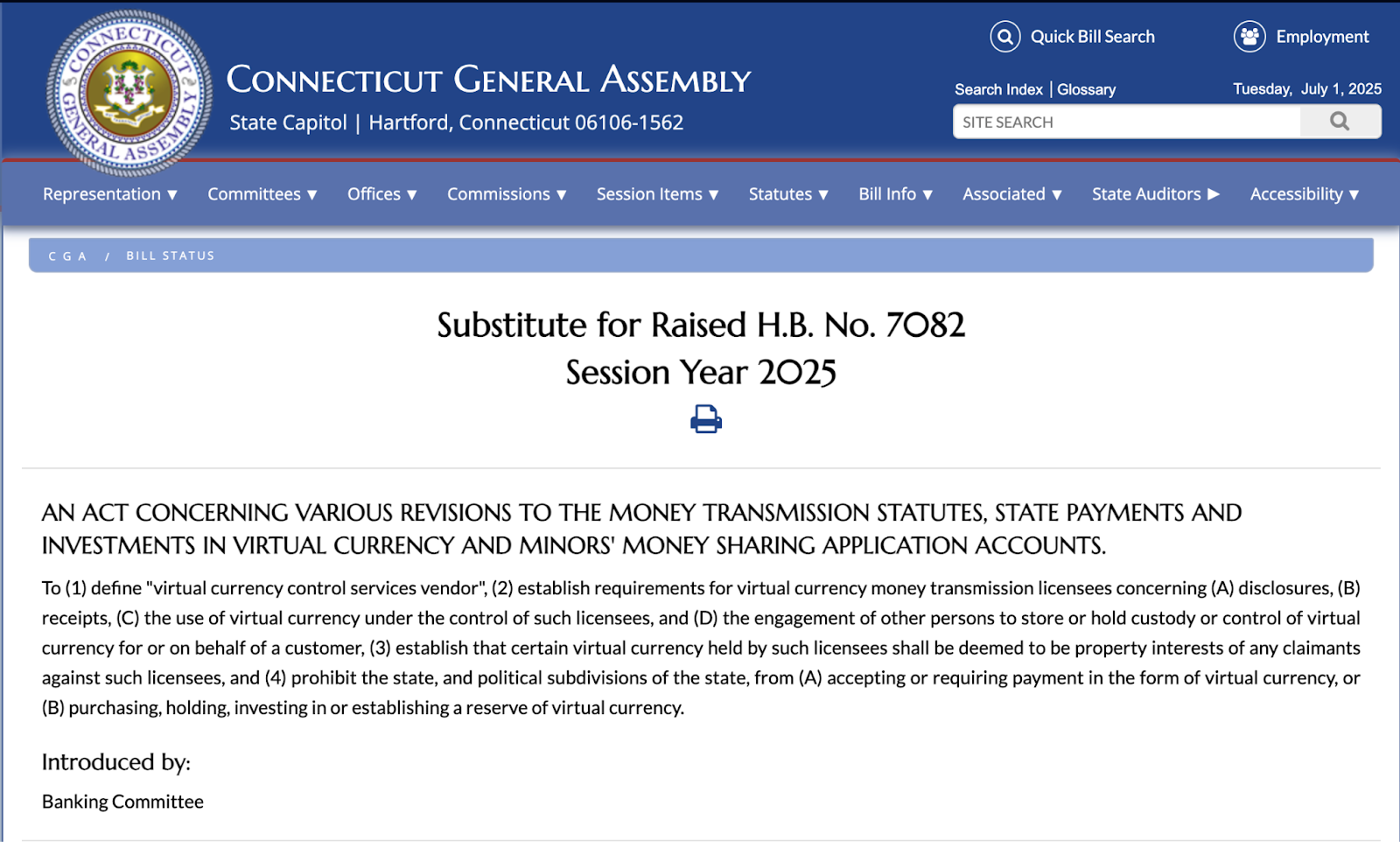
Connecticut Goes Anti-Crypto as Governor Lamont Signs Bill Banning State Digital Asset InvestmentsSource: cga.ct.gov

The new law explicitly bars Connecticut and its political subdivisions from accepting virtual currency as payment or establishing any form of digital asset reserve.

This positions Connecticut as one of the most restrictive states regarding cryptocurrency adoption, contrasting sharply with the growing trend of Bitcoin reserve legislation across the United States.

The timing appears particularly significant, as 26 states have introduced 47 Bitcoin reserve bills, with Texas, New Hampshire, and Arizona already having approved state-level Bitcoin reserve frameworks.

Connecticut’s decision effectively removes it from the national conversation around strategic crypto adoption for public treasuries.

The legislation extends beyond investment restrictions to comprehensive regulations governing the transmission of money.

Crypto businesses must now provide extensive disclosures about material risks, including warnings about fraud potential, market volatility, and the irreversible nature of transactions.

Additional protections require parental verification for users under 18 years old.

States Rally Around Bitcoin Adoption Despite Federal Uncertainty

Crypto adoption at the state level is aggressively growing and starkly contrasts with this new Connecticut move.

Texas leads the movement with Governor Greg Abbott signing Senate Bill 21, establishing America’s first state-funded Bitcoin reserve entirely separate from the state treasury.

Texas Comptroller Glenn Hegar will oversee the fund, with companion legislation HB 4488 protecting reserves from routine fund reallocations.

Senator Charles Schwertner led the initiative, arguing, “the state of Texas should have the option of evaluating the best performing asset over the last 10 years.

New Hampshire also achieved a historic milestone by becoming the first state to pass laws allowing public funds to be invested in Bitcoin reserves.

Governor Kelly Ayotte signed legislation permitting up to a 5% allocation in digital assets with a market capitalization exceeding $500 billion, effectively targeting Bitcoin exclusively.

California is also not left out with its progressive adoption through Assembly Bill 1180, which unanimously passed with 78 Assembly Members supporting pilot programs for digital asset fee payments.

The Department of Financial Protection and Innovation will create frameworks for cryptocurrency-based government transactions by 2025.

Arizona, however, presents a complex picture, with Governor Katie Hobbs vetoing comprehensive Bitcoin reserve legislation while simultaneously signing HB 2749, which creates frameworks for managing unclaimed digital assets.

The state maintains multiple active bills, including revised HB2324, which recently passed Senate reconsideration.

Corporate adoption accelerates regardless of state-level policies, with 252 entities now holding Bitcoin, representing approximately 16.57% of the total supply.

Connecticut Goes Anti-Crypto as Governor Lamont Signs Bill Banning State Digital Asset InvestmentsSource: BitcoinTreasuries

Strategy maintains the largest position at 597,325 BTC worth $63.93 billion, with the most recent purchase being 4,980 Bitcoin for $531.1 million, at an average price of approximately $106,801 per bitcoin.

Connecticut Goes Anti-Crypto as Governor Lamont Signs Bill Banning State Digital Asset InvestmentsSource: SaylorTracker

Regulatory Patchwork Creates Compliance Challenges

Notably, the new Connecticut law mandates extensive compliance measures, including customer identification protocols, transaction receipt requirements, and robust risk disclosure frameworks that exceed federal minimums.

Money transmission licensees must maintain virtual currency holdings equal to customer obligations while prohibiting unauthorized use of controlled assets.

The legislation establishes that virtual currency held by licensees becomes property interests of claimants, creating additional legal protections for consumers.

Several states have abandoned their efforts to reserve Bitcoin, creating an inconsistent national landscape.

Florida withdrew House Bill 487 and Senate Bill 550 during legislative sessions, joining Wyoming, South Dakota, North Dakota, Pennsylvania, Montana, and Oklahoma in failed adoption attempts.

Positively, some other states are still in the process. For instance, Michigan introduced House Bill 4087, which allows for a 10% treasury allocation to cryptocurrencies.

At the same time, Ohio advanced Senate Bill 57, which creates exclusive Bitcoin reserve funds with mandatory five-year holding periods.

Similarly, North Carolina also passed legislation permitting a 5% investment allocation pending validation by third-party oversight.

Additionally, West Virginia’s Inflation Protection Act proposes a 10% treasury allocation to digital assets with a market capitalization exceeding $750 billion, effectively limiting investments to Bitcoin and select stablecoins.

The legislation positions precious metals and cryptocurrencies as inflation hedges against government spending deficits.

Oklahoma has also approved the Strategic Bitcoin Reserve Act through the House Committee with a 12-2 vote, allowing for a 10% public fund allocation to digital assets that meet market capitalization thresholds.

The state previously passed Bitcoin Rights legislation protecting self-custody rights and transaction freedoms.


Market Opportunity
B Logo
B Price(B)
$0.14941
$0.14941$0.14941
-15.61%
USD
B (B) Live Price Chart
Disclaimer: The articles reposted on this site are sourced from public platforms and are provided for informational purposes only. They do not necessarily reflect the views of MEXC. All rights remain with the original authors. If you believe any content infringes on third-party rights, please contact service@support.mexc.com for removal. MEXC makes no guarantees regarding the accuracy, completeness, or timeliness of the content and is not responsible for any actions taken based on the information provided. The content does not constitute financial, legal, or other professional advice, nor should it be considered a recommendation or endorsement by MEXC.

You May Also Like

BFX Presale Raises $7.5M as Solana Holds $243 and Avalanche Eyes $1B Treasury — Best Cryptos to Buy in 2025

BFX Presale Raises $7.5M as Solana Holds $243 and Avalanche Eyes $1B Treasury — Best Cryptos to Buy in 2025

BFX presale hits $7.5M with tokens at $0.024 and 30% bonus code BLOCK30, while Solana holds $243 and Avalanche builds a $1B treasury to attract institutions.
Share
Blockchainreporter2025/09/18 01:07
Weekly Highlights | Gold, US Stocks, and Cryptocurrencies All Fall; Walsh and Epstein are the Celebrities of the Week.

Weekly Highlights | Gold, US Stocks, and Cryptocurrencies All Fall; Walsh and Epstein are the Celebrities of the Week.

PANews Editor's Note: PANews has selected the best content of the week to help you catch up on anything you might have missed over the weekend. Click on the title
Share
PANews2026/02/07 09:30
Michael Saylor Pushes Digital Capital Narrative At Bitcoin Treasuries Unconference

Michael Saylor Pushes Digital Capital Narrative At Bitcoin Treasuries Unconference

The post Michael Saylor Pushes Digital Capital Narrative At Bitcoin Treasuries Unconference appeared on BitcoinEthereumNews.com. The suitcoiners are in town.  From a low-key, circular podium in the middle of a lavish New York City event hall, Strategy executive chairman Michael Saylor took the mic and opened the Bitcoin Treasuries Unconference event. He joked awkwardly about the orange ties, dresses, caps and other merch to the (mostly male) audience of who’s-who in the bitcoin treasury company world.  Once he got onto the regular beat, it was much of the same: calm and relaxed, speaking freely and with confidence, his keynote was heavy on the metaphors and larger historical stories. Treasury companies are like Rockefeller’s Standard Oil in its early years, Michael Saylor said: We’ve just discovered crude oil and now we’re making sense of the myriad ways in which we can use it — the automobile revolution and jet fuel is still well ahead of us.  Established, trillion-dollar companies not using AI because of “security concerns” make them slow and stupid — just like companies and individuals rejecting digital assets now make them poor and weak.  “I’d like to think that we understood our business five years ago; we didn’t.”  We went from a defensive investment into bitcoin, Saylor said, to opportunistic, to strategic, and finally transformational; “only then did we realize that we were different.” Michael Saylor: You Come Into My Financial History House?! Jokes aside, Michael Saylor is very welcome to the warm waters of our financial past. He acquitted himself honorably by invoking the British Consol — though mispronouncing it, and misdating it to the 1780s; Pelham’s consolidation of debts happened in the 1750s and perpetual government debt existed well before then — and comparing it to the gold standard and the future of bitcoin. He’s right that Strategy’s STRC product in many ways imitates the consols; irredeemable, perpetual debt, issued at par, with…
Share
BitcoinEthereumNews2025/09/18 02:12



