The post Cardano (ADA) Price Jumps 8% Today as Whales Buy Return appeared first on Coinpedia Fintech News Cardano (ADA) has started 2026 on a positive note, risingThe post Cardano (ADA) Price Jumps 8% Today as Whales Buy Return appeared first on Coinpedia Fintech News Cardano (ADA) has started 2026 on a positive note, rising

Cardano (ADA) Price Jumps 8% Today as Whales Buy Return
Cardano Price Prediction: Will ADA Reclaim $0.50 and Open the Path Toward $1?

The post Cardano (ADA) Price Jumps 8% Today as Whales Buy Return appeared first on Coinpedia Fintech News

Cardano (ADA) has started 2026 on a positive note, rising nearly 8% today, moving above the $0.36 level and ranking among the day’s top altcoin gainers. This rise comes after a rough December, when ADA fell nearly 20%, leaving many investors cautious.

So, what’s driving Cardano’s price higher today?

CryptoQuant Data Shows Whale Buying

One of the clearest signals behind ADA’s rise comes from CryptoQuant data. Recent on-chain numbers show an increase in activity from large holders, often called whales. Both spot and futures data point to bigger orders entering the market.

When whales begin to buy again, it often signals growing confidence. According to CryptoQuant, market conditions are easing, and buy-side pressure is slowly increasing. This supports the idea that the current move is more than just a random bounce.

Beyond trading data, Cardano’s network is showing real signs of use. Transaction activity and wallet interactions have increased over recent days. This means users are actively using the blockchain, not just holding ADA.

Cardano DeFi TVL Shows Signs of Recovery

Another positive signal comes from Cardano’s DeFi ecosystem. According to DefiLlama, Cardano’s TVL increased by 4% in the last 24 hours, reaching about $178.9 million. This means more users are putting their funds into Cardano-based DeFi platforms.

When more money flows into DeFi, it usually shows growing trust in the network, which can also increase demand for the ADA token.

  • Also Read :
  •   Bitcoin 2025 Price Predictions: How Wrong Were Crypto’s Biggest Names?
  •   ,

Cardano Price Analysis

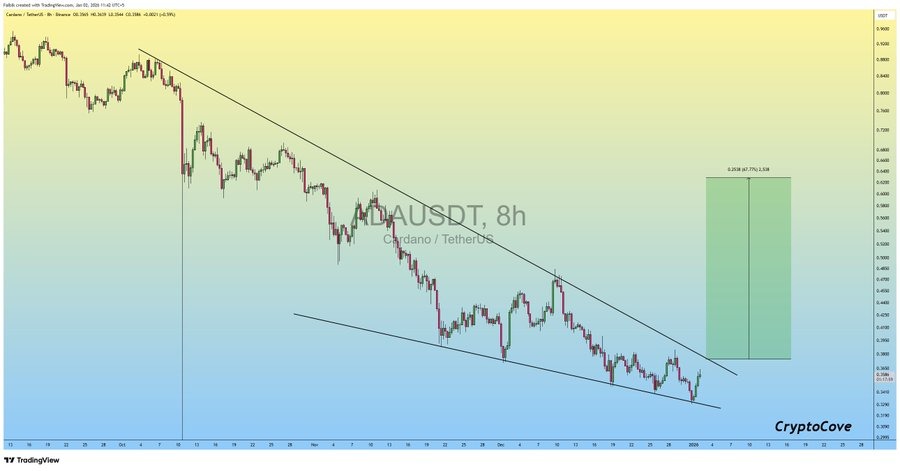
For several months, ADA has been moving inside a falling wedge pattern. This happens when the price keeps going down, but selling slowly becomes weaker. As the range gets tighter, it often means a big move is getting close.

Right now, ADA is holding near the $0.35 support level. This area is helping the price stay stable, and buyers are slowly stepping in, showing that selling pressure is easing.

Crypto trader Captain Faibik shared a chart showing ADA near the end of this falling wedge. He believes a breakout could happen if the price moves above the upper trendline.
CARDANO price chart

As long as ADA stays above support, the setup remains healthy. If the breakout happens, the price could move toward the $0.52–$0.55 zone, which would mean nearly a 50% rise from current levels.

Never Miss a Beat in the Crypto World!

Stay ahead with breaking news, expert analysis, and real-time updates on the latest trends in Bitcoin, altcoins, DeFi, NFTs, and more.

bell icon Subscribe to News

FAQs

Why is Cardano (ADA) attracting investor attention in early 2026?

Rising on-chain activity, improving market conditions, and renewed large-holder interest suggest stronger confidence in ADA’s short-term outlook.

What is Cardano’s (ADA) price prediction for 2026?

Cardano could trade between $2.75 and $3.25 in 2026 if market sentiment improves, adoption grows, and key support levels hold.

Is Cardano a good long-term investment?

Cardano is considered a long-term project due to its research-driven development, scalability upgrades, and focus on decentralization.

What will Cardano be worth in 2030?

By 2030, Cardano could be valued around $9 to $10 based on long-term growth, network usage, and sustained investor confidence.


Market Opportunity
Cardano Logo
Cardano Price(ADA)
$0.3846
$0.3846$0.3846
+3.47%
USD
Cardano (ADA) Live Price Chart
Disclaimer: The articles reposted on this site are sourced from public platforms and are provided for informational purposes only. They do not necessarily reflect the views of MEXC. All rights remain with the original authors. If you believe any content infringes on third-party rights, please contact service@support.mexc.com for removal. MEXC makes no guarantees regarding the accuracy, completeness, or timeliness of the content and is not responsible for any actions taken based on the information provided. The content does not constitute financial, legal, or other professional advice, nor should it be considered a recommendation or endorsement by MEXC.

You May Also Like

The Channel Factories We’ve Been Waiting For

The Channel Factories We’ve Been Waiting For

The post The Channel Factories We’ve Been Waiting For appeared on BitcoinEthereumNews.com. Visions of future technology are often prescient about the broad strokes while flubbing the details. The tablets in “2001: A Space Odyssey” do indeed look like iPads, but you never see the astronauts paying for subscriptions or wasting hours on Candy Crush.  Channel factories are one vision that arose early in the history of the Lightning Network to address some challenges that Lightning has faced from the beginning. Despite having grown to become Bitcoin’s most successful layer-2 scaling solution, with instant and low-fee payments, Lightning’s scale is limited by its reliance on payment channels. Although Lightning shifts most transactions off-chain, each payment channel still requires an on-chain transaction to open and (usually) another to close. As adoption grows, pressure on the blockchain grows with it. The need for a more scalable approach to managing channels is clear. Channel factories were supposed to meet this need, but where are they? In 2025, subnetworks are emerging that revive the impetus of channel factories with some new details that vastly increase their potential. They are natively interoperable with Lightning and achieve greater scale by allowing a group of participants to open a shared multisig UTXO and create multiple bilateral channels, which reduces the number of on-chain transactions and improves capital efficiency. Achieving greater scale by reducing complexity, Ark and Spark perform the same function as traditional channel factories with new designs and additional capabilities based on shared UTXOs.  Channel Factories 101 Channel factories have been around since the inception of Lightning. A factory is a multiparty contract where multiple users (not just two, as in a Dryja-Poon channel) cooperatively lock funds in a single multisig UTXO. They can open, close and update channels off-chain without updating the blockchain for each operation. Only when participants leave or the factory dissolves is an on-chain transaction…
Share
BitcoinEthereumNews2025/09/18 00:09
Sui Ecosystem Gains Spotlight as Taipei Builders Demo Day Highlights New DeFi Ideas

Sui Ecosystem Gains Spotlight as Taipei Builders Demo Day Highlights New DeFi Ideas

Sui Taipei Builders’ Demo Day brings developers, investors, and enthusiasts together to present blockchain projects. The Sui ecosystem will host the Taipei Builders
Share
LiveBitcoinNews2026/01/03 00:00
Stability World AI Makes AI Accessible and Ownable for People

Stability World AI Makes AI Accessible and Ownable for People

Stability World AI blends AI agents with blockchain incentives to promoting trust, accessibility, shared ownership of AI through user-driven governance.
Share
Blockchainreporter2026/01/03 00:00