Cardano Stabilizes Near $0.38 as Sellers Defend Descending Resistance Dip buying offers short-term relief, but broader bearish structure remains intact. ExchangeCardano Stabilizes Near $0.38 as Sellers Defend Descending Resistance Dip buying offers short-term relief, but broader bearish structure remains intact. Exchange

Cardano Price Prediction 2026–2030: Can ADA Hit $0.45 Soon?

2026/01/04 05:43
6 min read
For feedback or concerns regarding this content, please contact us at crypto.news@mexc.com
  • Cardano Stabilizes Near $0.38 as Sellers Defend Descending Resistance
  • Dip buying offers short-term relief, but broader bearish structure remains intact.
  • Exchange inflows and leverage buildup continue to cap upside momentum.

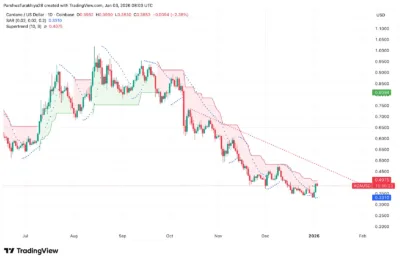
Cardano price today trades near $0.385, attempting to stabilize after another rejection below descending resistance. The move follows a sharp selloff earlier in the week that dragged ADA to fresh December lows before dip buyers stepped in near the $0.37 area. Despite the bounce, price remains pinned beneath resistance as persistent selling pressure prevents a sustained recovery.


Sellers continue to fade rallies, leaving ADA locked in a corrective phase rather than transitioning into a basing structure. Momentum remains muted as buyers struggle to reclaim key technical levels.


Also Read: XRP Price Prediction 2025–2029: Can XRP Break Above $2.00 Soon?


Cardano’s Base Holds, but the Trend Remains Intact

Cardano continues to respect the $0.37 support zone, an area that has attracted dip buyers following the recent selloff. This zone represents the last consistently defended level preventing a retest of December lows.


However, the broader trend has not improved. On the daily chart, ADA remains firmly below a descending trendline that has capped price since August. Each attempt to rally into this trendline has been met with renewed selling, reinforcing seller dominance.


The Supertrend remains bearish near $0.4075, while Parabolic SAR continues to print above price, confirming that downside pressure remains active despite short-term stabilization. Until ADA reclaims these levels, any upside move remains corrective rather than trend-forming.

ADA

Source: Tradingview

EMA Structure Highlights Heavy Overhead Supply

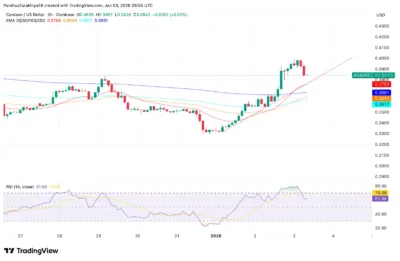
Lower-timeframe price action explains why ADA has struggled to build momentum. On the two-hour chart, ADA rebounded from the $0.33–$0.34 zone and briefly pushed toward $0.39, lifting price above short-term moving averages.


However, price stalled as it approached higher EMAs, with the 200 EMA continuing to act as resistance. RSI rolled over from near overbought levels, signaling fading upside strength rather than renewed trend participation.

ADA

Source: Tradingview

This structure suggests short-term relief rather than a trend shift. Buyers must reclaim and hold above key EMAs to shift momentum away from the current bearish bias.


Spot Netflows Reveal Ongoing Distribution

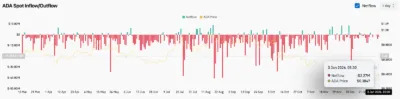
On-chain data continues to act as a headwind. ADA has recorded persistent net exchange inflows, including a -$2.27 million netflow reading on January 3. This pattern extends a broader trend of supply moving onto exchanges throughout Q4.


These inflows suggest that holders are using rebounds to distribute tokens back into the market. This steady sell-side activity has limited follow-through and kept price capped below resistance.

ADA

Source: Coinglass

The pattern remains consistent: rebounds stabilize price temporarily, but ongoing distribution prevents a sustained recovery.


Derivatives Data Shows Leverage Building

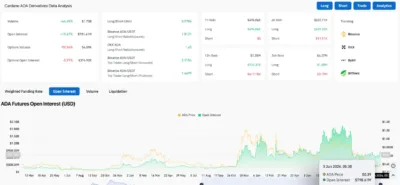
Derivatives positioning adds another layer of risk. ADA futures open interest has risen to approximately $798 million, up more than 10% on the day, while trading volume jumped 64% to $1.73 billion.

ADA

Source: Coinglass

Liquidation data shows longs absorbing most of the pressure, with $4.27 million in long liquidations compared with $3.19 million in shorts over the past 24 hours. Long-to-short ratios remain skewed toward longs, increasing downside risk if price fails to hold support. Rising leverage without structural confirmation leaves ADA vulnerable to sharp downside moves.


Key Support and Resistance Levels for Cardano

For the bullish case to gain traction, ADA must hold above $0.37 and secure a daily close above $0.41, opening room toward $0.45. A decisive reclaim of this zone would mark the first meaningful step toward trend repair. On the downside, a daily close below $0.37 would invalidate the current base and expose the recent lows near $0.33, increasing downside risk.


A daily close above $0.41 would signal improving momentum and reduce downside pressure, allowing ADA to challenge higher resistance near $0.45. Failure to hold $0.37 would confirm that seller control remains intact. A breakdown would expose $0.33, with further downside risk if selling pressure accelerates.


Cardano Price Prediction 2026–2030

Year Minimum Price Average Price Maximum Price
2026 $0.34 $0.40 $0.45
2027 $0.38 $0.46 $0.55
2028 $0.45 $0.55 $0.65
2029 $0.52 $0.62 $0.75
2030 $0.60 $0.70 $0.85

2026


Cardano enters 2026 stabilizing above key demand after a sharp corrective phase. Holding $0.37 remains critical, while a reclaim of $0.41 would be required to unlock recovery potential. Failure to reclaim resistance keeps price range-bound and vulnerable to renewed selling.


2027


If sell-side pressure gradually fades and structural conditions improve, ADA could trade within a broader range as volatility compresses. Price action during this period is likely to remain cyclical rather than trend-driven.


2028


With reduced distribution and improving market structure, Cardano could attempt a more sustained recovery phase. Upside progress is likely to occur in measured phases rather than sharp breakouts.


2029


By 2029, a clearer trend shift could emerge if ADA continues to hold higher support levels and demand remains consistent. Sustained acceptance above long-term resistance would be critical for maintaining upside momentum.


2030


By 2030, long-term structural clarity should be evident. If Cardano has successfully transitioned into a higher trading range, price action could reflect a more established trend. Failure to maintain gains would suggest continued long-term consolidation.


Conclusion

Cardano’s price is stabilizing above key support, but the broader trend has not yet turned bullish. Persistent exchange inflows, rising leverage, and technical resistance continue to cap upside.


Until ADA can reclaim the $0.41 resistance zone, rallies remain corrective rather than trend-defining. The coming sessions will determine whether consolidation resolves into recovery or another leg lower. ADA sits at a critical inflection point supported, but not yet freed from seller control.


FAQs

1. Why is Cardano price not rising despite stabilization?

Persistent exchange inflows suggest ongoing distribution, with holders using rebounds to sell into strength.


2. What is the key support level for ADA?


The primary support level is $0.37.


3. What resistance must ADA break to turn bullish?


A daily close above $0.41 is required to confirm a trend shift.


4. Could ADA fall to $0.33?


Yes. A loss of $0.37 would expose the recent demand zone near $0.33.


5. Is Cardano in a long-term downtrend?


Yes. ADA remains below its descending trendline and key moving averages, keeping the broader structure bearish despite short-term stabilization.


Also Read: Pudgy Penguins (PUDGY) Price Prediction 2025–2029: Can PUDGY Break $0.015 Soon?


The post Cardano Price Prediction 2026–2030: Can ADA Hit $0.45 Soon? appeared first on 36Crypto.

Disclaimer: The articles reposted on this site are sourced from public platforms and are provided for informational purposes only. They do not necessarily reflect the views of MEXC. All rights remain with the original authors. If you believe any content infringes on third-party rights, please contact crypto.news@mexc.com for removal. MEXC makes no guarantees regarding the accuracy, completeness, or timeliness of the content and is not responsible for any actions taken based on the information provided. The content does not constitute financial, legal, or other professional advice, nor should it be considered a recommendation or endorsement by MEXC.

You May Also Like

Navigating The Critical Sideways Bias With Safe-Haven Support

Navigating The Critical Sideways Bias With Safe-Haven Support

The post Navigating The Critical Sideways Bias With Safe-Haven Support appeared on BitcoinEthereumNews.com. USD/CAD Forecast: Navigating The Critical Sideways Bias
Share
BitcoinEthereumNews2026/03/09 17:39
Support at 1.15 under pressure – ING

Support at 1.15 under pressure – ING

The post Support at 1.15 under pressure – ING appeared on BitcoinEthereumNews.com. ING’s Chris Turner highlights that strong support just below 1.1500 in EUR/USD
Share
BitcoinEthereumNews2026/03/09 17:19
Crucial ETH Unstaking Period: Vitalik Buterin’s Unwavering Defense for Network Security

Crucial ETH Unstaking Period: Vitalik Buterin’s Unwavering Defense for Network Security

BitcoinWorld Crucial ETH Unstaking Period: Vitalik Buterin’s Unwavering Defense for Network Security Ever wondered why withdrawing your staked Ethereum (ETH) isn’t an instant process? It’s a question that often sparks debate within the crypto community. Ethereum founder Vitalik Buterin recently stepped forward to defend the network’s approximately 45-day ETH unstaking period, asserting its crucial role in safeguarding the network’s integrity. This lengthy waiting time, while sometimes seen as an inconvenience, is a deliberate design choice with profound implications for security. Why is the ETH Unstaking Period a Vital Security Measure? Vitalik Buterin’s defense comes amidst comparisons to other networks, like Solana, which boast significantly shorter unstaking times. He drew a compelling parallel to military operations, explaining that an army cannot function effectively if its soldiers can simply abandon their posts at a moment’s notice. Similarly, a blockchain network requires a stable and committed validator set to maintain its security. The current ETH unstaking period isn’t merely an arbitrary delay. It acts as a critical buffer, providing the network with sufficient time to detect and respond to potential malicious activities. If validators could instantly exit, it would open doors for sophisticated attacks, jeopardizing the entire system. Currently, Ethereum boasts over one million active validators, collectively staking approximately 35.6 million ETH, representing about 30% of the total supply. This massive commitment underpins the network’s robust security model, and the unstaking period helps preserve this stability. Network Security: Ethereum’s Paramount Concern A shorter ETH unstaking period might seem appealing for liquidity, but it introduces significant risks. Imagine a scenario where a large number of validators, potentially colluding, could quickly withdraw their stake after committing a malicious act. Without a substantial delay, the network would have limited time to penalize them or mitigate the damage. This “exit queue” mechanism is designed to prevent sudden validator exodus, which could lead to: Reduced decentralization: A rapid drop in active validators could concentrate power among fewer participants. Increased vulnerability to attacks: A smaller, less stable validator set is easier to compromise. Network instability: Frequent and unpredictable changes in validator numbers can lead to performance issues and consensus failures. Therefore, the extended period is not a bug; it’s a feature. It’s a calculated trade-off between immediate liquidity for stakers and the foundational security of the entire Ethereum ecosystem. Ethereum vs. Solana: Different Approaches to Unstaking When discussing the ETH unstaking period, many point to networks like Solana, which offers a much quicker two-day unstaking process. While this might seem like an advantage for stakers seeking rapid access to their funds, it reflects fundamental differences in network architecture and security philosophies. Solana’s design prioritizes speed and immediate liquidity, often relying on different consensus mechanisms and validator economics to manage security risks. Ethereum, on the other hand, with its proof-of-stake evolution from proof-of-work, has adopted a more cautious approach to ensure its transition and long-term stability are uncompromised. Each network makes design choices based on its unique goals and threat models. Ethereum’s substantial value and its role as a foundational layer for countless dApps necessitate an extremely robust security posture, making the current unstaking duration a deliberate and necessary component. What Does the ETH Unstaking Period Mean for Stakers? For individuals and institutions staking ETH, understanding the ETH unstaking period is crucial for managing expectations and investment strategies. It means that while staking offers attractive rewards, it also comes with a commitment to the network’s long-term health. Here are key considerations for stakers: Liquidity Planning: Stakers should view their staked ETH as a longer-term commitment, not immediately liquid capital. Risk Management: The delay inherently reduces the ability to react quickly to market volatility with staked assets. Network Contribution: By participating, stakers contribute directly to the security and decentralization of Ethereum, reinforcing its value proposition. While the current waiting period may not be “optimal” in every sense, as Buterin acknowledged, simply shortening it without addressing the underlying security implications would be a dangerous gamble for the network’s reliability. In conclusion, Vitalik Buterin’s defense of the lengthy ETH unstaking period underscores a fundamental principle: network security cannot be compromised for the sake of convenience. It is a vital mechanism that protects Ethereum’s integrity, ensuring its stability and trustworthiness as a leading blockchain platform. This deliberate design choice, while requiring patience from stakers, ultimately fortifies the entire ecosystem against potential threats, paving the way for a more secure and reliable decentralized future. Frequently Asked Questions (FAQs) Q1: What is the main reason for Ethereum’s long unstaking period? A1: The primary reason is network security. A lengthy ETH unstaking period prevents malicious actors from quickly withdrawing their stake after an attack, giving the network time to detect and penalize them, thus maintaining stability and integrity. Q2: How long is the current ETH unstaking period? A2: The current ETH unstaking period is approximately 45 days. This duration can fluctuate based on network conditions and the number of validators in the exit queue. Q3: How does Ethereum’s unstaking period compare to other blockchains? A3: Ethereum’s unstaking period is notably longer than some other networks, such as Solana, which has a two-day period. This difference reflects varying network architectures and security priorities. Q4: Does the unstaking period affect ETH stakers? A4: Yes, it means stakers need to plan their liquidity carefully, as their staked ETH is not immediately accessible. It encourages a longer-term commitment to the network, aligning staker interests with Ethereum’s stability. Q5: Could the ETH unstaking period be shortened in the future? A5: While Vitalik Buterin acknowledged the current period might not be “optimal,” any significant shortening would likely require extensive research and network upgrades to ensure security isn’t compromised. For now, the focus remains on maintaining robust network defenses. Found this article insightful? Share it with your friends and fellow crypto enthusiasts on social media to spread awareness about the critical role of the ETH unstaking period in Ethereum’s security! To learn more about the latest Ethereum trends, explore our article on key developments shaping Ethereum’s institutional adoption. This post Crucial ETH Unstaking Period: Vitalik Buterin’s Unwavering Defense for Network Security first appeared on BitcoinWorld.
Share
Coinstats2025/09/18 15:30







