Ethereum price is approaching a critical technical moment as it trades near the upper boundary of a descending wedge. ETH’s slow but steady climb has placed it Ethereum price is approaching a critical technical moment as it trades near the upper boundary of a descending wedge. ETH’s slow but steady climb has placed it

Ethereum’s New Holder Count Jumped 110% Since December’s Fusaka Upgrade

Ethereum price is approaching a critical technical moment as it trades near the upper boundary of a descending wedge. ETH’s slow but steady climb has placed it inches from a breakout.

This momentum is widely attributed to the Fusaka upgrade, which went live on December 3 and aims to improve scalability while lowering Layer 2 costs, a long-standing Ethereum challenge.

These changes arrive as market participants position for 2026, creating favorable conditions for network growth and price stabilization.

Ethereum Holders Show Strength

Ethereum network activity has expanded quickly over the past three weeks. Data shows a sharp rise in new addresses, defined as wallets interacting with ETH for the first time. This metric has increased by roughly 110% during the period, highlighting accelerating user adoption.

Ethereum now adds approximately 292,000 new addresses per day. This surge reflects a combination of seasonal factors and structural upgrades.

Christmas 2025, New Year positioning, and optimism surrounding the Fusaka upgrade appear to be driving renewed engagement across the ecosystem.

Want more token insights like this? Sign up for Editor Harsh Notariya’s Daily Crypto Newsletter here.
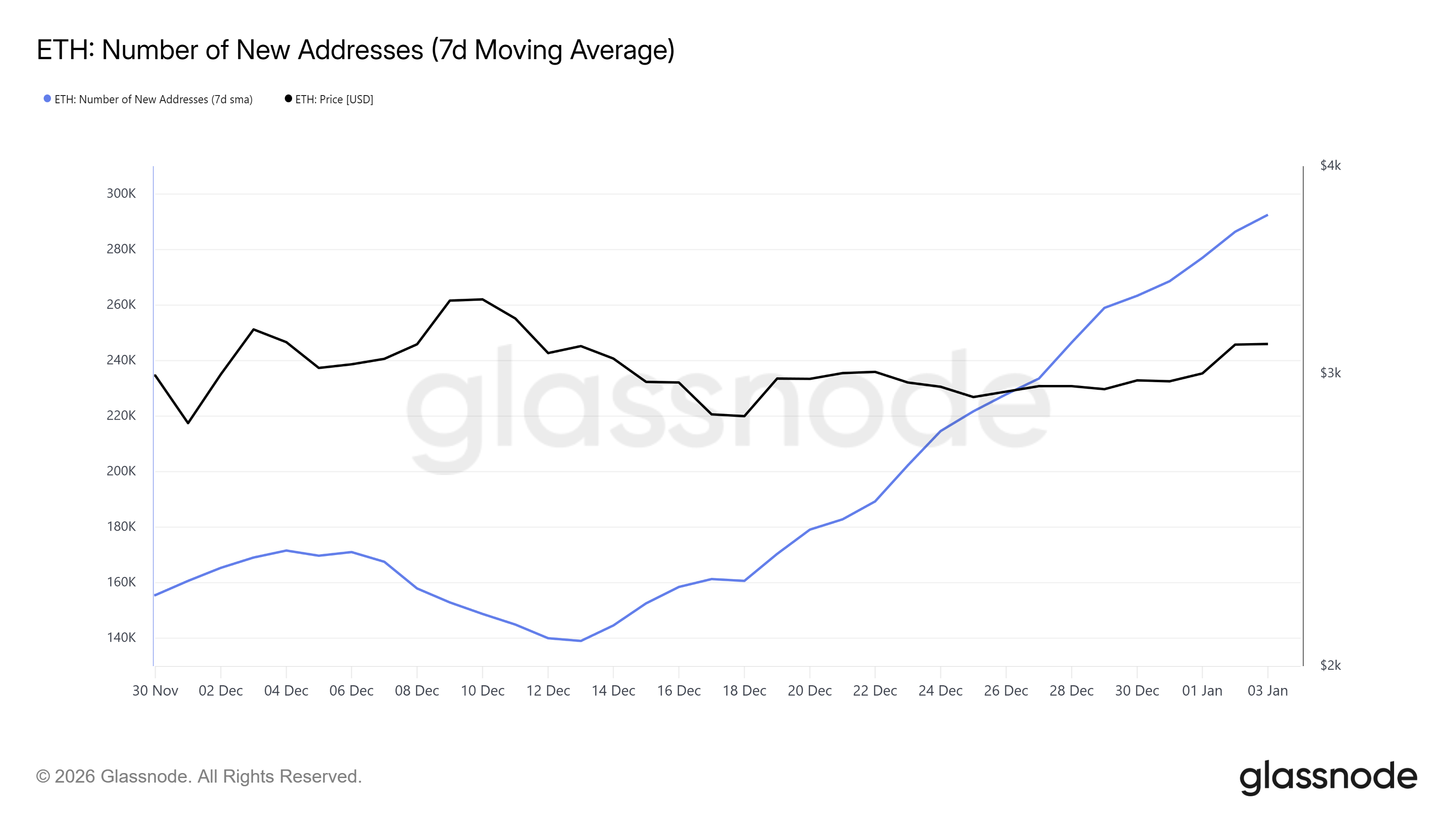
Ethereum New AddressesEthereum New Addresses. Source: Glassnode

Rising address creation often precedes increased transaction demand. While not every new address represents a long-term investor, sustained growth at this scale suggests expanding participation. Broader user inflows typically improve liquidity depth and reinforce price resilience during volatile market phases.

Forced to Hold, But Beneficial to ETH Nonetheless

Macro indicators present a mixed but informative picture. HODL Waves show growth among mid-term holders, defined as wallets holding ETH for three to six months. These investors largely entered positions between July and October 2025.

Early July buyers currently sit in profit, while those who entered after mid-July remain underwater. This distribution creates forced holding behavior, as many holders wait for price recovery. Such positioning can provide temporary support by reducing selling pressure during pullbacks.
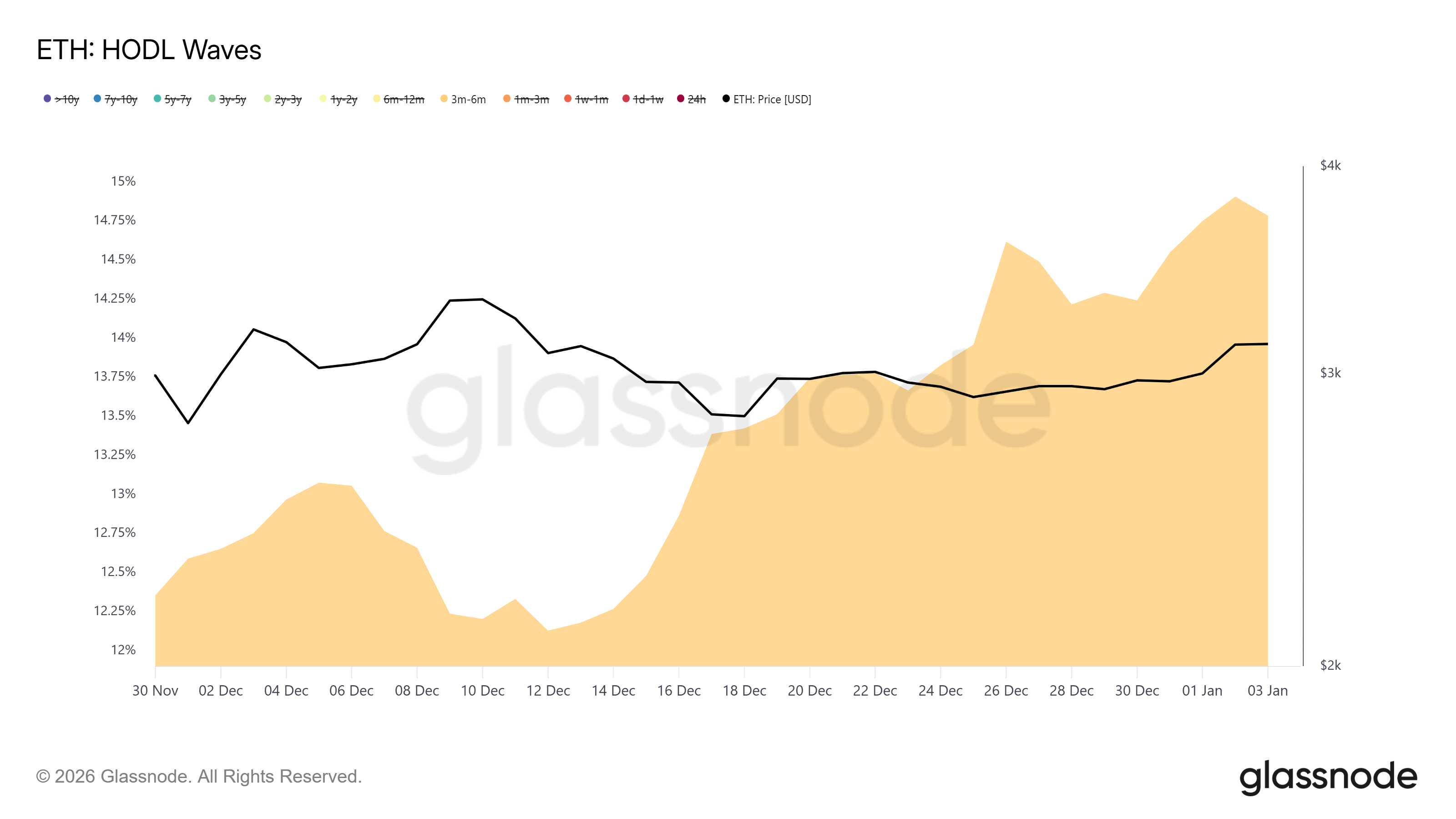
Ethereum HODL WavesEthereum HODL Waves. Source: Glassnode

However, rising prices may trigger distribution from these cohorts. As ETH approaches break-even levels for mid-term holders, selling risk increases. This dynamic could limit upside unless fresh capital offsets profit-taking from trapped supply.

ETH Price Is Nearing A Breakout

Ethereum price continues to trade within a descending wedge that formed in early November. ETH currently changes hands near $3,141, placing it close to a potential breakout. The structure suggests momentum is compressing, often preceding directional expansion.

The wedge projects a theoretical upside of roughly 29.5%, targeting $4,061. While ambitious, such a move would require stronger buying pressure than currently observed. A more realistic scenario involves ETH breaking out and pushing past $3,287, opening a short-term path toward $3,447.
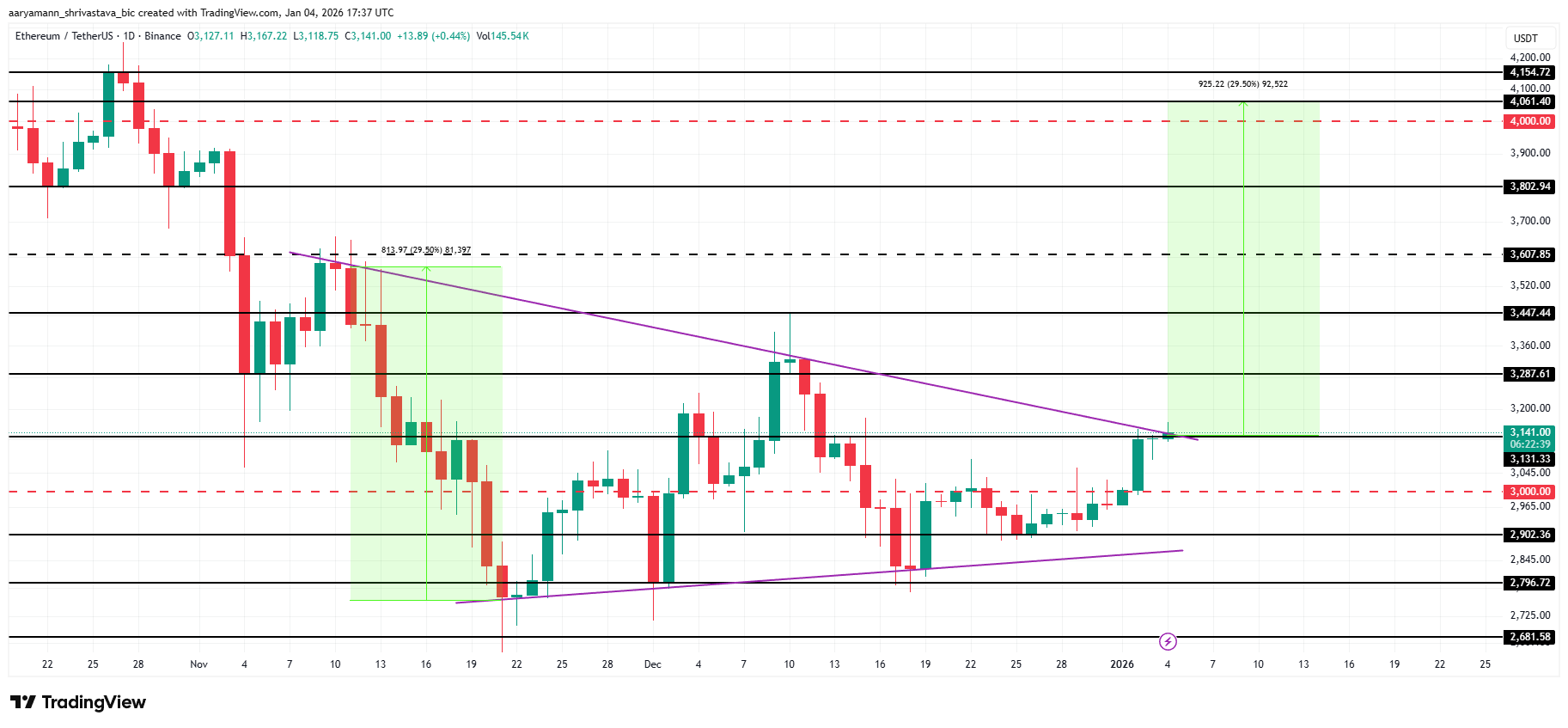
ETH Price Analysis. ETH Price Analysis. Source: TradingView

Downside risks remain if macro conditions deteriorate or the breakout fails. A rejection could send Ethereum back below $3,000. In that case, ETH may retest the $2,902 support level, invalidating the bullish thesis and reinforcing range-bound conditions.


Market Opportunity
NEAR Logo
NEAR Price(NEAR)
$1.75
$1.75$1.75
-2.56%
USD
NEAR (NEAR) Live Price Chart
Disclaimer: The articles reposted on this site are sourced from public platforms and are provided for informational purposes only. They do not necessarily reflect the views of MEXC. All rights remain with the original authors. If you believe any content infringes on third-party rights, please contact service@support.mexc.com for removal. MEXC makes no guarantees regarding the accuracy, completeness, or timeliness of the content and is not responsible for any actions taken based on the information provided. The content does not constitute financial, legal, or other professional advice, nor should it be considered a recommendation or endorsement by MEXC.

You May Also Like

RAKBank Gets CBUAE Nod as UAE AED Stablecoins Grow

RAKBank Gets CBUAE Nod as UAE AED Stablecoins Grow

The post RAKBank Gets CBUAE Nod as UAE AED Stablecoins Grow appeared on BitcoinEthereumNews.com. RAKBank secured in-principle approval from the Central Bank of
Share
BitcoinEthereumNews2026/01/07 21:37
New Year 2026 Presale Showdown: IPO Genie ($IPO) vs Bitcoin Hyper vs Nexchain – Who Wins?

New Year 2026 Presale Showdown: IPO Genie ($IPO) vs Bitcoin Hyper vs Nexchain – Who Wins?

Explore 2026’s presale battle between IPO Genie ($IPO), Bitcoin Hyper, and Nexchain. Compare growth potential, tokenomics, and investor opportunities.
Share
Blockchainreporter2026/01/07 21:10
Chorus One and MEV Zone Team Up to Boost Avalanche Staking Rewards

Chorus One and MEV Zone Team Up to Boost Avalanche Staking Rewards

The post Chorus One and MEV Zone Team Up to Boost Avalanche Staking Rewards appeared on BitcoinEthereumNews.com. Through the partnership with MEV Zone, Chorus One users will earn extra yield automatically. The Chorus One Avalanche node has a total stake of over 1.7 million, valued at around $55 million. This collaboration will introduce MEV Zone to both public nodes and Validator-as-a-Service. The Avalanche network stands to benefit from fairer and more efficient markets due to enhanced transparency. Chorus One, a highly decorated institutional-grade staking provider, has inked a strategic partnership with MEV Zone to enhance yield generation on the Avalanche (AVAX) network. The Chorus One partnered with MEV Zone to increase the AVAX staking yields, while simultaneously contributing to the general growth of the Avalanche network. “At Chorus One, we see this as an important step in our ongoing journey to provide robust infrastructure and innovative yield strategies for our partners and clients,” the announcement noted.  Why Did Chorus One Partner With MEV Zone? The Chorus One platform has grown to a top-tier institutional-grade staking ecosystem, with more than 40 blockchains, since 2018. In a bid to evolve with the needs of crypto investors and the supported blockchains, Chorus One has inked several strategic partnerships in the recent past, including MEV Zone. In the recent past, MEV Zone has specialized in addressing the Maximal Extractable Value (MEV) challenges on the Avalanche network. The MEV Zone will help Chorus One’s AVAX node validator to use Proposer-Builder Separation (PBS). As such, Chorus One’s AVAX node will seamlessly select certain transactions that are more profitable when making blocks. For instance, MEV Zone will help Chorus One’s AVAX node validator to capture arbitrage and liquidation transactions more often since they are more profitable.  How will Chorus One’s AVAX Stakers Benefit Via This Partnership? The Chorus One AVAX node has grown over the years to more than 1.77 million coins staked, valued…
Share
BitcoinEthereumNews2025/09/18 03:19



