Bitcoin entered the geopolitical spotlight over the weekend after a report alleged Venezuela secretly accumulated as much as 600,000 BTC, coinciding with the USBitcoin entered the geopolitical spotlight over the weekend after a report alleged Venezuela secretly accumulated as much as 600,000 BTC, coinciding with the US

600,000 Bitcoin Allegedly Held In Venezuelan Shadow Reserve: Report

Bitcoin entered the geopolitical spotlight over the weekend after a report alleged Venezuela secretly accumulated as much as 600,000 BTC, coinciding with the US capture of President Nicolás Maduro.

A new Whale Hunting investigation landed just as Washington delivered its own shock to Caracas: over the weekend, US forces captured Venezuelan leader Nicolás Maduro and transported him to the United States, where he is expected to face federal charges in New York. Against that backdrop, the report makes a massive claim: that a Maduro-era shadow network may have stockpiled Bitcoin on a scale that would instantly rank among the biggest in the world.

The piece, published by Project Brazen’s Whale Hunting, says Alex Saab, long described as a key financial operator for the Maduro government, “may control $60 billion in Bitcoin” tied to the regime. If you translate that notional value into coins, the figure ricocheting around crypto X has been roughly 600,000–660,000 BTC, though that conversion is coming from social-media extrapolation rather than the report itself.

What We Know About The Venezuelan Bitcoin Reserve

Still, timing matters. The authors frame the US raid as the opening act and the money trail as the real second act. In one of the article’s bluntest passages, Whale Hunting puts it this way: “Nicolás Maduro is in US custody. Where is the money? His name is Alex Saab.”

The report does not present an on-chain attribution proving a $60 billion hoard. It says the allegation comes from HUMINT sources and “has not been confirmed through blockchain analysis.” That caveat is doing real work: the story is written as an intelligence-and-networks narrative, not a blockchain-forensics teardown.

What the authors do supply is a plausibility sketch based on Venezuela’s resource flows and historical BTC price bands. Venezuela exported “73.2 tons of gold in 2018 alone,” the report notes, roughly $2.7 billion at the time, and argues that converting even a fraction into Bitcoin when BTC traded between roughly $3,000 and $10,000 could yield outsized gains if held into the 2021 cycle peak.

They then outline an alleged operational pipeline: gold proceeds routed through Turkish and Emirati intermediaries, passed through mixers, and moved into cold wallets “beyond the reach of Western enforcement,” with access concentrated among a small group around Saab. The implied risk is simple: even if authorities can seize people, they may not be able to seize keys.

The Maduro capture immediately fused two storylines that usually live in different parts of the market’s brain: geopolitics and the strategic-bitcoin-reserve discourse. Former Bitwise exec and now ProCap CIO Jeff Park posted via X, “What if Venezuela is the US Strategic Bitcoin Reserve,” crystallizing the cynical version of that mash-up in a single sentence.

Others ran the arithmetic. Crypto commentator MartyParty (@martypartymusic) suggested: “With the assumed 600-660k $BTC added to the existing 328k in the US Government wallets the total of the SBR would be roughy 928k-988k. Very close to the projected 1m Bitcoin from the original Strategic Bitcoin Reserve Senate markups.”

At press time, Bitcoin traded at $92,558.
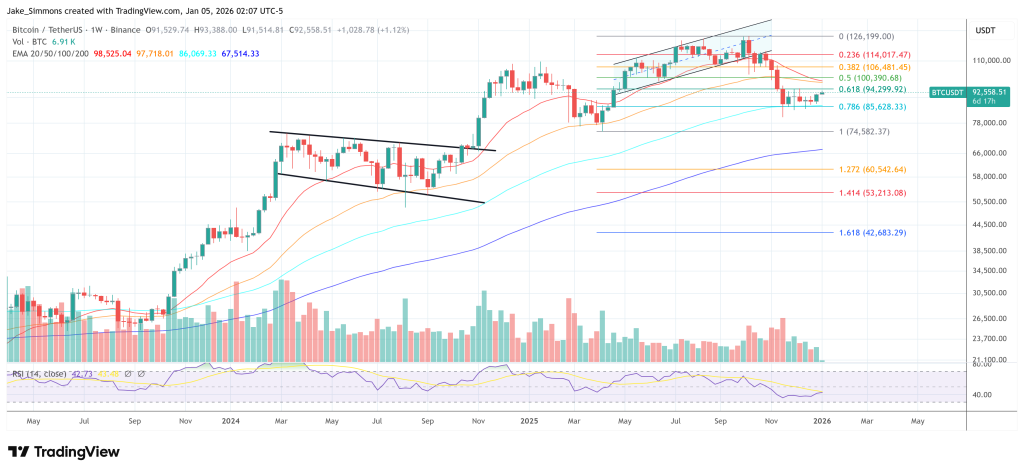
Bitcoin price chart
Disclaimer: The articles reposted on this site are sourced from public platforms and are provided for informational purposes only. They do not necessarily reflect the views of MEXC. All rights remain with the original authors. If you believe any content infringes on third-party rights, please contact service@support.mexc.com for removal. MEXC makes no guarantees regarding the accuracy, completeness, or timeliness of the content and is not responsible for any actions taken based on the information provided. The content does not constitute financial, legal, or other professional advice, nor should it be considered a recommendation or endorsement by MEXC.

You May Also Like

Shocking OpenVPP Partnership Claim Draws Urgent Scrutiny

Shocking OpenVPP Partnership Claim Draws Urgent Scrutiny

The post Shocking OpenVPP Partnership Claim Draws Urgent Scrutiny appeared on BitcoinEthereumNews.com. The cryptocurrency world is buzzing with a recent controversy surrounding a bold OpenVPP partnership claim. This week, OpenVPP (OVPP) announced what it presented as a significant collaboration with the U.S. government in the innovative field of energy tokenization. However, this claim quickly drew the sharp eye of on-chain analyst ZachXBT, who highlighted a swift and official rebuttal that has sent ripples through the digital asset community. What Sparked the OpenVPP Partnership Claim Controversy? The core of the issue revolves around OpenVPP’s assertion of a U.S. government partnership. This kind of collaboration would typically be a monumental endorsement for any private cryptocurrency project, especially given the current regulatory climate. Such a partnership could signify a new era of mainstream adoption and legitimacy for energy tokenization initiatives. OpenVPP initially claimed cooperation with the U.S. government. This alleged partnership was said to be in the domain of energy tokenization. The announcement generated considerable interest and discussion online. ZachXBT, known for his diligent on-chain investigations, was quick to flag the development. He brought attention to the fact that U.S. Securities and Exchange Commission (SEC) Commissioner Hester Peirce had directly addressed the OpenVPP partnership claim. Her response, delivered within hours, was unequivocal and starkly contradicted OpenVPP’s narrative. How Did Regulatory Authorities Respond to the OpenVPP Partnership Claim? Commissioner Hester Peirce’s statement was a crucial turning point in this unfolding story. She clearly stated that the SEC, as an agency, does not engage in partnerships with private cryptocurrency projects. This response effectively dismantled the credibility of OpenVPP’s initial announcement regarding their supposed government collaboration. Peirce’s swift clarification underscores a fundamental principle of regulatory bodies: maintaining impartiality and avoiding endorsements of private entities. Her statement serves as a vital reminder to the crypto community about the official stance of government agencies concerning private ventures. Moreover, ZachXBT’s analysis…
Share
BitcoinEthereumNews2025/09/18 02:13
LMAX Group Deepens Ripple Partnership With RLUSD Collateral Rollout

LMAX Group Deepens Ripple Partnership With RLUSD Collateral Rollout

LMAX Group has revealed a multi-year partnership with Ripple to integrate traditional finance with digital asset markets. As part of the agreement, LMAX will introduce
Share
Tronweekly2026/01/16 23:00
Pastor Involved in High-Stakes Crypto Fraud

Pastor Involved in High-Stakes Crypto Fraud

A gripping tale of deception has captured the media’s spotlight, especially in foreign outlets, centering on a cryptocurrency fraud case from Denver, Colorado. Eli Regalado, a pastor, alongside his wife Kaitlyn, was convicted, but what makes this case particularly intriguing is their unconventional defense.Continue Reading:Pastor Involved in High-Stakes Crypto Fraud
Share
Coinstats2025/09/18 00:38






