

Crypto Weekly Market Wrap January 5: Market Stability, Global Tensions, and Digital Asset Surge
Last week in crypto, regulation tensions rose, legal headlines shook the industry, and big players doubled down on Bitcoin. From court dismissals and ETF filings to global policy shifts and platform pivots, here’s your concise roundup of the biggest stories that shaped the crypto market last week.
Crypto Markets Hold Firm Amid Venezuela Turmoil
The crypto market remained stable following the alleged arrest of President Nicolás Maduro of Venezuela by U.S. forces. Wall Street was closed on January 3, and therefore, crypto was the first to react to the news.
Despite major geopolitical tensions, Bitcoin increased by almost 5% in three days and broke the $90,000 barrier. The overall market gained over $100 billion, with investors targeting long-term trends. Analysts believe the effect on crypto will be minimal, and a significant correction is not likely to occur soon.
Judge Dismisses Lawsuit Targeting Mark Cuban
A federal judge dismissed the lawsuit against Mark Cuban and the Dallas Mavericks over their promotion of Voyager Digital. The court held that the plaintiffs did not establish the connection between what Cuban did and Florida, where the lawsuit was filed. Due to the lack of jurisdictional support, the matter could not proceed further.
The lawsuit had linked investor losses with Cuban public endorsements and team campaigns. It also referenced a promotion of Bitcoin rewards to Voyager users. But lacking any direct connection to Florida or concrete evidence of individual interest, the court dismissed the case completely.
Rep. Waters Pressures SEC for Crypto Oversight
Representative Maxine Waters urged the House Financial Services Committee to hold an oversight hearing with SEC Chair Paul Atkins. She alleged that the agency was undermining crypto enforcement in the current administration. Waters asserted the necessity of balance following the SEC dismissal of various high-profile cases.
In her letter, Waters claimed that former Chair Gary Gensler had appeared twice in his first year, as opposed to Atkins. Her concerns are indicative of increasing conflict in Washington over crypto regulation. Regulation could soon reenter the limelight as lawmakers take another look at the way the SEC implements digital asset regulations.
Bitfinex Hacker Released Under Trump-Era Law
Ilya Lichtenstein, the mastermind behind the massive Bitfinex hack, announced his early prison release. He credited it to the First Step Act signed by President Trump in 2018. The law allows shorter sentences for non-violent offenders by rehabilitating them and awarding time credit.
Lichtenstein posted his update on social media, noting that he wants to make a positive contribution to cybersecurity. He is released at a time when major debates concerning prison reform and its applicability to digital crimes are being discussed. His history is still a subject of controversy, yet his future intentions attract attention.
BitMine Pushes to Expand Share Authorization
BitMine Immersion Chairman Tom Lee requested the shareholders to endorse a rise in the number of authorized shares of the firm. The offer would increase the number of shares from 500 million to 50 billion. Lee said in his New Year’s message that this move would assist in growth and safeguard current investments.
He emphasized that the change would not dilute current shareholders. The push reflects BitMine’s desire to expand its activities as the demand for Ethereum infrastructure increases. Lee added that the board believes in long-term opportunities of tapping broader capital markets.
Strategy Buys More Bitcoin, Crosses 672,000 BTC
Led by Michael Saylor, Strategy resumed its bitcoin accumulation with a purchase of $108.8 million. The company purchased 1,229 BTC at an average cost of $88,568. It financed the acquisition by using its at-the-market stock offering program.
Strategy sold more than 663,000 MSTR shares in the same week to match the Bitcoin purchase. Its total holdings reached 672,497 BTC, with a cost basis of approximately $74,997 per coin. The company is not slowing down on its aggressive Bitcoin treasury strategy.
UK to Collect Full Crypto Tax Data by 2026
Beginning in 2026, the UK tax authority HMRC will require exchanges to report complete user trading histories. This involves the number of transactions, profits or losses, as well as information on tax residency. All the major platforms with UK users have to comply.
In the year 2027, the UK will start sharing this data with 47 jurisdictions as part of the CARF initiative by OECD. Capital gains or income taxes may be imposed on individuals with earnings exceeding £3,000. The move puts the UK on par with global efforts at making crypto activity more transparent.
Mirae Asset in Talks to Acquire Korbit
Mirae Asset, a leading financial group in South Korea, is considering a majority stake in crypto exchange Korbit. The transaction may be valued at 140 billion won ($97 million). In case the deal proceeds, Mirae would own 92% of Korbit. This would be the first move by Mirae into the crypto sphere. The company considers an opportunity to leverage its traditional finance experience and blockchain infrastructure. Although Korbit is smaller than its competitors, it may act as a catapult to new offerings.
Iran Accepts Crypto for Military Purchases
Mindex, the Iranian defense export agency, now accepts cryptocurrency as a payment method for arms. This involves missiles, drones, and armored vehicles. Customers are allowed to pay in crypto, rials, or even by bartering. The move assists Iran in maneuvering around global financial sanctions. The adoption of digital currencies enables quicker, cross-border transactions. The move also indicates the broader interest in crypto in Iran as a means of trade and logistics.
Turkmenistan Legalizes Crypto for Growth
Turkmenistan enacted new law, which legalized crypto mining and exchanges. The government seeks to entice foreign investors and digitize its digital economy. The law was signed by President Berdimuhamedov in late November.
The rules establish concrete rules on how to use, develop, and trade digital assets. The nation is optimistic that the move will lead to technological advancement and revenue diversification beyond the exports of natural gas.
Truth Social Plans Token Drop for Shareholders
Trump Media announced that it will distribute a digital token to shareholders. The token, which is issued on the Cronos blockchain by Crypto.com, matches one token per share of the DJT stock. The platform combines social media and blockchain as Truth Social extends its digital ecosystem. Although launch details are yet to be announced, the move falls under the broader tokenization efforts of traditional companies.
China to Offer Interest on Digital Yuan
The central bank of China now allows commercial banks to pay interest on digital yuan balances. This took effect on January 1, 2026. It signifies a change in e-CNY from becoming digital cash to being a digital deposit. The shift deals with low adoption rates despite years of experimentation. The central bank believes that financial incentives will encourage users to use and hold the digital yuan more widely. Banks become flexible to handle the currency in a similar way to traditional deposits.
Bitwise Pushes Forward With Altcoin ETFs
Bitwise submitted applications to the SEC to introduce 11 single-asset ETFs covering major altcoins. The proposed ETFs will consist of AAVE, TRX, NEAR, and UNI tokens. Direct crypto assets and derivatives would be held in each fund.
The company plans to launch them by March 2026 with streamlined listing regulations. Bitwise seeks to provide regulated access to altcoins in the U.S. markets. The move would also increase investor access to diversified crypto products, should it be approved.
Phishing Campaign Hits Multiple Wallets
A wallet-draining campaign was initiated by hackers across Ethereum and associated networks. The combined loss incurred by victims was over $107,000. The majority of individual thefts were less than $2,000. ZachXBT, a security researcher, discovered a recurring address used by the attacker. The hack spans across several chains, including Optimism, BNB Chain, and Blast, and most likely, is a result of phishing or compromised wallets and not a protocol vulnerability.
Coinbase to Pause Services in Argentina
Coinbase announced that it will cease Peso-to-USDC operations in Argentina by January 31, 2026. The company decided after analyzing its local operations. Although the pause will occur, crypto transfers will not be blocked. Coinbase claimed Argentina remains a core part of its regional strategy. The company plans to come back with a stronger product in the future.
Congressman Proposes Ban on Prediction Market Insider Trades
Rep. Ritchie Torres plans to introduce a bill against the use of inside information by officials on prediction markets. The act follows the decision of a trader who bet on the ouster of Maduro and earned $400,000. The trader opened a new Polymarket account and made big bets shortly before U.S. forces arrested the Venezuelan president. Torres seeks to expand STOCK Act regulations to prevent such trades based on political outcomes.
SEC Left With All-Republican Panel After Crenshaw Departure
Caroline Crenshaw, the only Democratic Commissioner on the SEC, departed the agency on January 2. Her departure was after her renomination was canceled by the Senate Banking Committee.
Crenshaw was a longtime critic of crypto products and had voted against a number of ETF approvals. Her resignation leaves the SEC with three Republican commissioners and two vacancies.
Aave Labs Considers Sharing Non-Protocol Revenue
Aave creator Stani Kulechov said that Aave Labs could share revenue earned outside the protocol with token holders. His statement was meant to break the tension in the community. He further suggested that different teams should build separately on Aave, which would benefit the DAO through increased usage. The move comes after the recent controversy in the redirection of fees and governance in DAOs.
Bitfarms Exits Latin America to Focus on U.S. Infrastructure
Bitfarms sold its 70-megawatt Paraguay facility for $30 million, completing its exit from LATAM. The company will divert funds to North American AI and high-performance computing infrastructure. CEO Ben Gagnon said that the sale accelerates cash flow realization. Bitfarms currently focuses all energy activities in North America. In addition, the company is moving to power resources that can facilitate wider tech loads.
Coinbase Warns Against Stablecoin Interest Ban
Coinbase’s Faryar Shirzad cautioned that a ban on stablecoin interest payments would benefit overseas competitors. He cited the move by China to provide yield on its digital yuan. Shirzad urged the U.S. lawmakers to defend the position of the dollar worldwide, calling on the negotiators to maintain innovation while shaping stablecoin rules.
Prenetics Drops Bitcoin Plans to Focus on Health Brand
David Beckham-backed Prenetics Global cancelled plans to purchase additional bitcoin. Last year, the company raised $48 million to fund the treasury. The company will now concentrate fully on expanding its supplement brand, IM8. According to leadership, the key to maximizing shareholder value is to scale its consumer health business. The firm still holds 510 BTC.
Grayscale Files for Spot Bittensor ETF
Grayscale filed paperwork on a spot Bittensor ETF. The fund, called Grayscale Bittensor Trust, would be listed on NYSE Arca under the symbol GTAO. The custodians will be Coinbase Custody and BitGo. This move is the initial effort at a U.S.-traded ETF that provides direct exposure to Bittensor. Grayscale aims to increase access to AI-linked blockchain assets.
Metaplanet Acquires Over 4,000 BTC in Q4
In Q4, Metaplanet bought 4,279 BTC at a cost of $451 million. The Japanese company financed the acquisition through loans and stock sales. The firm currently owns more than 35,000 BTC that cost an average of $107,606 per coin. Its market value is just slightly higher than BTC treasury value, which is an indicator of investor confidence.
South Korea’s Stablecoin Bill Delayed Over Eligibility Dispute
South Korean lawmakers are still divided on who to issue stablecoins. The Central Bank wants banks to own 51% of any issuer consortium. However, the Financial Services Commission favors a more flexible approach. The stalling is impacting the broader crypto regulation progress, such as investor safeguards and guidelines on ICO approvals. The discussion might go on until the upcoming legislative session.
Digital Asset Investment Products Market Overview
Digital asset investments closed 2025 at $47.2 billion, nearly matching 2024’s record, as per CoinShares’ latest report. The year began on solid ground, though midweek volatility slowed momentum. The United States led inflows but dipped 12% from last year. Germany and Canada rebounded strongly after prior outflows, recording inflows of $2.5 billion and $1.1 billion, respectively. Switzerland also posted steady growth of 11.5% year-on-year.
Bitcoin saw a notable slowdown, dropping 35% in flows to $26.9 billion. Short-Bitcoin products gained modest attention, totaling $105 million in inflows. However, their total assets under management remain small at $139 million. Ethereum dominated growth with inflows up 138% to $12.7 billion. XRP rose 500%, reaching $3.7 billion, while Solana soared 1000% to $3.6 billion. Other altcoins declined 30% to $318 million, signaling selective investor confidence.
Bitcoin Price Performance
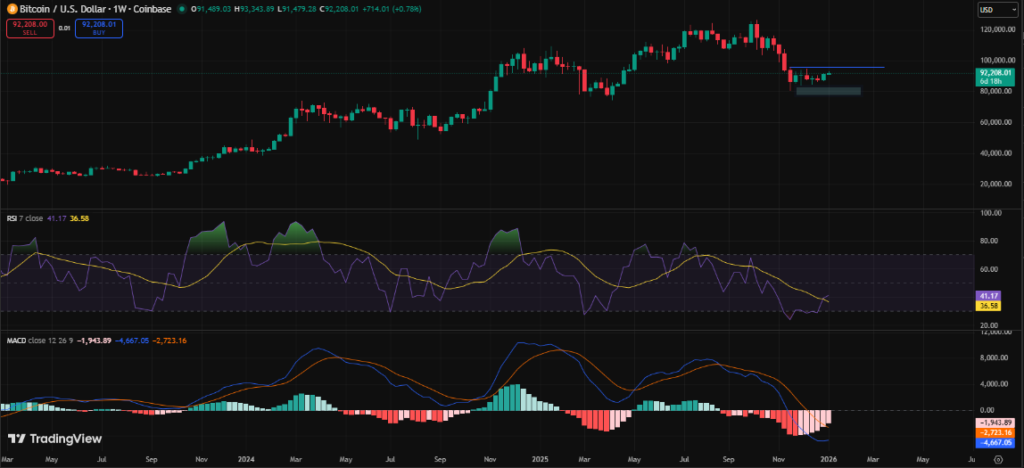
The flagship asset experienced a positive trend over the last week by recording a gain of more than 2%. BTC surged from the $86k region and climbed above the $90k level, aligning with the renewed rally in the market. The recent brief rally has seen the asset’s market capitalization and trading volume surge to $1.84 trillion and $34 billion, respectively.
Looking at the weekly chart, BTC’s price is bouncing off its current support. Several green candlesticks have formed from this region, which indicates the bulls have taken the lead and could challenge the immediate resistance at the $95k level.
 Source: TradingView
Meanwhile, indicators such as the MACD and RSI support this bullish thesis. The 14-day RSI is steadily climbing from the oversold region, currently hovering around 41 levels. In addition, the histogram is slowly turning positive as red bars fade away, indicating increased buying pressure.
eToro Platform
Best Crypto Exchange
- Over 90 top cryptos to trade
- Regulated by top-tier entities
- User-friendly trading app
- 30+ million users
eToro is a multi-asset investment platform. The value of your investments may go up or down. Your capital is at risk. Don’t invest unless you’re prepared to lose all the money you invest. This is a high-risk investment, and you should not expect to be protected if something goes wrong.


You May Also Like

LIXTE Biotechnology Advances Precision Oncology with Novel PP2A Inhibitor LB-100

Major Legal Face-Off in TerraUSD Collapse: Jane Street Defends Its Role




