The Ethics of Artists Using AI Technology in Their Designs

The rapid rise of artificial intelligence in creative industries has sparked intense debate about authorship, originality, labor, and even the future of art itself. From generative image tools like Google Gemini or Adobe Firefly to AI-assisted music composition and design automation, artists now have access to technologies that can produce work faster, cheaper, and at unprecedented scale. While some see these tools as a natural evolution of creative practice, others argue that they raise serious ethical concerns about ownership, exploitation, and the devaluation of human creativity.
At the heart of the debate are some fundamental questions. Is AI a legitimate creative tool? Or does its use undermine the ethical foundations of artistic work? The answer isn’t that simple. Like photography, digital illustration, or graphic design software before it, AI can empower artists. But it can also cause harm and a future we may regret.
Understanding AI in Artistic Design
AI in art typically refers to machine learning systems trained on large datasets of existing creative works. These systems identify patterns and generate new outputs whether it be images, music, text, or designs based on prompts provided by users. Importantly, most current AI tools do not “create” in a human sense, they simply remix and recombine patterns derived from data created by other people.
For example, an illustrator might use AI to generate concept art for a fantasy character in their comic book, then refine it manually. A fashion designer might use AI to explore pattern variations for a dress, or a graphic designer might rely on AI to suggest layouts or color palettes to match a particular theme. In these cases, AI acts as a collaborator rather than a replacement for human creativity.
However, ethical concerns arise when the boundaries between assistance, authorship, and appropriation become blurred.
The Ethical Case For AI Use in Art
1. AI as a Creative Tool, Not a Replacement
Supporters of AI argue that it is simply another tool in the old toolbox. Not terribly different from Photoshop, 3D modeling software, or digital brushes. Artists still make creative decisions by selecting prompts, refining outputs, curating results, and applying human judgment. In this view, AI expands creative possibility rather than replacing creativity.
Historically, new technologies have always faced resistance. When photography emerged, painters feared it would make them obsolete. When digital art became widespread, critics questioned whether it was “real art.” Over time, these tools were absorbed into accepted practice. AI, proponents argue, is following the same trajectory.
2. Increased Accessibility and Democratization
AI tools can lower barriers to entry for people who lack formal training or physical ability. Someone with limited drawing skills can express visual ideas using AI, while disabled artists may use AI to overcome a disability. This democratization allows more voices to participate in our creative culture.
For independent creators, AI can also reduce costs and production time. A solo game developer might use AI-generated textures or concept art to prototype ideas that would otherwise be financially impossible. In this sense, AI can help that small game studio level the playing field with their AAA counterparts.
3. Innovation and New Artistic Forms
AI has enabled entirely new genres of art, such as generative art installations and interactive experiences. Some artists train custom models on their own work, creating systems that extend their personal style rather than copying others. These practices push creative boundaries and raise compelling philosophical questions about collaboration between human and computer.
An example is the use of AI in live performances, where visuals respond dynamically to music or audience movement. Here, AI is not replacing artistic intent but amplifying it in ways previously impossible.
The Ethical Case Against AI Use in Art
 1. Training Data and Consent
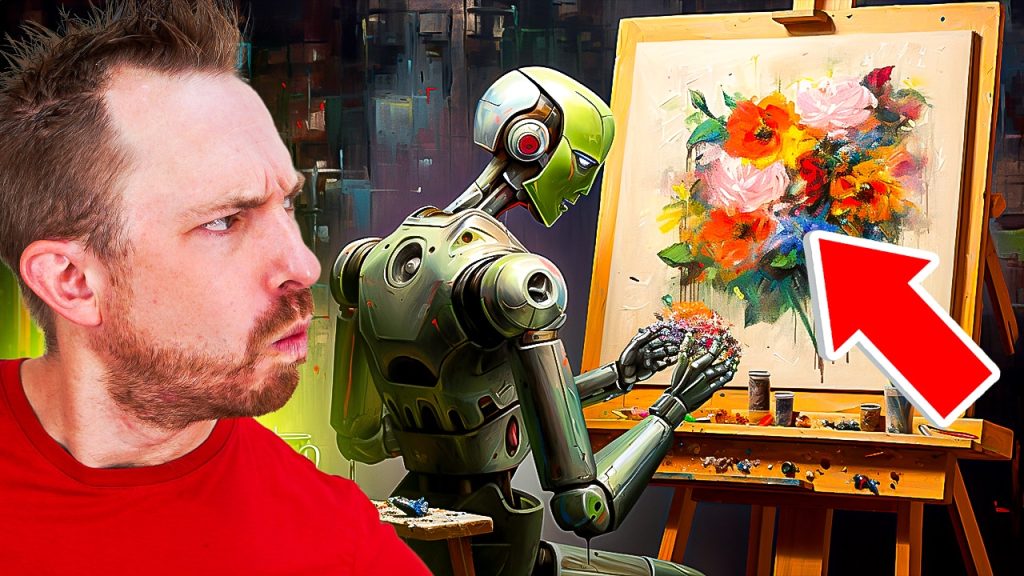
One of the most serious ethical concerns is how AI models are trained. Many systems are trained on vast datasets scraped from the internet (some would say stolen), often without the consent of the original artists. This means that illustrators, photographers, and designers may unknowingly contribute to systems that replicate aspects of their style, sometimes competing directly with them.
From an ethical standpoint, this raises questions about exploitation. If an AI model produces work that closely resembles a living artist’s style, is that plagiarism? Even if no single image is copied, the collective use of artists’ labor without compensation challenges principles of fairness and respect.
Several lawsuits and protests from artist communities highlight how deeply this issue resonates. Many creators argue that ethical AI use must include transparency, consent, and proper compensation. Important court cases will likely answer these questions in the near future.
2. Authorship and Attribution
When AI generates a design, who is the artist? Is it the person who wrote the prompt, the engineers who built the model, or the thousands of artists whose work trained it? Claiming full authorship over AI-generated work can feel ethically dubious, particularly when the human contribution is minimal.
Problems arise when AI-generated art is submitted to competitions, sold commercially, or passed off as entirely human-made without disclosure. This lack of transparency can mislead audiences and devalue the effort of artists who rely solely on their own skills.
For example, when AI-generated art is popping up in big chain stores like Michaels without disclosure. Is it unethical to sell a piece of art that was created by a machine if the consumer doesn’t know this? A painting for instance that took hundreds of hours and personal sacrifice may hold a higher value to that consumer than one generated in 30 seconds with a short prompt.
3. Economic Harm and Devaluation of Labor
AI’s ability to produce large volumes of “good enough” art quickly threatens the livelihoods of working artists, especially in commercial fields like illustration, stock imagery, and graphic design. Companies may opt for cheaper AI-generated content rather than hiring human artists, reducing opportunities and wages. We recently saw this with Coca-Cola’s 2025 Christmas commercial.
While technological change has always disrupted labor markets, the speed and scale of AI adoption raise ethical concerns about responsibility. If artists lose income because their work was used to train systems that replace them, the moral implications are significant.
4. Cultural Homogenization
AI models tend to reproduce dominant styles and aesthetics present in their training data. This can lead to visual homogenization, where designs start to look similar and reinforce existing cultural biases. AI slowly morphs from training on artists to training off their own AI’s previous work. Minority styles, experimental approaches, and culturally specific art forms may be underrepresented or distorted.
Ethically, this raises questions about whose voices are amplified and whose are erased. If AI becomes a primary creative tool, it risks narrowing, rather than expanding, artistic diversity.
Navigating an Ethical Middle Ground
The ethical issue is not just whether artists should use AI, but how they should use it. Responsible practices are emerging that attempt to balance innovation with integrity. These include:
Clearly disclosing when AI is used in the creative process
Avoiding prompts that deliberately mimic living artists without permission
Supporting AI tools trained on licensed or opt-in datasets
Using AI as a starting point rather than a finished product
Advocating for fair compensation and artist protections
Some artists choose to train models exclusively on their own work, ensuring full ownership and ethical consistency. Others incorporate AI in early ideation stages but rely on human craftsmanship for final execution.
Joey Cutler, CEO of Cubby Games and a freelance artist for companies such as Custom Comet states, “Don’t overestimate or underestimate the power of artificial intelligence. AI will always have pros and cons, but it’s too large of a concept to be considered at face value. The best we can do as workers and owners is to embrace the different changes AI will inevitably bring, accepting and improving the good with it, while also preventing the bad and ensuring protections for our workforce.”
Conclusion
AI is neither inherently ethical nor unethical. It is a tool shaped by human choices. For artists, the ethical use of AI requires honesty, responsibility, and awareness of broader social impacts. While AI can sometimes enhance creativity and accessibility, it also poses real risks to artistic labor, consent, and cultural diversity.
The future of art will likely involve coexistence between human creativity and machine assistance. The challenge lies in ensuring that this coexistence is grounded in respect for artists, transparency for audiences, and systems that value human contribution rather than erasing it. As with any powerful technology, the ethics of AI in art will ultimately be defined not by what is possible, but by what we choose to accept as fair, responsible, and humane.


You May Also Like

Unifas Labs, ZenChain, and Perle Lead Token Sales in Q1 2026 Quarter Based on ATH ROI

Ethereum stalls: Can whale demand prevent ETH’s drop to $1,930?