

The tug-of-war between two paths behind the tokenization of DTCC in the US stock market: the debate between DTCC's "improvement" and crypto-native "revolution".
Author: Spinach | bocaibocai
On December 11, 2025, the U.S. Depository Trust Company (DTCC) received a "No-Action Letter" from the SEC, authorizing it to tokenize its custodied securities assets on the blockchain.
The news was met with cheers from the industry and became the focus of attention—$99 trillion in custodial assets are about to be put on the blockchain, and the gates for the tokenization of US stocks have finally been opened.
However, a careful reading of this document reveals a crucial detail: DTCC tokenizes "security entitlements," not the stocks themselves.
This distinction sounds like a legal jargon exercise.
But in reality, it reveals two completely different paths in the field of security tokenization, and the game between two forces behind these two paths.
1. Who are the true owners of US stocks?
To understand this game, we need to first understand a counterintuitive fact: in the US public market, investors have never truly "owned" stocks.
Before 1973, stock trading relied on the circulation of physical certificates. After a transaction was completed, the buyer and seller would exchange physical stock certificates, sign and endorse them, and then mail them to a transfer agent to complete the registration change. This process was still feasible in an era of low trading volume.
However, in the late 1960s, the average daily trading volume of US stocks soared from three to four million shares to over ten million shares, bringing the entire system to the brink of collapse. Brokerage firms' back-offices were piled up with millions of stock certificates awaiting processing, with loss, theft, and forgery occurring frequently. Wall Street referred to this period as the "Paperwork Crisis."
DTC (Depository Traded) was the solution born out of this crisis. Its core idea is simple: centralize all stock certificates in one place, and record transactions digitally in a ledger without moving the physical certificates.
To achieve this, DTC established a nominee organization called Cede & Co., which registered almost all the shares of listed companies under the name of Cede & Co.
Official data disclosed in 1998 showed that Cede & Co. held legal ownership of 83% of the outstanding public stock in the United States.
What does this mean? When you see "holding 100 shares of Apple" in your brokerage account, Apple's shareholder register lists Cede & Co.
What you hold is a contractual claim called "securities rights"—you have the right to claim the economic benefits derived from these 100 shares from the brokerage firm, which in turn has the right to claim from the clearing broker, and the clearing broker has the right to claim from the DTCC. This is a nested chain of rights, rather than a direct property right.
This "indirect holding system" has been operating for over fifty years. It eliminated the paper crisis and supported the daily clearing of trillions of dollars in transactions, but at the cost of permanently separating investors from the securities they hold.
II. DTCC Options: Upgrade Pipeline, Retain Architecture
With this background understood, the boundaries of DTCC's tokenization become clear.
According to the SEC's disclaimer and the DTCC's public statements, its tokenization service targets "securities interests held by participants with the DTC." Participants refer to clearinghouses and banks that directly connect with the DTCC—currently, only a few hundred institutions in the United States possess this qualification.
Ordinary investors cannot directly use DTCC's tokenization services.
The tokenized "security equity tokens" will circulate on a DTCC-approved blockchain, but these tokens still represent contractual claims to the underlying assets, not direct ownership. The underlying shares remain registered under Cede & Co., and this remains unchanged.
This is an infrastructure upgrade, not an architectural refactoring. Its goal is to improve the efficiency of the existing system, not to replace it. DTCC explicitly listed several potential benefits in its application documents:
- First, collateral liquidity: In the traditional model, the movement of securities between different accounts requires waiting for a settlement period, and funds are locked up. After tokenization, participants can achieve near real-time transfer of equity, releasing frozen capital.
- Second, reconciliation is simplified: In the current system, DTCC, clearing brokers, and retail brokers each maintain independent ledgers, requiring a large amount of reconciliation work every day. On-chain records can serve as a shared "single source of truth."
- Third, paving the way for future innovation: The DTCC document mentions that equity tokens may be allowed to have settlement value in the future, or dividends may be paid in stablecoins. However, these will require additional regulatory approval.
It is important to emphasize that DTCC has explicitly stated that these tokens will not enter the DeFi ecosystem, will not bypass existing participants, and will not change the issuer's shareholder register.
In other words, it doesn't intend to subvert anyone, and this choice has its rationale.
Multilateral netting is a core advantage of the current securities clearing system. With trillions of dollars in daily market transactions, after netting by the NSCC, only a few tens of billions of dollars need to be moved to complete the settlement. This efficiency can only be achieved under a centralized architecture.
As a systemically important financial infrastructure, the primary responsibility of the DTCC is to maintain stability, not to pursue innovation.
III. Direct Holding: From Tokens to Stocks Themselves
While DTCC is cautiously upgrading, another path has begun to emerge.
On September 3, 2025, Galaxy Digital announced that it had become the first Nasdaq-listed company to tokenize its SEC-registered equity on a major public blockchain. Through a partnership with Superstate, Galaxy's Class A common stock can now be held and transferred in token form on the Solana blockchain.
The key difference is that these tokens represent actual shares, not claims to those shares. As an SEC-registered transfer agent, Superstate updates the issuer's shareholder register in real time as tokens are transferred on-chain.
The names of token holders will appear directly on Galaxy's shareholder register—while Cede & Co. is not on this chain.
This is true "direct ownership." Investors acquire property rights, not contractual rights.
In December 2025, Securitize announced that it would launch a tokenized stock service with "fully on-chain compliant trading" in the first quarter of 2026. Unlike many "synthetic tokenized stocks" on the market that rely on derivative structures, SPV packaging, or offshore structures, Securitize emphasizes that its tokens will be "real, regulated stocks: issued on-chain and recorded directly on the issuer's shareholder register."
Securitize goes a step further: it not only supports on-chain holdings but also on-chain transactions.
During US stock market opening hours, the price is anchored to the National Best Price (NBBO); during market closures, the price is dynamically determined by Automated Market Makers (AMMs) based on on-chain supply and demand. This implies a theoretical 24/7 trading window.
This path represents a different vision: treating blockchain as a native layer of securities infrastructure, rather than an add-on to existing systems.
IV. Two paths, representing two futures
This is not a debate over technological approaches, but a contest between two institutional logics.
The DTCC approach represents a gradual improvement that acknowledges the merits of the existing system—the efficiency of multilateral netting, the risk mitigation of central counterparties, and the maturity of the regulatory framework—by using blockchain technology to make the machine run faster and more transparent.
The role of intermediaries will not disappear; they will simply adopt a different accounting method.
The direct ownership path represents a structural change—it questions the necessity of the indirect ownership system itself: since blockchain can provide an immutable record of ownership, why are nested intermediaries still needed? If investors can safeguard their assets themselves, why should they relinquish ownership to Cede & Co.?
Both paths have their own trade-offs.
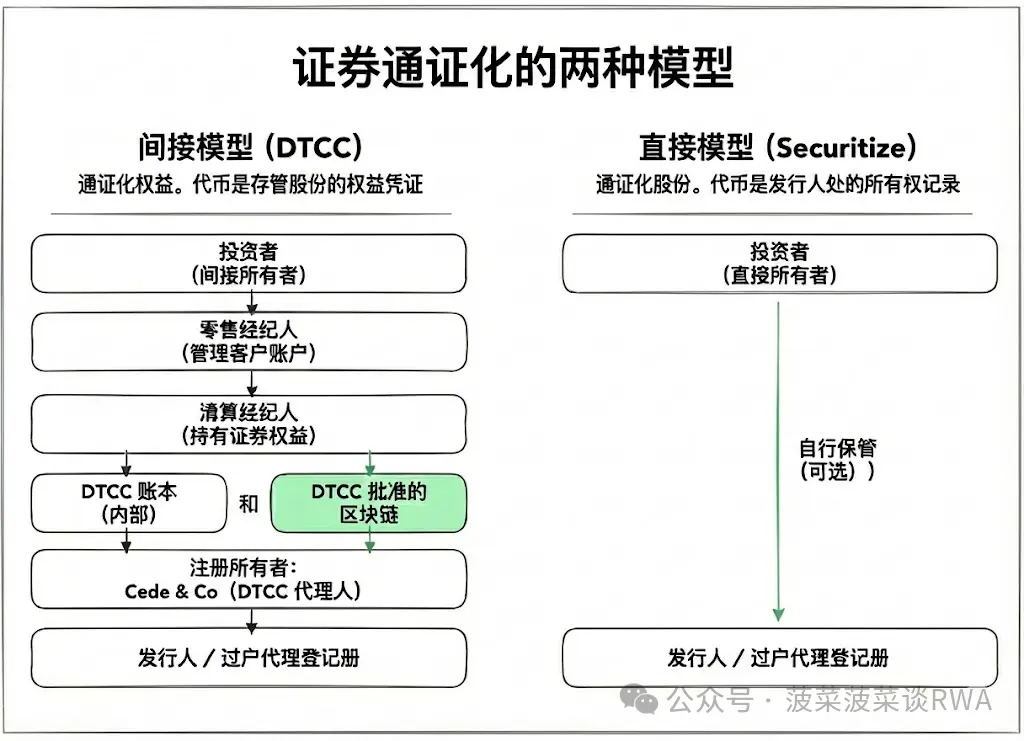 (Translation by Chuk Okpalugo)
Direct holding brings autonomy: self-custody, peer-to-peer transfers, and composability with DeFi protocols. However, the cost is dispersed liquidity and loss of netting efficiency. If every transaction must be fully settled on-chain without a central clearinghouse, capital requirements will increase significantly.
In addition, direct ownership means that investors bear more operational risks themselves—risks such as lost private keys and stolen wallets, which were traditionally covered by intermediaries, are now transferred to individuals.
Indirect holding preserves system efficiency: economies of scale from centralized clearing, a mature regulatory compliance framework, and operating models familiar to institutional investors. However, the cost is that investors can only exercise their rights through intermediaries. Shareholder proposals, voting, and direct communication with issuers—rights that theoretically belong to shareholders—require navigating multiple layers of intermediaries in practice.
It is worth noting that the SEC remains open to both paths.
In a statement released on December 11 regarding the DTCC's disclaimer, Commissioner Hester Peirce stated explicitly: "The DTCC's tokenized equity model is a promising step in this journey, but other market participants are exploring different experimental paths... Some issuers have already begun tokenizing their own securities, which could make it easier for investors to hold and trade securities directly, rather than through intermediaries."
The regulators are sending a clear signal: this is not an either-or choice, but rather letting the market decide which model is more suitable for which type of demand.
V. Defensive Strategies of Financial Intermediaries
Faced with this path game, how should existing financial intermediaries respond?
First, clearing brokers and custodians need to consider the following questions:
In the DTCC model, are you indispensable or replaceable? If tokenized rights can be directly transferred between participants, will the custody fees, transfer fees, and reconciliation fees originally charged by clearing brokers still have a basis? Institutions that adopt DTCC tokenization services first may gain a differentiated competitive advantage, but in the long run, this service itself may be standardized and commoditized.
Second, retail brokerages face more complex challenges:
Under the DTCC model, their role is solidified—ordinary investors still can only access the market through brokerages. However, the proliferation of the direct holding model will erode this moat. If investors can hold SEC-registered shares themselves and trade them on compliant on-chain exchanges, what is the value of retail brokerages? The answer may lie in their services: compliance consulting, tax planning, portfolio management—high-value-added functions that cannot be replaced by smart contracts.
Third, the role of the transfer agent may be undergoing a historic upgrade:
In the traditional system, the transfer agent is a low-profile back-office function, primarily responsible for maintaining the shareholder register. However, in the direct holding model, the transfer agent becomes a crucial link between the issuer and investors. It is no coincidence that Superstate and Securitize both hold SEC-registered transfer agent licenses. Controlling the right to update the shareholder register means controlling the entry point into the direct holding system.
Fourth, asset managers need to pay attention to the competitive pressure brought about by composability:
If tokenized shares can be used as collateral for on-chain lending protocols, traditional margin financing will be impacted. If investors can trade 24/7 and settle instantly on AMMs, arbitrage opportunities arising from T+1 settlement cycles will disappear. These changes won't happen overnight, but asset management institutions need to assess in advance how much their business models rely on assumptions about settlement efficiency.
VI. The intersection of two curves
The transformation of financial infrastructure is never accomplished overnight. The paper crisis of the 1970s gave rise to an indirect holding system, but it took more than two decades for this system to truly solidify, from the establishment of the DTC to Cede & Co. holding 83% of US stocks. SWIFT, also founded in 1973, is still being restructured in cross-border payments.
Both paths will grow in their respective territories in the short term:
DTCC’s institutional-grade services will first penetrate the wholesale markets most sensitive to settlement efficiency, such as collateral management, securities lending, and ETF creation and redemption.
The direct holding model, on the other hand, enters from the periphery: native crypto users, small issuers, and regulatory sandboxes in specific jurisdictions.
In the long run, the two curves may converge. When the circulation of tokenized equity is large enough and the regulatory framework for direct holding is mature enough, investors may gain real choice for the first time—enjoying the efficiency of net settlement within the DTCC system, or exiting to on-chain self-custody and regaining direct control of the assets.
The very existence of this choice is itself a form of change.
Since 1973, ordinary investors have never truly had this option: the moment a stock is purchased into an account, it automatically enters an indirect holding system, Cede & Co. becomes the legal holder, and the investor becomes the beneficiary at the end of the equity chain. This is not the result of choice, but the only path.
Cede & Co. still holds the vast majority of its publicly traded U.S. shares. This proportion may begin to loosen, or it may remain so for a long time. But fifty years later, another path has finally been paved.
Reference


You May Also Like
MoneyFlare Launches Free AI Crypto Trading Bot for Fully Automated and Efficient Investing

68% of global BTC miners came from the U.S., Russia, and China, Q1 2026




