Ethereum Co-Founder Calls for Protocol Simplification to Combat Bloat Vitalik Buterin, co-founder of Ethereum, has issued a compelling appeal to developers to addressEthereum Co-Founder Calls for Protocol Simplification to Combat Bloat Vitalik Buterin, co-founder of Ethereum, has issued a compelling appeal to developers to address

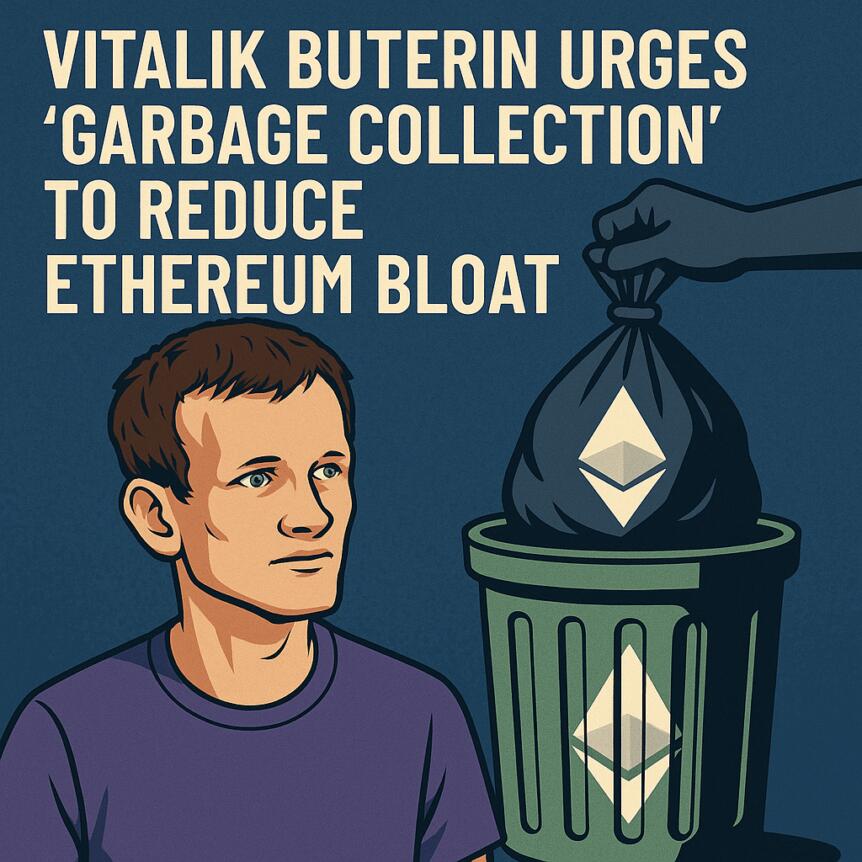
Vitalik Buterin Urges ‘Garbage Collection’ to Reduce Ethereum Bloat
For feedback or concerns regarding this content, please contact us at crypto.news@mexc.com
Vitalik Buterin Urges 'garbage Collection' To Reduce Ethereum Bloat

Ethereum Co-Founder Calls for Protocol Simplification to Combat Bloat

Vitalik Buterin, co-founder of Ethereum, has issued a compelling appeal to developers to address the long-standing issue of protocol bloat. In a recent post on X, he emphasized that the core principle of trustlessness and self-sovereignty in blockchain networks depends less on deploying extensive decentralization metrics and more on maintaining simplicity within the protocol. Buterin warned that increasing complexity, driven by continuous feature additions and insufficient removal of outdated code, compromises the protocol’s integrity and usability.

Key Takeaways

  • Buterin advocates for a focus on simplicity to enhance trustlessness, self-sovereignty, and the protocol’s overall health.
  • He criticizes the tendency to prioritize backward compatibility over meaningful protocol cleanup, leading to unwieldy, bloated codebases.
  • Buterin proposes implementing explicit “garbage collection” mechanisms to trim unnecessary features and reduce cryptographic complexity.
  • He cites past Ethereum upgrades, such as the transition from proof-of-work to proof-of-stake, as successful examples of large-scale protocol cleanup.

Tickers mentioned: ETH

Sentiment: Neutral

Price impact: Neutral. The call for simplification aims to enhance the protocol’s sustainability rather than immediate price fluctuations.

Trading idea (Not Financial Advice): Hold. Focus on the protocol’s health and long-term viability rather than short-term price movements.

The debate over Ethereum’s future approach to protocol development has gained renewed attention. Buterin stressed that the relentless growth of the codebase hampers decentralization and trust, as complexities force users and developers to rely heavily on cryptography and expert explanations. This erosion of transparency and portability affects the core values of blockchain technology.

He highlighted that most protocol upgrades tend to favor additions rather than subtractions, driven by a bias towards backward compatibility. This pattern causes the protocol to become increasingly cumbersome, making it harder for new teams to rebuild high-quality clients if existing ones disappear. To combat this, Buterin champions a structured “garbage collection” process—an explicit effort to reduce total code lines, limit reliance on cryptographic primitives, and establish fixed, predictable invariants.

Historical examples, such as Ethereum’s transition from proof-of-work to proof-of-stake, serve as precedents for effective cleanup efforts. Recent initiatives like refining gas costs, which link computational costs more directly to resource use, are steps toward simplifying the network. Future proposals may involve migrating seldom-used features into smart contracts, easing developer burden and improving protocol agility.

Meanwhile, Solana Labs CEO Anatoly Yakovenko emphasized the importance of continuous evolution, asserting that Solana (SOL) must remain in constant motion. Responding to Buterin, he argued that iteration is critical for staying relevant in a competitive market, even if this means no single team drives all changes.

Ultimately, Buterin envisions a future where Ethereum reaches a state of optimal stability—one capable of operating securely and predictably for decades without ongoing developer interventions, thus passing the “walkaway test” of long-term reliability.

This article was originally published as Vitalik Buterin Urges ‘Garbage Collection’ to Reduce Ethereum Bloat on Crypto Breaking News – your trusted source for crypto news, Bitcoin news, and blockchain updates.


Market Opportunity
Belong Logo
Belong Price(LONG)
$0.00189
$0.00189$0.00189
-0.26%
USD
Belong (LONG) Live Price Chart
Disclaimer: The articles reposted on this site are sourced from public platforms and are provided for informational purposes only. They do not necessarily reflect the views of MEXC. All rights remain with the original authors. If you believe any content infringes on third-party rights, please contact crypto.news@mexc.com for removal. MEXC makes no guarantees regarding the accuracy, completeness, or timeliness of the content and is not responsible for any actions taken based on the information provided. The content does not constitute financial, legal, or other professional advice, nor should it be considered a recommendation or endorsement by MEXC.

You May Also Like

CEO Sandeep Nailwal Shared Highlights About RWA on Polygon

CEO Sandeep Nailwal Shared Highlights About RWA on Polygon

The post CEO Sandeep Nailwal Shared Highlights About RWA on Polygon appeared on BitcoinEthereumNews.com. Polygon CEO Sandeep Nailwal highlighted Polygon’s lead in global bonds, Spiko US T-Bill, and Spiko Euro T-Bill. Polygon published an X post to share that its roadmap to GigaGas was still scaling. Sentiments around POL price were last seen to be bearish. Polygon CEO Sandeep Nailwal shared key pointers from the Dune and RWA.xyz report. These pertain to highlights about RWA on Polygon. Simultaneously, Polygon underlined its roadmap towards GigaGas. Sentiments around POL price were last seen fumbling under bearish emotions. Polygon CEO Sandeep Nailwal on Polygon RWA CEO Sandeep Nailwal highlighted three key points from the Dune and RWA.xyz report. The Chief Executive of Polygon maintained that Polygon PoS was hosting RWA TVL worth $1.13 billion across 269 assets plus 2,900 holders. Nailwal confirmed from the report that RWA was happening on Polygon. The Dune and https://t.co/W6WSFlHoQF report on RWA is out and it shows that RWA is happening on Polygon. Here are a few highlights: – Leading in Global Bonds: Polygon holds 62% share of tokenized global bonds (driven by Spiko’s euro MMF and Cashlink euro issues) – Spiko U.S.… — Sandeep | CEO, Polygon Foundation (※,※) (@sandeepnailwal) September 17, 2025 The X post published by Polygon CEO Sandeep Nailwal underlined that the ecosystem was leading in global bonds by holding a 62% share of tokenized global bonds. He further highlighted that Polygon was leading with Spiko US T-Bill at approximately 29% share of TVL along with Ethereum, adding that the ecosystem had more than 50% share in the number of holders. Finally, Sandeep highlighted from the report that there was a strong adoption for Spiko Euro T-Bill with 38% share of TVL. He added that 68% of returns were on Polygon across all the chains. Polygon Roadmap to GigaGas In a different update from Polygon, the community…
Share
BitcoinEthereumNews2025/09/18 01:10
Liquid crypto funds have a DeFi problem nobody talks about

Liquid crypto funds have a DeFi problem nobody talks about

The post Liquid crypto funds have a DeFi problem nobody talks about appeared on BitcoinEthereumNews.com. The following is a guest post and guest post from Thomas
Share
BitcoinEthereumNews2026/03/08 06:03
HBAR Eyes Breakout Above $0.105 With Bullish Momentum and Trend Reversal Signals

HBAR Eyes Breakout Above $0.105 With Bullish Momentum and Trend Reversal Signals

The post HBAR Eyes Breakout Above $0.105 With Bullish Momentum and Trend Reversal Signals appeared on BitcoinEthereumNews.com. Key Insights: HBAR tests the upper
Share
BitcoinEthereumNews2026/03/08 06:06




