Virtuals Protocol has introduced a 60-day trial framework that changes how early crypto projects launch while VIRTUAL token is up almost 3%. The post Virtuals ProtocolVirtuals Protocol has introduced a 60-day trial framework that changes how early crypto projects launch while VIRTUAL token is up almost 3%. The post Virtuals Protocol

Virtuals Protocol Debuts 60-Day Trial for Founders, VIRTUAL Shows Signs of Life

3 min read

Virtuals Protocol VIRTUAL $0.64 24h volatility: 2.2% Market cap: $421.06 M Vol. 24h: $79.67 M has introduced a new launch framework called “60 Days,” giving early-stage founders a reversible way to test products, tokens, and market demand.

Instead of forcing immediate and permanent commitment, founders build publicly for 60 days while capital forms through trading activity and optional growth pools.

At the end of the window, founders choose whether to commit. If they commit, funds unlock over time and the project continues.

If they don’t, the token winds down and all eligible funds are returned to holders. The framework removes the usual one-way risk tied to early token launches.

How the 60 Days Mechanism Works

Each project launches a token on the Base network using a standard bonding curve. Tokens trade during the 60-day trial while founders ship updates, engage users, publish metrics, and collect feedback.

Projects begin in private pools. Once cumulative volume reaches 42,000 VIRTUAL, liquidity migrates to a Uniswap V2 pool for open trading.

All trades carry a 1% fee and 30% goes to the protocol while 70% is allocated to the founder but remains locked during the trial.

If the founder commits, those funds unlock. If not, they are redirected into the refund pool.

Capital Formation and Founder Support

Virtuals uses Automated Capital Formation (ACF) to allocate funds to founders based on trading activity.

Released ACF funds support operations and early scaling. Unreleased allocations stay locked and are excluded from refunds until formally released.

Founders may also open a Growth Allocation pool by selling up to 5% of team tokens at a fixed valuation.

These funds are held in escrow and fully refunded if the founder does not commit. If the founder commits, Growth Allocation tokens vest linearly over six months.

To cover living and operating costs, founders receive stipends every 30 days. The stipend equals 10% of collected funds from founder trading fees and released ACF, capped at $5,000 USDC per payout.

It is important to note founders can commit early or wait until Day 60. A commitment unlocks founder trading fees, releases ACF funds, and starts Growth Allocation vesting.

If the founder does not commit, liquidity is drained, token issuance stops, and refunds trigger automatically.

VIRTUAL Attempts a Comeback

VIRTUAL token is up almost 3% in the past 24 hours, currently trading at $0.6374. However, the token has dropped more than 20% in the last 30 days alone.

The chart below shows prices below a descending trendline and the main demand zone sits near the $0.60 area.
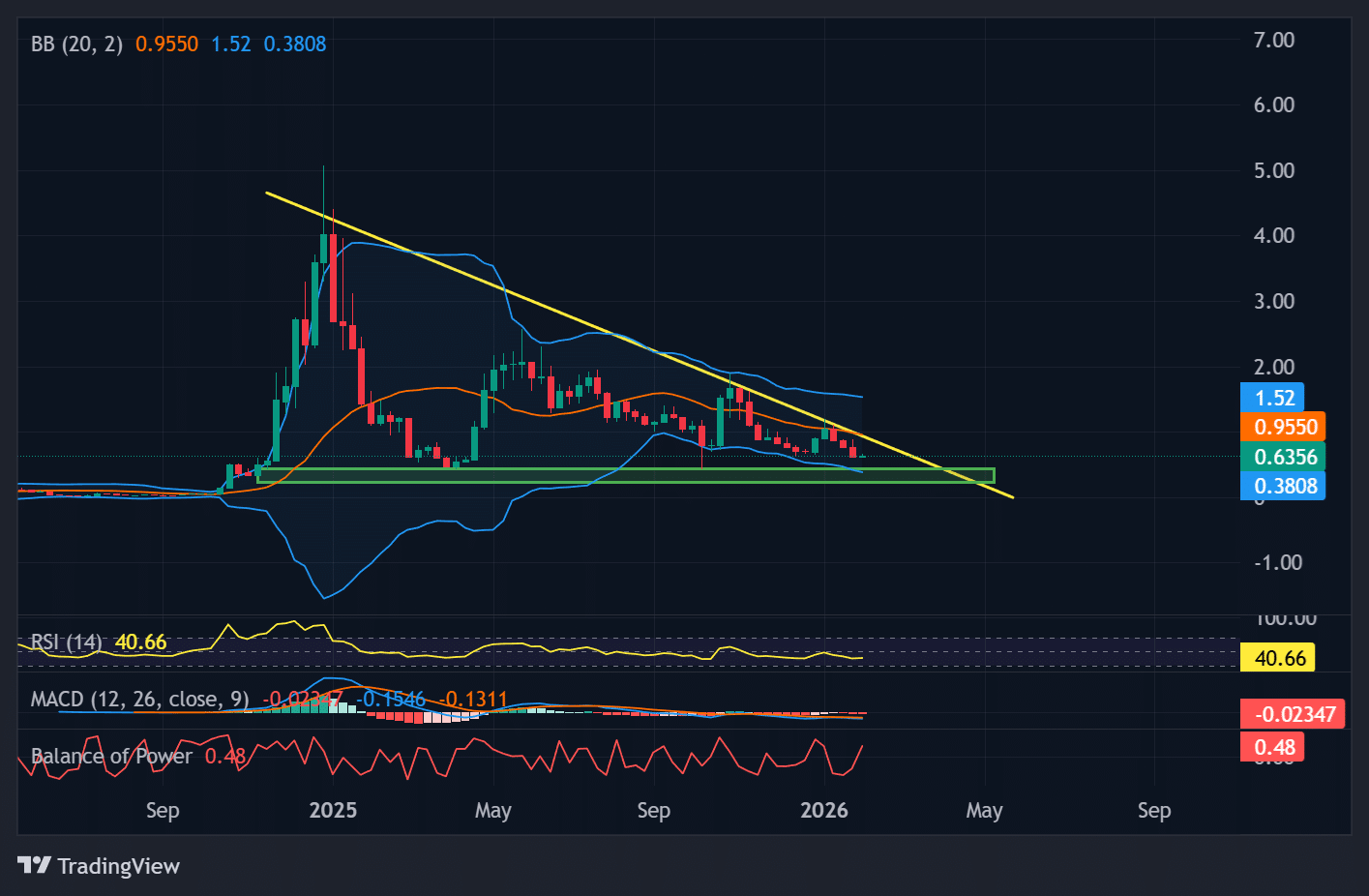
VIRTUAL price chart with momentum indicators. | Source: TradingView

VIRTUAL price chart with momentum indicators. | Source: TradingView

If VIRTUAL holds the current support and breaks the descending trendline, a test of the $0.95 to $1.50 range is possible. However, A clean break below support would expose the $0.38 area.

next

The post Virtuals Protocol Debuts 60-Day Trial for Founders, VIRTUAL Shows Signs of Life appeared first on Coinspeaker.


Disclaimer: The articles reposted on this site are sourced from public platforms and are provided for informational purposes only. They do not necessarily reflect the views of MEXC. All rights remain with the original authors. If you believe any content infringes on third-party rights, please contact service@support.mexc.com for removal. MEXC makes no guarantees regarding the accuracy, completeness, or timeliness of the content and is not responsible for any actions taken based on the information provided. The content does not constitute financial, legal, or other professional advice, nor should it be considered a recommendation or endorsement by MEXC.

You May Also Like

SBI VC Trade Adds Litecoin to Japanese Lending Program

SBI VC Trade Adds Litecoin to Japanese Lending Program

The post SBI VC Trade Adds Litecoin to Japanese Lending Program appeared on BitcoinEthereumNews.com. SBI VC Trade added Litecoin to its regulated lending program
Share
BitcoinEthereumNews2026/02/03 19:53
Work Dogs TGE Is Running — Is WD About to Drop in Q2 After March 30?

Work Dogs TGE Is Running — Is WD About to Drop in Q2 After March 30?

Work Dogs Token Listing Date Expected in Q2 2026 as WD TGE Nears Completion The countdown to the Work Dogs (WD) token listing date has officially begun. Afte
Share
Hokanews2026/02/03 20:16
Italy passes law on AI outlining privacy and child access

Italy passes law on AI outlining privacy and child access

The post Italy passes law on AI outlining privacy and child access appeared on BitcoinEthereumNews.com. Italy has formally passed a sweeping new law to regulate artificial intelligence, becoming the first member of the European Union to roll out comprehensive legislation in step with the bloc’s landmark AI Act. The Italian Senate granted final approval after a year of debate, concluding what Prime Minister Giorgia Meloni’s government described as a decisive step in shaping how new technologies are deployed across the country. Italy sets tough penalties for offenders The legislation, ministers argue, lays out the boundaries for human-centric, transparent, and safe use of AI while balancing the need to foster innovation, cybersecurity, and economic growth. The law casts its net widely, and it stretches into healthcare, schools, the justice system, workplaces, sport, and the public sector. AI access for children under 14 has also been tightened, and it now requires parental consent. “This law brings innovation back within the perimeter of the public interest, steering AI toward growth, rights and full protection of citizens.” Alessio Butti, the undersecretary for digital transformation. Lawmakers also opted for a hard line on abuses. A new offence has been added to the criminal code covering the unlawful spread of AI-generated or manipulated content, such as deepfakes. Anyone found guilty faces between one and five years in prison if their actions cause harm. Using AI to commit fraud, identity theft, market manipulation, or money laundering will now be treated as an aggravating circumstance, raising potential sentences by a third. Judges remain the sole authority in legal rulings, though courts are empowered to demand rapid takedowns of illicit material. Government agencies to oversee its implementation Responsibility for enforcing the regime lies with the Agency for Digital Italy and the National Cybersecurity Agency, though existing financial watchdogs such as the Bank of Italy and Consob retain powers in their own spheres. The Department…
Share
BitcoinEthereumNews2025/09/18 06:05



