Ethereum (ETH) celebrates its 10th anniversary on Wednesday, marking a decade of powering decentralized applications, smart contracts, and blockchain innovation. ETH's anniversary comes as its price remains close to year-to-date highs, above its key support at $3,730.Ethereum (ETH) celebrates its 10th anniversary on Wednesday, marking a decade of powering decentralized applications, smart contracts, and blockchain innovation. ETH's anniversary comes as its price remains close to year-to-date highs, above its key support at $3,730.

Ethereum Price Forecast: ETH turns 10 close to year-to-date highs as Fed decision looms

2025/07/30 21:00
7 min read
For feedback or concerns regarding this content, please contact us at crypto.news@mexc.com
  • Ethereum price holds above the daily support at $3,730, signaling potential upside toward $4,000.
  • 180 Life Sciences Corp and BTCS announce plans to raise $425 million and $2 billion in funds to acquire ETH for treasury reserves.
  • Market participants should be cautious as the upcoming Fed rate decision could bring sharp volatility in ETH.

Ethereum (ETH) celebrates its 10th anniversary on Wednesday, marking a decade of powering decentralized applications, smart contracts, and blockchain innovation. ETH's anniversary comes as its price remains close to year-to-date highs, above its key support at $3,730. Corporate companies' demand for ETH continues to strengthen and institutional inflows via ETFs persist, increasing the chances that ETH reaches the psychological $4,000 level.

Despite the rising demand for ETH, traders should keep a watch on the upcoming Federal Reserve’s (Fed) interest rate decision, which could bring sharp volatility in the crypto market.

Ethereum turns a decade

Ethereum, the second-largest cryptocurrency by market capitalization and one of the top 25 assets in the world, turns 10 years on Wednesday, marking the anniversary of its launch in 2015. 

ETH has grown from a bold vision of decentralized computing to a foundational layer powering Decentralized Finance (DeFi), Non-Fungible Tokens (NFTs), Decentralized Autonomous Organizations (DAOs), and more, with currently 1,456 protocols, 644,221 active addresses and 59.82% market share, according to DefiLlama. 

Ethereum chart. Source: DefiLama 

Ethereum chart. Source: DefiLama 

“Ethereum’s first decade has been a testament to decentralised innovation. Its next decade promises to be just as, if not more, transformative,” said Bondex CEO Ignacio Palomera to FXStreet.

Palomera further predicted that ETH would fluctuate within the $3,200 to $3,600 range in August, and added that, by the end of the year, ETH could push toward $4,500 or even retest its all-time high at $4,868.

Ethereum’s corporate interest continues to strengthen 

Demand for Ethereum to fill treasury reserves remains robust. 180 Life Sciences Corp. (ATNF) announced on Tuesday that it plans to adopt a treasury policy under which the principal holding in its treasury reserve will be Ethereum, and the firm intends to rebrand to ETHZilla Corporation. 

This plan consists of a $425 million private investment in a public equity transaction (PIPE) for the purchase and sale of common stock, set to close around August 1, with the capital raised going into the purchase of ETH.

Meanwhile, Blockchain Technology Consensus Solutions (BTCS) filed an S-3 registration statement indicating its plan to raise up to $2 billion through at-the-market (ATM) offerings, convertible notes, and warrants. The net proceeds are intended to be used to expand ETH reserves, support working capital, and for other general corporate purposes, the company said. After its recent purchases earlier this week, the firm currently holds 70,028 ETH in its reserve.
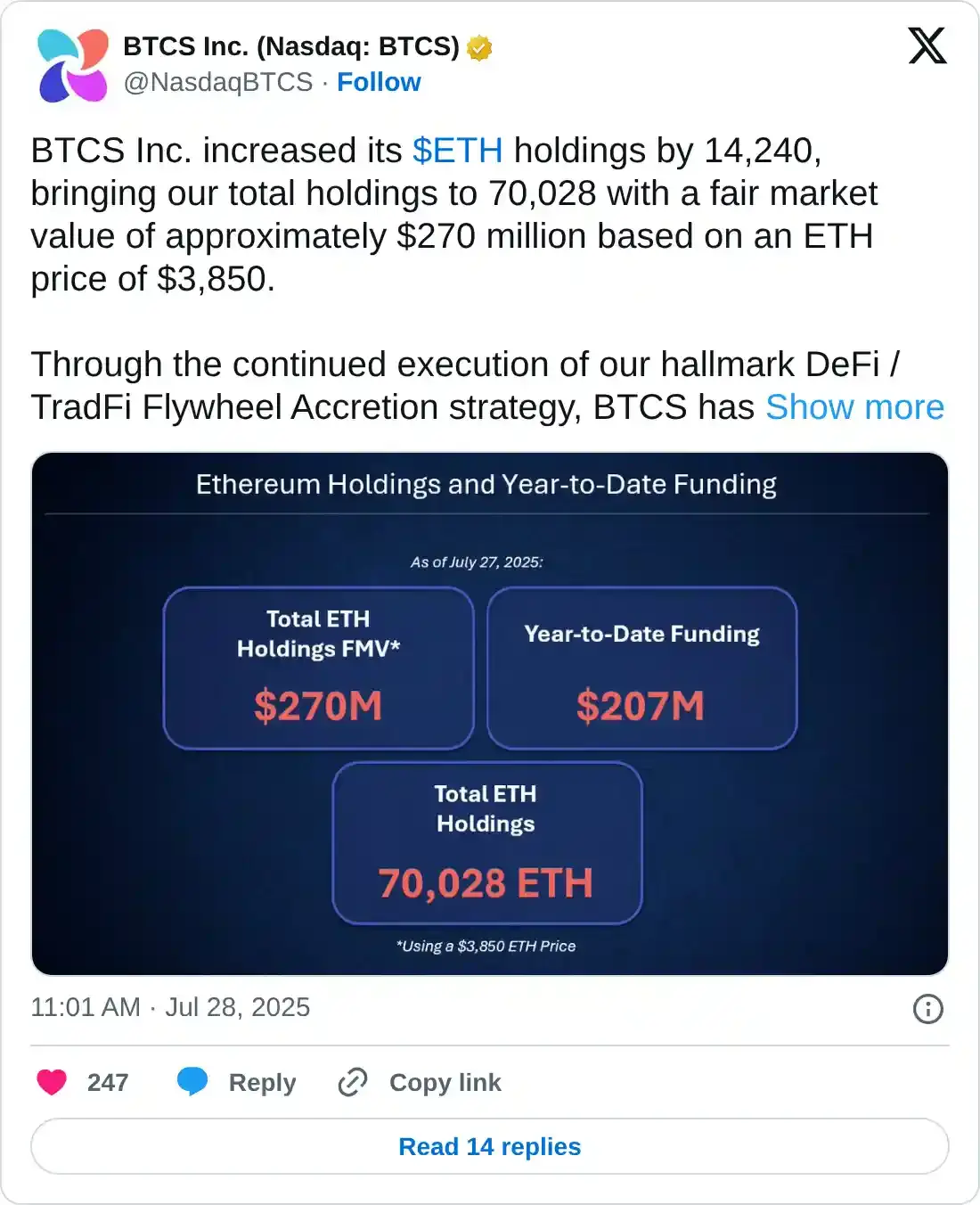
https://twitter.com/NasdaqBTCS/status/1949787329972863207

Institutional demand is also rising. According to the SoSoValue data, US spot Ethereum Exchange Traded Funds (ETFs) recorded an inflow of $218.64 on Tuesday, continuing its streak of positive flows since July 3. So far in July, the monthly flows have reached $5.41 billion, the highest level since their launch.

Total Ethereum spot ETF net inflow daily chart. Source: SoSoValue
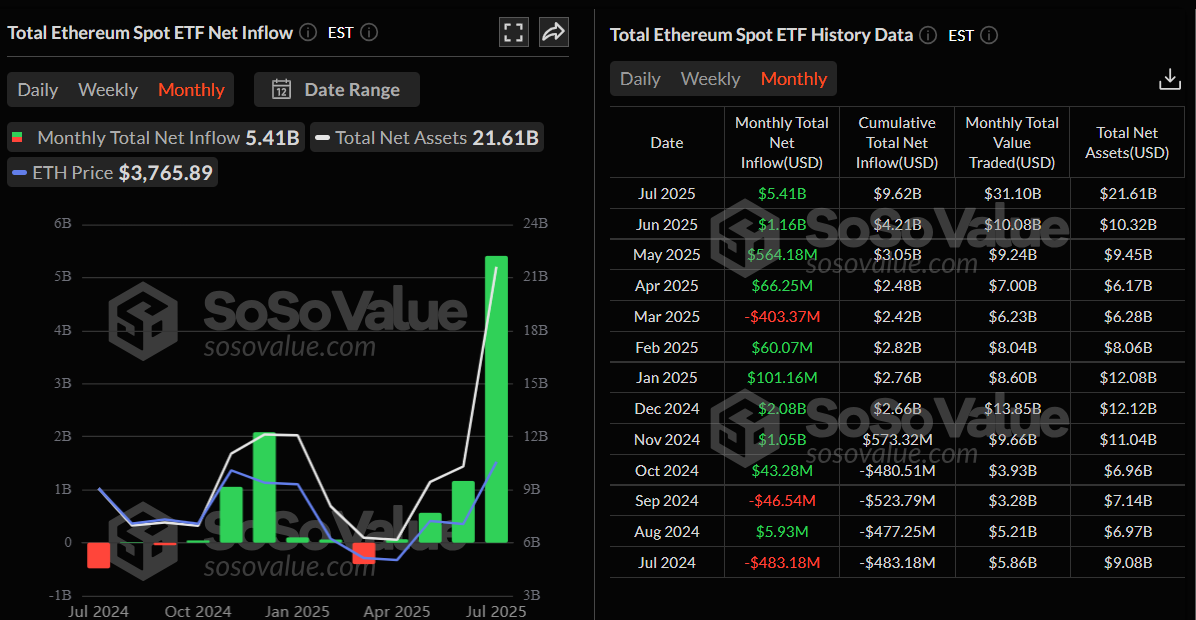
Total Ethereum spot ETF net inflow daily chart. Source: SoSoValue

Total Ethereum spot ETF net inflow monthly chart. Source: SoSoValue

Total Ethereum spot ETF net inflow monthly chart. Source: SoSoValue

US SEC acknowledges BlackRock's staking request for ETH ETF

The US Securities and Exchange Commission (SEC) acknowledged Nasdaq’s proposal to permit staking for BlackRock’s spot Ethereum ETF (ETHA) on Tuesday, signaling that the regulator could approve the highly anticipated rule change in the coming months.

If the proposal is approved, then BlackRock would be able to participate in Ethereum’s proof-of-stake consensus model using its ETFs’ funds, while also passing along those rewards to its shareholders. 

Adding to this and on the same day, the US SEC gives the green light to in-kind creations and redemptions for Bitcoin and Ethereum exchange-traded products (ETPs). This development marks a regulatory shift from the previous cash-only mechanism used for spot Bitcoin and Ethereum ETPs, now aligning crypto products with traditional commodity-based ETPs like Gold and Oil.

Volatility ahead with $2 billion shorts liquidation above $4,000

Traders await the outcome of the US Fed's interest rate decision on Wednesday, which could drive sharp volatility across ETH. While markets broadly expect the Fed to keep interest rates unchanged, any comments from Chair Jerome Powell about what will the central bank do after the summer could move markets.

CoinGlass ETH Exchange Liquidation Map data indicates that over $2 billion of ETH shorts are poised to be liquidated if Ethereum surpasses $4,000, potentially triggering a short squeeze and further fueling the rally.

Ethereum Exchange Liquidation Map chart. Source: Coinglass

Ethereum Exchange Liquidation Map chart. Source: Coinglass

Ethereum Price Forecast: ETH holds above its daily support at $3,730

Ethereum price retested and found support around its daily level at $3,500 on July 24, recovering nearly 8% and closing above the daily resistance at $3,730 on Sunday. At the start of this week on Monday, ETH reached a new year-to-date high of $3,940, but faced a slight decline the next day and retested its daily support at $3,730. At the time of writing on Wednesday, ETH trades slightly above its daily support level at $3,730.

If the daily support at $3,730 holds, ETH could continue its upward momentum targeting its key psychological level of $4,000.

The Relative Strength Index (RSI) indicator on the daily chart reads 75, above its overbought level of 70, indicating increasing chances of a correction. The Moving Average Convergence Divergence (MACD) indicator shows a bearish crossover on the daily chart, suggesting early signs of bearish momentum and a potential downward trend ahead.
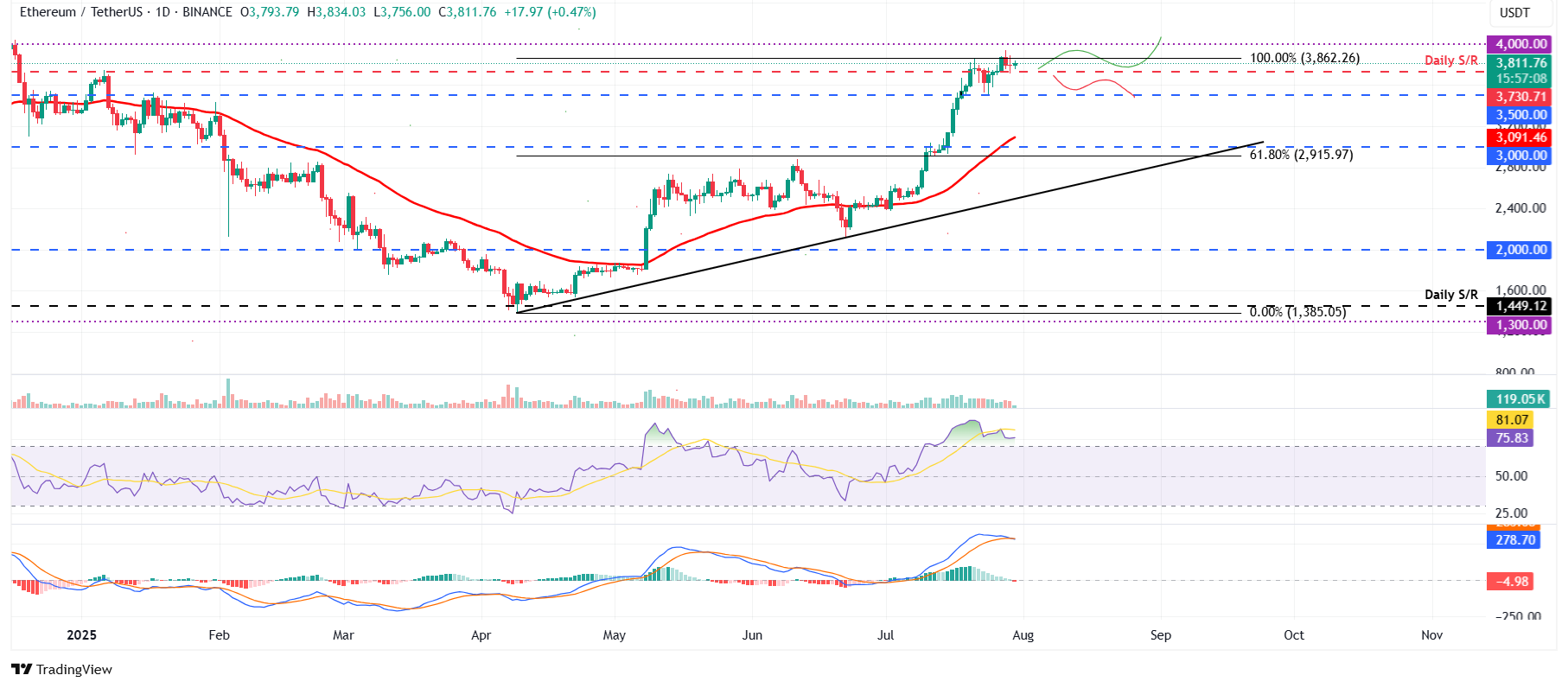
ETH/USDT daily chart 

ETH/USDT daily chart 

If ETH faces a pullback and closes below the daily support at $3,730, it could extend the decline to the next support at $3,500.

Ethereum development FAQs

After the Dencun upgrade in March 2024, Ethereum users are looking towards the Pectra upgrade slated for early 2025. The upgrade will come in two phases, featuring improved wallet experience, an upgrade to the Ethereum virtual machine (EVM), PeerDAS for scaling L2s, improvement of blob capacity, etc.

Forks are upgrades or changes to the codebase/architecture of a blockchain network. Considering blockchain networks have no central governance, forks are only carried out after developers and validators reach a consensus. Hard forks are substantial permanent changes in a blockchain protocol that create two parallel chains – one with the old rules and the new with the implemented changes. Developers can either upgrade their software to build on the new chain or remain on the old chain as a separate network. During a hard fork, users receive an equivalent amount of their tokens on the new blockchain network 1:1. Soft forks, on the other hand, are subtle changes on a blockchain network that are backwards-compatible, meaning the network still operates as a single entity even when some developers don't implement the new changes.

Famously scribbled by Ethereum co-founder Vitalik Buterin in 22 minutes, Ethereum improvement proposal EIP-7702 is an advanced way of marrying EIP-3074 and ERC-4337 to unlock massive adoption for Ethereum's smart wallet functionality. Slated to go live in the upcoming Pectra upgrade, EIP-7702 will implement an advanced version of account abstraction enabling features like batching that allows users to pay a one-off transaction fee for multiple actions, sponsorship to enable an account pay gas fees for other users and wallet recovery options if users misplace their seed phrase.

Layer 2 is a collective term for protocols that aim to scale Ethereum by processing batches of transactions off the Mainnet. After performing a series of mathematical computations to ensure their validity, these L2s send a compressed version of the transactions back to the Mainnet for final processing. As a result, Layer 2 networks reduce transaction fees and enhance the Mainnet's speed while reaping its security. Think of them like several personal assistants that help their boss to process a series of paperworks. These assistants send a summarised version of the paperworks to the boss who confirms and signs on them.

Layer 3 solutions are application-specific blockchains built upon existing Layer 2 networks to offer high scalability and interoperability. For example, an L3 can focus on tackling privacy, increased scalability, gaming, or some complex functionality while still ultimately deriving security from the Layer 1.


Market Opportunity
Smart Blockchain Logo
Smart Blockchain Price(SMART)
$0.004073
$0.004073$0.004073
-0.24%
USD
Smart Blockchain (SMART) Live Price Chart

Get Covered, Share 1M USDT

Get Covered, Share 1M USDTGet Covered, Share 1M USDT

Higher VVIP tiers, higher compensation odds.

Disclaimer: The articles reposted on this site are sourced from public platforms and are provided for informational purposes only. They do not necessarily reflect the views of MEXC. All rights remain with the original authors. If you believe any content infringes on third-party rights, please contact crypto.news@mexc.com for removal. MEXC makes no guarantees regarding the accuracy, completeness, or timeliness of the content and is not responsible for any actions taken based on the information provided. The content does not constitute financial, legal, or other professional advice, nor should it be considered a recommendation or endorsement by MEXC.

You May Also Like

Not a loophole: Singapore AI export controls let China tap US AI legally

Not a loophole: Singapore AI export controls let China tap US AI legally

American AI technology is reaching Chinese tech giants through a route that US export controls were never designed to close: Singapore. The city-state sits outside
Share
The Cryptonomist2026/07/10 14:46
Unlocking Massive Value: Curve Finance Revenue Sharing Proposal for CRV Holders

Unlocking Massive Value: Curve Finance Revenue Sharing Proposal for CRV Holders

BitcoinWorld Unlocking Massive Value: Curve Finance Revenue Sharing Proposal for CRV Holders The dynamic world of decentralized finance (DeFi) is constantly evolving, bringing forth new opportunities and innovations. A significant development is currently unfolding at Curve Finance, a leading decentralized exchange (DEX). Its founder, Michael Egorov, has put forth an exciting proposal designed to offer a more direct path for token holders to earn revenue. This initiative, centered around a new Curve Finance revenue sharing model, aims to bolster the value for those actively participating in the protocol’s governance. What is the “Yield Basis” Proposal and How Does it Work? At the core of this forward-thinking initiative is a new protocol dubbed Yield Basis. Michael Egorov introduced this concept on the CurveDAO governance forum, outlining a mechanism to distribute sustainable profits directly to CRV holders. Specifically, it targets those who stake their CRV tokens to gain veCRV, which are essential for governance participation within the Curve ecosystem. Let’s break down the initial steps of this innovative proposal: crvUSD Issuance: Before the Yield Basis protocol goes live, $60 million in crvUSD will be issued. Strategic Fund Allocation: The funds generated from the sale of these crvUSD tokens will be strategically deployed into three distinct Bitcoin-based liquidity pools: WBTC, cbBTC, and tBTC. Pool Capping: To ensure balanced risk and diversified exposure, each of these pools will be capped at $10 million. This carefully designed structure aims to establish a robust and consistent income stream, forming the bedrock of a sustainable Curve Finance revenue sharing mechanism. Why is This Curve Finance Revenue Sharing Significant for CRV Holders? This proposal marks a pivotal moment for CRV holders, particularly those dedicated to the long-term health and governance of Curve Finance. Historically, generating revenue for token holders in the DeFi space can often be complex. The Yield Basis proposal simplifies this by offering a more direct and transparent pathway to earnings. By staking CRV for veCRV, holders are not merely engaging in governance; they are now directly positioned to benefit from the protocol’s overall success. The significance of this development is multifaceted: Direct Profit Distribution: veCRV holders are set to receive a substantial share of the profits generated by the Yield Basis protocol. Incentivized Governance: This direct financial incentive encourages more users to stake their CRV, which in turn strengthens the protocol’s decentralized governance structure. Enhanced Value Proposition: The promise of sustainable revenue sharing could significantly boost the inherent value of holding and staking CRV tokens. Ultimately, this move underscores Curve Finance’s dedication to rewarding its committed community and ensuring the long-term vitality of its ecosystem through effective Curve Finance revenue sharing. Understanding the Mechanics: Profit Distribution and Ecosystem Support The distribution model for Yield Basis has been thoughtfully crafted to strike a balance between rewarding veCRV holders and supporting the wider Curve ecosystem. Under the terms of the proposal, a substantial portion of the value generated by Yield Basis will flow back to those who contribute to the protocol’s governance. Returns for veCRV Holders: A significant share, specifically between 35% and 65% of the value generated by Yield Basis, will be distributed to veCRV holders. This flexible range allows for dynamic adjustments based on market conditions and the protocol’s performance. Ecosystem Reserve: Crucially, 25% of the Yield Basis tokens will be reserved exclusively for the Curve ecosystem. This allocation can be utilized for various strategic purposes, such as funding ongoing development, issuing grants, or further incentivizing liquidity providers. This ensures the continuous growth and innovation of the platform. The proposal is currently undergoing a democratic vote on the CurveDAO governance forum, giving the community a direct voice in shaping the future of Curve Finance revenue sharing. The voting period is scheduled to conclude on September 24th. What’s Next for Curve Finance and CRV Holders? The proposed Yield Basis protocol represents a pioneering approach to sustainable revenue generation and community incentivization within the DeFi landscape. If approved by the community, this Curve Finance revenue sharing model has the potential to establish a new benchmark for how decentralized exchanges reward their most dedicated participants. It aims to foster a more robust and engaged community by directly linking governance participation with tangible financial benefits. This strategic move by Michael Egorov and the Curve Finance team highlights a strong commitment to innovation and strengthening the decentralized nature of the protocol. For CRV holders, a thorough understanding of this proposal is crucial for making informed decisions regarding their staking strategies and overall engagement with one of DeFi’s foundational platforms. FAQs about Curve Finance Revenue Sharing Q1: What is the main goal of the Yield Basis proposal? A1: The primary goal is to establish a more direct and sustainable way for CRV token holders who stake their tokens (receiving veCRV) to earn revenue from the Curve Finance protocol. Q2: How will funds be generated for the Yield Basis protocol? A2: Initially, $60 million in crvUSD will be issued and sold. The funds from this sale will then be allocated to three Bitcoin-based pools (WBTC, cbBTC, and tBTC), with each pool capped at $10 million, to generate profits. Q3: Who benefits from the Yield Basis revenue sharing? A3: The proposal states that between 35% and 65% of the value generated by Yield Basis will be returned to veCRV holders, who are CRV stakers participating in governance. Q4: What is the purpose of the 25% reserve for the Curve ecosystem? A4: This 25% reserve of Yield Basis tokens is intended to support the broader Curve ecosystem, potentially funding development, grants, or other initiatives that contribute to the platform’s growth and sustainability. Q5: When is the vote on the Yield Basis proposal? A5: A vote on the proposal is currently underway on the CurveDAO governance forum and is scheduled to run until September 24th. If you found this article insightful and valuable, please consider sharing it with your friends, colleagues, and followers on social media! Your support helps us continue to deliver important DeFi insights and analysis to a wider audience. To learn more about the latest DeFi market trends, explore our article on key developments shaping decentralized finance institutional adoption. This post Unlocking Massive Value: Curve Finance Revenue Sharing Proposal for CRV Holders first appeared on BitcoinWorld.
Share
Coinstats2025/09/18 00:35
Q2 Market Insights: Bitcoin regains dominance in risk-averse environment, ETFs remain critical to market structure


Q2 Market Insights: Bitcoin regains dominance in risk-averse environment, ETFs remain critical to market structure

The market will show a downward trend in the short term, and then rebound and set new highs in the second half of the year.
Share
PANews2025/04/28 19:40

Record Ads, Stock Down 7%

Record Ads, Stock Down 7%Record Ads, Stock Down 7%

Jul 29: Meta earnings face the market's question.

