

Vitalik Buterin: Ethereum Scaling Must Move Beyond L2s
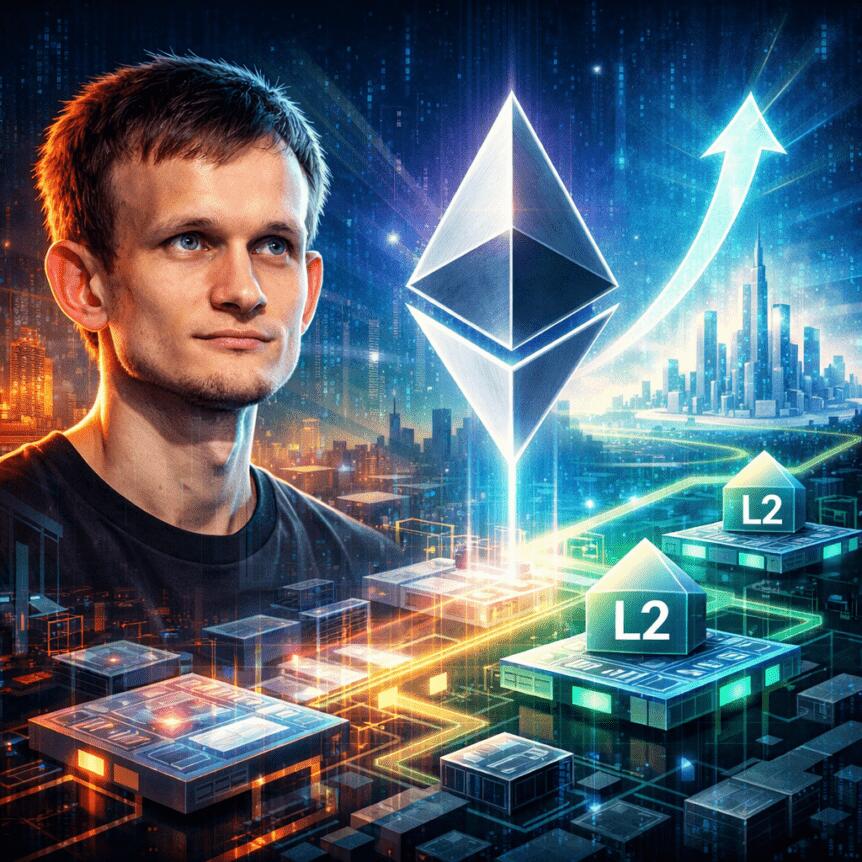
Ethereum (CRYPTO: ETH) co-founder Vitalik Buterin has reversed his long-held view that layer-2 solutions should be the primary engine for scaling the network, arguing that the approach no longer makes sense in its current form. In a concise post on X, he said a “new path” is needed as the Ethereum mainnet continues to scale through ongoing gas-limit enhancements and the advent of native rollups. The comments reflect a broader rethinking within the ecosystem about how best to relieve congestion, cut fees, and maintain robust security while enabling developers to push the boundaries of on-chain applications.
Buterin’s stance stands in contrast to years of rhetoric positioning L2s as the principal scaling lever for Ethereum. He noted that many rollups have fallen short of the decentralization and security ideals originally envisioned, and that the mainnet’s capacity is approaching a scale where a pivot toward other architectural approaches may be warranted. “Both of these facts, for their own separate reasons, mean that the original vision of L2s and their role in Ethereum no longer makes sense, and we need a new path,” he wrote, underscoring the complexity of balancing throughput with trust minimization.
Layer-2 networks—such as Arbitrum, Optimism, Base, and Starknet—were conceived as fast, low-cost extensions that inherit Ethereum’s security properties. The goal was to create block space that remains secured by the L1 mainnet, ensuring transactions could be validated and final, uncensored. But Buterin contends that many L2 designs rely on bridges and mediations that can undermine true scaling if critical security guarantees are mediated by complex cross-chain mechanisms rather than being anchored to base-layer security.
While the narrative around scaling has often centered on throughput, the discussion has also touched on the security and decentralization characteristics of L2 ecosystems. Buterin’s comment that a 10,000 TPS “EVM” connected to L1 through a multisig bridge does not represent real scaling sparked renewed debate about whether the path to higher capacity lies primarily in more efficient rollups or in a broader reconfiguration of how Ethereum processes transactions.
In related commentary, prominent voices within the ecosystem weighed in on the pivot. Max Resnick, a former Ethereum infrastructure researcher who shifted toward the Solana ecosystem when scaling emphasis cooled around mainnet improvements, argued that focusing scaling efforts on the mainnet could yield more tangible benefits for developers and users. His stance underscores a perennial tension within Ethereum’s community: should efforts concentrate on pushing more work through the base layer, or should they continue to rely on rollups to provide modular scaling while maintaining strong security guarantees?
Not all reactions were muted. Ryan Sean Adams, co-host of the Ethereum-focused program Bankless, welcomed Buterin’s pivot, calling it a clear signal for strategic realignment. “This is ‘the pivot.’ I’m glad it’s now being said. Strong ETH, Strong L1,” he wrote in a post that resonated with a segment of the community seeking a refocused emphasis on mainnet engineering and foundational security. The dialogue underscores a pragmatic reassessment of the roadmap that has long prioritized L2-centric scaling as the default path forward.
Native rollups, gas limit rises key scaling Ethereum mainnet
Buterin argues that native rollups—where certain scaling logic is effectively embedded in Ethereum’s own protocol stack—will play a central role as scaling advances mature. He emphasized the importance of native rollups that can be verified directly by Ethereum validators, a distinction from traditional off-chain rollups whose security relies on bridges and cross-layer data availability. The emphasis is on deeper integration and trust assumptions that align more closely with Ethereum’s base layer, especially as zk-based technology matures.
One of the pivotal technical developments underpinning this shift is the anticipated integration of zero-knowledge Ethereum Virtual Machine (zkEVM) proofs into the base layer. zkEVM technology promises to enable more private, scalable, and provable computations, potentially unlocking new use cases while preserving security guarantees. As zkEVM proofs become more mature and broadly integrated, the consensus is that the mainnet could handle larger volumes of transactions with stronger cryptographic assurances, reducing the reliance on peripheral L2 constructs.
Historically, rollups have functioned by batching transactions off-chain and posting summary data back to Ethereum, thereby creating a balance between speed and security. The native-rollup approach, by contrast, weaves rollup logic into the core protocol, allowing transactions to be validated by Ethereum nodes directly rather than via bridging channels. This distinction is central to the argument that true scaling may hinge on deeper, more secure mainnet integration rather than layering on external validators and bridges. The idea is to maintain Ethereum’s finality and censorship-resistance while expanding throughput more aggressively than through isolated L2 ecosystems.
Looking back at the roadmap, Ethereum developers have previously discussed expanding the mainnet’s gas capacity as a mechanism to raise throughput. In late 2025 and into early 2026, discussions circulated about increasing the gas limit from roughly 60 million to 80 million per block, contingent on the successful deployment of the blob-parameter feature and subsequent hard forks. The blob fork, designed to increase block space without sacrificing security, began rolling out in December and was fully enacted in January, enabling more complex smart contracts and higher transaction throughput per block. This capacity uplift has the potential to lessen the perceived urgency for ever-larger L2 ecosystems if efficiency gains materialize quickly enough.
Industry researchers have long projected dramatic improvements in throughput. In July of the previous year, Justin Drake proposed a 10-year plan to reach approximately 10,000 transactions per second on the Ethereum mainnet once all scaling features are in place—a figure that would mark a substantial leap over today’s throughput levels and push Ethereum closer to truly global-scale usage. While ambitious, the plan continues to anchor the debate around how best to realize scalable, secure, and decentralized computation on the chain.
As the conversation evolves, the ecosystem remains split between doubling down on the mainnet’s capabilities and leveraging rollups that can be designed for specialized use cases. Proponents of L2-heavy scaling argued that external networks could unlock rapid innovation while preserving Ethereum’s security through data availability on the mainnet. Buterin’s pivot suggests a more nuanced approach: scale on multiple layers while ensuring core security guarantees are not compromised and user trust remains central to long-term adoption.
Ultimately, the path forward may combine elements of both strategies. Native rollups could become a cornerstone of the scaling architecture, with zkEVM and other zero-knowledge proofs enabling more efficient verification on the base layer. Meanwhile, mainstream L2s could concentrate on niches—privacy-centric features, identity services, financial primitives, social apps, and even AI-driven use cases—without becoming the sole mechanism for scaling the network. The evolving stance signals a broader trend toward a more integrated, security-focused scaling framework for Ethereum.
As the debate continues, observers will watch for concrete milestones: the progress of zkEVM integration into the base layer, the deployment milestones for native rollups, and the practical impact of the upcoming gas-limit expansion on transaction costs and throughput. The dialogue also highlights the importance of maintaining a balance between innovation and security, ensuring that scaling advances do not come at the expense of decentralization or user protections. The ecosystem’s ability to execute on these milestones could shape Ethereum’s competitive position in a rapidly evolving crypto landscape.
Related: Arbitrum, Optimism, Base and Starknet are among the L2s most discussed in this pivot, but the broader question remains: can native, deeply integrated scaling finally deliver on the long-promised combination of speed, cost-efficiency, and security on the mainnet? The coming quarters are likely to reveal how far the community is willing to go in redefining Ethereum’s layering strategy, and whether the market responds to a more unified approach that prioritizes mainnet scalability and cryptographic assurances over modular, bridge-dependent solutions.
— Sources: Vitalik Buterin’s X post; zkEVM integration discussions and related zk-tech articles; discussions on gas-limit increases and blob hard forks; commentary from Max Resnick; reactions from Ryan S. Adams; and historical plans like Justin Drake’s Lean Ethereum proposal.
- Sources & verification
- Vitalik Buterin’s X post: https://x.com/VitalikButerin/status/2018711006394843585
- Zero-knowledge Ethereum Virtual Machine (zkEVM) proofs and scaling: https://cointelegraph.com/news/2026-is-the-year-ethereum-starts-scaling-exponentially-with-zk-tech
- Gas limit rise discussions: https://cointelegraph.com/news/ethereum-could-get-faster-gas-limit-rise-january
- Blob parameter hard fork and January implementation: https://cointelegraph.com/news/ethereum-blob-limit-raised-to-21-layer-2-cheaper
- Lean Ethereum concept: https://blog.ethereum.org/2025/07/31/lean-ethereum
- Max Resnick’s perspective: https://cointelegraph.com/magazine/great-enemies-ethereum-solana-anza-economist-max-resnick/
- Ryan S Adams’ reaction: https://x.com/RyanSAdams/status/2018727620624384059
- Arbitrum, Optimism, Base context: https://cointelegraph.com/news/these-5-blockchains-led-2025
This article was originally published as Vitalik Buterin: Ethereum Scaling Must Move Beyond L2s on Crypto Breaking News – your trusted source for crypto news, Bitcoin news, and blockchain updates.


You May Also Like

The changing face of elder care in Malaysia — Sayed Mohammad Reza Yamani Sayed Umar

GOP lawmakers want nothing to do with Trump's ballroom chaos: report

Not a loophole: Singapore AI export controls let China tap US AI legally



