In a thread on August 19, analyst Miles Deutscher argued that MicroStrategy’s market-implied net asset value (mNAV) premium—the core gear in Michael Saylor’s Bitcoin acquisition flywheel—has compressed sharply, weakening the feedback loop that helped the company outpace Bitcoin through most of the cycle. “Michael Saylor built the craziest BTC flywheel in history. But his buying power is starting to fade. The market is now asking one question: ‘Is the BTC treasury bubble finally popping?’” MicroStrategy’s Bitcoin Premium Is Fading Deutscher grounds the discussion in how investors currently value MicroStrategy. “People often overlook that MicroStrategy has a legacy software business, which continues to generate revenue. However, MicroStrategy has essentially become a company whose valuation is primarily influenced by its BTC holdings. The entire system is powered by mNAV (Market-Implied NAV).” In practical terms, the mNAV multiple is the premium investors pay over the company’s look-through Bitcoin value to access leveraged BTC exposure via MSTR. “An mNAV of ~1.58x means the market is paying a 58% premium for their BTC.” According to Deutscher, that premium “was once a 3.4x mNAV” when Bitcoin was surging, but it has “now decreased to 1.58x. Demand is slowing down.” In other words, what had been a powerful flywheel—high premium enabling cheap equity issuance that funded more Bitcoin purchases, which in turn kept NAV rising and the premium elevated—now spins with much less torque. Related Reading: Crypto Founder Predicts The Collapse Of Bitcoin In This Timeframe That shift intersected with a contentious corporate action. “Recently, Saylor sparked controversy by revealing that Strategy had revised its MSTR Equity ATM Guidance to offer greater ‘flexibility’ in executing its capital markets strategy.” The implication, Deutscher argues, is that greater issuance flexibility “may dilute shareholder value and increase financial risk tied to Bitcoin’s volatility.” He notes that “the market is quite divided” on the change. On the constructive side, he quotes @thedefivillain’s take—“Slower concentration of supply in Saylor’s hands,” “Greater leverage to justify mNAV,” and “Reduced buying pressure for BTC in dollar terms”—as reasons the revision could ultimately be benign. But critics worry about “the possibility of a ‘death spiral.’ The removal of the 2.5x mNAV safeguard for equity issuance may allow MicroStrategy to sell shares at lower valuations.” Reflexivity, in Deutscher’s telling, is the operative risk factor: “Reflexivity is a brutal force that operates in both directions.” A Hypothetical Scenario Deutscher then sets up a stress-test to illustrate how that reflexivity could bite if Bitcoin weakens and the premium compresses to parity. “If BTC’s price drops 20% and MicroStrategy’s mNAV multiple falls to 1.0x, the stock might plummet by 46.5%.” He walks through the arithmetic from a notional baseline of $115,000 per BTC, which on a 20% decline would fall to $92,000. On MicroStrategy’s “226,331 BTC,” he calculates that would put look-through NAV at $20.82 billion. To align an mNAV of exactly 1.0x, he backs into enterprise value and market cap under that scenario: “Starting with an enterprise value of $20.82 billion, we subtract MicroStrategy’s $2.2 billion in debt and add its $0.1 billion in cash. This calculation unveils the company’s market cap, hitting $18.72 billion, a significant pullback from its original $35 billion market cap.” Related Reading: Bitcoin Bull Run Hinges On Trump’s Pick For Fed Chair: Analyst The conclusion he draws from the modeled path—BTC −20% to ~$92,000, mNAV → 1.0x, MSTR market cap −46.5%—is that MicroStrategy’s equity remains a leveraged instrument with an outcome path that can be materially worse than Bitcoin itself when the premium compresses. Beyond the scenario math, Deutscher links recent spot price action to changing marginal demand. “I think BTC’s recent weakness can be attributed to the market starting to price in reduced Saylor demand/tail potential risk of the revised ATM guidance.” In parallel, he highlights how the proliferation of spot ETFs erodes the original rationale for paying a large listed-company premium to own BTC “beta”: “Spot Bitcoin ETFs are plentiful now. Why would you pay a 58% premium for MSTR’s leveraged exposure when you can grab IBIT at a clean ~1.0x NAV?” By his framing, the mNAV premium itself “was indicative of the market’s view that MSTR was going to outperform BTC.” With that view fading, the premium looks less like an enduring structural feature and more like a belief-sensitive variable. “In my opinion, the MSTR premium is essentially a gamble. You’re betting on three fragile things: unwavering market confidence, open capital markets, and Saylor’s leadership. If any of those pillars start to wobble, the premium collapses.” At press time, BTC traded at $113,624. Featured image created with DALL.E, chart from TradingView.comIn a thread on August 19, analyst Miles Deutscher argued that MicroStrategy’s market-implied net asset value (mNAV) premium—the core gear in Michael Saylor’s Bitcoin acquisition flywheel—has compressed sharply, weakening the feedback loop that helped the company outpace Bitcoin through most of the cycle. “Michael Saylor built the craziest BTC flywheel in history. But his buying power is starting to fade. The market is now asking one question: ‘Is the BTC treasury bubble finally popping?’” MicroStrategy’s Bitcoin Premium Is Fading Deutscher grounds the discussion in how investors currently value MicroStrategy. “People often overlook that MicroStrategy has a legacy software business, which continues to generate revenue. However, MicroStrategy has essentially become a company whose valuation is primarily influenced by its BTC holdings. The entire system is powered by mNAV (Market-Implied NAV).” In practical terms, the mNAV multiple is the premium investors pay over the company’s look-through Bitcoin value to access leveraged BTC exposure via MSTR. “An mNAV of ~1.58x means the market is paying a 58% premium for their BTC.” According to Deutscher, that premium “was once a 3.4x mNAV” when Bitcoin was surging, but it has “now decreased to 1.58x. Demand is slowing down.” In other words, what had been a powerful flywheel—high premium enabling cheap equity issuance that funded more Bitcoin purchases, which in turn kept NAV rising and the premium elevated—now spins with much less torque. Related Reading: Crypto Founder Predicts The Collapse Of Bitcoin In This Timeframe That shift intersected with a contentious corporate action. “Recently, Saylor sparked controversy by revealing that Strategy had revised its MSTR Equity ATM Guidance to offer greater ‘flexibility’ in executing its capital markets strategy.” The implication, Deutscher argues, is that greater issuance flexibility “may dilute shareholder value and increase financial risk tied to Bitcoin’s volatility.” He notes that “the market is quite divided” on the change. On the constructive side, he quotes @thedefivillain’s take—“Slower concentration of supply in Saylor’s hands,” “Greater leverage to justify mNAV,” and “Reduced buying pressure for BTC in dollar terms”—as reasons the revision could ultimately be benign. But critics worry about “the possibility of a ‘death spiral.’ The removal of the 2.5x mNAV safeguard for equity issuance may allow MicroStrategy to sell shares at lower valuations.” Reflexivity, in Deutscher’s telling, is the operative risk factor: “Reflexivity is a brutal force that operates in both directions.” A Hypothetical Scenario Deutscher then sets up a stress-test to illustrate how that reflexivity could bite if Bitcoin weakens and the premium compresses to parity. “If BTC’s price drops 20% and MicroStrategy’s mNAV multiple falls to 1.0x, the stock might plummet by 46.5%.” He walks through the arithmetic from a notional baseline of $115,000 per BTC, which on a 20% decline would fall to $92,000. On MicroStrategy’s “226,331 BTC,” he calculates that would put look-through NAV at $20.82 billion. To align an mNAV of exactly 1.0x, he backs into enterprise value and market cap under that scenario: “Starting with an enterprise value of $20.82 billion, we subtract MicroStrategy’s $2.2 billion in debt and add its $0.1 billion in cash. This calculation unveils the company’s market cap, hitting $18.72 billion, a significant pullback from its original $35 billion market cap.” Related Reading: Bitcoin Bull Run Hinges On Trump’s Pick For Fed Chair: Analyst The conclusion he draws from the modeled path—BTC −20% to ~$92,000, mNAV → 1.0x, MSTR market cap −46.5%—is that MicroStrategy’s equity remains a leveraged instrument with an outcome path that can be materially worse than Bitcoin itself when the premium compresses. Beyond the scenario math, Deutscher links recent spot price action to changing marginal demand. “I think BTC’s recent weakness can be attributed to the market starting to price in reduced Saylor demand/tail potential risk of the revised ATM guidance.” In parallel, he highlights how the proliferation of spot ETFs erodes the original rationale for paying a large listed-company premium to own BTC “beta”: “Spot Bitcoin ETFs are plentiful now. Why would you pay a 58% premium for MSTR’s leveraged exposure when you can grab IBIT at a clean ~1.0x NAV?” By his framing, the mNAV premium itself “was indicative of the market’s view that MSTR was going to outperform BTC.” With that view fading, the premium looks less like an enduring structural feature and more like a belief-sensitive variable. “In my opinion, the MSTR premium is essentially a gamble. You’re betting on three fragile things: unwavering market confidence, open capital markets, and Saylor’s leadership. If any of those pillars start to wobble, the premium collapses.” At press time, BTC traded at $113,624. Featured image created with DALL.E, chart from TradingView.com

Is The Bitcoin Treasury Bubble Popping? Expert Answers

2025/08/21 09:00

In a thread on August 19, analyst Miles Deutscher argued that MicroStrategy’s market-implied net asset value (mNAV) premium—the core gear in Michael Saylor’s Bitcoin acquisition flywheel—has compressed sharply, weakening the feedback loop that helped the company outpace Bitcoin through most of the cycle. “Michael Saylor built the craziest BTC flywheel in history. But his buying power is starting to fade. The market is now asking one question: ‘Is the BTC treasury bubble finally popping?’”

MicroStrategy’s Bitcoin Premium Is Fading

Deutscher grounds the discussion in how investors currently value MicroStrategy. “People often overlook that MicroStrategy has a legacy software business, which continues to generate revenue. However, MicroStrategy has essentially become a company whose valuation is primarily influenced by its BTC holdings. The entire system is powered by mNAV (Market-Implied NAV).”

In practical terms, the mNAV multiple is the premium investors pay over the company’s look-through Bitcoin value to access leveraged BTC exposure via MSTR. “An mNAV of ~1.58x means the market is paying a 58% premium for their BTC.” According to Deutscher, that premium “was once a 3.4x mNAV” when Bitcoin was surging, but it has “now decreased to 1.58x. Demand is slowing down.” In other words, what had been a powerful flywheel—high premium enabling cheap equity issuance that funded more Bitcoin purchases, which in turn kept NAV rising and the premium elevated—now spins with much less torque.

That shift intersected with a contentious corporate action. “Recently, Saylor sparked controversy by revealing that Strategy had revised its MSTR Equity ATM Guidance to offer greater ‘flexibility’ in executing its capital markets strategy.” The implication, Deutscher argues, is that greater issuance flexibility “may dilute shareholder value and increase financial risk tied to Bitcoin’s volatility.”

He notes that “the market is quite divided” on the change. On the constructive side, he quotes @thedefivillain’s take—“Slower concentration of supply in Saylor’s hands,” “Greater leverage to justify mNAV,” and “Reduced buying pressure for BTC in dollar terms”—as reasons the revision could ultimately be benign.

But critics worry about “the possibility of a ‘death spiral.’ The removal of the 2.5x mNAV safeguard for equity issuance may allow MicroStrategy to sell shares at lower valuations.” Reflexivity, in Deutscher’s telling, is the operative risk factor: “Reflexivity is a brutal force that operates in both directions.”

A Hypothetical Scenario

Deutscher then sets up a stress-test to illustrate how that reflexivity could bite if Bitcoin weakens and the premium compresses to parity. “If BTC’s price drops 20% and MicroStrategy’s mNAV multiple falls to 1.0x, the stock might plummet by 46.5%.”

He walks through the arithmetic from a notional baseline of $115,000 per BTC, which on a 20% decline would fall to $92,000. On MicroStrategy’s “226,331 BTC,” he calculates that would put look-through NAV at $20.82 billion.

To align an mNAV of exactly 1.0x, he backs into enterprise value and market cap under that scenario: “Starting with an enterprise value of $20.82 billion, we subtract MicroStrategy’s $2.2 billion in debt and add its $0.1 billion in cash. This calculation unveils the company’s market cap, hitting $18.72 billion, a significant pullback from its original $35 billion market cap.”

The conclusion he draws from the modeled path—BTC −20% to ~$92,000, mNAV → 1.0x, MSTR market cap −46.5%—is that MicroStrategy’s equity remains a leveraged instrument with an outcome path that can be materially worse than Bitcoin itself when the premium compresses.

Beyond the scenario math, Deutscher links recent spot price action to changing marginal demand. “I think BTC’s recent weakness can be attributed to the market starting to price in reduced Saylor demand/tail potential risk of the revised ATM guidance.”

In parallel, he highlights how the proliferation of spot ETFs erodes the original rationale for paying a large listed-company premium to own BTC “beta”: “Spot Bitcoin ETFs are plentiful now. Why would you pay a 58% premium for MSTR’s leveraged exposure when you can grab IBIT at a clean ~1.0x NAV?”

By his framing, the mNAV premium itself “was indicative of the market’s view that MSTR was going to outperform BTC.” With that view fading, the premium looks less like an enduring structural feature and more like a belief-sensitive variable. “In my opinion, the MSTR premium is essentially a gamble. You’re betting on three fragile things: unwavering market confidence, open capital markets, and Saylor’s leadership. If any of those pillars start to wobble, the premium collapses.”

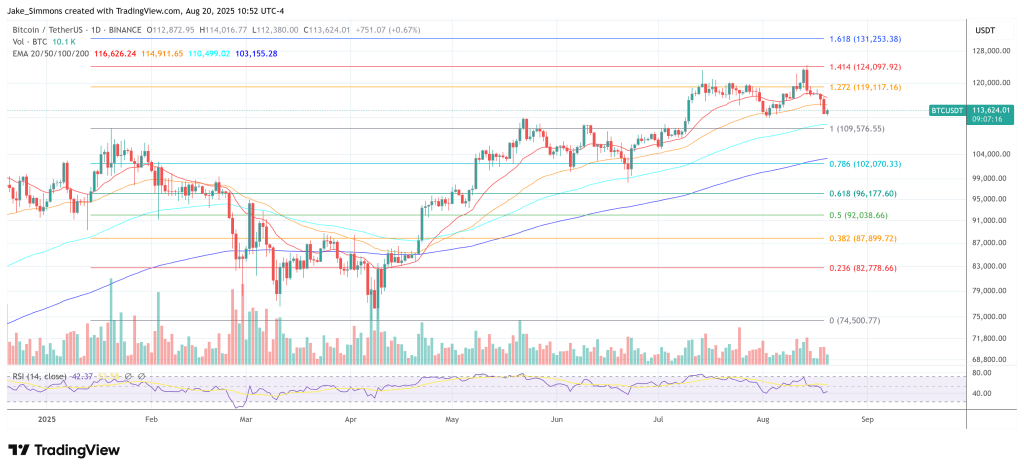
At press time, BTC traded at $113,624.

Bitcoin price
Market Opportunity
Gearbox Logo
Gearbox Price(GEAR)
$0,0010161
$0,0010161$0,0010161
+1,17%
USD
Gearbox (GEAR) Live Price Chart
Disclaimer: The articles reposted on this site are sourced from public platforms and are provided for informational purposes only. They do not necessarily reflect the views of MEXC. All rights remain with the original authors. If you believe any content infringes on third-party rights, please contact service@support.mexc.com for removal. MEXC makes no guarantees regarding the accuracy, completeness, or timeliness of the content and is not responsible for any actions taken based on the information provided. The content does not constitute financial, legal, or other professional advice, nor should it be considered a recommendation or endorsement by MEXC.

You May Also Like

BlackRock boosts AI and US equity exposure in $185 billion models

BlackRock boosts AI and US equity exposure in $185 billion models

The post BlackRock boosts AI and US equity exposure in $185 billion models appeared on BitcoinEthereumNews.com. BlackRock is steering $185 billion worth of model portfolios deeper into US stocks and artificial intelligence. The decision came this week as the asset manager adjusted its entire model suite, increasing its equity allocation and dumping exposure to international developed markets. The firm now sits 2% overweight on stocks, after money moved between several of its biggest exchange-traded funds. This wasn’t a slow shuffle. Billions flowed across multiple ETFs on Tuesday as BlackRock executed the realignment. The iShares S&P 100 ETF (OEF) alone brought in $3.4 billion, the largest single-day haul in its history. The iShares Core S&P 500 ETF (IVV) collected $2.3 billion, while the iShares US Equity Factor Rotation Active ETF (DYNF) added nearly $2 billion. The rebalancing triggered swift inflows and outflows that realigned investor exposure on the back of performance data and macroeconomic outlooks. BlackRock raises equities on strong US earnings The model updates come as BlackRock backs the rally in American stocks, fueled by strong earnings and optimism around rate cuts. In an investment letter obtained by Bloomberg, the firm said US companies have delivered 11% earnings growth since the third quarter of 2024. Meanwhile, earnings across other developed markets barely touched 2%. That gap helped push the decision to drop international holdings in favor of American ones. Michael Gates, lead portfolio manager for BlackRock’s Target Allocation ETF model portfolio suite, said the US market is the only one showing consistency in sales growth, profit delivery, and revisions in analyst forecasts. “The US equity market continues to stand alone in terms of earnings delivery, sales growth and sustainable trends in analyst estimates and revisions,” Michael wrote. He added that non-US developed markets lagged far behind, especially when it came to sales. This week’s changes reflect that position. The move was made ahead of the Federal…
Share
BitcoinEthereumNews2025/09/18 01:44
China Bans Nvidia’s RTX Pro 6000D Chip Amid AI Hardware Push

China Bans Nvidia’s RTX Pro 6000D Chip Amid AI Hardware Push

TLDR China instructs major firms to cancel orders for Nvidia’s RTX Pro 6000D chip. Nvidia shares drop 1.5% after China’s ban on key AI hardware. China accelerates development of domestic AI chips, reducing U.S. tech reliance. Crypto and AI sectors may seek alternatives due to limited Nvidia access in China. China has taken a bold [...] The post China Bans Nvidia’s RTX Pro 6000D Chip Amid AI Hardware Push appeared first on CoinCentral.
Share
Coincentral2025/09/18 01:09
Pi Network News: New Developments Could Push Price to $0.40

Pi Network News: New Developments Could Push Price to $0.40

Analysts highlight new Pi Network developments that could lift its price toward $0.40 in 2025.
Share
Blockchainreporter2025/09/18 07:59