Bitcoin is navigating a critical juncture after reaching a new all-time high of $124,500 last week before quickly retreating. The price is now searching for support, with volatility intensifying and traders debating whether this is the start of a deeper correction or simply a healthy consolidation phase before continuation. Some analysts remain optimistic, seeing this pullback as a natural reset in an overheated market, while others argue that momentum is fading as bearish signals emerge. Related Reading: Ethereum Treasury Boom Drives Demand: Can The Market Handle The Risks? Adding weight to the discussion, CryptoQuant analyst Axel Adler highlighted a key trend in retail participation. The share of retail transfers in the $0–$10K range within Bitcoin’s total USD turnover has been steadily declining throughout this cycle. From a peak of 2.7%, the share has now dropped to just 0.6%. Historically, such declines in retail participation have coincided with the later stages of bull cycles. This dynamic raises questions about whether the current phase marks a cooling of retail enthusiasm at a critical time for Bitcoin, as institutional and long-term holders dominate market structure. Bitcoin Retail Activity Declines as Market Cools According to CryptoQuant analyst Axel Adler, while the share of retail activity in Bitcoin’s network has dropped sharply, in absolute terms it still remains significant. Retail transfers in the $0–$10K range amount to over $400 million per day, but this represents only 0.6% of total USD turnover across the network. This shrinking share highlights a clear trend: while small investors are still active, their relative impact on overall market flows is diminishing. Adler notes that this cooling of retail demand was also observed in autumn 2021, at the peak of the previous cycle. At that time, the retail share fell to a historic low of just 0.19%, coinciding with overheated market conditions and marking the final stages of that bull cycle. The current decline in retail participation mirrors that pattern, suggesting that the market could be approaching a similar late-cycle environment. This dynamic is important because retail investors have traditionally been a strong driver of momentum during bull markets. With their reduced influence, institutional flows, long-term holders, and treasury strategies now play an even greater role in shaping market direction. The coming weeks will be critical as altcoins, led by Ethereum, show renewed strength. ETH is approaching its 2021 all-time high, and many analysts believe that its performance could dictate the broader crypto market’s next move. If retail demand continues to fade while institutional accumulation grows, Bitcoin may consolidate further, while capital rotation toward altcoins gains momentum. Related Reading: Ethereum Demand Holds Despite Pullback: New Whales Enter With $192M Buys Bulls Defend Key Demand Level The 8-hour chart shows Bitcoin (BTC) under pressure as it trades near $113,400, struggling to hold above its 200-day moving average (red line), currently aligned around $113,416. This level has become a critical support zone after BTC failed to sustain momentum above the $123,217 resistance, which has acted as a clear rejection point multiple times this cycle. Shorter-term moving averages highlight the bearish momentum. The 50-day SMA (blue) at $117,017 and the 100-day SMA (green) at $117,087 are both trending above the current price, creating overhead resistance. The breakdown below these averages confirms a weakening trend, with BTC struggling to regain lost ground. Price action also shows a sequence of lower highs and lower lows since the rejection at the $124K zone, reinforcing bearish short-term sentiment. Related Reading: Bitcoin Short-Term Holders Flip To Losses For First Time Since January For bulls, reclaiming the 100-day SMA near $117K would be key to reversing momentum and reattempting a push toward the $120K–$123K range. Failure to hold the 200-day SMA risks accelerating downside, potentially opening the path toward $110K, a major psychological level. Featured image from Dall-E, chart from TradingViewBitcoin is navigating a critical juncture after reaching a new all-time high of $124,500 last week before quickly retreating. The price is now searching for support, with volatility intensifying and traders debating whether this is the start of a deeper correction or simply a healthy consolidation phase before continuation. Some analysts remain optimistic, seeing this pullback as a natural reset in an overheated market, while others argue that momentum is fading as bearish signals emerge. Related Reading: Ethereum Treasury Boom Drives Demand: Can The Market Handle The Risks? Adding weight to the discussion, CryptoQuant analyst Axel Adler highlighted a key trend in retail participation. The share of retail transfers in the $0–$10K range within Bitcoin’s total USD turnover has been steadily declining throughout this cycle. From a peak of 2.7%, the share has now dropped to just 0.6%. Historically, such declines in retail participation have coincided with the later stages of bull cycles. This dynamic raises questions about whether the current phase marks a cooling of retail enthusiasm at a critical time for Bitcoin, as institutional and long-term holders dominate market structure. Bitcoin Retail Activity Declines as Market Cools According to CryptoQuant analyst Axel Adler, while the share of retail activity in Bitcoin’s network has dropped sharply, in absolute terms it still remains significant. Retail transfers in the $0–$10K range amount to over $400 million per day, but this represents only 0.6% of total USD turnover across the network. This shrinking share highlights a clear trend: while small investors are still active, their relative impact on overall market flows is diminishing. Adler notes that this cooling of retail demand was also observed in autumn 2021, at the peak of the previous cycle. At that time, the retail share fell to a historic low of just 0.19%, coinciding with overheated market conditions and marking the final stages of that bull cycle. The current decline in retail participation mirrors that pattern, suggesting that the market could be approaching a similar late-cycle environment. This dynamic is important because retail investors have traditionally been a strong driver of momentum during bull markets. With their reduced influence, institutional flows, long-term holders, and treasury strategies now play an even greater role in shaping market direction. The coming weeks will be critical as altcoins, led by Ethereum, show renewed strength. ETH is approaching its 2021 all-time high, and many analysts believe that its performance could dictate the broader crypto market’s next move. If retail demand continues to fade while institutional accumulation grows, Bitcoin may consolidate further, while capital rotation toward altcoins gains momentum. Related Reading: Ethereum Demand Holds Despite Pullback: New Whales Enter With $192M Buys Bulls Defend Key Demand Level The 8-hour chart shows Bitcoin (BTC) under pressure as it trades near $113,400, struggling to hold above its 200-day moving average (red line), currently aligned around $113,416. This level has become a critical support zone after BTC failed to sustain momentum above the $123,217 resistance, which has acted as a clear rejection point multiple times this cycle. Shorter-term moving averages highlight the bearish momentum. The 50-day SMA (blue) at $117,017 and the 100-day SMA (green) at $117,087 are both trending above the current price, creating overhead resistance. The breakdown below these averages confirms a weakening trend, with BTC struggling to regain lost ground. Price action also shows a sequence of lower highs and lower lows since the rejection at the $124K zone, reinforcing bearish short-term sentiment. Related Reading: Bitcoin Short-Term Holders Flip To Losses For First Time Since January For bulls, reclaiming the 100-day SMA near $117K would be key to reversing momentum and reattempting a push toward the $120K–$123K range. Failure to hold the 200-day SMA risks accelerating downside, potentially opening the path toward $110K, a major psychological level. Featured image from Dall-E, chart from TradingView

Bitcoin Retail Transfers Collapse: Lowest Since Bull Market Peak In 2021

2025/08/22 04:00
3 min read

Bitcoin is navigating a critical juncture after reaching a new all-time high of $124,500 last week before quickly retreating. The price is now searching for support, with volatility intensifying and traders debating whether this is the start of a deeper correction or simply a healthy consolidation phase before continuation. Some analysts remain optimistic, seeing this pullback as a natural reset in an overheated market, while others argue that momentum is fading as bearish signals emerge.

Adding weight to the discussion, CryptoQuant analyst Axel Adler highlighted a key trend in retail participation. The share of retail transfers in the $0–$10K range within Bitcoin’s total USD turnover has been steadily declining throughout this cycle. From a peak of 2.7%, the share has now dropped to just 0.6%.

Historically, such declines in retail participation have coincided with the later stages of bull cycles. This dynamic raises questions about whether the current phase marks a cooling of retail enthusiasm at a critical time for Bitcoin, as institutional and long-term holders dominate market structure.

Bitcoin Retail Activity Declines as Market Cools

According to CryptoQuant analyst Axel Adler, while the share of retail activity in Bitcoin’s network has dropped sharply, in absolute terms it still remains significant. Retail transfers in the $0–$10K range amount to over $400 million per day, but this represents only 0.6% of total USD turnover across the network. This shrinking share highlights a clear trend: while small investors are still active, their relative impact on overall market flows is diminishing.
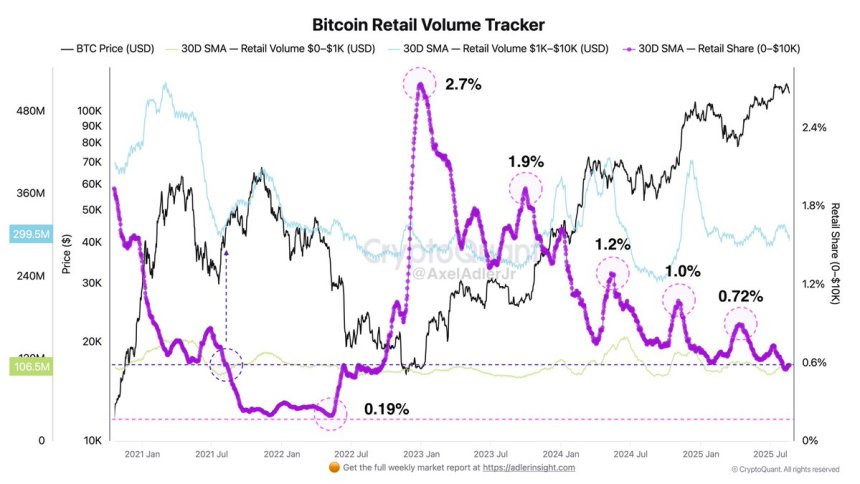
Bitcoin Retail Volume Tracker | Source: Axel Adler

Adler notes that this cooling of retail demand was also observed in autumn 2021, at the peak of the previous cycle. At that time, the retail share fell to a historic low of just 0.19%, coinciding with overheated market conditions and marking the final stages of that bull cycle. The current decline in retail participation mirrors that pattern, suggesting that the market could be approaching a similar late-cycle environment.

This dynamic is important because retail investors have traditionally been a strong driver of momentum during bull markets. With their reduced influence, institutional flows, long-term holders, and treasury strategies now play an even greater role in shaping market direction. The coming weeks will be critical as altcoins, led by Ethereum, show renewed strength. ETH is approaching its 2021 all-time high, and many analysts believe that its performance could dictate the broader crypto market’s next move.

If retail demand continues to fade while institutional accumulation grows, Bitcoin may consolidate further, while capital rotation toward altcoins gains momentum.

Bulls Defend Key Demand Level

The 8-hour chart shows Bitcoin (BTC) under pressure as it trades near $113,400, struggling to hold above its 200-day moving average (red line), currently aligned around $113,416. This level has become a critical support zone after BTC failed to sustain momentum above the $123,217 resistance, which has acted as a clear rejection point multiple times this cycle.
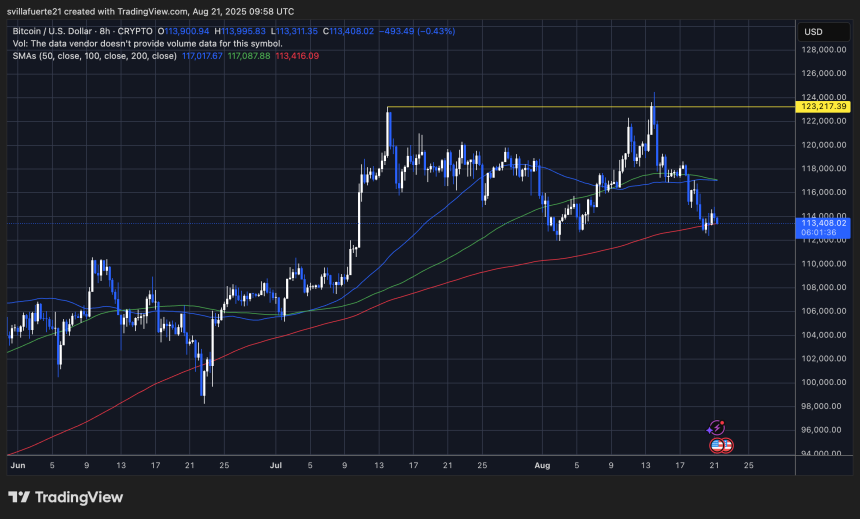
BTC testing pivotal level | Source: BTCUSDT chart on TradingView

Shorter-term moving averages highlight the bearish momentum. The 50-day SMA (blue) at $117,017 and the 100-day SMA (green) at $117,087 are both trending above the current price, creating overhead resistance. The breakdown below these averages confirms a weakening trend, with BTC struggling to regain lost ground. Price action also shows a sequence of lower highs and lower lows since the rejection at the $124K zone, reinforcing bearish short-term sentiment.

For bulls, reclaiming the 100-day SMA near $117K would be key to reversing momentum and reattempting a push toward the $120K–$123K range. Failure to hold the 200-day SMA risks accelerating downside, potentially opening the path toward $110K, a major psychological level.

Featured image from Dall-E, chart from TradingView

Market Opportunity
NEAR Logo
NEAR Price(NEAR)
$0.978
$0.978$0.978
-7.82%
USD
NEAR (NEAR) Live Price Chart
Disclaimer: The articles reposted on this site are sourced from public platforms and are provided for informational purposes only. They do not necessarily reflect the views of MEXC. All rights remain with the original authors. If you believe any content infringes on third-party rights, please contact service@support.mexc.com for removal. MEXC makes no guarantees regarding the accuracy, completeness, or timeliness of the content and is not responsible for any actions taken based on the information provided. The content does not constitute financial, legal, or other professional advice, nor should it be considered a recommendation or endorsement by MEXC.

You May Also Like

Microsoft Corp. $MSFT blue box area offers a buying opportunity

Microsoft Corp. $MSFT blue box area offers a buying opportunity

The post Microsoft Corp. $MSFT blue box area offers a buying opportunity appeared on BitcoinEthereumNews.com. In today’s article, we’ll examine the recent performance of Microsoft Corp. ($MSFT) through the lens of Elliott Wave Theory. We’ll review how the rally from the April 07, 2025 low unfolded as a 5-wave impulse followed by a 3-swing correction (ABC) and discuss our forecast for the next move. Let’s dive into the structure and expectations for this stock. Five wave impulse structure + ABC + WXY correction $MSFT 8H Elliott Wave chart 9.04.2025 In the 8-hour Elliott Wave count from Sep 04, 2025, we saw that $MSFT completed a 5-wave impulsive cycle at red III. As expected, this initial wave prompted a pullback. We anticipated this pullback to unfold in 3 swings and find buyers in the equal legs area between $497.02 and $471.06 This setup aligns with a typical Elliott Wave correction pattern (ABC), in which the market pauses briefly before resuming its primary trend. $MSFT 8H Elliott Wave chart 7.14.2025 The update, 10 days later, shows the stock finding support from the equal legs area as predicted allowing traders to get risk free. The stock is expected to bounce towards 525 – 532 before deciding if the bounce is a connector or the next leg higher. A break into new ATHs will confirm the latter and can see it trade higher towards 570 – 593 area. Until then, traders should get risk free and protect their capital in case of a WXY double correction. Conclusion In conclusion, our Elliott Wave analysis of Microsoft Corp. ($MSFT) suggested that it remains supported against April 07, 2025 lows and bounce from the blue box area. In the meantime, keep an eye out for any corrective pullbacks that may offer entry opportunities. By applying Elliott Wave Theory, traders can better anticipate the structure of upcoming moves and enhance risk management in volatile markets. Source: https://www.fxstreet.com/news/microsoft-corp-msft-blue-box-area-offers-a-buying-opportunity-202509171323
Share
BitcoinEthereumNews2025/09/18 03:50
Marathon Digital BTC Transfers Highlight Miner Stress

Marathon Digital BTC Transfers Highlight Miner Stress

The post Marathon Digital BTC Transfers Highlight Miner Stress appeared on BitcoinEthereumNews.com. In a tense week for crypto markets, marathon digital has drawn
Share
BitcoinEthereumNews2026/02/06 15:16
Fintech in a Fragmented World: Building Financial Products Across Geopolitical Lines

Fintech in a Fragmented World: Building Financial Products Across Geopolitical Lines

For most of the last ten years, the fintech growth story was one without borders. Startups made digital wallets, payment platforms, lending systems, and trading
Share
Globalfintechseries2026/02/06 15:17