Strategy founder Michael Saylor unveiled a plan to convert roughly $6 billion of convertible debt into equity, a move designed to ease balance‑sheet pressure whileStrategy founder Michael Saylor unveiled a plan to convert roughly $6 billion of convertible debt into equity, a move designed to ease balance‑sheet pressure while

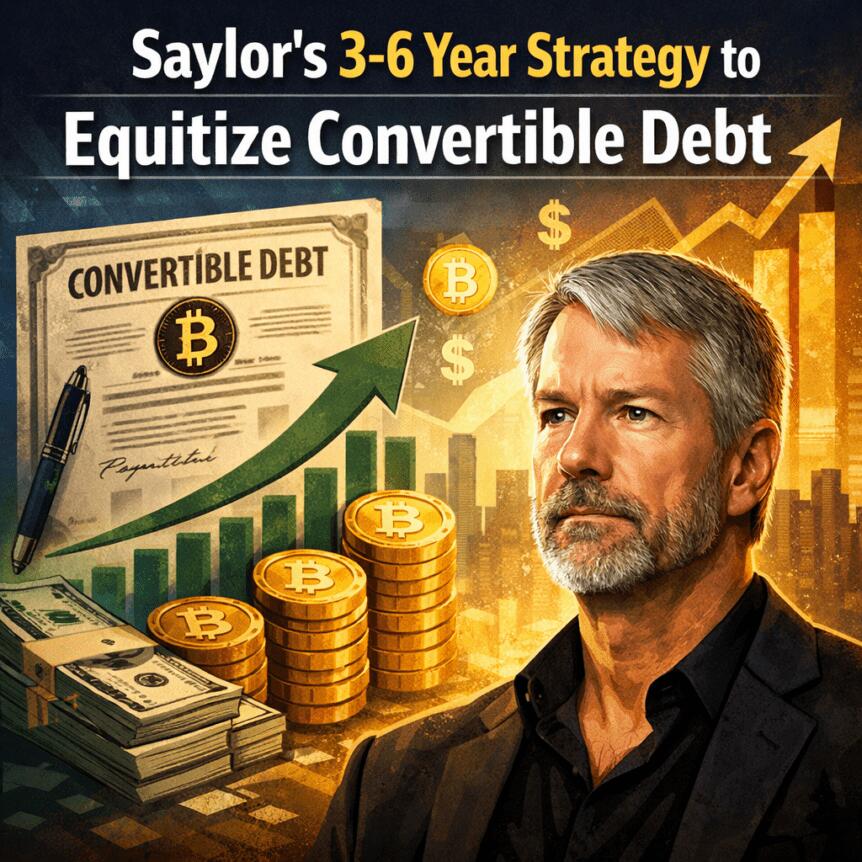
Saylor’s 3-6 Year Strategy to Equitize Convertible Debt
For feedback or concerns regarding this content, please contact us at crypto.news@mexc.com
Saylor's 3-6 Year Strategy To Equitize Convertible Debt

Strategy founder Michael Saylor unveiled a plan to convert roughly $6 billion of convertible debt into equity, a move designed to ease balance‑sheet pressure while preserving the firm’s Bitcoin holdings. The company maintains a Bitcoin treasury of about 714,644 BTC, valued at roughly $49 billion at current prices, a substantial cushion for its leverage profile. Equitizing the debt—converting bonds into equity rather than repaying cash—would turn bondholders into shareholders and reduce near‑term debt obligations. The announcement, prompted by a Sunday post on X, followed a public assertion that the plan could withstand a dramatic BTC price drop and still fully cover the debt, a claim the firm made in a message linked to a Saylor post. The news comes as the market contends with sharp volatility and a price environment that has kept BTC trading in a wide range around the high 60,000s.

Key takeaways

  • Strategy plans to convert about $6 billion of convertible debt into equity, reducing debt exposure without a cash repayment.
  • The firm’s Bitcoin treasury stands at approximately 714,644 BTC, underpinning the balance sheet with a sizeable asset base worth tens of billions of dollars at current prices.
  • Bond-to-equity conversion hinges on BTC price sensitivity; the firm argues that BTC would need to fall about 88% for the debt and equity to be equivalent on a value basis.
  • Equitization could dilute existing shareholders by issuing new stock, though it also eases pressure on cash flow and debt servicing.
  • The company has continued accumulating BTC, signaling a persistent long‑term thesis even as market prices dip.
  • Strategy’s stock has fallen roughly 70% from its all‑time high, reflecting broader declines in crypto markets and investor sentiment as BTC fluctuates near $68,000–$70,000.

Tickers mentioned: $BTC, $MSTR

Sentiment: Neutral

Price impact: Neutral. The described debt conversion is a balance‑sheet adjustment rather than a direct price move.

Trading idea (Not Financial Advice): Hold. The company is pursuing structural relief through equity issuance while continuing to accumulate BTC, which could support downside protection if BTC stabilizes or recovers.

Market context: The strategy reflects a broader approach among BTC‑heavy firms to balance debt with control over equity issuance, as crypto markets experience episodic volatility and shifting investor risk appetite.

Why it matters

The move to convert debt into equity spotlights a pragmatic path for crypto‑native companies seeking to de‑risk their balance sheets without selling large BTC holdings into a volatile market. If successful, the conversion could limit cash obligations and preserve a strategic BTC reserve that could support future liquidity needs. For investors, the key question is how the equity dilution will affect existing shareholders and whether the new capital structure will provide a clearer path to profitability as BTC remains a cornerstone of Strategy’s balance sheet.

From a market perspective, Strategy’s strategy tests how far a BTC‑backed business can lean on its crypto reserves while weathering price swings and volatility in both digital assets and traditional equity markets. The company contends its BTC hoard provides a robust cushion, even if the price of BTC experiences extended drawdowns. The dynamic between debt relief and equity dilution will be watched closely by investors and analysts, particularly as BTC prices hover in a historically elevated but highly cyclical band and as the broader market evaluates the durability of corporate treasury strategies tied to crypto assets.

What to watch next

  • Details on the final terms of the debt‑to‑equity conversion, including any changes to voting rights, dilution thresholds, and timing of the issuance.
  • Any updates to the BTC accumulation program, including changes to the size of the reserve and the cadence of purchases.
  • Regulatory developments around convertible notes and crypto treasuries that could influence balance‑sheet choices for BTC‑heavy companies.
  • Further commentary from Michael Saylor or Strategy on future buy signals or treasury strategy, including additional posts on X.

Sources & verification

  • Strategy’s official posts and remarks on X detailing the debt conversion and BTC holdings.
  • Historical data on Strategy’s stock price (MSTR) and Bitcoin price data from referenced sources (Google Finance, CoinGecko).
  • Previously published articles referenced in the original piece about Saylor’s buy signals and prior accumulation episodes.

Strategy’s balance sheet reshaped by a debt-to-equity plan

Strategy’s planned move to convert about $6 billion of convertible debt into equity reflects a deliberate effort to pare back leverage while preserving governance and the strategic advantage of its bitcoin reserves. Bitcoin (CRYPTO: BTC) is central to this approach, and the company publicly states that its 714,644 BTC stack creates a substantial cushion that could sustain debt obligations even as market prices swing. The conversion turns creditors into shareholders, realigning incentives with long‑horizon investors who expect the BTC treasury to underpin future growth and liquidity.

From a structural standpoint, the strategy has a double effect. On the one hand, it reduces the near‑term debt load on the balance sheet and eliminates cash interest obligations tied to the convertible notes. On the other hand, it introduces equity dilution, which can dilute existing owners’ ownership and shareholder earnings per share if the new stock issuance expands the float. The firm emphasizes that the conversion would be fully backed by BTC reserves; in other words, the risk on debt coverage remains anchored by the crypto asset base, even if BTC experiences a meaningful price correction.

The financial calculus is anchored to a striking data point: the conversion would effectively require an 88% drop in BTC price for the debt and the resulting equity to be value‑balanced. The math underscores how much the reserve acts as a backstop and also highlights the sensitivity of the plan to BTC’s price trajectory. The firm’s public statements to date suggest that even under severe stress scenarios, the strategy could sustain debt coverage while giving bondholders an ownership stake rather than a cash repayment at maturity, thereby avoiding forced sales in a downturn.

Meanwhile, Strategy has continued to accumulate BTC, a pattern that has persisted through recent market turbulence. The company’s average entry price for Bitcoin sits around $76,000, implying that even with current prices near $68,400, the overall position remains underwater on a cost basis. The ongoing accumulation is part of a broader narrative wherein the company uses its treasury not simply as a reserve but as a cornerstone of its equity‑backed financial stance. The public posts and related coverage indicate a steady cadence of purchases, including mentions of multiple weeks of continued accumulation as BTC price action fluctuates.

Beyond the internal balance‑sheet mechanics, the market response to Strategy’s leadership has been a mix of caution and curiosity. Strategy’s stock (MSTR) has endured a significant drawdown from its all‑time high, illustrating how crypto equities can decouple from the performance of BTC during periods of broad risk aversion. The latest trading, with shares near a fraction of the peak, showcases the tension between a potentially stabilizing balance‑sheet strategy and the market’s perception of dilution risk and growth prospects. As BTC attempted to reattain key levels in late trading and again faced pressure, investors weighed whether the new equity issuance would unlock a clearer path to profitability or simply reset the capital structure without delivering immediate earnings momentum.

The ongoing narrative also intersects with broader market sentiment about crypto treasuries and convertible debt, a topic covered in prior industry discussions. The company’s approach, while tailored to its own assets and obligations, mirrors a broader trend in which BTC‑centric businesses seek structural options to weather cycles of drawdown without sacrificing long‑term exposure to the asset that forms the core of their strategic thesis.

This article was originally published as Saylor’s 3-6 Year Strategy to Equitize Convertible Debt on Crypto Breaking News – your trusted source for crypto news, Bitcoin news, and blockchain updates.


Market Opportunity
Bitcoin Logo
Bitcoin Price(BTC)
$66,181.8
$66,181.8$66,181.8
-0.76%
USD
Bitcoin (BTC) Live Price Chart

Get Covered, Share 1M USDT

Get Covered, Share 1M USDTGet Covered, Share 1M USDT

Higher VVIP tiers, higher compensation odds.

Disclaimer: The articles reposted on this site are sourced from public platforms and are provided for informational purposes only. They do not necessarily reflect the views of MEXC. All rights remain with the original authors. If you believe any content infringes on third-party rights, please contact crypto.news@mexc.com for removal. MEXC makes no guarantees regarding the accuracy, completeness, or timeliness of the content and is not responsible for any actions taken based on the information provided. The content does not constitute financial, legal, or other professional advice, nor should it be considered a recommendation or endorsement by MEXC.

You May Also Like

Not a loophole: Singapore AI export controls let China tap US AI legally

Not a loophole: Singapore AI export controls let China tap US AI legally

American AI technology is reaching Chinese tech giants through a route that US export controls were never designed to close: Singapore. The city-state sits outside
Share
The Cryptonomist2026/07/10 14:46
Unlocking Massive Value: Curve Finance Revenue Sharing Proposal for CRV Holders

Unlocking Massive Value: Curve Finance Revenue Sharing Proposal for CRV Holders

BitcoinWorld Unlocking Massive Value: Curve Finance Revenue Sharing Proposal for CRV Holders The dynamic world of decentralized finance (DeFi) is constantly evolving, bringing forth new opportunities and innovations. A significant development is currently unfolding at Curve Finance, a leading decentralized exchange (DEX). Its founder, Michael Egorov, has put forth an exciting proposal designed to offer a more direct path for token holders to earn revenue. This initiative, centered around a new Curve Finance revenue sharing model, aims to bolster the value for those actively participating in the protocol’s governance. What is the “Yield Basis” Proposal and How Does it Work? At the core of this forward-thinking initiative is a new protocol dubbed Yield Basis. Michael Egorov introduced this concept on the CurveDAO governance forum, outlining a mechanism to distribute sustainable profits directly to CRV holders. Specifically, it targets those who stake their CRV tokens to gain veCRV, which are essential for governance participation within the Curve ecosystem. Let’s break down the initial steps of this innovative proposal: crvUSD Issuance: Before the Yield Basis protocol goes live, $60 million in crvUSD will be issued. Strategic Fund Allocation: The funds generated from the sale of these crvUSD tokens will be strategically deployed into three distinct Bitcoin-based liquidity pools: WBTC, cbBTC, and tBTC. Pool Capping: To ensure balanced risk and diversified exposure, each of these pools will be capped at $10 million. This carefully designed structure aims to establish a robust and consistent income stream, forming the bedrock of a sustainable Curve Finance revenue sharing mechanism. Why is This Curve Finance Revenue Sharing Significant for CRV Holders? This proposal marks a pivotal moment for CRV holders, particularly those dedicated to the long-term health and governance of Curve Finance. Historically, generating revenue for token holders in the DeFi space can often be complex. The Yield Basis proposal simplifies this by offering a more direct and transparent pathway to earnings. By staking CRV for veCRV, holders are not merely engaging in governance; they are now directly positioned to benefit from the protocol’s overall success. The significance of this development is multifaceted: Direct Profit Distribution: veCRV holders are set to receive a substantial share of the profits generated by the Yield Basis protocol. Incentivized Governance: This direct financial incentive encourages more users to stake their CRV, which in turn strengthens the protocol’s decentralized governance structure. Enhanced Value Proposition: The promise of sustainable revenue sharing could significantly boost the inherent value of holding and staking CRV tokens. Ultimately, this move underscores Curve Finance’s dedication to rewarding its committed community and ensuring the long-term vitality of its ecosystem through effective Curve Finance revenue sharing. Understanding the Mechanics: Profit Distribution and Ecosystem Support The distribution model for Yield Basis has been thoughtfully crafted to strike a balance between rewarding veCRV holders and supporting the wider Curve ecosystem. Under the terms of the proposal, a substantial portion of the value generated by Yield Basis will flow back to those who contribute to the protocol’s governance. Returns for veCRV Holders: A significant share, specifically between 35% and 65% of the value generated by Yield Basis, will be distributed to veCRV holders. This flexible range allows for dynamic adjustments based on market conditions and the protocol’s performance. Ecosystem Reserve: Crucially, 25% of the Yield Basis tokens will be reserved exclusively for the Curve ecosystem. This allocation can be utilized for various strategic purposes, such as funding ongoing development, issuing grants, or further incentivizing liquidity providers. This ensures the continuous growth and innovation of the platform. The proposal is currently undergoing a democratic vote on the CurveDAO governance forum, giving the community a direct voice in shaping the future of Curve Finance revenue sharing. The voting period is scheduled to conclude on September 24th. What’s Next for Curve Finance and CRV Holders? The proposed Yield Basis protocol represents a pioneering approach to sustainable revenue generation and community incentivization within the DeFi landscape. If approved by the community, this Curve Finance revenue sharing model has the potential to establish a new benchmark for how decentralized exchanges reward their most dedicated participants. It aims to foster a more robust and engaged community by directly linking governance participation with tangible financial benefits. This strategic move by Michael Egorov and the Curve Finance team highlights a strong commitment to innovation and strengthening the decentralized nature of the protocol. For CRV holders, a thorough understanding of this proposal is crucial for making informed decisions regarding their staking strategies and overall engagement with one of DeFi’s foundational platforms. FAQs about Curve Finance Revenue Sharing Q1: What is the main goal of the Yield Basis proposal? A1: The primary goal is to establish a more direct and sustainable way for CRV token holders who stake their tokens (receiving veCRV) to earn revenue from the Curve Finance protocol. Q2: How will funds be generated for the Yield Basis protocol? A2: Initially, $60 million in crvUSD will be issued and sold. The funds from this sale will then be allocated to three Bitcoin-based pools (WBTC, cbBTC, and tBTC), with each pool capped at $10 million, to generate profits. Q3: Who benefits from the Yield Basis revenue sharing? A3: The proposal states that between 35% and 65% of the value generated by Yield Basis will be returned to veCRV holders, who are CRV stakers participating in governance. Q4: What is the purpose of the 25% reserve for the Curve ecosystem? A4: This 25% reserve of Yield Basis tokens is intended to support the broader Curve ecosystem, potentially funding development, grants, or other initiatives that contribute to the platform’s growth and sustainability. Q5: When is the vote on the Yield Basis proposal? A5: A vote on the proposal is currently underway on the CurveDAO governance forum and is scheduled to run until September 24th. If you found this article insightful and valuable, please consider sharing it with your friends, colleagues, and followers on social media! Your support helps us continue to deliver important DeFi insights and analysis to a wider audience. To learn more about the latest DeFi market trends, explore our article on key developments shaping decentralized finance institutional adoption. This post Unlocking Massive Value: Curve Finance Revenue Sharing Proposal for CRV Holders first appeared on BitcoinWorld.
Share
Coinstats2025/09/18 00:35
Q2 Market Insights: Bitcoin regains dominance in risk-averse environment, ETFs remain critical to market structure

Q2 Market Insights: Bitcoin regains dominance in risk-averse environment, ETFs remain critical to market structure

The market will show a downward trend in the short term, and then rebound and set new highs in the second half of the year.
Share
PANews2025/04/28 19:40

Record Ads, Stock Down 7%

Record Ads, Stock Down 7%Record Ads, Stock Down 7%

Jul 29: Meta earnings face the market's question.