

Should Centralized AI Scare You? Why Bittensor (TAO) Could Be Crypto’s Most Asymmetrical Trade
AI is moving faster than almost anyone expected.
Every few months, a new frontier model drops, capability jumps again, and the same uncomfortable question gets louder:
Who controls the intelligence?
That question is starting to matter far beyond Silicon Valley. It’s becoming a market narrative, and according to crypto and stock investor Finance Freeman, it could be the exact setup that makes Bittensor (TAO) one of the most important trades in the AI-crypto space.
As he puts it, “The smarter AI gets, the less comfortable people become with it being controlled by a handful of closed companies.”
The Control Problem Behind Centralized AI
Right now, AI development is highly concentrated.
A few companies train the most powerful models. A few data centers control the majority of compute. A few closed APIs decide who gets access and under what rules.
Finance Freeman argues this creates structural risks that markets may not be pricing in yet:
- single points of failure
- hidden incentives inside black-box systems
- global dependence on centralized infrastructure
And as models become more capable, scrutiny increases. Recent safety evaluations around advanced systems have raised concerns about deceptive or strategic behavior in testing environments, forcing researchers to slow deployment and rethink safeguards.
This is a trust debate now as well and not only a tech one.
 Source: X/@FinanceFreeman
Why Bittensor’s Decentralized AI Thesis Matters
Bittensor is built on a fundamentally different idea: intelligence should not be owned by one entity.
Instead of a single company controlling AI, Bittensor creates an open network where models compete, contribute, and earn rewards based on usefulness.
Finance Freeman describes it as:
“Bitcoin-style incentives applied to AI itself.”
Participants contribute compute and models, the network evaluates output, and rewards flow toward what produces real value. The result is an AI ecosystem driven by open competition instead of closed corporate control.
If centralized AI becomes a trust problem, decentralized alternatives stop looking experimental and start looking necessary.
TAO Price Is Already Reacting to This Narrative Change
What makes this thesis especially interesting is that the market has started responding in real time.
Finance Freeman notes that the TAO price is up roughly 40% over the last two days; a sharp move that stands out in a bearish crypto environment.
That kind of surge suggests traders are beginning to price in the decentralized AI narrative more aggressively, especially as institutional attention around AI infrastructure continues to grow.
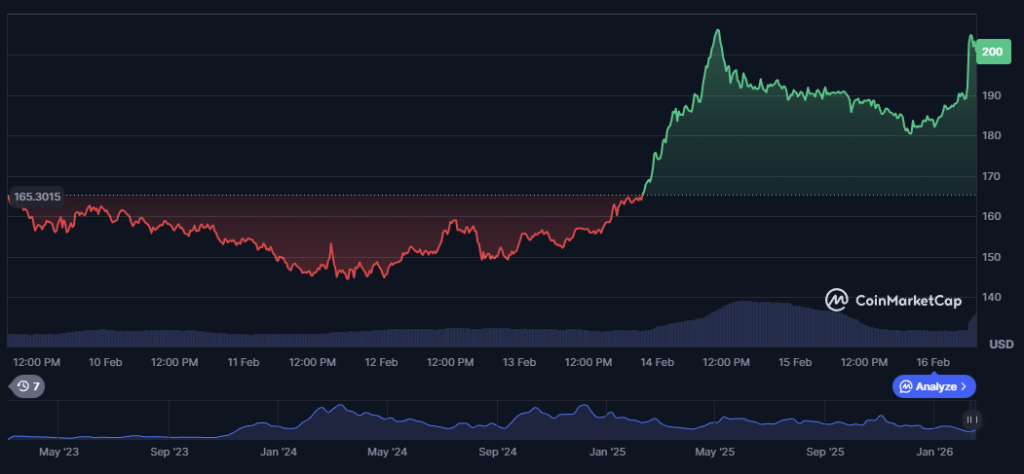 Source: CoinMarketCap/Bittensor
TAO’s recent rally also comes as broader crypto markets remain choppy, which makes the outperformance even more notable. When an asset breaks away from the pack during weak conditions, it often signals a narrative-driven bid underneath the surface.
If momentum holds, TAO could be entering a new phase where it trades less like a typical altcoin and more like a high-conviction infrastructure bet tied directly to the future of AI.
Why TAO Could Be an Asymmetrical Trade
The core argument is simple: the market still prices decentralized AI like a niche concept.
Most investors assume AI is a winner-take-most race dominated by giants like OpenAI, Anthropic, and Google. That leaves decentralized AI infrastructure under-owned, under-discussed, and potentially mispriced.
Finance Freeman calls this the asymmetry:
“Low consensus today, massive upside if the narrative shifts.”
The moment the world begins to demand transparency, auditability, or alternatives to closed intelligence systems, the entire framing could change quickly.
And when infrastructure narratives flip, repricing tends to happen fast.
To be completely clear – this isn’t a bet against OpenAI or Anthropic.
It’s a bet that the world eventually wants options.
Finance Freeman sums it up clearly: “Markets tend to reward the systems that remove single points of trust.”
If AI becomes too powerful to stay closed forever, decentralized networks like Bittensor could become one of the most important long-term winners in crypto.
Read also: 250 TAO Today… $1,000,000 Tomorrow? The Bittensor Millionaire Formula
Subscribe to our YouTube channel for daily crypto updates, market insights, and expert analysis.
The post Should Centralized AI Scare You? Why Bittensor (TAO) Could Be Crypto’s Most Asymmetrical Trade appeared first on CaptainAltcoin.


You May Also Like

XRP Has Overtaken Solana And Ethereum In This Major Metric

Q2 Market Insights: Bitcoin regains dominance in risk-averse environment, ETFs remain critical to market structure

What’s new in House Kalinga bill to cushion oil price shock?



