Bitcoin is down in 2026, but some assets are soaring. Here's why some altcoins are leading the top 10 cryptos up YTD despite the Bitcoin crash.Bitcoin is down in 2026, but some assets are soaring. Here's why some altcoins are leading the top 10 cryptos up YTD despite the Bitcoin crash.

Top 10 Cryptos Defying the 2026 Crash: UP Despite the Bitcoin Crash

2026/02/15 23:33
6 min read

The 2026 "Hard Reset" has seen $Bitcoin drop below $70,000 due to institutional de-leveraging and ETF outflows. However, a select group of mid-cap assets is decoupling from the trend. Through original market data, we identify the top 10 coins—led by Pippin ($PIPPIN) and Humanity Protocol ($H)—that remain significantly up YTD, fueled by AI and decentralized identity narratives.

The 2026 "Hard Reset"

The cryptocurrency market in early 2026 has been defined by a brutal correction that many analysts are calling a "structural hard reset." After the euphoric highs of late 2025, the total market capitalization has retracted significantly, leaving many investors wondering if the bull run has met a premature end.

While the broader market is in the red, it is not a universal decline. Specific sectors, particularly AI Agents and Decentralized Identity (DeID), are showing remarkable resilience. Projects like Pippin and Humanity Protocol are currently up over 70% YTD, proving that "alpha" still exists for those looking beyond the top two assets.

Why Did Bitcoin Crash in 2026?

To understand the current gainers, we must first understand the "King’s" decline. The 2026 crash wasn't triggered by a single black swan event like FTX, but rather by institutional mechanics.

  1. Basis Trade Collapse: Hedge funds that profited from the gap between spot ETFs and futures saw their yields drop from 17% to under 5%. This led to a massive unwinding of positions.
  2. Negative Coinbase Premium: For much of February 2026, Bitcoin traded cheaper on Coinbase than on offshore exchanges, signaling aggressive selling by U.S. institutional players.
  3. ETF Outflows: After billions in inflows in 2025, spot Bitcoin ETFs saw over $3 billion in net outflows in January 2026 alone as investors rotated to safer havens.
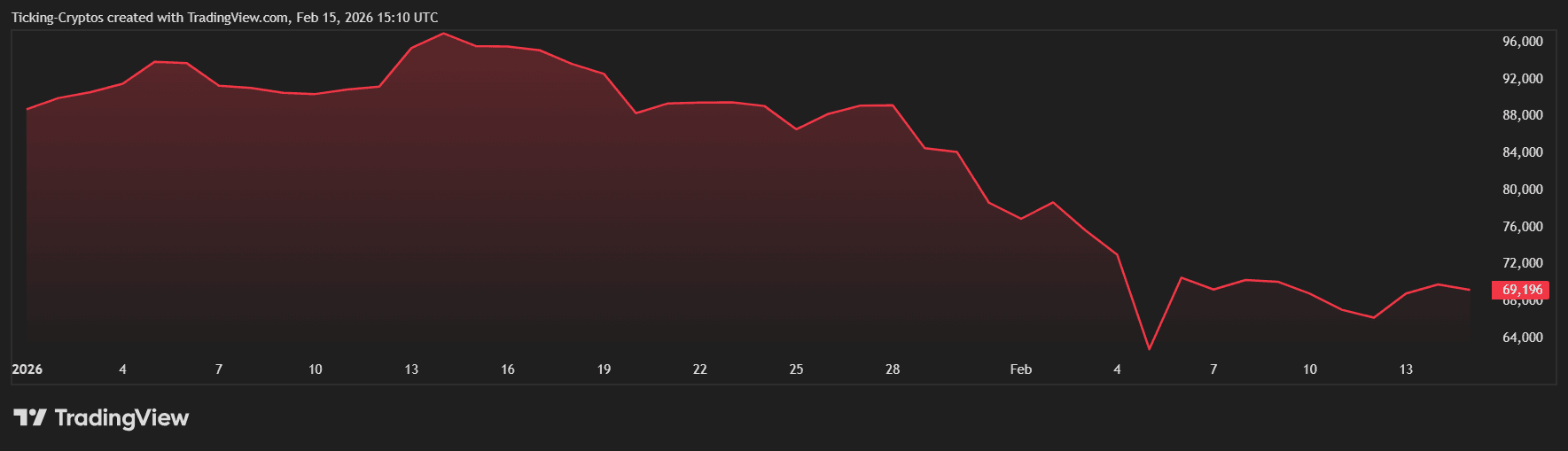
bitcoin price analysis BTCUSD_2026-02-15Bitcoin price in USD YTD - TradingView

Top 10 Cryptos Defying the Trend: The 2026 Winners

Despite the sea of red, these ten assets have maintained a positive YTD (Year-To-Date) trajectory in 2026.

1. Kite (KITE) | +151.56% YTD

Kite is a purpose-built Layer-1 blockchain designed to serve as the foundational payment and coordination infrastructure for the emerging AI agent economy. It provides autonomous AI agents with a verifiable identity and a secure environment to process real-time, low-cost payments using state channels. By acting as a decentralized backbone, Kite enables AI entities to interact, exchange data, and transact independently of centralized platforms.

2. pippin (PIPPIN) | +78.27% YTD

Pippin is a high-performance autonomous AI agent operating on the Solana blockchain. Originally inspired by an AI-generated SVG unicorn, the project evolved into a sophisticated experiment in "agentic" AI. The Pippin agent lives in a continuous loop, executing activities such as posting on social media and interacting with its environment based on internal states and memory, blending meme culture with advanced LLM frameworks.

3. Stable (STABLE) | +67.88% YTD

Stable refers to the native environment of Stablechain, a blockchain specifically engineered for stablecoin payments and global settlements. By utilizing USDT as its primary medium for both transactions and network fees, Stable aims to streamline the decentralized finance experience. It focuses on reducing the friction typically associated with multi-token ecosystems, making digital dollar payments more accessible for everyday use.

4. LayerZero (ZRO) | +42.40% YTD

LayerZero is an omnichain interoperability protocol designed to enable seamless messaging and asset transfers across disparate blockchains. As a foundational layer of "cross-chain" infrastructure, it allows developers to build decentralized applications that can interact with multiple networks simultaneously without compromising security. The ZRO token serves as the governance and utility hub for this interconnected ecosystem.

5. Decred (DCR) | +41.84% YTD

Decred is a community-directed cryptocurrency that prioritizes decentralized governance and sustainable funding. It utilizes a unique hybrid consensus mechanism that combines Proof-of-Work (PoW) with Proof-of-Stake (PoS) to ensure a fair balance between miners and token holders. This structure allows the community to vote on protocol upgrades and treasury expenditures, making it a pioneer in the decentralized autonomous organization (DAO) space.

6. Humanity Protocol (H) | +40.05% YTD

Humanity Protocol is a decentralized identity network focused on establishing "Proof of Humanity" in an era of increasing AI automation. Using privacy-preserving biometric technology, such as palm-print recognition, it allows users to verify their unique human identity on-chain without exposing personal data. The $H token powers this ecosystem, rewarding validators and securing a human-centric layer for the internet.

7. Hyperliquid (HYPE) | +21.54% YTD

Hyperliquid is a high-performance Layer-1 blockchain built specifically to support a decentralized exchange (DEX) for perpetual futures. It is designed to offer the speed and user experience of a centralized exchange while maintaining the transparency and self-custody of DeFi. The HYPE token is used for network staking and governance, supporting a platform capable of processing thousands of transactions per second.

8. Morpho (MORPHO) | +24.86% YTD

Morpho is a decentralized lending protocol that improves the capital efficiency of existing peer-to-peer markets. By layering a matching engine on top of lending pools, Morpho allows borrowers and lenders to be matched directly for better interest rates while still providing the liquidity of a traditional pool-based system. It represents a "primitive" layer for DeFi, offering highly flexible and permissionless lending infrastructure.

9. PAX Gold (PAXG) | +16.23% YTD

PAX Gold is a regulated, gold-backed digital asset where each token represents one fine troy ounce of a London Good Delivery gold bar. Stored in professional vaults, the underlying physical gold is legally owned by the token holder, providing a way to trade and hold the commodity with the speed and divisibility of a blockchain asset. It bridges the gap between traditional precious metals and digital finance.

10. Tether Gold (XAUt) | +15.61% YTD

Tether Gold is a digital token that provides ownership of physical gold through the efficiency of the blockchain. Each XAUt token represents one troy fine ounce of gold on a London Good Delivery bar, with the physical assets held in secure Swiss vaults. It is designed for investors seeking the stability of gold combined with the ease of transfer and storage offered by the Tether ecosystem.

Summary of 2026 Market Performance

AssetYTD StatusPrimary Growth Driver
Bitcoin ($BTC)DownInstitutional De-leveraging
Pippin ($PIPPIN)Up 86%AI Agent Narrative
Humanity Protocol ($H)Up 75%DeID & Biometric Tech
Kite ($KITE)Up 33%Mainnet Launch Hype
Disclaimer: The articles reposted on this site are sourced from public platforms and are provided for informational purposes only. They do not necessarily reflect the views of MEXC. All rights remain with the original authors. If you believe any content infringes on third-party rights, please contact service@support.mexc.com for removal. MEXC makes no guarantees regarding the accuracy, completeness, or timeliness of the content and is not responsible for any actions taken based on the information provided. The content does not constitute financial, legal, or other professional advice, nor should it be considered a recommendation or endorsement by MEXC.

You May Also Like

SM Offices investing P1B in Cebu expansion

SM Offices investing P1B in Cebu expansion

SM OFFICES, the commercial property arm of SM Prime Holdings, Inc., plans to add more than 60,000 square meters (sq.m.) of new leasable space worth about P1 billion
Share
Bworldonline2026/02/20 00:06
Summarize Any Stock’s Earnings Call in Seconds Using FMP API

Summarize Any Stock’s Earnings Call in Seconds Using FMP API

Turn lengthy earnings call transcripts into one-page insights using the Financial Modeling Prep APIPhoto by Bich Tran Earnings calls are packed with insights. They tell you how a company performed, what management expects in the future, and what analysts are worried about. The challenge is that these transcripts often stretch across dozens of pages, making it tough to separate the key takeaways from the noise. With the right tools, you don’t need to spend hours reading every line. By combining the Financial Modeling Prep (FMP) API with Groq’s lightning-fast LLMs, you can transform any earnings call into a concise summary in seconds. The FMP API provides reliable access to complete transcripts, while Groq handles the heavy lifting of distilling them into clear, actionable highlights. In this article, we’ll build a Python workflow that brings these two together. You’ll see how to fetch transcripts for any stock, prepare the text, and instantly generate a one-page summary. Whether you’re tracking Apple, NVIDIA, or your favorite growth stock, the process works the same — fast, accurate, and ready whenever you are. Fetching Earnings Transcripts with FMP API The first step is to pull the raw transcript data. FMP makes this simple with dedicated endpoints for earnings calls. If you want the latest transcripts across the market, you can use the stable endpoint /stable/earning-call-transcript-latest. For a specific stock, the v3 endpoint lets you request transcripts by symbol, quarter, and year using the pattern: https://financialmodelingprep.com/api/v3/earning_call_transcript/{symbol}?quarter={q}&year={y}&apikey=YOUR_API_KEY here’s how you can fetch NVIDIA’s transcript for a given quarter: import requestsAPI_KEY = "your_api_key"symbol = "NVDA"quarter = 2year = 2024url = f"https://financialmodelingprep.com/api/v3/earning_call_transcript/{symbol}?quarter={quarter}&year={year}&apikey={API_KEY}"response = requests.get(url)data = response.json()# Inspect the keysprint(data.keys())# Access transcript contentif "content" in data[0]: transcript_text = data[0]["content"] print(transcript_text[:500]) # preview first 500 characters The response typically includes details like the company symbol, quarter, year, and the full transcript text. If you aren’t sure which quarter to query, the “latest transcripts” endpoint is the quickest way to always stay up to date. Cleaning and Preparing Transcript Data Raw transcripts from the API often include long paragraphs, speaker tags, and formatting artifacts. Before sending them to an LLM, it helps to organize the text into a cleaner structure. Most transcripts follow a pattern: prepared remarks from executives first, followed by a Q&A session with analysts. Separating these sections gives better control when prompting the model. In Python, you can parse the transcript and strip out unnecessary characters. A simple way is to split by markers such as “Operator” or “Question-and-Answer.” Once separated, you can create two blocks — Prepared Remarks and Q&A — that will later be summarized independently. This ensures the model handles each section within context and avoids missing important details. Here’s a small example of how you might start preparing the data: import re# Example: using the transcript_text we fetched earliertext = transcript_text# Remove extra spaces and line breaksclean_text = re.sub(r'\s+', ' ', text).strip()# Split sections (this is a heuristic; real-world transcripts vary slightly)if "Question-and-Answer" in clean_text: prepared, qna = clean_text.split("Question-and-Answer", 1)else: prepared, qna = clean_text, ""print("Prepared Remarks Preview:\n", prepared[:500])print("\nQ&A Preview:\n", qna[:500]) With the transcript cleaned and divided, you’re ready to feed it into Groq’s LLM. Chunking may be necessary if the text is very long. A good approach is to break it into segments of a few thousand tokens, summarize each part, and then merge the summaries in a final pass. Summarizing with Groq LLM Now that the transcript is clean and split into Prepared Remarks and Q&A, we’ll use Groq to generate a crisp one-pager. The idea is simple: summarize each section separately (for focus and accuracy), then synthesize a final brief. Prompt design (concise and factual) Use a short, repeatable template that pushes for neutral, investor-ready language: You are an equity research analyst. Summarize the following earnings call sectionfor {symbol} ({quarter} {year}). Be factual and concise.Return:1) TL;DR (3–5 bullets)2) Results vs. guidance (what improved/worsened)3) Forward outlook (specific statements)4) Risks / watch-outs5) Q&A takeaways (if present)Text:<<<{section_text}>>> Python: calling Groq and getting a clean summary Groq provides an OpenAI-compatible API. Set your GROQ_API_KEY and pick a fast, high-quality model (e.g., a Llama-3.1 70B variant). We’ll write a helper to summarize any text block, then run it for both sections and merge. import osimport textwrapimport requestsGROQ_API_KEY = os.environ.get("GROQ_API_KEY") or "your_groq_api_key"GROQ_BASE_URL = "https://api.groq.com/openai/v1" # OpenAI-compatibleMODEL = "llama-3.1-70b" # choose your preferred Groq modeldef call_groq(prompt, temperature=0.2, max_tokens=1200): url = f"{GROQ_BASE_URL}/chat/completions" headers = { "Authorization": f"Bearer {GROQ_API_KEY}", "Content-Type": "application/json", } payload = { "model": MODEL, "messages": [ {"role": "system", "content": "You are a precise, neutral equity research analyst."}, {"role": "user", "content": prompt}, ], "temperature": temperature, "max_tokens": max_tokens, } r = requests.post(url, headers=headers, json=payload, timeout=60) r.raise_for_status() return r.json()["choices"][0]["message"]["content"].strip()def build_prompt(section_text, symbol, quarter, year): template = """ You are an equity research analyst. Summarize the following earnings call section for {symbol} ({quarter} {year}). Be factual and concise. Return: 1) TL;DR (3–5 bullets) 2) Results vs. guidance (what improved/worsened) 3) Forward outlook (specific statements) 4) Risks / watch-outs 5) Q&A takeaways (if present) Text: <<< {section_text} >>> """ return textwrap.dedent(template).format( symbol=symbol, quarter=quarter, year=year, section_text=section_text )def summarize_section(section_text, symbol="NVDA", quarter="Q2", year="2024"): if not section_text or section_text.strip() == "": return "(No content found for this section.)" prompt = build_prompt(section_text, symbol, quarter, year) return call_groq(prompt)# Example usage with the cleaned splits from Section 3prepared_summary = summarize_section(prepared, symbol="NVDA", quarter="Q2", year="2024")qna_summary = summarize_section(qna, symbol="NVDA", quarter="Q2", year="2024")final_one_pager = f"""# {symbol} Earnings One-Pager — {quarter} {year}## Prepared Remarks — Key Points{prepared_summary}## Q&A Highlights{qna_summary}""".strip()print(final_one_pager[:1200]) # preview Tips that keep quality high: Keep temperature low (≈0.2) for factual tone. If a section is extremely long, chunk at ~5–8k tokens, summarize each chunk with the same prompt, then ask the model to merge chunk summaries into one section summary before producing the final one-pager. If you also fetched headline numbers (EPS/revenue, guidance) earlier, prepend them to the prompt as brief context to help the model anchor on the right outcomes. Building the End-to-End Pipeline At this point, we have all the building blocks: the FMP API to fetch transcripts, a cleaning step to structure the data, and Groq LLM to generate concise summaries. The final step is to connect everything into a single workflow that can take any ticker and return a one-page earnings call summary. The flow looks like this: Input a stock ticker (for example, NVDA). Use FMP to fetch the latest transcript. Clean and split the text into Prepared Remarks and Q&A. Send each section to Groq for summarization. Merge the outputs into a neatly formatted earnings one-pager. Here’s how it comes together in Python: def summarize_earnings_call(symbol, quarter, year, api_key, groq_key): # Step 1: Fetch transcript from FMP url = f"https://financialmodelingprep.com/api/v3/earning_call_transcript/{symbol}?quarter={quarter}&year={year}&apikey={api_key}" resp = requests.get(url) resp.raise_for_status() data = resp.json() if not data or "content" not in data[0]: return f"No transcript found for {symbol} {quarter} {year}" text = data[0]["content"] # Step 2: Clean and split clean_text = re.sub(r'\s+', ' ', text).strip() if "Question-and-Answer" in clean_text: prepared, qna = clean_text.split("Question-and-Answer", 1) else: prepared, qna = clean_text, "" # Step 3: Summarize with Groq prepared_summary = summarize_section(prepared, symbol, quarter, year) qna_summary = summarize_section(qna, symbol, quarter, year) # Step 4: Merge into final one-pager return f"""# {symbol} Earnings One-Pager — {quarter} {year}## Prepared Remarks{prepared_summary}## Q&A Highlights{qna_summary}""".strip()# Example runprint(summarize_earnings_call("NVDA", 2, 2024, API_KEY, GROQ_API_KEY)) With this setup, generating a summary becomes as simple as calling one function with a ticker and date. You can run it inside a notebook, integrate it into a research workflow, or even schedule it to trigger after each new earnings release. Free Stock Market API and Financial Statements API... Conclusion Earnings calls no longer need to feel overwhelming. With the Financial Modeling Prep API, you can instantly access any company’s transcript, and with Groq LLM, you can turn that raw text into a sharp, actionable summary in seconds. This pipeline saves hours of reading and ensures you never miss the key results, guidance, or risks hidden in lengthy remarks. Whether you track tech giants like NVIDIA or smaller growth stocks, the process is the same — fast, reliable, and powered by the flexibility of FMP’s data. Summarize Any Stock’s Earnings Call in Seconds Using FMP API was originally published in Coinmonks on Medium, where people are continuing the conversation by highlighting and responding to this story
Share
Medium2025/09/18 14:40
Meme Coin Frenzy Cools, Altcoins Take the Spotlight

Meme Coin Frenzy Cools, Altcoins Take the Spotlight

Pump.fun’s flagship coin PUMP dropped nearly 10% in a single day, dragging down related tokens such as TROLL and Aura, […] The post Meme Coin Frenzy Cools, Altcoins Take the Spotlight appeared first on Coindoo.
Share
Coindoo2025/09/20 00:00