

The New Architecture of Resilience: EmpactUS Reimagines Post-Conflict Recovery in MENA
Amid the high-stakes tech deal-making of Web Summit Qatar 2026, a new investment thesis emerged that challenges the traditional global response to regional instability. Hammam Elmasri, Co-Founder of EmpactUS, presented a compelling case to global venture capitalists and institutional leaders: the future of post-conflict recovery in the Middle East and North Africa (MENA) must pivot from a reliance on humanitarian aid to the construction of “Stabilization Infrastructure” through entrepreneurship.
For decades, the global community has responded to crises in Palestine, Lebanon, Syria, and Iraq with a standard playbook of short-term relief and physical reconstruction. While essential, Elmasri argues this model fails to address the underlying economic vacuum that often leads to recurring cycles of fragility.
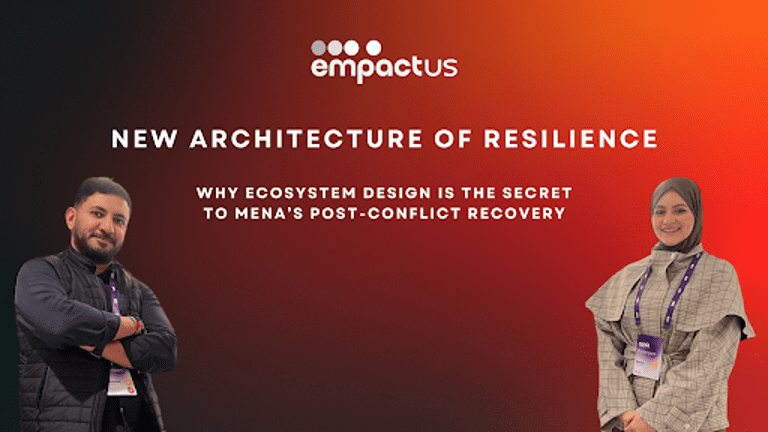 EmpactUS
The Limits of Traditional Reconstruction
“Recovery is not just about rebuilding what was lost; it is about restoring economic dignity,” Elmasri stated during a keynote engagement in Doha. “In many of these regions, we are seeing a paradox. You have young populations that are highly skilled, digitally connected, and inherently entrepreneurial, yet they remain trapped in a cycle of aid dependency because the systems to support their growth simply do not exist.”
According to EmpactUS, the “cement-first” approach to recovery—focusing primarily on buildings and roads—is insufficient in a 2026 digital economy. Without long-term economic systems and “Digital Infrastructure,” communities remain vulnerable to future shocks.
The EmpactUS Three-Pillar System
To bridge this gap, EmpactUS has deployed a framework designed to transform individual survival into systemic resilience. This model, which gained significant traction among investors at Web Summit, rests on three integrated pillars:
- Capacity First: Rather than general vocational training, EmpactUS focuses on high-level skill-building aligned with global market demands. This includes training in digital services and tech-enabled sectors that can operate independently of local physical infrastructure disruptions.
- Ecosystem Integration: A critical barrier for founders in conflict zones is geographical and institutional isolation. EmpactUS serves as a conduit, connecting local innovators to regional and global technology platforms, investors, and corporate partners.
- Values-Driven Entrepreneurship: In fragile contexts, trust is the primary currency. EmpactUS works with founders who prioritize governance integrity and sustainable growth over short-term speculative gains, ensuring that businesses act as anchors for local economic circulation.
A New Asset Class: Stabilization Infrastructure
For the finance-focused audience of Yahoo Finance and Business Insider, the EmpactUS model presents a new way to view social impact. By treating startups as “Employment Engines” rather than mere small businesses, EmpactUS is creating a platform for rebuilding trust and local economic resilience.
“The prevailing narrative often frames conflict-affected regions as recipients of assistance,” Elmasri concluded. “But if supported through coherent systems, these entrepreneurs can redefine what recovery looks like. We are moving from aid dependency to economic agency, and the global investment community has a strategic role to play in that transition.”
About Hammam Elmasri & EmpactUS
Hammam Elmasri is a social impact entrepreneur and the Co-Founder of EmpactUS, a venture-building ecosystem dedicated to fostering value-driven entrepreneurship in conflict-affected regions across the Middle East. For more information, visit https://empactus.org.uk/


You May Also Like

The changing face of elder care in Malaysia — Sayed Mohammad Reza Yamani Sayed Umar

GOP lawmakers want nothing to do with Trump's ballroom chaos: report

Not a loophole: Singapore AI export controls let China tap US AI legally



