US CLARITY Act Could Pass by April, Says Senator Bernie Moreno
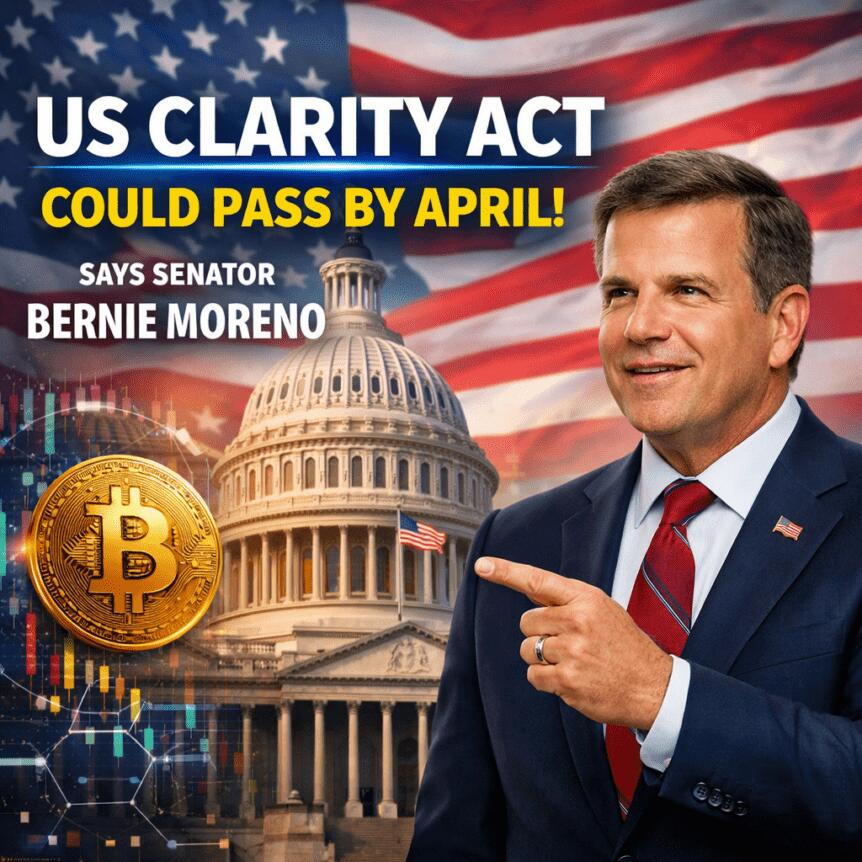
The US CLARITY Act, a long-awaited framework intended to clarify how the United States will regulate the burgeoning crypto sector, could be on track for a congressional pass in the coming weeks, according to crypto-friendly policymakers. Senator Bernie Moreno suggested a potential April milestone as he spoke to CNBC in Florida, where he was touring President Donald Trump’s Mar-a-Lago resort. The remarks came as Coinbase CEO Brian Armstrong joined Moreno for a discussion that touched on market structure and the regulatory path forward at a gathering organized by the World Liberty Financial crypto forum.
Armstrong described the current climate as offering a “path forward” that might yield a balanced outcome for the industry, traditional banks, and American consumers. He noted that earlier iterations of the draft included provisions that would ban interest-bearing stablecoins and would place the U.S. Securities and Exchange Commission in a central regulatory role over crypto markets. Those elements proved problematic for the exchange and had contributed to a pause in its public backing for the bill. At the same time, members of the crypto community have emphasized the need for a predictable regulatory framework that can spur investment and innovation while protecting consumers and the broader financial system.
Moreno, who co-authored or championed the legislation’s bipartisan path, signaled that the sticking point on stablecoins—particularly the idea of rewarding users with yield—has shifted toward a more workable compromise. In his view, the debate over stablecoin rewards “shouldn’t be part of this equation,” and he indicated that lawmakers were looking to refine the language so it could pass with broad support. The discussion has not been simple, given the various interests involved, from traditional banking to fintech platforms and consumer advocates. But with executives from the crypto industry at the table alongside bankers and lawmakers, the atmosphere has become more conducive to finding a compromise that can be signed into law.
From the trading floor to the Capitol, the conversation has also been about market structure and consumer protections. Armstrong invoked a vision of a “win-win-win” scenario where the bill would advance the interests of the crypto industry, safeguard banks, and benefit American consumers by consolidating a coherent national framework. The idea is to harmonize the fast-moving crypto markets with existing financial regulations, reducing uncertainty for businesses and investors alike. The discussions have taken place against a backdrop of broader regulatory activity, including ongoing policy reviews at the White House and within Congress, and amid an intensifying push from both parties to deliver tangible crypto reforms.
The regulatory conversation has not occurred in a vacuum. Polymarket, a prediction market for crypto policy, offered a glimpse into market sentiment by showing the odds of the CLARITY Act passing in 2026 swing between 90% and roughly 72% around the time of the interview. The volatility in these odds underscores the uncertainty that still surrounds the drafting process and the political dynamics at play in a year marked by competing priorities for lawmakers. While Moreno suggested a constructive path forward, he also acknowledged that the timetable is influenced by technical details that still require resolution, particularly around stablecoins and the precise allocation of regulatory authority among federal agencies.
Key takeaways
- The CLARITY Act is gaining momentum in Congress, with a potential passage window cited as “April” by Senator Bernie Moreno in a CNBC interview conducted at Mar-a-Lago.
- Coinbase previously withdrew support over provisions that would ban interest-bearing stablecoins and centralize crypto regulation under the SEC, complicating the bill’s path; the White House reportedly viewed the move as a unilateral action.
- Armstrong and Moreno signaled a renewed effort to achieve a balanced compromise that would advance crypto market structure while addressing concerns from the banking sector.
- Market-facing sentiment on the bill has fluctuated, with Polymarket showing odds of passage in 2026 ranging from 90% to 72% around the talks.
- The discussions emphasize restoring clarity for market participants, investors, and consumers, potentially shaping the United States’ stance on crypto policy for years to come.
Sentiment: Bullish
Market context: The rhetoric around the CLARITY Act reflects a broader push for regulatory clarity in a volatile asset class, as lawmakers seek a stable framework to accommodate innovation while safeguarding financial stability and consumer protections in a rapidly evolving market.
Why it matters
The CLARITY Act represents more than a regulatory tweak; it signals a concerted attempt to establish a nationwide standard for crypto assets, a move that could significantly influence how exchanges, wallet providers, and fintech firms operate in the United States. By aiming to clarify which activities trigger regulatory oversight and which agencies oversee them, the bill seeks to reduce the current fragmentation that has left many market participants navigating a patchwork of state and federal rules. If enacted, the act could provide a predictable environment for investment, product development, and institutional participation, potentially attracting capital that has been cautious due to regulatory ambiguity.
However, the path to passage remains contingent on reconciling divergent priorities. The debate over stablecoins—whether to treat certain yields as permissible rewards or to prohibit certain yield-bearing mechanisms—highlights the trade-offs lawmakers face between fostering innovation and protecting financial stability. The White House’s reaction to Coinbase’s withdrawal illustrates the delicate political optics involved in crypto legislation, with officials wary of any moves that could cast the administration as unfavorably aligned with industry players or skeptical of robust consumer protections. As talks continue, stakeholders on all sides are watching for a clearer set of draft language that can win broad bipartisan support and withstand evolving regulatory scrutiny.
For investors and users, the potential passage of the CLARITY Act could usher in a period of relative regulatory certainty, enabling more precise risk assessment and potentially more defined product offerings. The balance being sought is delicate: too lenient a regime could invite operational risk, while overly restrictive provisions might stifle innovation and push activity offshore or into less regulated ecosystems. The ongoing discussions at the WLF crypto forum, coupled with public comments from industry leaders, show a sector eager for governance that protects consumers without quashing growth.
What to watch next
- Upcoming committee hearings or markup sessions in Congress that could reveal the final language of the CLARITY Act.
- Any revisions to stablecoin treatment within the bill, particularly around yield-bearing arrangements and consumer protections.
- White House statements or official remarks that signal shifting positions or tailored guidance on crypto regulation.
- Respective statements or filings from Coinbase and other major players to gauge industry alignment with the revised draft.
- Follow-up coverage on the World Liberty Financial crypto forum and any subsequent policy pledges or compromises announced by lawmakers.
Sources & verification
- CNBC interview at Mar-a-Lago featuring Senator Bernie Moreno and Coinbase CEO Brian Armstrong.
- World Liberty Financial crypto forum discussions on market structure and regulatory pathways.
- Coinbase withdrawal of support for the CLARITY Act and White House reaction documenting the administration’s stance.
- Polymarket odds page tracking the CLARITY Act’s passage probability in 2026.
- David Sacks statements cited by Cointelegraph regarding confidence in the bill’s trajectory.
US CLARITY Act gains momentum as lawmakers edge toward April passage
The ongoing dialogue around the CLARITY Act underscores a broader shift in how the United States intends to regulate crypto markets. As policymakers seek a cohesive and comprehensive framework, industry leaders are pushing for a balance that preserves innovation while ensuring consumer protection and financial stability. The discussions at the Mar-a-Lago event and the WLF crypto forum point to a willingness to negotiate, even if core points—from stablecoin policy to the SEC’s regulatory role—remain contested. If April proves to be a viable milestone, as Moreno suggested, lawmakers may be positioned to deliver a bill that could redefine the U.S. market structure for years to come. The unfolding narrative will likely influence investor sentiment, the trajectory of exchange policies, and the pace at which traditional financial institutions engage with crypto products in a regulated environment.
As the sector awaits more precise legislative language, participants will be closely watching for any signals that the political calculus has shifted enough to secure bipartisan support. The balance of risk and opportunity in the year ahead will hinge on how effectively the bill reconciles the industry’s demand for clarity with the banking sector’s emphasis on safety and soundness. The next few weeks could prove pivotal for a piece of legislation that many view as a potential turning point for mainstream crypto adoption in the United States.
This article was originally published as US CLARITY Act Could Pass by April, Says Senator Bernie Moreno on Crypto Breaking News – your trusted source for crypto news, Bitcoin news, and blockchain updates.
You May Also Like

Why the UK Is Seeing an Uplift in Property Sales in 2026

CME Group to launch options on XRP and SOL futures