Paris-based semiconductor firm Sequans Communications (NYSE: SQNS) has decided to pivot from selling chips to stacking sats—big time. The company has filed for an at-the-market (ATM) equity program that will allow it to issue up to $200 million worth of American Depositary Shares (ADSs). The proceeds? Not for R&D, not for acquisitions, not even for shareholder dividends—this money is earmarked primarily for one thing: Bitcoin.Paris-based semiconductor firm Sequans Communications (NYSE: SQNS) has decided to pivot from selling chips to stacking sats—big time. The company has filed for an at-the-market (ATM) equity program that will allow it to issue up to $200 million worth of American Depositary Shares (ADSs). The proceeds? Not for R&D, not for acquisitions, not even for shareholder dividends—this money is earmarked primarily for one thing: Bitcoin.

French Chipmaker Sequans Bets $200M on Bitcoin Treasury Play

2025/08/27 04:59
3 min read
For feedback or concerns regarding this content, please contact us at crypto.news@mexc.com
Paris-based semiconductor firm Sequans Communications (NYSE: SQNS) has decided to pivot from selling chips to stacking sats—big time. The company has filed for an at-the-market (ATM) equity program that will allow it to issue up to $200 million worth of American Depositary Shares (ADSs). The proceeds? Not for R&D, not for acquisitions, not even for shareholder dividends—this money is earmarked primarily for one thing: Bitcoin.

The French chipmaker wants to beef up its balance sheet with Bitcoin, joining the growing ranks of corporations treating BTC as a primary treasury asset.

From semiconductors to sats

Sequans already holds more than 3,000 BTC, currently valued at about $331 million, making it one of Europe’s largest corporate holders of Bitcoin. Only Germany’s Bitcoin Group SE sits higher on the leaderboard. And this isn’t a half-measure—Sequans has set an audacious target of accumulating 100,000 BTC by 2030.

To put that in perspective, 100,000 BTC is roughly 0.5% of all the Bitcoin that will ever exist. For a mid-cap semiconductor outfit, that’s not just “skin in the game”—it’s a full-on metamorphosis into a Bitcoin proxy stock.

The new ATM program follows a $189 million raise in July through secured convertible debentures and warrants, bringing Sequans’ recent financing haul to around $376 million. Clearly, this is less about incremental treasury management and more about a deliberate, aggressive strategy to tie the company’s future to Bitcoin’s performance.
Paris-based semiconductor firm Sequans Communications (NYSE: SQNS) has decided to pivot from selling chips to stacking sats—big time. The company has filed for an at-the-market (ATM) equity program that will allow it to issue up to $200 million worth of American Depositary Shares (ADSs). The proceeds? Not for R&D, not for acquisitions, not even for shareholder dividends—this money is earmarked primarily for one thing: Bitcoin.

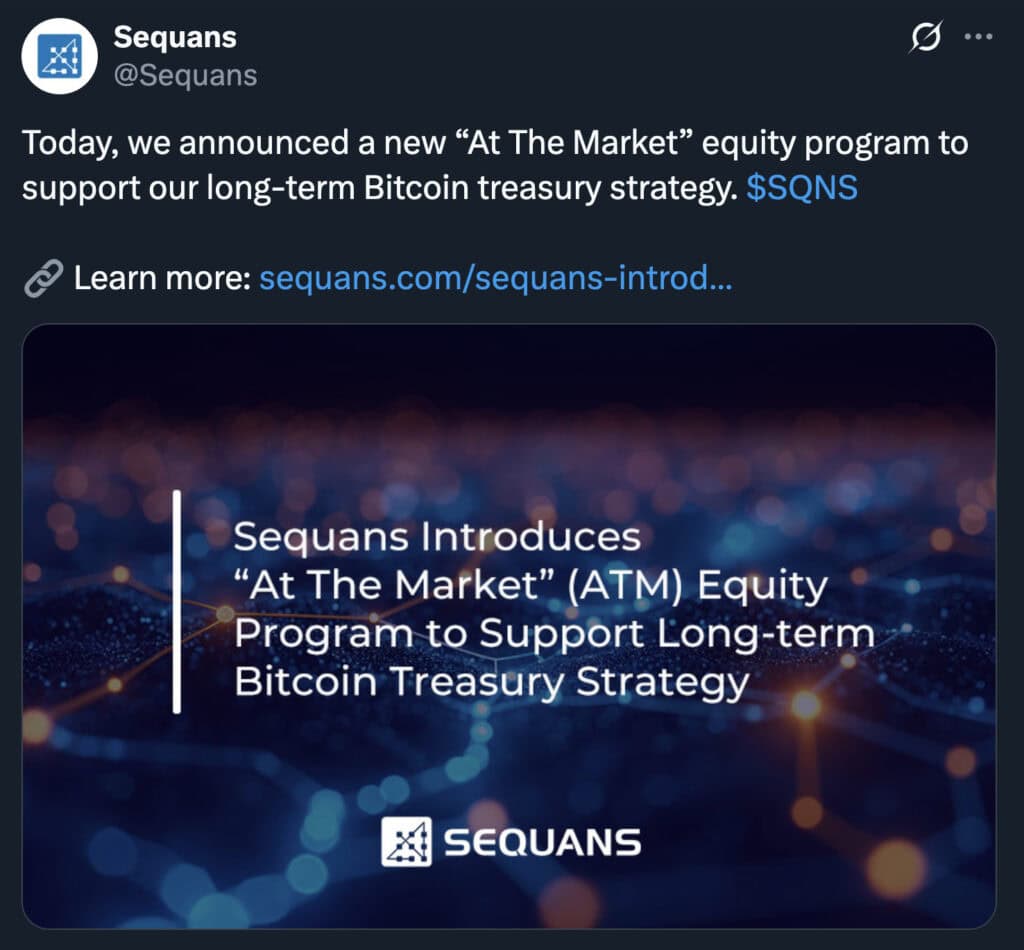
The French chipmaker made the announcement on X

Equity dilution for digital gold

CEO Dr. Georges Karam framed the decision as building a “treasury foundation” and promised to deploy the funds “judiciously.” But issuing equity to buy Bitcoin is a controversial play. Shareholders are essentially accepting dilution in exchange for leveraged exposure to Bitcoin’s long-term trajectory. If BTC soars, Sequans could look like a genius. If it tanks? Well, the pain is borne by investors who thought they were buying into a semiconductor company, not a synthetic Bitcoin ETF.

Equity-funded BTC purchases act less like speculative punts and more like leveraged exposure, but the model only works with strict discipline.

“Smaller firms can innovate using structured financing, options strategies, or BTC-backed deals to accumulate effectively. The model is not copy-paste, but scalable if tailored.”

In other words, Sequans is playing the Michael Saylor playbook—but without MicroStrategy’s billion-dollar cash cushion.

The bigger picture: Bitcoinization of corporate treasuries

Sequans isn’t alone here. Strategy (formerly MicroStrategy) recently raised $310 million in stock to buy $357 million worth of Bitcoin. Meanwhile, KindlyMD snapped up nearly 5,744 BTC for $679 million, only to watch its stock price crater afterward. The market’s message is clear: Wall Street hasn’t decided whether to reward or punish companies for tying themselves to Bitcoin.

What Sequans is doing highlights a broader shift. Corporate treasuries are no longer just about holding cash, bonds, or gold—they’re becoming a battleground for Bitcoin accumulation. If Sequans hits its 100,000 BTC target, it would leapfrog into the ranks of the largest institutional holders of Bitcoin globally. If you don’t own Bitcoin yourself, now might be a good time to consider whether you should buy Bitcoin.

The contrarian view

Sequans may not survive the next brutal Bitcoin drawdown if it overextends. Unlike MicroStrategy, which has software margins fat enough to cushion a crypto winter, Sequans is a hardware company competing in a cutthroat industry. Semiconductors aren’t exactly a cash cow—especially for a French mid-cap player trying to scale.

If Bitcoin rips to $200k, Sequans’ bet will look visionary. But if BTC retraces to $50k and stays there for two years, Sequans could find itself with a wrecked balance sheet, angry shareholders, and dwindling operational runway.

Bitcoin maximalists will cheer this as another domino falling in hyperbitcoinization. But investors? They should ask whether they’re buying Sequans the chipmaker—or Sequans the Bitcoin holding company. Because those are two very different risk profiles.


 

Market Opportunity
DAR Open Network Logo
DAR Open Network Price(D)
$0.007105
$0.007105$0.007105
+0.68%
USD
DAR Open Network (D) Live Price Chart
Disclaimer: The articles reposted on this site are sourced from public platforms and are provided for informational purposes only. They do not necessarily reflect the views of MEXC. All rights remain with the original authors. If you believe any content infringes on third-party rights, please contact crypto.news@mexc.com for removal. MEXC makes no guarantees regarding the accuracy, completeness, or timeliness of the content and is not responsible for any actions taken based on the information provided. The content does not constitute financial, legal, or other professional advice, nor should it be considered a recommendation or endorsement by MEXC.

You May Also Like

iZUMi Finance and Nasdaq-Listed Company CIMG Co-Launch $20M Upstarts Fund

iZUMi Finance and Nasdaq-Listed Company CIMG Co-Launch $20M Upstarts Fund

Singapore, Singapore, 18th September 2025, Chainwire
Share
Blockchainreporter2025/09/18 14:10
Pundit Shares ‘XRP Endgame’: What To Watch Out For With Ripple

Pundit Shares ‘XRP Endgame’: What To Watch Out For With Ripple

Crypto pundit Pumpius is drawing attention to what he calls the “XRP Endgame,” saying all the key pieces are falling into place for Ripple and its token. According to him, these shifts put XRP in a rare position to rise above other digital assets. Global rules and banking standards are also moving in Ripple’s favor at the same time. Pundit: Institutional Rails And Legal Clarity Cement XRP’s Role Pumpius stresses that Ripple’s victory in its long fight with the SEC is not just a legal win but a turning point. After years in court, XRP now has the strongest legal clarity of any cryptocurrency in the U.S.  Related Reading: Market Expert Says XRP Price At $1,000 Will Happen, But The Timeline Is Different He also points to Ripple’s launch of RLUSD, its enterprise stablecoin backed by reserves at BNY Mellon. Pumpius notes that this connection matters because BNY Mellon safeguards trillions in assets for global giants, including BlackRock and the U.S. Treasury. Tying a stablecoin to XRP’s payment rails creates what he calls a “stable reserve army” that strengthens trust in Ripple’s network. On the banking front, Pumpius explains that Ripple is not only licensed as a money service business but has also applied for the highly difficult New York banking charter. He adds that Ripple has taken it a step further by applying for a Federal Reserve master account, the highest privilege in the U.S. banking system. If granted, Ripple would not just compete with banks but effectively act as one, placing XRP at the center of financial settlements. XRP ETFs, Ripple’s Global Standards, And Tech Drive Convergence Pumpius notes that nearly 20 XRP spot ETFs are awaiting approval. If greenlit, these funds could open the doors to trillions of dollars from institutional investors and push XRP into the ranks of Wall Street assets overnight. Another major shift is the migration to ISO 20022, a global messaging standard that all major banks must adhere to by November. Pumpius points out that XRP has been ready for this for years, meaning RippleNet can easily connect with traditional banking rails the moment the change takes effect. Related Reading: Crypto Analyst Debunks XRP Price To $10,000 Claims, Reveals How High It Can Go Additionally, he notes that XRP is in the liquidity tokenization plan of DTCC, the world’s largest settlement utility. At the same time, he notes that the DNA Protocol is quietly developing biometric and genomic identity tools on the XRP Ledger. This step could solve Know Your Customer checks at the deepest level, blending finance and digital identity in a way no other blockchain has achieved. Ripple benefits as he notes the rise of a supportive political environment. A pro-crypto administration is pushing laws that fit Ripple’s long-term playbook. With regulators and policymakers leaning in the same direction, he believes the stage is set for XRP to move into its endgame. Featured image from DALL.E, chart from TradingView.com
Share
NewsBTC2025/09/19 00:00
Tim Draper’s Stark Prediction As Fiat Trust Plummets

Tim Draper’s Stark Prediction As Fiat Trust Plummets

The post Tim Draper’s Stark Prediction As Fiat Trust Plummets appeared on BitcoinEthereumNews.com. Bitcoin Adoption: Tim Draper’s Stark Prediction As Fiat Trust
Share
BitcoinEthereumNews2026/03/14 14:57