BitcoinWorld Prediction Markets: Vitalik Buterin Reveals Why They’re Astonishingly More Accurate In the dynamic world of cryptocurrency, where information spreads at lightning speed, discerning truth from speculation is crucial. Ethereum founder Vitalik Buterin recently dropped a fascinating insight, suggesting that prediction markets are surprisingly more accurate than even professional media. This bold claim invites us to explore how these innovative platforms might reshape our understanding of future events. Why Are Prediction Markets Astonishingly More Accurate? Vitalik Buterin’s argument is rooted in a fundamental principle: incentives. He highlights that participants in prediction markets face a direct financial consequence for incorrect forecasts. Unlike traditional media, which often prioritizes sensationalism, or even token governance votes where there’s no penalty for a wrong choice, prediction market participants put their money where their mouth is. Skin in the Game: When you bet on an outcome, you have a strong incentive to research thoroughly and make an informed decision. Financial Penalty: Incorrect predictions lead to monetary losses, encouraging a more disciplined and reality-based approach. Collective Wisdom: The aggregated decisions of many financially incentivized participants often yield a highly accurate probability. This ‘skin in the game’ mechanism is what, according to Buterin, helps investors stay firmly grounded in reality. It prevents the kind of rampant overhyping or baseless speculation often seen elsewhere. Instead, it fosters an environment where genuine probability and objective assessment take precedence. The Power of Incentives: How Prediction Markets Keep Investors Grounded Buterin articulated his views on Farcaster, emphasizing the stark contrast between prediction markets and other information sources. He noted that professional media and social media platforms often lack a direct accountability mechanism for the accuracy of their reports or forecasts. This can lead to a landscape filled with opinions that aren’t necessarily tethered to factual outcomes. Consider the difference: Media: Journalists and pundits might face reputational risk, but rarely a direct financial loss for an inaccurate prediction. Social Media: Influencers can spread misinformation with little to no consequence. Token Governance: While important, votes don’t typically penalize participants for choices that don’t pan out. In contrast, every trade within a prediction market is a statement of belief backed by capital. If that belief proves wrong, the capital is lost. This powerful feedback loop encourages rational thought and discourages emotional decision-making, leading to a remarkably precise collective forecast. Trusting Prediction Markets Over General Sentiment: Vitalik’s Stance Vitalik Buterin himself stated that he personally finds the probabilities presented by prediction markets to be more trustworthy than being swayed by general sentiment or the prevailing narrative. This is a significant endorsement from a highly respected figure in the crypto space, underscoring the potential for these platforms to serve as a superior source of information. The beauty of these markets lies in their ability to distill complex information into a simple, actionable probability. When a market shows an 80% chance of an event occurring, it’s not just a guess; it’s a reflection of thousands of participants’ aggregated, financially-backed assessments. This makes them incredibly valuable tools for: Forecasting Elections: Often outperforming traditional polls. Predicting Product Success: Gauging public interest and viability. Anticipating Global Events: Providing real-time, dynamic probabilities. What Challenges Do Prediction Markets Face? While the accuracy of prediction markets is compelling, it’s also important to acknowledge their limitations and challenges. These platforms, while powerful, are not without hurdles that need careful consideration for their widespread adoption and optimal function. Key challenges include: Liquidity: Smaller markets might not have enough participants or capital to generate truly robust probabilities. Regulatory Uncertainty: The legal landscape for these markets is still evolving in many jurisdictions, creating barriers to entry. Market Manipulation: Although less likely due to financial incentives, the potential for manipulation in illiquid markets exists. Ethical Concerns: Markets on sensitive topics (e.g., assassinations) raise significant ethical debates. Despite these challenges, the core mechanism of incentivized accuracy remains a powerful force, suggesting a bright future for these tools as they mature and gain broader acceptance. Addressing these issues will be key to unlocking their full potential. Vitalik Buterin’s assertion that prediction markets offer superior accuracy to professional media or social media is a powerful statement. By aligning financial incentives with truthful forecasting, these platforms create a unique environment where collective wisdom triumphs over hype and speculation. As we navigate an increasingly complex information landscape, the disciplined, reality-grounded insights offered by prediction markets could become an indispensable tool for informed decision-making. Their potential to cut through the noise and provide clear, probability-driven forecasts is truly transformative. Frequently Asked Questions (FAQs) 1. What are prediction markets? Prediction markets are platforms where users can bet on the outcome of future events. Participants buy and sell shares representing specific outcomes, and the market price of these shares reflects the collective probability of that event occurring. 2. Why does Vitalik Buterin believe prediction markets are more accurate? Buterin argues that prediction markets are more accurate because participants have ‘skin in the game.’ They lose money if their predictions are incorrect, creating a strong financial incentive to research thoroughly and make accurate forecasts, unlike traditional media or social media where there’s less direct accountability. 3. How do prediction markets differ from traditional media in terms of accuracy? Traditional media often faces pressures for sensationalism or clicks, and journalists typically don’t incur direct financial penalties for inaccurate reports. Prediction markets, however, directly penalize incorrect forecasts through monetary loss, leading to more grounded and reality-checked probabilities. 4. What role do incentives play in prediction markets? Incentives are central to the accuracy of prediction markets. The financial reward for correct predictions and the penalty for incorrect ones drive participants to be more rational, research-oriented, and less susceptible to emotional biases or hype, thus contributing to more reliable collective forecasts. 5. Are there any downsides or challenges to using prediction markets? Yes, prediction markets face challenges such as ensuring sufficient liquidity, navigating complex regulatory landscapes, and mitigating potential for market manipulation, especially in smaller markets. Ethical concerns can also arise depending on the event being predicted. Did Vitalik Buterin’s insights on prediction markets spark your interest? Share this article with your network and join the conversation about the future of accurate forecasting! Your friends and followers will appreciate this valuable perspective. To learn more about the latest prediction markets trends, explore our article on key developments shaping decentralized finance market insights. This post Prediction Markets: Vitalik Buterin Reveals Why They’re Astonishingly More Accurate first appeared on BitcoinWorld and is written by Editorial TeamBitcoinWorld Prediction Markets: Vitalik Buterin Reveals Why They’re Astonishingly More Accurate In the dynamic world of cryptocurrency, where information spreads at lightning speed, discerning truth from speculation is crucial. Ethereum founder Vitalik Buterin recently dropped a fascinating insight, suggesting that prediction markets are surprisingly more accurate than even professional media. This bold claim invites us to explore how these innovative platforms might reshape our understanding of future events. Why Are Prediction Markets Astonishingly More Accurate? Vitalik Buterin’s argument is rooted in a fundamental principle: incentives. He highlights that participants in prediction markets face a direct financial consequence for incorrect forecasts. Unlike traditional media, which often prioritizes sensationalism, or even token governance votes where there’s no penalty for a wrong choice, prediction market participants put their money where their mouth is. Skin in the Game: When you bet on an outcome, you have a strong incentive to research thoroughly and make an informed decision. Financial Penalty: Incorrect predictions lead to monetary losses, encouraging a more disciplined and reality-based approach. Collective Wisdom: The aggregated decisions of many financially incentivized participants often yield a highly accurate probability. This ‘skin in the game’ mechanism is what, according to Buterin, helps investors stay firmly grounded in reality. It prevents the kind of rampant overhyping or baseless speculation often seen elsewhere. Instead, it fosters an environment where genuine probability and objective assessment take precedence. The Power of Incentives: How Prediction Markets Keep Investors Grounded Buterin articulated his views on Farcaster, emphasizing the stark contrast between prediction markets and other information sources. He noted that professional media and social media platforms often lack a direct accountability mechanism for the accuracy of their reports or forecasts. This can lead to a landscape filled with opinions that aren’t necessarily tethered to factual outcomes. Consider the difference: Media: Journalists and pundits might face reputational risk, but rarely a direct financial loss for an inaccurate prediction. Social Media: Influencers can spread misinformation with little to no consequence. Token Governance: While important, votes don’t typically penalize participants for choices that don’t pan out. In contrast, every trade within a prediction market is a statement of belief backed by capital. If that belief proves wrong, the capital is lost. This powerful feedback loop encourages rational thought and discourages emotional decision-making, leading to a remarkably precise collective forecast. Trusting Prediction Markets Over General Sentiment: Vitalik’s Stance Vitalik Buterin himself stated that he personally finds the probabilities presented by prediction markets to be more trustworthy than being swayed by general sentiment or the prevailing narrative. This is a significant endorsement from a highly respected figure in the crypto space, underscoring the potential for these platforms to serve as a superior source of information. The beauty of these markets lies in their ability to distill complex information into a simple, actionable probability. When a market shows an 80% chance of an event occurring, it’s not just a guess; it’s a reflection of thousands of participants’ aggregated, financially-backed assessments. This makes them incredibly valuable tools for: Forecasting Elections: Often outperforming traditional polls. Predicting Product Success: Gauging public interest and viability. Anticipating Global Events: Providing real-time, dynamic probabilities. What Challenges Do Prediction Markets Face? While the accuracy of prediction markets is compelling, it’s also important to acknowledge their limitations and challenges. These platforms, while powerful, are not without hurdles that need careful consideration for their widespread adoption and optimal function. Key challenges include: Liquidity: Smaller markets might not have enough participants or capital to generate truly robust probabilities. Regulatory Uncertainty: The legal landscape for these markets is still evolving in many jurisdictions, creating barriers to entry. Market Manipulation: Although less likely due to financial incentives, the potential for manipulation in illiquid markets exists. Ethical Concerns: Markets on sensitive topics (e.g., assassinations) raise significant ethical debates. Despite these challenges, the core mechanism of incentivized accuracy remains a powerful force, suggesting a bright future for these tools as they mature and gain broader acceptance. Addressing these issues will be key to unlocking their full potential. Vitalik Buterin’s assertion that prediction markets offer superior accuracy to professional media or social media is a powerful statement. By aligning financial incentives with truthful forecasting, these platforms create a unique environment where collective wisdom triumphs over hype and speculation. As we navigate an increasingly complex information landscape, the disciplined, reality-grounded insights offered by prediction markets could become an indispensable tool for informed decision-making. Their potential to cut through the noise and provide clear, probability-driven forecasts is truly transformative. Frequently Asked Questions (FAQs) 1. What are prediction markets? Prediction markets are platforms where users can bet on the outcome of future events. Participants buy and sell shares representing specific outcomes, and the market price of these shares reflects the collective probability of that event occurring. 2. Why does Vitalik Buterin believe prediction markets are more accurate? Buterin argues that prediction markets are more accurate because participants have ‘skin in the game.’ They lose money if their predictions are incorrect, creating a strong financial incentive to research thoroughly and make accurate forecasts, unlike traditional media or social media where there’s less direct accountability. 3. How do prediction markets differ from traditional media in terms of accuracy? Traditional media often faces pressures for sensationalism or clicks, and journalists typically don’t incur direct financial penalties for inaccurate reports. Prediction markets, however, directly penalize incorrect forecasts through monetary loss, leading to more grounded and reality-checked probabilities. 4. What role do incentives play in prediction markets? Incentives are central to the accuracy of prediction markets. The financial reward for correct predictions and the penalty for incorrect ones drive participants to be more rational, research-oriented, and less susceptible to emotional biases or hype, thus contributing to more reliable collective forecasts. 5. Are there any downsides or challenges to using prediction markets? Yes, prediction markets face challenges such as ensuring sufficient liquidity, navigating complex regulatory landscapes, and mitigating potential for market manipulation, especially in smaller markets. Ethical concerns can also arise depending on the event being predicted. Did Vitalik Buterin’s insights on prediction markets spark your interest? Share this article with your network and join the conversation about the future of accurate forecasting! Your friends and followers will appreciate this valuable perspective. To learn more about the latest prediction markets trends, explore our article on key developments shaping decentralized finance market insights. This post Prediction Markets: Vitalik Buterin Reveals Why They’re Astonishingly More Accurate first appeared on BitcoinWorld and is written by Editorial Team

Prediction Markets: Vitalik Buterin Reveals Why They’re Astonishingly More Accurate

BitcoinWorld
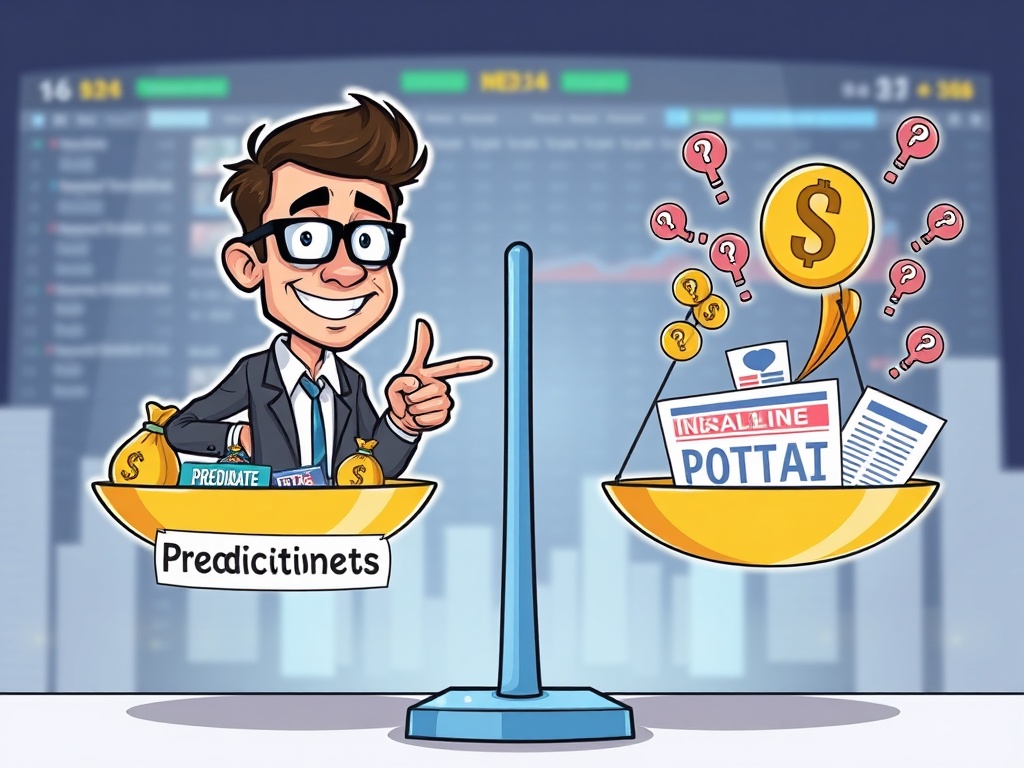
Prediction Markets: Vitalik Buterin Reveals Why They’re Astonishingly More Accurate

In the dynamic world of cryptocurrency, where information spreads at lightning speed, discerning truth from speculation is crucial. Ethereum founder Vitalik Buterin recently dropped a fascinating insight, suggesting that prediction markets are surprisingly more accurate than even professional media. This bold claim invites us to explore how these innovative platforms might reshape our understanding of future events.

Why Are Prediction Markets Astonishingly More Accurate?

Vitalik Buterin’s argument is rooted in a fundamental principle: incentives. He highlights that participants in prediction markets face a direct financial consequence for incorrect forecasts. Unlike traditional media, which often prioritizes sensationalism, or even token governance votes where there’s no penalty for a wrong choice, prediction market participants put their money where their mouth is.

  • Skin in the Game: When you bet on an outcome, you have a strong incentive to research thoroughly and make an informed decision.
  • Financial Penalty: Incorrect predictions lead to monetary losses, encouraging a more disciplined and reality-based approach.
  • Collective Wisdom: The aggregated decisions of many financially incentivized participants often yield a highly accurate probability.

This ‘skin in the game’ mechanism is what, according to Buterin, helps investors stay firmly grounded in reality. It prevents the kind of rampant overhyping or baseless speculation often seen elsewhere. Instead, it fosters an environment where genuine probability and objective assessment take precedence.

The Power of Incentives: How Prediction Markets Keep Investors Grounded

Buterin articulated his views on Farcaster, emphasizing the stark contrast between prediction markets and other information sources. He noted that professional media and social media platforms often lack a direct accountability mechanism for the accuracy of their reports or forecasts. This can lead to a landscape filled with opinions that aren’t necessarily tethered to factual outcomes.

Consider the difference:

  • Media: Journalists and pundits might face reputational risk, but rarely a direct financial loss for an inaccurate prediction.
  • Social Media: Influencers can spread misinformation with little to no consequence.
  • Token Governance: While important, votes don’t typically penalize participants for choices that don’t pan out.

In contrast, every trade within a prediction market is a statement of belief backed by capital. If that belief proves wrong, the capital is lost. This powerful feedback loop encourages rational thought and discourages emotional decision-making, leading to a remarkably precise collective forecast.

Trusting Prediction Markets Over General Sentiment: Vitalik’s Stance

Vitalik Buterin himself stated that he personally finds the probabilities presented by prediction markets to be more trustworthy than being swayed by general sentiment or the prevailing narrative. This is a significant endorsement from a highly respected figure in the crypto space, underscoring the potential for these platforms to serve as a superior source of information.

The beauty of these markets lies in their ability to distill complex information into a simple, actionable probability. When a market shows an 80% chance of an event occurring, it’s not just a guess; it’s a reflection of thousands of participants’ aggregated, financially-backed assessments. This makes them incredibly valuable tools for:

  • Forecasting Elections: Often outperforming traditional polls.
  • Predicting Product Success: Gauging public interest and viability.
  • Anticipating Global Events: Providing real-time, dynamic probabilities.

What Challenges Do Prediction Markets Face?

While the accuracy of prediction markets is compelling, it’s also important to acknowledge their limitations and challenges. These platforms, while powerful, are not without hurdles that need careful consideration for their widespread adoption and optimal function.

Key challenges include:

  • Liquidity: Smaller markets might not have enough participants or capital to generate truly robust probabilities.
  • Regulatory Uncertainty: The legal landscape for these markets is still evolving in many jurisdictions, creating barriers to entry.
  • Market Manipulation: Although less likely due to financial incentives, the potential for manipulation in illiquid markets exists.
  • Ethical Concerns: Markets on sensitive topics (e.g., assassinations) raise significant ethical debates.

Despite these challenges, the core mechanism of incentivized accuracy remains a powerful force, suggesting a bright future for these tools as they mature and gain broader acceptance. Addressing these issues will be key to unlocking their full potential.

Vitalik Buterin’s assertion that prediction markets offer superior accuracy to professional media or social media is a powerful statement. By aligning financial incentives with truthful forecasting, these platforms create a unique environment where collective wisdom triumphs over hype and speculation. As we navigate an increasingly complex information landscape, the disciplined, reality-grounded insights offered by prediction markets could become an indispensable tool for informed decision-making. Their potential to cut through the noise and provide clear, probability-driven forecasts is truly transformative.

Frequently Asked Questions (FAQs)

1. What are prediction markets?
Prediction markets are platforms where users can bet on the outcome of future events. Participants buy and sell shares representing specific outcomes, and the market price of these shares reflects the collective probability of that event occurring.

2. Why does Vitalik Buterin believe prediction markets are more accurate?
Buterin argues that prediction markets are more accurate because participants have ‘skin in the game.’ They lose money if their predictions are incorrect, creating a strong financial incentive to research thoroughly and make accurate forecasts, unlike traditional media or social media where there’s less direct accountability.

3. How do prediction markets differ from traditional media in terms of accuracy?
Traditional media often faces pressures for sensationalism or clicks, and journalists typically don’t incur direct financial penalties for inaccurate reports. Prediction markets, however, directly penalize incorrect forecasts through monetary loss, leading to more grounded and reality-checked probabilities.

4. What role do incentives play in prediction markets?
Incentives are central to the accuracy of prediction markets. The financial reward for correct predictions and the penalty for incorrect ones drive participants to be more rational, research-oriented, and less susceptible to emotional biases or hype, thus contributing to more reliable collective forecasts.

5. Are there any downsides or challenges to using prediction markets?
Yes, prediction markets face challenges such as ensuring sufficient liquidity, navigating complex regulatory landscapes, and mitigating potential for market manipulation, especially in smaller markets. Ethical concerns can also arise depending on the event being predicted.

Did Vitalik Buterin’s insights on prediction markets spark your interest? Share this article with your network and join the conversation about the future of accurate forecasting! Your friends and followers will appreciate this valuable perspective.

To learn more about the latest prediction markets trends, explore our article on key developments shaping decentralized finance market insights.

This post Prediction Markets: Vitalik Buterin Reveals Why They’re Astonishingly More Accurate first appeared on BitcoinWorld and is written by Editorial Team


Market Opportunity
Gravity Logo
Gravity Price(G)
$0.004757
$0.004757$0.004757
-1.99%
USD
Gravity (G) Live Price Chart
Disclaimer: The articles reposted on this site are sourced from public platforms and are provided for informational purposes only. They do not necessarily reflect the views of MEXC. All rights remain with the original authors. If you believe any content infringes on third-party rights, please contact service@support.mexc.com for removal. MEXC makes no guarantees regarding the accuracy, completeness, or timeliness of the content and is not responsible for any actions taken based on the information provided. The content does not constitute financial, legal, or other professional advice, nor should it be considered a recommendation or endorsement by MEXC.

You May Also Like

Crypto News: Donald Trump-Aligned Fed Governor To Speed Up Fed Rate Cuts?

Crypto News: Donald Trump-Aligned Fed Governor To Speed Up Fed Rate Cuts?

The post Crypto News: Donald Trump-Aligned Fed Governor To Speed Up Fed Rate Cuts? appeared on BitcoinEthereumNews.com. In recent crypto news, Stephen Miran swore in as the latest Federal Reserve governor on September 16, 2025, slipping into the board’s last open spot right before the Federal Open Market Committee kicks off its two-day rate discussion. Traders are betting heavily on a 25-basis-point trim, which would bring the federal funds rate down to 4.00%-4.25%, based on CME FedWatch Tool figures from September 15, 2025. Miran, who’s been Trump’s top economic advisor and a supporter of his trade ideas, joins a seven-member board where just three governors come from Democratic picks, according to the Fed’s records updated that same day. Crypto News: Miran’s Background and Quick Path to Confirmation The Senate greenlit Miran on September 15, 2025, with a tight 48-47 vote, following his nomination on September 2, 2025, as per a recent crypto news update. His stint runs only until January 31, 2026, stepping in for Adriana D. Kugler, who stepped down in August 2025 for reasons not made public. Miran earned his economics Ph.D. from Harvard and worked at the Treasury back in Trump’s first go-around. Afterward, he moved to Hudson Bay Capital Management as an economist, then looped back to the White House in December 2024 to head the Council of Economic Advisers. There, he helped craft Trump’s “reciprocal tariffs” approach, aimed at fixing trade gaps with China and the EU. He wouldn’t quit his White House gig, which irked Senator Elizabeth Warren at the September 7, 2025, confirmation hearings. That limited time frame means Miran gets to cast a vote straight away at the FOMC session starting September 16, 2025. The full board now features Chair Jerome H. Powell (Trump pick, term ends 2026), Vice Chair Philip N. Jefferson (Biden, to 2036), and folks like Lisa D. Cook (Biden, to 2028) and Michael S. Barr…
Share
BitcoinEthereumNews2025/09/18 03:14
What John Harbaugh And Mike Tomlin’s Departures Mean For NFL Coaching

What John Harbaugh And Mike Tomlin’s Departures Mean For NFL Coaching

The post What John Harbaugh And Mike Tomlin’s Departures Mean For NFL Coaching appeared on BitcoinEthereumNews.com. Baltimore Ravens head coach John Harbaugh (L
Share
BitcoinEthereumNews2026/01/15 10:56
Twitter founder's "weekend experiment": Bitchat encryption software becomes a "communication Noah's Ark"

Twitter founder's "weekend experiment": Bitchat encryption software becomes a "communication Noah's Ark"

Author: Nancy, PANews In the crypto world, both assets and technologies are gradually taking center stage with greater practical significance. In the past few months
Share
PANews2026/01/15 11:00