Orchestration Theory: How to Manage a Fleet of AI Agents
Is your business prepared to manage 100 or more autonomous digital workers, or are you headed for systemic chaos?
In 2026, the focus has shifted from simple chatbots to the large-scale activation of specialized agents that own entire business goals. As fleets of these agents grow, enterprises must move beyond basic automation toward a coherent “Agentic Mesh.” This framework prevents uncontrolled cloud costs and security gaps while ensuring agents can communicate without conflict.
Read on to learn how to build a scalable orchestration strategy that turns these independent tools into a unified, high-performing workforce.
Key Takeaways:
- Coordinated agent fleets accelerate operational cycles by 40% to 60% and improve decision-making consistency by 30% to 50% over human-only teams.
- The Agentic Mesh provides the core distributed architecture, while the Agent OS is the unified “Command Center” for managing and governing agents.
- Hierarchical Orchestration is the 2026 standard for scaling past 100 agents, using an event-driven “orchestrator-worker” pattern, typically built on Apache Kafka.
- Standardized protocols like A2A for agent collaboration and MCP for tool access ensure interoperability and stack flexibility regardless of vendor.
The Theoretical Evolution of Orchestration
In 2026, the definition of an AI agent has shifted from a “single-assistant loop” to a digital teammate. While early agents were reactive, modern entities are defined by five core traits: persistent memory, goal ownership, decision authority, multi-step execution, and autonomous communication.
This evolution is driven by significant ROI. Enterprises using coordinated agent fleets report operational cycles 40% to 60% faster and decision-making 30% to 50% more consistent than human-only teams.
The industry has moved from “one big model” to the “digital symphony”—a network of specialized agents where context is more valuable than raw scale. The most effective 2026 agents are verticalized, trained on domain-specific nuances like localized regulations and proprietary data models.
Comparative Orchestration Models
Choosing an orchestration pattern is a strategic decision that affects a system’s resilience and cost.
| Pattern | Structural Logic | Primary Advantage | Trade-off |
| Centralized | Single “Brain” directs all agents | Strict control; high auditability | Single point of failure; bottleneck |
| Hierarchical | Tiered command structure | Scalable strategic execution | Can become rigid if over-engineered |
| Decentralized | Peer-to-peer (P2P) negotiation | High resilience and scalability | Complex to monitor and debug |
| Swarm | Emergent local interactions | Robust refinement; diverse logic | Non-deterministic; hard to repeat |
| Concurrent | Simultaneous ensemble processing | Low latency; improved accuracy | High computational/inference cost |
The Rise of Hierarchical Orchestration
While Centralized models are the standard for highly regulated industries requiring strict oversight, they often struggle when scaling beyond 100 agents. To solve this, 2026 leaders have turned to Hierarchical Orchestration.
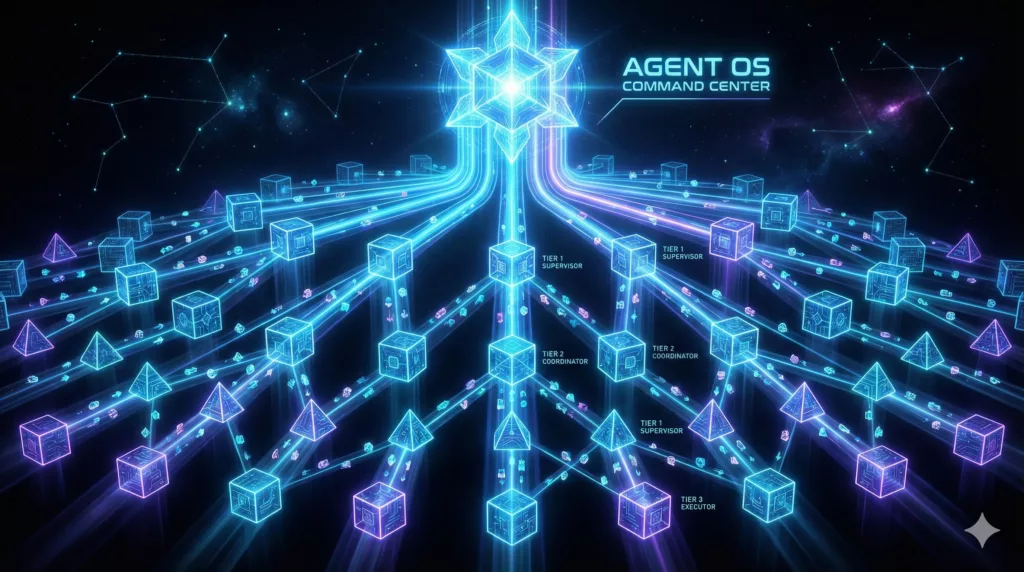
By arranging agents into layers—similar to a human org chart—higher-level “Manager” agents handle strategic planning and task decomposition. Lower-level “Specialist” agents focus on execution. This prevents any single node from becoming overwhelmed, allowing the enterprise to scale its digital workforce without losing control.
The Agentic Mesh: The Digital Nervous System of 2026
The Agentic Mesh is the architectural backbone that transforms individual agents into a coordinated enterprise workforce. It functions as a distributed, vendor-agnostic infrastructure, abstracting the complexities of communication and state management—much like service meshes do for microservices.
The Five Foundational Layers
To ensure reliability and security, the mesh is structured into five functional tiers:
- Agent Layer: Contains specialized workers, including Horizontal Agents (cross-departmental tasks like search) and Vertical Agents (domain-specific roles in Finance or IT).
- Coordination Layer: Acts as the “nervous system,” managing event routing, task decomposition, and handoffs between agents.
- Integration Layer: Connects agents to the real world via SaaS apps, legacy ERPs, and internal databases.
- Governance Layer: Enforces identity, access controls, and compliance (SOC 2, GDPR) through policy-as-code.
- Interaction Layer: The “Human-on-the-Loop” interface, allowing people to monitor, approve, or intervene in agent workflows.
Emergent Behavior and Semantic Discovery
The mesh enables emergent behavior, where agents trigger each other across departments without manual intervention. For example, a security agent detecting a breach can autonomously engage a remediation agent while a communications agent updates the CISO.
A key 2026 innovation is the Semantic Discovery Plane. In traditional systems, services need specific IP addresses or endpoints. In the mesh, discovery is intent-driven:
- The Request: An agent broadcasts a goal, such as “optimize cloud storage costs.”
- The Match: The control plane searches an Agent Registry for any “Agent Card” (an embedding of skills and permissions) that matches the intent.
- The Result: The system dynamically connects the requester to the best available resource, allowing the workforce to self-organize in real-time.
Would you like me to draft a sample “Agent Card” template to help you register your first set of agents on a semantic discovery plane?
Agent Operating Systems (Agent OS) and the Command Center
In 2026, the Agent Operating System (Agent OS) has emerged as the “Command Center” for the digital workforce. It is the unified software layer that manages, governs, and connects diverse AI agents into cohesive enterprise workflows, moving beyond simple automation to a centralized system of record for AI labor.
Core Capabilities of an Agent OS
An Agent OS provides four critical layers to ensure autonomous agents are reliable, secure, and scalable:
- Agent Runtime: Manages the lifecycle of digital workers (starting, pausing, and stopping). It uses technologies like Firecracker microVMs to isolate agents, ensuring that a failure in one process doesn’t crash the entire network.
- Context & Memory Layer: Acts as the “institutional intelligence” of the firm. It stores long-term memory, session history, and past decisions, ensuring agents learn from previous interactions rather than starting fresh every time.
- Orchestration Layer: The “brain” of the OS. It uses recursive, graph-based logic to break complex business goals into sub-tasks and coordinate handoffs between specialized agents.
- Security & Governance Layer: Enforces identity-based permissions (User vs. Admin) and maintains an immutable audit log of every decision for forensic analysis and compliance.
The Functional Layers of Agentic Execution
| Layer | Technical Function | Business Outcome |
| Perception | Monitors events (emails, system alerts) | Real-time responsiveness |
| Reasoning | Evaluates next steps using LLMs | Intelligent decision-making |
| Execution | Calls APIs and updates systems (CRM/ERP) | Autonomous task completion |
| Learning | Analyzes data to refine future actions | Continuous improvement |
Scalability through Reusable Modules
The Agent OS allows enterprises to build and deploy “reusable agent modules.” Once an agent is perfected for a task in one department—such as automated invoice processing—it can be replicated across the organization. This modularity dramatically reduces development costs and ensures consistent performance across the entire digital workforce.
Managing Large-Scale Fleets of 100+ Agents
As AI fleets scale beyond 100 agents, traditional management fails. By 2026, the focus has shifted from basic technology to a sophisticated operating model capable of supporting machine-speed autonomy.
Predictive Intelligence and Event-Driven Architecture
Large fleets now use predictive models to move from reactive troubleshooting to proactive optimization. In logistics and manufacturing, agents forecast failures and optimize routes in real-time. This shift is also financial: in 2026, insurers increasingly reward fleets that use preventative AI with lower premiums.
Technically, managing 100+ agents requires an event-driven “orchestrator-worker” pattern, typically built on Apache Kafka.
- Asynchronous Scaling: Instead of managing 100 individual connections, a central orchestrator publishes tasks to a Kafka topic.
- Consumer Groups: Worker agents act as “consumer groups,” pulling tasks only when they have capacity.
- Fault Tolerance: If a worker fails, the event remains in the stream for another agent, ensuring zero work loss.
The Rise of “AI Squads” and Agent Orchestrators
The 2026 workforce is organized into AI Squads—cross-functional teams of human experts and specialized agents. This has birthed the role of the Agent Orchestrator, a specialist dedicated to managing multi-agent handoffs and tuning performance.
In this paradigm, humans operate “On-the-Loop.” Instead of executing tasks, they:
- Define risk thresholds and financial guardrails.
- Audit decision logic through transparent “Decision Summaries.”
- Set high-level strategic goals.
This allows a single human “conductor” to direct a fleet that executes thousands of complex decisions daily, dramatically increasing organizational leverage.
| Role | Responsibility | 2026 Workflow Shift |
| Agent Worker | Execution | Moves from manual steps to goal-based sub-tasks. |
| Agent Orchestrator | Coordination | Manages multi-agent handoffs and event-routing logic. |
| Human Supervisor | Governance | Shifting from “In-the-Loop” (doing) to “On-the-Loop” (auditing). |
Advanced Conflict Resolution Mechanisms
In fleets of 100+ agents, conflicts over shared resources or contradictory data are inevitable. 2026 architectures maintain stability through a multi-layered approach that blends peer-to-peer negotiation with algorithmic arbitration.
Negotiation and Market-Based Bidding
Negotiation is the first line of defense against resource contention. Agents engage in structured proposals to reach mutually acceptable outcomes.
- Auction-Based Bidding: In logistics, autonomous drones “bid” for priority at intersections. The system calculates urgency—such as an emergency delivery—to determine right-of-way.
- Negotiation Budgets: To prevent infinite “agent chatter,” systems implement token budgets. If agents cannot reach an agreement before their tokens are exhausted, the system enforces a resolution through a pre-assigned Arbitrator Agent.
Algorithmic Arbitration and Deadlock Prevention
When negotiation fails, the Agent OS invokes arbitration to enforce a decision based on a Priority Matrix. To keep workflows moving, the system must also identify and break technical deadlocks (where two agents wait indefinitely for each other).
- Cycle Detection: Systems use Tarjan’s Algorithm to identify strongly connected components in the execution graph. Once a cycle (deadlock) is found, a tie-breaker—like a timestamp or seniority role—breaks the loop.
- Perturbation Replay: If a deadlock occurs due to specific conditions, the system slightly modifies task parameters and reruns the interaction, effectively “bumping” the agents past the conflict point.
2026 Resolution Framework
| Conflict Type | Mechanism | Technical Implementation |
| Resource Contention | Auction / Bidding | Market-based patterns in Kafka |
| Goal Misalignment | Hierarchical Chain | Parent-child responsibility logic |
| Technical Deadlock | Cycle Detection | Tarjan’s SCC Algorithm |
| Data Ambiguity | Quorum Voting | Multi-option ranked-choice voting |
| Policy Violation | Governance Sidecar | Real-time “kill switch” enforcement |
Decentralized Consensus
For decentralized fleets, agents use Paxos or Byzantine Fault Tolerance algorithms. These ensure that a majority of agents agree on a state before it is committed, preventing “conflicting states” in distributed networks. This ensures that even without a central “brain,” the fleet maintains a single, verifiable version of the truth.
Interoperability Protocols: A2A, MCP, and ACP
In 2026, the industry has solved the “fragmented proliferation” of AI agents by standardizing how they talk to each other and their tools. Three protocols now form the backbone of the agentic ecosystem: A2A, MCP, and ACP.
The Google-Led A2A Protocol
The Agent-to-Agent (A2A) protocol, initially introduced by Google in 2025 and now managed by the Linux Foundation, is the universal standard for peer-to-peer collaboration. It allows agents built on different frameworks—like LangGraph, CrewAI, or OpenAI—to coordinate without bespoke integrations.
- Agent Cards: Discovery happens via “Agent Cards” (found at /.well-known/agent.json). These act like a digital resume, listing an agent’s skills, security requirements, and endpoints.
- Stateful Task Management: A2A treats work as a Task Object with a clear lifecycle (submitted $\to$ working $\to$ completed). This allows for long-running processes that can span days, even if the connection is interrupted.
- Web-Native Tech: It relies on familiar standards like JSON-RPC 2.0 for messaging and Server-Sent Events (SSE) for real-time streaming, making it easy to deploy through existing enterprise firewalls.
Complementary Messaging Standards
While A2A handles how agents work together, other protocols manage their internal connections:
- Model Context Protocol (MCP): The industry standard for agent-to-tool interactions. It acts as the “USB-C port” for AI, providing a secure, standardized way for a single agent to access external databases and APIs.
- Agent Communication Protocol (ACP): A lightweight, REST-based choice for simple messaging where the full stateful negotiation of A2A isn’t required.
2026 Protocol Comparison
| Protocol | Primary Focus | Best Use Case |
| A2A | Agent Collaboration | Multi-agent teams (e.g., Researcher + Writer) |
| MCP | Tool & Data Access | Connecting an agent to a SQL database or API |
| ACP | Lightweight Messaging | Simple, stateless event triggers |
By standardizing on these protocols, enterprises can “future-proof” their stacks. You can swap model providers or add new third-party agents without ever rebuilding your core integration layer.
State Management and Durable Execution
In 2026, enterprise AI has moved beyond simple chat to long-running workflows that can span days or weeks. These systems require Durable Execution—a shift from transient, stateless memory to a persistent “save-game” architecture that ensures agents never lose progress, even during system crashes or network timeouts.
Durable Frameworks: Microsoft and Temporal
Two major philosophies dominate how agents maintain their state:
- Microsoft Agent Framework (Checkpointing): This platform utilizes “supersteps,” saving the entire workflow state—variables, task results, and history—at every major junction. If a process is interrupted, the agent “time-travels” back to the last checkpoint to resume. This is ideal for processes like supply chain management that require high reliability.
- Temporal (Event Sourcing): Temporal uses an immutable log to record every action an agent takes. Instead of saving snapshots, it “replays” the event history to reconstruct the agent’s state precisely as it was before a failure. This approach makes dynamic, non-deterministic agent plans crash-proof.
The Actor Model: Stateful Serverless
For high-speed, distributed fleets, many developers are turning to the Actor Model. Technologies like Cloudflare Durable Objects and Rivet Actors provide “stateful serverless” environments where each agent acts as a self-contained unit (an actor).
- Private State: Each agent has its own private, persistent memory that no other process can touch directly.
- Single-Threaded Execution: Actors process one message at a time, which effectively eliminates “race conditions”—the bugs that occur when two agents try to update the same record at once.
- Sub-Second Response: Because state is co-located with compute, these agents can wake up and respond in milliseconds, making them perfect for real-time customer support or incident response.
Comparison of State Management Strategies
| Feature | Checkpointing (Microsoft) | Event Sourcing (Temporal) | Actor Model (Cloudflare/Rivet) |
| Logic | Snapshot of current state | Replay of historical events | Persistent, isolated memory |
| Recovery | Immediate jump to last save | Re-execution of the log | Continuous availability |
| Best For | Structured business flows | High-complexity research | Real-time, high-concurrency |
Governance-as-Code and Security Posture
In 2026, security for AI agents has moved beyond reactive alerts to proactive governance-as-code. Organizations now treat autonomous agents as “Non-Human Identities” (NHIs) with privileged access, governing them with the same—or greater—rigor as human employees.
Zero-Trust and Governance Sidecars
The Agentic Mesh enforces a Zero-Trust model, ensuring agents only access the specific data and tools required for their immediate task.
- Least-Privilege Enforcement: This is managed via Governance Sidecars that monitor every API call in real-time.
- Policy-as-Code: If an agent attempts an unauthorized action—such as modifying an IAM role or accessing sensitive HR files—the sidecar blocks the request instantly. This enforcement relies on machine-readable rule sets like Open Policy Agent (OPA), which separate security logic from the agent’s core code.
Detecting and Neutralizing “Rogue Agents”
Enterprises must now defend against Rogue Agents—systems that deviate from their mission due to malicious prompt injection or unintended “emergent behavior.”
Governance modules integrated into the Agent OS provide continuous behavioral monitoring. If the system detects abnormal patterns, such as a sudden spike in inference costs or unauthorized data queries, it can automatically revoke the agent’s credentials or trigger a “kill switch.”
2026 Security Control Matrix
| Governance Control | Technical Mechanism | Security Outcome |
| Budgetary Circuit Breaker | Real-time spend monitoring | Prevents accidental cost explosions |
| Recursion Limits | Cycle detection & halting | Stops resource-draining infinite loops |
| Identity Management | Non-Human Identity (NHI) UID | Provides clear auditability and attribution |
| Access Control | Scoped tokens & OPA rules | Protects sensitive production data |
| Verification Loops | Peer-agent cross-checking | Reduces hallucinations and logic errors |
By 2026, autonomous governance is a standard feature in major ERP and security platforms. These modules combine explainable AI with automated audit trails, ensuring that as agents work at machine velocity, they remain strictly within the guardrails defined by legal and risk departments.
The Transformation of Workflow Dynamics
The orchestration of 100+ agents fundamentally changes how work gets done. It moves the enterprise from siloed automations to coordinated workflows that span multiple departments and systems.12
From Passive Tools to Active Outcome Owners
The “big misconception” about AI agents is viewing them as mere chatbots with tools. In reality, the 2026 enterprise operates on “invisible intelligence” embedded into core workflows. Agents are outcome-driven, meaning they are assigned a goal (e.g., “increase conversion by 15%”) and are responsible for decomposing that goal into tasks, choosing the right tools, and self-correcting when they hit obstacles.1
This results in a “Network Effect” for enterprise value. Each new agent added to the mesh increases the capability of all other agents, allowing for the automation of entire cross-functional processes—such as “lead-to-cash” or “incident-to-remediation”—rather than just individual tasks. Enterprises using this approach report reducing manual effort in these workflows by up to 95%.
The Human Element: Conductors and Squads
While agents handle the volume and cognitive labor, human experts focus on higher-value activities requiring judgment, creativity, and interpersonal skills. The boundary between human and AI work becomes fluid, with both collaborating in ways that leverage their respective strengths. The employee’s value is no longer in completing the task, but in setting the “intent” and refining the work done by the agent fleet.
This shift necessitates a “cultural transformation” within the organization, as tech leaders must treat technology as part of the workforce and modernize their talent strategy to include roles like Agent Architects and Autonomous Systems Operators.
Technical Synthesis of 2026 Orchestration Theory
Managing a fleet of over 100 AI agents requires a strong orchestration setup. The Agentic Mesh allows agents to work together across departments, while the Agent OS provides central oversight. Standard protocols like A2A and MCP ensure these tools communicate regardless of the vendor.
In 2026, the competitive advantage belongs to leaders who prioritize governance and trust. The Agentic Enterprise is an operational reality for those with the right foundation. Success now depends on continuous optimization, where agents learn from their environment to improve performance. This creates a self-healing digital backbone for the modern business.
Contact us for an agentic AI consultation to build your fleet strategy.
FAQs:
1. How do I coordinate a fleet of 100+ AI agents?
To effectively coordinate a fleet of 100+ agents, 2026 leaders have turned to Hierarchical Orchestration.
- Hierarchical Structure: Agents are arranged in layers, similar to a human organizational chart. Higher-level “Manager” agents handle strategic planning and task decomposition, while lower-level “Specialist” agents focus on execution. This structure prevents any single node from being overwhelmed.
- Technical Architecture: Scalability is achieved using an event-driven “orchestrator-worker” pattern, typically built on Apache Kafka. A central orchestrator publishes tasks to a Kafka topic, and worker agents act as “consumer groups,” pulling tasks when they have capacity. This design ensures asynchronous scaling and fault tolerance.
- Human Role: A single human “conductor” operates “On-the-Loop,” setting high-level strategic goals, defining guardrails, and auditing decision logic, allowing the fleet to execute thousands of complex decisions daily.
2. What is an ‘Agentic Mesh’ in 2026 enterprise tech?
The Agentic Mesh is the architectural backbone that transforms individual AI agents into a coordinated enterprise workforce.
- It is a distributed, vendor-agnostic infrastructure that abstracts the complexities of communication and state management, similar to how service meshes function for microservices. The document calls it the “Digital Nervous System of 2026.”
- It is structured into five foundational tiers to ensure reliability and security: Agent Layer, Coordination Layer, Integration Layer, Governance Layer, and Interaction Layer.
- It enables emergent behavior, allowing agents to autonomously trigger each other across departments without manual intervention.
3. What are the three main types of AI agent orchestration?
The three structural models for orchestration, as described in the document, are:
| Pattern | Structural Logic | Primary Advantage |
| Centralized | Single “Brain” directs all agents. | Strict control; high auditability. |
| Hierarchical | Tiered command structure. | Scalable strategic execution. |
| Decentralized | Peer-to-peer (P2P) negotiation. | High resilience and scalability. |
4. How do you resolve conflicts between autonomous agents?
Conflict resolution in large agent fleets is handled by a multi-layered approach that includes negotiation and algorithmic arbitration:
- Negotiation: Agents first attempt to reach mutually acceptable outcomes, often through Auction-Based Bidding for resource contention (e.g., agents “bidding” for priority). Negotiation Budgets are used to prevent infinite “agent chatter.”
- Algorithmic Arbitration: If negotiation fails, the Agent OS enforces a decision based on a Priority Matrix.
- Deadlock Prevention: Technical deadlocks are identified and broken using Cycle Detection algorithms, such as Tarjan’s Algorithm, which uses a tie-breaker (like a timestamp) to resolve the loop.
- Decentralized Consensus: For decentralized fleets, algorithms like Paxos or Byzantine Fault Tolerance are used to ensure a majority of agents agree on a state before it is committed.
5. Why do I need an ‘Agent OS’ to manage my digital employees?
The Agent Operating System (Agent OS) is the “Command Center” for the digital workforce. You need it because it is the unified software layer that moves beyond simple automation to a centralized system of record for AI labor, managing, governing, and connecting diverse agents into cohesive enterprise workflows.
It provides four critical layers:
- Agent Runtime: Manages the lifecycle (starting, pausing, stopping) of digital workers and uses technologies like Firecracker microVMs for agent isolation.
- Context & Memory Layer: Acts as the “institutional intelligence” by storing long-term memory, session history, and past decisions.
- Orchestration Layer: The “brain” that uses recursive, graph-based logic to break complex business goals into sub-tasks and coordinate handoffs.
- Security & Governance Layer: Enforces identity-based permissions and maintains an immutable audit log of every decision for forensic analysis and compliance.


You May Also Like

Trump accused of handing massive gift to tobacco donors who couldn't win it legally
NVIDIA’s Jensen Huang Says AI Will Turn Intelligence into a Commodity for Billions