This article evaluates six deep-learning feature extractors for content-based image retrieval (CBIR), spanning both self-supervised and supervised approaches. It analyzes DINOv1, DINOv2, and DreamSim as ImageNet-pretrained self-supervised models, and contrasts them with SwinTransformer and two ResNet50 variants—one trained on RadImageNet and another on fractal geometry renderings. By extending earlier studies, the comparison highlights how backbone choice, training data, and pretraining strategies impact performance across medical and synthetic imaging tasks.This article evaluates six deep-learning feature extractors for content-based image retrieval (CBIR), spanning both self-supervised and supervised approaches. It analyzes DINOv1, DINOv2, and DreamSim as ImageNet-pretrained self-supervised models, and contrasts them with SwinTransformer and two ResNet50 variants—one trained on RadImageNet and another on fractal geometry renderings. By extending earlier studies, the comparison highlights how backbone choice, training data, and pretraining strategies impact performance across medical and synthetic imaging tasks.

Comparing Six Deep Learning Feature Extractors for CBIR Tasks

Abstract and 1. Introduction

  1. Materials and Methods

    2.1 Vector Database and Indexing

    2.2 Feature Extractors

    2.3 Dataset and Pre-processing

    2.4 Search and Retrieval

    2.5 Re-ranking retrieval and evaluation

  2. Evaluation and 3.1 Search and Retrieval

    3.2 Re-ranking

  3. Discussion

    4.1 Dataset and 4.2 Re-ranking

    4.3 Embeddings

    4.4 Volume-based, Region-based and Localized Retrieval and 4.5 Localization-ratio

  4. Conclusion, Acknowledgement, and References

2.2 Feature Extractors

We extend the analysis of Khun Jush et al. [2023] by adding two ResNet50 embeddings and evaluating the performance of six different slice embedding extractors for CBIR tasks. All the feature extractors are based on deep-learning-based models.

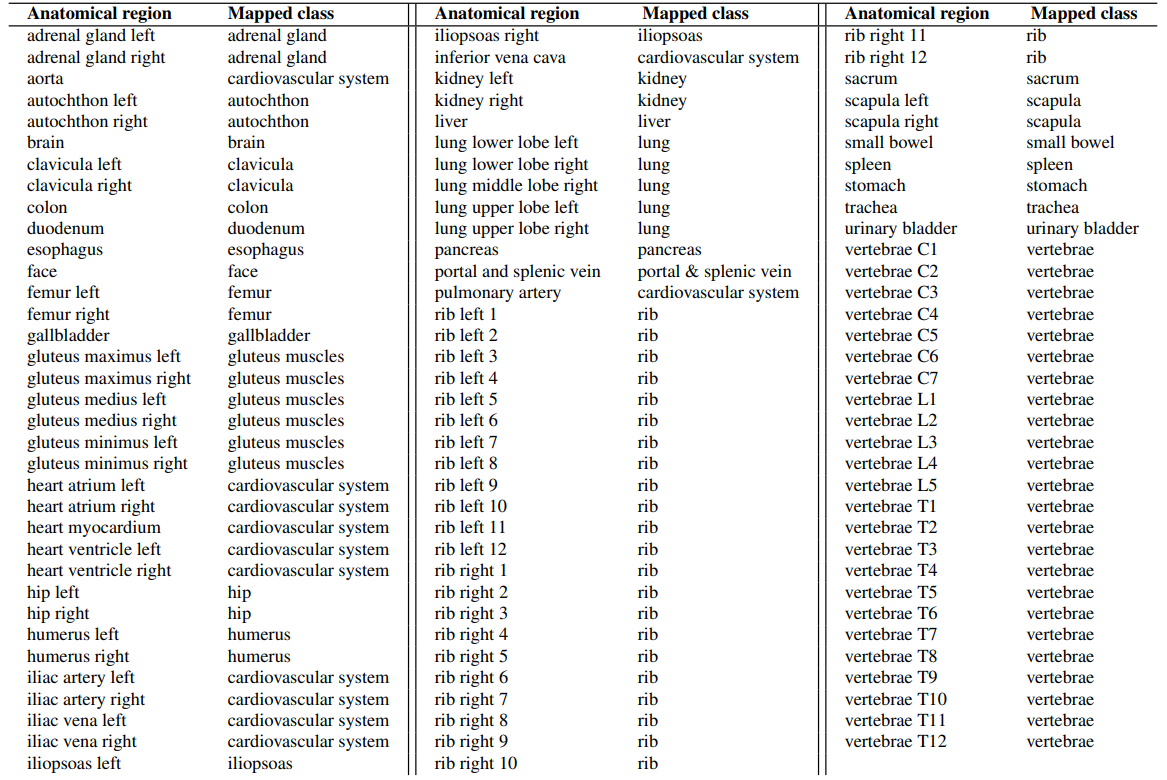
\ Table 1: Mapping of the original TS classes to 29 coarse anatomical regions.
\ Self-supervised Models: We employed three self-supervised models pre-trained on ImageNet [Deng et al., 2009]. DINOv1 [Caron et al., 2021], that demonstrated learning efficient image representations from unlabeled data using self-distillation. DINOv2 [Oquab et al., 2023], is built upon DINOv1 [Caron et al., 2021], and this model scales the pre-training process by combining an improved training dataset, patchwise objectives during training and introducing a new regularization technique, which gives rise to superior performance on segmentation tasks. DreamSim [Fu et al., 2023], built upon the foundation of DINOv1 [Caron et al., 2021], fine-tunes the model using synthetic data triplets specifically designed to be cognitively impenetrable with human judgments. For the self-supervised models, we used the best-performing backbone reported by the developers of the models.

\ Supervised Models: We included a SwinTransformer model [Liu et al., 2021] and a ResNet50 model [He et al., 2016] trained in a supervised manner using the RadImageNet dataset [Mei et al., 2022] that includes 5 million annotated 2D CT, MRI, and ultrasound images of musculoskeletal, neurologic, oncologic, gastrointestinal, endocrine, and pulmonary pathology. Furthermore, a ResNet50 model pre-trained on rendered images of fractal geometries was included based on [Kataoka et al., 2022]. These training images are formula-derived, non-natural, and do not require any human annotation.

\

:::info Authors:

(1) Farnaz Khun Jush, Bayer AG, Berlin, Germany (farnaz.khunjush@bayer.com);

(2) Steffen Vogler, Bayer AG, Berlin, Germany (steffen.vogler@bayer.com);

(3) Tuan Truong, Bayer AG, Berlin, Germany (tuan.truong@bayer.com);

(4) Matthias Lenga, Bayer AG, Berlin, Germany (matthias.lenga@bayer.com).

:::


:::info This paper is available on arxiv under CC BY 4.0 DEED license.

:::

\

Market Opportunity
SIX Logo
SIX Price(SIX)
$0.01226
$0.01226$0.01226
-0.80%
USD
SIX (SIX) Live Price Chart
Disclaimer: The articles reposted on this site are sourced from public platforms and are provided for informational purposes only. They do not necessarily reflect the views of MEXC. All rights remain with the original authors. If you believe any content infringes on third-party rights, please contact service@support.mexc.com for removal. MEXC makes no guarantees regarding the accuracy, completeness, or timeliness of the content and is not responsible for any actions taken based on the information provided. The content does not constitute financial, legal, or other professional advice, nor should it be considered a recommendation or endorsement by MEXC.

You May Also Like

Crypto News: Donald Trump-Aligned Fed Governor To Speed Up Fed Rate Cuts?

Crypto News: Donald Trump-Aligned Fed Governor To Speed Up Fed Rate Cuts?

The post Crypto News: Donald Trump-Aligned Fed Governor To Speed Up Fed Rate Cuts? appeared on BitcoinEthereumNews.com. In recent crypto news, Stephen Miran swore in as the latest Federal Reserve governor on September 16, 2025, slipping into the board’s last open spot right before the Federal Open Market Committee kicks off its two-day rate discussion. Traders are betting heavily on a 25-basis-point trim, which would bring the federal funds rate down to 4.00%-4.25%, based on CME FedWatch Tool figures from September 15, 2025. Miran, who’s been Trump’s top economic advisor and a supporter of his trade ideas, joins a seven-member board where just three governors come from Democratic picks, according to the Fed’s records updated that same day. Crypto News: Miran’s Background and Quick Path to Confirmation The Senate greenlit Miran on September 15, 2025, with a tight 48-47 vote, following his nomination on September 2, 2025, as per a recent crypto news update. His stint runs only until January 31, 2026, stepping in for Adriana D. Kugler, who stepped down in August 2025 for reasons not made public. Miran earned his economics Ph.D. from Harvard and worked at the Treasury back in Trump’s first go-around. Afterward, he moved to Hudson Bay Capital Management as an economist, then looped back to the White House in December 2024 to head the Council of Economic Advisers. There, he helped craft Trump’s “reciprocal tariffs” approach, aimed at fixing trade gaps with China and the EU. He wouldn’t quit his White House gig, which irked Senator Elizabeth Warren at the September 7, 2025, confirmation hearings. That limited time frame means Miran gets to cast a vote straight away at the FOMC session starting September 16, 2025. The full board now features Chair Jerome H. Powell (Trump pick, term ends 2026), Vice Chair Philip N. Jefferson (Biden, to 2036), and folks like Lisa D. Cook (Biden, to 2028) and Michael S. Barr…
Share
BitcoinEthereumNews2025/09/18 03:14
What John Harbaugh And Mike Tomlin’s Departures Mean For NFL Coaching

What John Harbaugh And Mike Tomlin’s Departures Mean For NFL Coaching

The post What John Harbaugh And Mike Tomlin’s Departures Mean For NFL Coaching appeared on BitcoinEthereumNews.com. Baltimore Ravens head coach John Harbaugh (L
Share
BitcoinEthereumNews2026/01/15 10:56
Twitter founder's "weekend experiment": Bitchat encryption software becomes a "communication Noah's Ark"

Twitter founder's "weekend experiment": Bitchat encryption software becomes a "communication Noah's Ark"

Author: Nancy, PANews In the crypto world, both assets and technologies are gradually taking center stage with greater practical significance. In the past few months
Share
PANews2026/01/15 11:00