USDT’s 60-day market cap change has fallen below -$3 billion, a threshold reached only once before, during late 2022 when Bitcoin based near $16,000. The secondUSDT’s 60-day market cap change has fallen below -$3 billion, a threshold reached only once before, during late 2022 when Bitcoin based near $16,000. The second

USDT 60-Day Contraction Drops Below -$3B as Bitcoin Trades $65K–$70K

2026/02/23 11:14
3 min read

USDT’s 60-day market cap change has fallen below -$3 billion, a threshold reached only once before, during late 2022 when Bitcoin based near $16,000.

The second occurrence is unfolding now, in early 2026, with BTC trading in the $65,000–$70,000 range following its prior all-time high expansion.

The magnitude of the contraction places stablecoin liquidity at the center of current market structure. This is not a routine fluctuation. It reflects sustained capital withdrawal from the crypto ecosystem over a compressed period.

Rare Liquidity Signal Reappears

Stablecoins function as deployable liquidity across the digital asset market. When supply expands, it typically signals fresh capital entering exchanges and on-chain venues. When supply contracts aggressively, it implies redemptions, deleveraging, or capital exiting the ecosystem.
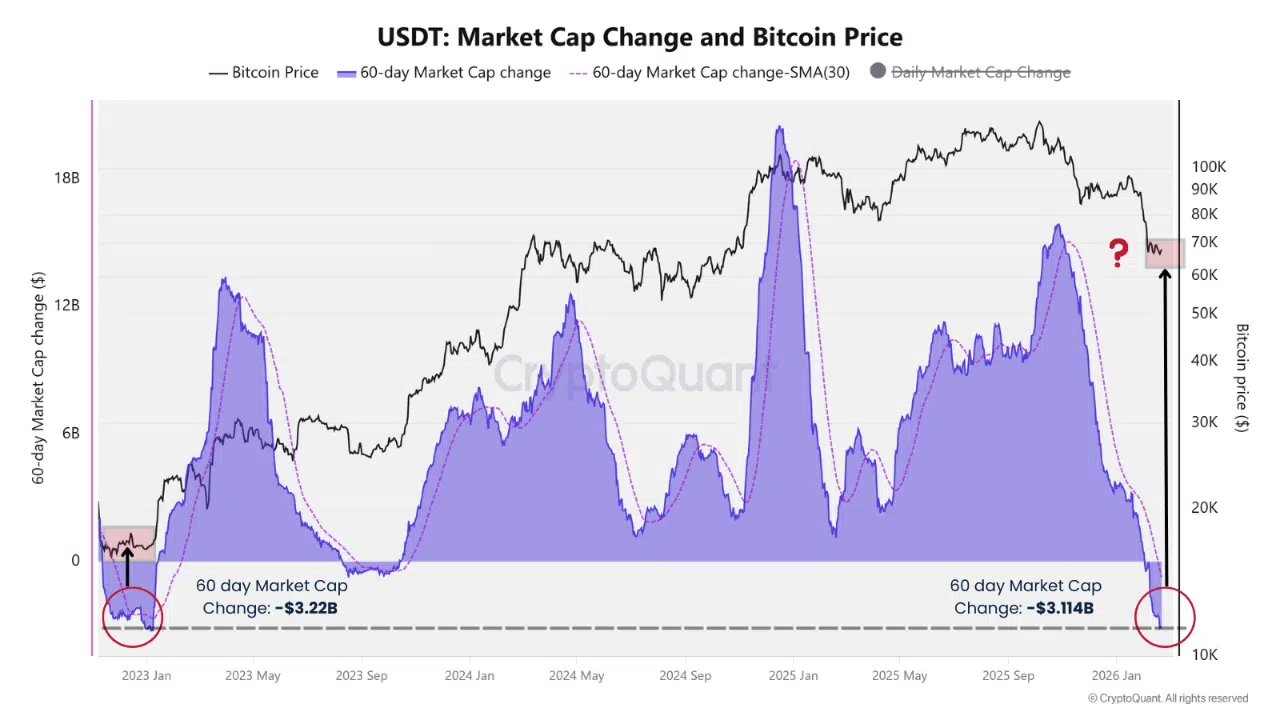
The 60-day USDT contraction below -$3 billion has occurred on only two occasions:

  • Late 2022: Bitcoin traded near $16,000, marking a cycle low amid peak capitulation.
  • Early 2026: Bitcoin trades between $65,000 and $70,000 after a prior all-time high phase.

The structural difference in price level makes the comparison more complex. In 2022, the contraction aligned with systemic stress and forced selling. Today, the contraction is occurring from significantly higher valuation levels, suggesting liquidity tightening rather than full-cycle collapse.

Daily Outflows Add to the Stress Signal

On a daily basis, USDT has printed three separate single-day outflows exceeding -$1 billion. Historically, episodes of this scale have aligned with either macro bottoms or volatility clusters in Bitcoin.

Large-scale redemptions typically reflect institutional or large-holder activity rather than retail flows. When redemptions accelerate at this magnitude, they often coincide with exhaustion phases, periods where forced positioning unwinds rather than the early stages of sustained structural downtrends.

That distinction matters. Liquidity exits can precede either stabilization or further downside depending on whether the contraction persists.

Bitcoin’s Liquidity Sensitivity

Bitcoin remains deeply reflexive to liquidity conditions. When stablecoin supply compresses, the available on-exchange buying power shrinks. That creates a more fragile environment, especially during periods of heightened volatility.

The current 60-day contraction suggests structural tightening in crypto-native liquidity. If redemptions continue at this pace, downside pressure could extend as market depth thins and risk appetite remains subdued.

However, historical precedent shows that once forced deleveraging phases complete and stablecoin flows stabilize, Bitcoin has often transitioned into strong medium-term recoveries as liquidity normalizes.

Smart Money Buys the Dip as 1,000+ BTC Whales Accumulate

Stabilization Is the Inflection Variable

The key variable is not the depth of contraction alone, but whether flows begin to flatten.

If USDT supply continues to decline, structural pressure may persist. If the contraction slows or reverses, the risk-reward profile shifts rapidly, as even modest liquidity expansion can have an outsized effect in a reflexive market.

Extreme liquidity stress has historically marked opportunity, but only after selling exhaustion is confirmed. For now, Bitcoin trades in a tightening liquidity regime, and stabilization in USDT flows remains the condition that could redefine the next structural phase.

The post USDT 60-Day Contraction Drops Below -$3B as Bitcoin Trades $65K–$70K appeared first on ETHNews.


Market Opportunity
Bitcoin Logo
Bitcoin Price(BTC)
$65,398.37
$65,398.37$65,398.37
-3.37%
USD
Bitcoin (BTC) Live Price Chart
Disclaimer: The articles reposted on this site are sourced from public platforms and are provided for informational purposes only. They do not necessarily reflect the views of MEXC. All rights remain with the original authors. If you believe any content infringes on third-party rights, please contact service@support.mexc.com for removal. MEXC makes no guarantees regarding the accuracy, completeness, or timeliness of the content and is not responsible for any actions taken based on the information provided. The content does not constitute financial, legal, or other professional advice, nor should it be considered a recommendation or endorsement by MEXC.

You May Also Like

If you put $1,000 in Intel at the start of 2025, here’s your return now

If you put $1,000 in Intel at the start of 2025, here’s your return now

The post If you put $1,000 in Intel at the start of 2025, here’s your return now appeared on BitcoinEthereumNews.com. Intel (NASDAQ: INTC) and Nvidia (NASDAQ: NVDA) announced a new partnership on Thursday, September 18, working on several generations of custom data center and computing chips designed to boost performance in hyperscale, enterprise, and consumer applications. As part of the collaboration, Nvidia, the undisputed leader of the semiconductor sector, will also invest $5 billion in Intel by purchasing its common stock at a price of $23.28 per share. Following the news, Intel stock jumped more than 30% in pre-market trading, while Nvidia saw a 3% uptick, a welcome change following weeks of shaky performance and controversies regarding its Chinese sales. Trading at $31.34 at the time of writing, INTC shares are up 54.99% year-to-date (YTD). INTC YTD stock price. Source: Google Accordingly, a $1,000 investment in the tech company at the start of the year would now be worth $1,549.90, giving you a return of $549.90. ‘The next era of computing’ The move follows a wave of fresh backing for the struggling Intel, including a nearly $9 billion U.S. government purchase of a 10% stake just weeks ago and a $2 billion investment from Japan’s SoftBank. As such, the deal has the potential to put Intel back into the game after years of trying to catch up not just with Nvidia but also AMD (NASDAQ: AMD) and Broadcom (NASDAQ: AVGO). “This historic collaboration tightly couples NVIDIA’s AI and accelerated computing stack with Intel’s CPUs and the vast x86 ecosystem — a fusion of two world-class platforms. Together, we will expand our ecosystems and lay the foundation for the next era of computing,” wrote Nvidia founder and chief executive officer (CEO), Jensen Huang.  However, the U.S. government’s direct involvement suggests that more is at stake than simply propping up Intel, as it likely reflects a broader concern about keeping America competitive…
Share
BitcoinEthereumNews2025/09/18 22:47
In an era of agent explosion, how should we cope with AI anxiety?

In an era of agent explosion, how should we cope with AI anxiety?

Author: XinGPT AI is yet another movement for technological equality. A recent article titled "The Internet is Dead, Agents Live On" went viral on social media
Share
PANews2026/02/23 11:33
SEC Approves! Paving the Way for Altcoin ETFs: New Decision Closely Concerns 12 Altcoins Including XRP!

SEC Approves! Paving the Way for Altcoin ETFs: New Decision Closely Concerns 12 Altcoins Including XRP!

The SEC has approved general listing standards for cryptocurrency ETFs, covering 12 altcoins including XRP, Solana (SOL). Continue Reading: SEC Approves! Paving the Way for Altcoin ETFs: New Decision Closely Concerns 12 Altcoins Including XRP!
Share
Coinstats2025/09/18 21:32