This article explores the key approaches to medical image retrieval—volume-based, region-based, and localized retrieval—and explains when each is most effective. It also introduces the concept of localization-ratio, showing how parameter choices (like the value of L) directly impact retrieval accuracy. By highlighting trade-offs and optimization strategies, the piece provides a clear guide for improving organ-level image search in real-world medical imaging tasks.This article explores the key approaches to medical image retrieval—volume-based, region-based, and localized retrieval—and explains when each is most effective. It also introduces the concept of localization-ratio, showing how parameter choices (like the value of L) directly impact retrieval accuracy. By highlighting trade-offs and optimization strategies, the piece provides a clear guide for improving organ-level image search in real-world medical imaging tasks.

Why One Small Parameter Can Make or Break Your Medical Image Retrieval

Abstract and 1. Introduction

  1. Materials and Methods

    2.1 Vector Database and Indexing

    2.2 Feature Extractors

    2.3 Dataset and Pre-processing

    2.4 Search and Retrieval

    2.5 Re-ranking retrieval and evaluation

  2. Evaluation and 3.1 Search and Retrieval

    3.2 Re-ranking

  3. Discussion

    4.1 Dataset and 4.2 Re-ranking

    4.3 Embeddings

    4.4 Volume-based, Region-based and Localized Retrieval and 4.5 Localization-ratio

  4. Conclusion, Acknowledgement, and References

4.4 Volume-based, Region-based and Localized Retrieval

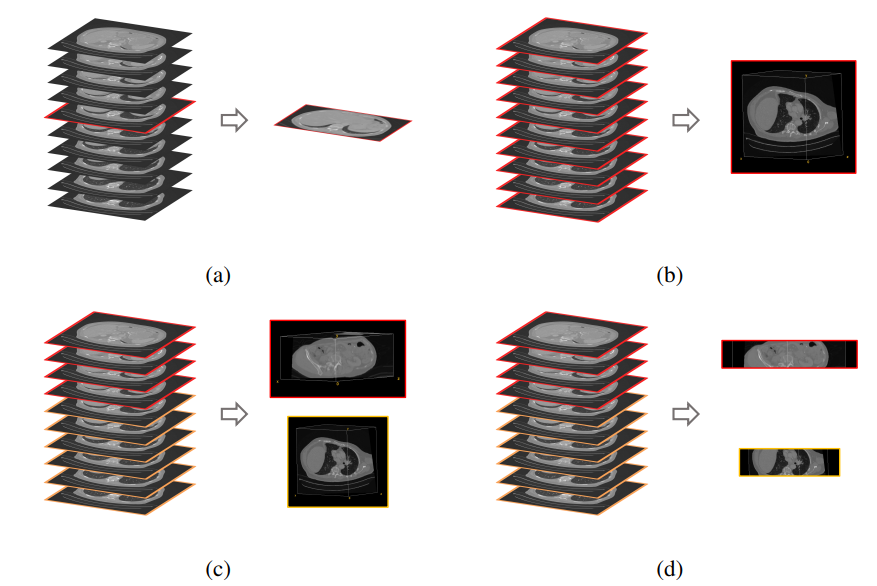
Since multiple organs (i.e. labels) are present in each query volume, there are essentially different ways in which image retrieval can be performed. The preferred choice depends on the context of the retrieval task in the real world. If the goal is to find a scan out of a database that is most similar to a complete query scan with the entirety of all present organs (think scan-id to scan-id but visual), then volume-based retrieval is the right choice. In contrast, if the experimenter is interested in a particular organ and its most similar counterpart in the database (and all other organs just happen to be in the same scan due to proximity), then region-based retrieval or localized retrieval is advised. Slice-wise retrieval can find the most similar slice of a volume regardless of the number of other slices. This is not usually a practical choice in real scenarios. Figure 11 visualizes the options.

4.5 Localization-ratio

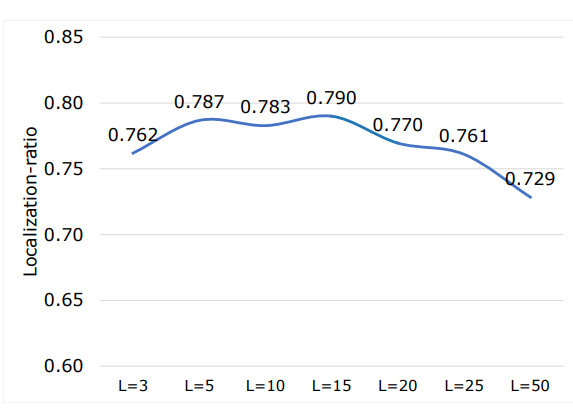
Table 22 shows the average localization-ratio for with and without re-ranking (L = 15). There is a drop for both 29 coarse and 104 original TS classes after re-ranking. However, both with and without re-ranking the localization-ratio is high, indicating that most of the slices contributing to the final retrieval of the volumes actually contain the desired anatomical region. However, based on (7) the choice of L can impact this measure. Figure 12 shows localization-ratio for different values of L as shown increasing the L to more that L = 15 decreases the localization-ratio. This indicates

\ Table 20: Summary of the average retrieval recall and standard deviation between classes for 29 anatomical regions, the boldfaced values highlight the highest recall across feature extractors.

\ Table 21: Summary of the average retrieval recall and standard deviation between classes for 104 anatomical regions, the boldfaced values highlight the highest recall across feature extractors.

\ Figure 11: An overview of three retrieval methods: (a) Slice-wise, where the retrieval is based on one selected slice e.g., the user zooms to a slice and retrieves the most similar slice (b) volume-based, where the retrieval is based on a complete volume, e.g., the user would like to retrieve similar volumes to the volumes under examination or simply filter the database (c) region-based, where the retrieval is based on the selected organ (or sub-volume), e.g, the user zooms in to a specific region and the most similar volume containing that region is retrieved, (d) localized, where the retrieval is based on the selected organ (or sub-volume) but the region in the retrieved volume is localized to the desired organ (or sub-volume), e.g, the user zooms in to a specific region and the system returns the localized region in the retrieved volume.

\ Figure 12: Average localization-ratio for different L values for re-ranking evaluation using DreamSim model (bestperforming embedding) based on (7).

\ Table 22: Summary of the average localization-ratio and standard deviation between classes for 29 and 104 anatomical regions for L = 15, the boldfaced values highlight the highest localization-ratio across feature extractors.

\ that the first highest values in vector mSIM based on (6) points to the exact slices that contain the desired anatomical structure. To improve the re-ranking localization-ratio, further studies can focus on optimizing the L value based on heuristic, organ size, etc.

\

:::info Authors:

(1) Farnaz Khun Jush, Bayer AG, Berlin, Germany (farnaz.khunjush@bayer.com);

(2) Steffen Vogler, Bayer AG, Berlin, Germany (steffen.vogler@bayer.com);

(3) Tuan Truong, Bayer AG, Berlin, Germany (tuan.truong@bayer.com);

(4) Matthias Lenga, Bayer AG, Berlin, Germany (matthias.lenga@bayer.com).

:::


:::info This paper is available on arxiv under CC BY 4.0 DEED license.

:::

\

Market Opportunity
RealLink Logo
RealLink Price(REAL)
$0.08031
$0.08031$0.08031
-0.29%
USD
RealLink (REAL) Live Price Chart
Disclaimer: The articles reposted on this site are sourced from public platforms and are provided for informational purposes only. They do not necessarily reflect the views of MEXC. All rights remain with the original authors. If you believe any content infringes on third-party rights, please contact service@support.mexc.com for removal. MEXC makes no guarantees regarding the accuracy, completeness, or timeliness of the content and is not responsible for any actions taken based on the information provided. The content does not constitute financial, legal, or other professional advice, nor should it be considered a recommendation or endorsement by MEXC.

You May Also Like

The Economics of Self-Isolation: A Game-Theoretic Analysis of Contagion in a Free Economy

The Economics of Self-Isolation: A Game-Theoretic Analysis of Contagion in a Free Economy

Exploring how the costs of a pandemic can lead to a self-enforcing lockdown in a networked economy, analyzing the resulting changes in network structure and the existence of stable equilibria.
Share
Hackernoon2025/09/17 23:00
One Of Frank Sinatra’s Most Famous Albums Is Back In The Spotlight

One Of Frank Sinatra’s Most Famous Albums Is Back In The Spotlight

The post One Of Frank Sinatra’s Most Famous Albums Is Back In The Spotlight appeared on BitcoinEthereumNews.com. Frank Sinatra’s The World We Knew returns to the Jazz Albums and Traditional Jazz Albums charts, showing continued demand for his timeless music. Frank Sinatra performs on his TV special Frank Sinatra: A Man and his Music Bettmann Archive These days on the Billboard charts, Frank Sinatra’s music can always be found on the jazz-specific rankings. While the art he created when he was still working was pop at the time, and later classified as traditional pop, there is no such list for the latter format in America, and so his throwback projects and cuts appear on jazz lists instead. It’s on those charts where Sinatra rebounds this week, and one of his popular projects returns not to one, but two tallies at the same time, helping him increase the total amount of real estate he owns at the moment. Frank Sinatra’s The World We Knew Returns Sinatra’s The World We Knew is a top performer again, if only on the jazz lists. That set rebounds to No. 15 on the Traditional Jazz Albums chart and comes in at No. 20 on the all-encompassing Jazz Albums ranking after not appearing on either roster just last frame. The World We Knew’s All-Time Highs The World We Knew returns close to its all-time peak on both of those rosters. Sinatra’s classic has peaked at No. 11 on the Traditional Jazz Albums chart, just missing out on becoming another top 10 for the crooner. The set climbed all the way to No. 15 on the Jazz Albums tally and has now spent just under two months on the rosters. Frank Sinatra’s Album With Classic Hits Sinatra released The World We Knew in the summer of 1967. The title track, which on the album is actually known as “The World We Knew (Over and…
Share
BitcoinEthereumNews2025/09/18 00:02
The U.S. Department of Justice files civil forfeiture lawsuit for over $225 million in crypto fraud funds

The U.S. Department of Justice files civil forfeiture lawsuit for over $225 million in crypto fraud funds

PANews reported on June 18 that according to an official announcement, the U.S. Department of Justice filed a civil forfeiture lawsuit in the U.S. District Court for the District of
Share
PANews2025/06/18 23:59