

MoneyGram Joins Cardano’s Midnight As Federated Mainnet Validator
MoneyGram has joined Midnight’s launch-phase infrastructure as a federated node operator, adding a major cross-border payments brand to the Cardano based privacy-focused network’s initial mainnet cohort ahead of a planned March launch. The move matters because Cardano’s Midnight is explicitly positioning its early validator set around operators with compliance-heavy, always-on production experience rather than crypto-native firms alone.
In a February 24 update, the Midnight Foundation said the network is expanding its federated node operator roster during the Kūkolu phase of its roadmap, a stage designed to prioritize coordinated participation and operational stability as mainnet goes live. MoneyGram was announced alongside Pairpoint by Vodafone and eToro, building on previously named partners that include Google Cloud, Blockdaemon, Shielded Technologies, and AlphaTON. The announcement adds to the institutional profile of the Cardano-linked privacy network ahead of launch.
Why MoneyGram Matters For Cardano’s Midnight
Midnight describes MoneyGram as a cross-border digital P2P payments leader operating in more than 200 countries and territories. Beyond simply running a node, the Foundation said the two organizations are also exploring how established payment networks could move onto blockchain rails while preserving regulatory trust. The specific focus is on confidential transactions where settlement can function as verifiable proof of compliance without exposing sensitive user data.
Luke Tuttle, MoneyGram’s chief product and technology officer, framed the move as a continuation of the company’s existing crypto strategy rather than a new experiment. “MoneyGram has been delivering real-world crypto solutions for years, focusing on making the benefits of digital finance accessible to the people who actually need them,” Tuttle said. “Working with Midnight and running blockchain nodes fits naturally into this strategy, allowing us to help ensure that privacy, compliance and reliability are built in from day one.”
The Foundation’s announcement repeatedly ties the federated model to launch reliability. Its argument is straightforward: operators that already manage high-volume, mission-critical systems in payments, telecom and regulated fintech are better suited to support early mainnet performance while developers begin deploying privacy-preserving applications. Midnight also says this phase is part of a longer path toward community-driven decentralization, not the endpoint.
That framing comes through clearly in comments from both eToro and the Foundation. eToro Chief Blockchain Officer Omri Ross said, “We were excited to learn about Midnight’s novel approach to programmable data protection and selective disclosure, designed to balance user confidentiality with regulatory compliance. We believe technologies enabling granular control over data visibility will be foundational to the next generation of blockchain infrastructure. Midnight’s architecture for confidential smart contracts with built-in verifiability aligns with our long-term view that, over time, all asset classes will increasingly move on-chain.”
Midnight Foundation President Fahmi Syed made the same point in more strategic terms, arguing the mix of operators itself is the signal. “When a global payments network, a leading technology company backed by a Fortune 500 telco, and a publicly traded fintech all choose to operate nodes on the same privacy-enhancing blockchain, that tells you where this industry is heading,” Syed said, adding that the consortium is only the beginning.
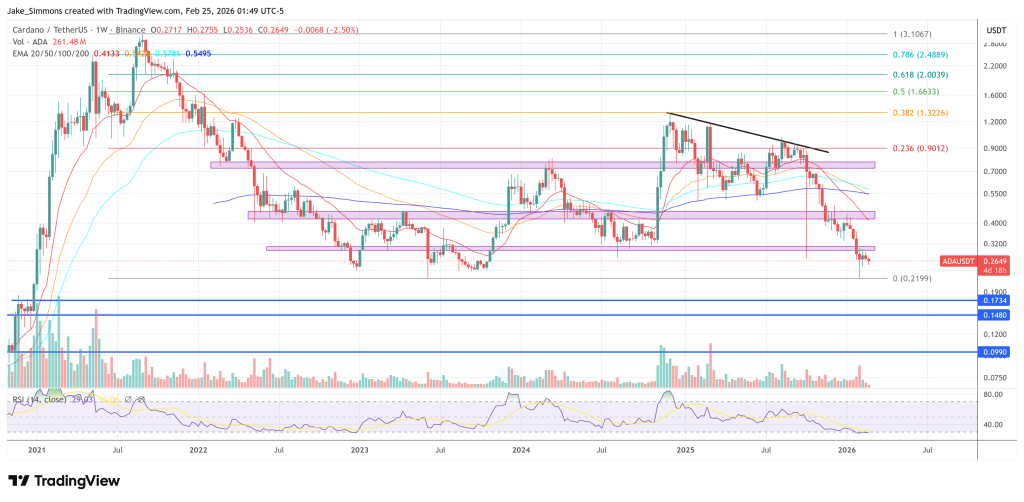
At press time, Cardano traded at $0.2649.


You May Also Like

Car Accident Injuries That Often Lead to Higher Settlements

Trump's revenge tour will come back to bite him in the you-know-what

Ethereum price today $2,130 — bearish below $2,150; $2,116 key



