South Korean retail investors sold a net $657 million in Tesla stock during August, marking the largest outflow since early 2023 as traders pivot toward crypto investments amid growing disillusionment with the electric vehicle maker. According to a Bloomberg report, the dump resulted from waning enthusiasm among Tesla’s most loyal global retail base, with investors instead favoring volatile crypto proxies, such as Bitmine Immersion Technologies, which attracted $253 million in net inflows. Individual Korean investors reduced their U.S. big tech share purchases from a monthly average of $1.68 billion between January and April to just $260 million in July, according to the Korean Center for International Finance. Crypto-related stock investments surged from 8.5% in January to 36.5% in June before declining to 31.4% in July as domestic markets outperformed overseas alternatives. The shift coincides with South Korea’s aggressive push toward developing the crypto market, with President Lee Jae-myung designating digital asset ecosystem construction as a “key national task” within the five-year state administration plan. As of August, over 10,000 Korean crypto investors now hold assets exceeding 1 billion won ($750,000), with the nation’s 10.86 million active trading accounts representing roughly 20% of the population. Tesla Loses Its Korean Retail Champion Status to Crypto Fever Tesla remains the top foreign stock among Korean retail traders with $21.9 billion in holdings, but investor sentiment has soured considerably. Han Jungsu, a 33-year-old investor who first bought Tesla in 2019, sold his position earlier this year, stating, “Tesla used to offer a lot of inspiring narratives but it has failed to win people’s hearts.”Source: Bloomberg The leveraged TSLL ETF, which offers double Tesla exposure, recorded its biggest monthly outflow since early 2024, with $554 million withdrawn in August. Korean investors criticized Tesla’s failure to establish a compelling narrative in artificial intelligence compared to emerging crypto opportunities. Young Korean investors in their 20s lead crypto adoption, with an average holding of 2.69 billion won, despite representing the smallest demographic group among high-net-worth crypto holders. This generation is increasingly favoring digital assets over traditional U.S. tech stocks, allocating an average of 14% of their financial assets to cryptocurrencies. The demographic breakdown among Korea’s crypto millionaires reveals 3,994 investors in their 50s and 3,086 in their 40s, but the 137 twentysomething investors maintain the highest average balances.Source: YNA Early adopters typically began with Bitcoin before diversifying into altcoins and stablecoins, with 60% of them starting their investments during the 2020 bull run. Additionally, retail investment behavior shifted dramatically as Korean investors expressed concerns about the impact of U.S. tariffs and the strengthening of the local currency. A similar survey data indicate that 27% of Koreans currently hold cryptocurrencies, with an average holding of 13 million won ($9,547) per investor. Over half of South Koreans aged 20-59 have experience with crypto trading, establishing the nation as a global crypto powerhouse. Government-Led Crypto Infrastructure Revolution Accelerates President Lee Jae-myung’s administration has fast-tracked pro-business crypto reforms, reclassifying crypto trading firms as “venture companies” to grant them access to tax incentives, subsidies, and state-backed financing that was previously denied since 2018. The Ministry of SMEs and Startups proposed amendments to include Virtual Asset Service Providers under the status of a venture company. Similarly, financial regulators have lifted restrictions on institutional crypto investments while preparing approval for Korea’s first spot crypto ETFs. The Financial Services Commission presented implementation measures for spot crypto ETFs and regulatory frameworks for won-based stablecoins, scheduled for implementation in late 2025. Major banks established dedicated crypto teams, anticipating legislative approval. Woori Bank launched a nine-member Digital Asset Team, while Kookmin Bank created a Digital Asset Response Council covering KB Financial Group affiliates. Shinhan Bank formed a 20-employee crypto task force as institutions prepare rapid market entry strategies. Regional institutions, including Busan Bank, have also established blockchain teams that cover all aspects of distributed ledger technology. As adoption of crypto grows, the Financial Intelligence Unit has begun reorganizing anti-money laundering protocols to institutionalize the use of stablecoins, conducting external research to compile guidelines for operators and issuers in DecemberSouth Korean retail investors sold a net $657 million in Tesla stock during August, marking the largest outflow since early 2023 as traders pivot toward crypto investments amid growing disillusionment with the electric vehicle maker. According to a Bloomberg report, the dump resulted from waning enthusiasm among Tesla’s most loyal global retail base, with investors instead favoring volatile crypto proxies, such as Bitmine Immersion Technologies, which attracted $253 million in net inflows. Individual Korean investors reduced their U.S. big tech share purchases from a monthly average of $1.68 billion between January and April to just $260 million in July, according to the Korean Center for International Finance. Crypto-related stock investments surged from 8.5% in January to 36.5% in June before declining to 31.4% in July as domestic markets outperformed overseas alternatives. The shift coincides with South Korea’s aggressive push toward developing the crypto market, with President Lee Jae-myung designating digital asset ecosystem construction as a “key national task” within the five-year state administration plan. As of August, over 10,000 Korean crypto investors now hold assets exceeding 1 billion won ($750,000), with the nation’s 10.86 million active trading accounts representing roughly 20% of the population. Tesla Loses Its Korean Retail Champion Status to Crypto Fever Tesla remains the top foreign stock among Korean retail traders with $21.9 billion in holdings, but investor sentiment has soured considerably. Han Jungsu, a 33-year-old investor who first bought Tesla in 2019, sold his position earlier this year, stating, “Tesla used to offer a lot of inspiring narratives but it has failed to win people’s hearts.”Source: Bloomberg The leveraged TSLL ETF, which offers double Tesla exposure, recorded its biggest monthly outflow since early 2024, with $554 million withdrawn in August. Korean investors criticized Tesla’s failure to establish a compelling narrative in artificial intelligence compared to emerging crypto opportunities. Young Korean investors in their 20s lead crypto adoption, with an average holding of 2.69 billion won, despite representing the smallest demographic group among high-net-worth crypto holders. This generation is increasingly favoring digital assets over traditional U.S. tech stocks, allocating an average of 14% of their financial assets to cryptocurrencies. The demographic breakdown among Korea’s crypto millionaires reveals 3,994 investors in their 50s and 3,086 in their 40s, but the 137 twentysomething investors maintain the highest average balances.Source: YNA Early adopters typically began with Bitcoin before diversifying into altcoins and stablecoins, with 60% of them starting their investments during the 2020 bull run. Additionally, retail investment behavior shifted dramatically as Korean investors expressed concerns about the impact of U.S. tariffs and the strengthening of the local currency. A similar survey data indicate that 27% of Koreans currently hold cryptocurrencies, with an average holding of 13 million won ($9,547) per investor. Over half of South Koreans aged 20-59 have experience with crypto trading, establishing the nation as a global crypto powerhouse. Government-Led Crypto Infrastructure Revolution Accelerates President Lee Jae-myung’s administration has fast-tracked pro-business crypto reforms, reclassifying crypto trading firms as “venture companies” to grant them access to tax incentives, subsidies, and state-backed financing that was previously denied since 2018. The Ministry of SMEs and Startups proposed amendments to include Virtual Asset Service Providers under the status of a venture company. Similarly, financial regulators have lifted restrictions on institutional crypto investments while preparing approval for Korea’s first spot crypto ETFs. The Financial Services Commission presented implementation measures for spot crypto ETFs and regulatory frameworks for won-based stablecoins, scheduled for implementation in late 2025. Major banks established dedicated crypto teams, anticipating legislative approval. Woori Bank launched a nine-member Digital Asset Team, while Kookmin Bank created a Digital Asset Response Council covering KB Financial Group affiliates. Shinhan Bank formed a 20-employee crypto task force as institutions prepare rapid market entry strategies. Regional institutions, including Busan Bank, have also established blockchain teams that cover all aspects of distributed ledger technology. As adoption of crypto grows, the Financial Intelligence Unit has begun reorganizing anti-money laundering protocols to institutionalize the use of stablecoins, conducting external research to compile guidelines for operators and issuers in December

South Korean Investors Dump $657M in Tesla Stock, Chase Crypto Returns Instead

South Korean retail investors sold a net $657 million in Tesla stock during August, marking the largest outflow since early 2023 as traders pivot toward crypto investments amid growing disillusionment with the electric vehicle maker.

According to a Bloomberg report, the dump resulted from waning enthusiasm among Tesla’s most loyal global retail base, with investors instead favoring volatile crypto proxies, such as Bitmine Immersion Technologies, which attracted $253 million in net inflows.

Individual Korean investors reduced their U.S. big tech share purchases from a monthly average of $1.68 billion between January and April to just $260 million in July, according to the Korean Center for International Finance.

Crypto-related stock investments surged from 8.5% in January to 36.5% in June before declining to 31.4% in July as domestic markets outperformed overseas alternatives.

The shift coincides with South Korea’s aggressive push toward developing the crypto market, with President Lee Jae-myung designating digital asset ecosystem construction as a “key national task” within the five-year state administration plan.

As of August, over 10,000 Korean crypto investors now hold assets exceeding 1 billion won ($750,000), with the nation’s 10.86 million active trading accounts representing roughly 20% of the population.

Tesla Loses Its Korean Retail Champion Status to Crypto Fever

Tesla remains the top foreign stock among Korean retail traders with $21.9 billion in holdings, but investor sentiment has soured considerably.

Han Jungsu, a 33-year-old investor who first bought Tesla in 2019, sold his position earlier this year, stating, “Tesla used to offer a lot of inspiring narratives but it has failed to win people’s hearts.”
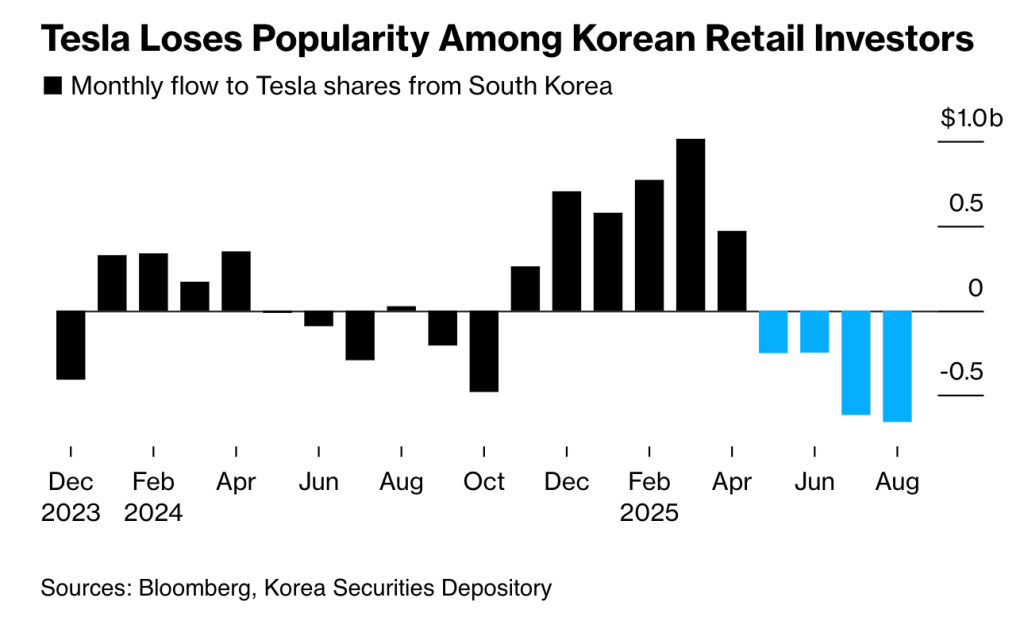
South Korean Investors Dump $657M in Tesla Stock, Chase Crypto Returns InsteadSource: Bloomberg

The leveraged TSLL ETF, which offers double Tesla exposure, recorded its biggest monthly outflow since early 2024, with $554 million withdrawn in August.

Korean investors criticized Tesla’s failure to establish a compelling narrative in artificial intelligence compared to emerging crypto opportunities.

Young Korean investors in their 20s lead crypto adoption, with an average holding of 2.69 billion won, despite representing the smallest demographic group among high-net-worth crypto holders.

This generation is increasingly favoring digital assets over traditional U.S. tech stocks, allocating an average of 14% of their financial assets to cryptocurrencies.

The demographic breakdown among Korea’s crypto millionaires reveals 3,994 investors in their 50s and 3,086 in their 40s, but the 137 twentysomething investors maintain the highest average balances.

South Korean Investors Dump $657M in Tesla Stock, Chase Crypto Returns InsteadSource: YNA

Early adopters typically began with Bitcoin before diversifying into altcoins and stablecoins, with 60% of them starting their investments during the 2020 bull run.

Additionally, retail investment behavior shifted dramatically as Korean investors expressed concerns about the impact of U.S. tariffs and the strengthening of the local currency.

A similar survey data indicate that 27% of Koreans currently hold cryptocurrencies, with an average holding of 13 million won ($9,547) per investor.

Over half of South Koreans aged 20-59 have experience with crypto trading, establishing the nation as a global crypto powerhouse.

Government-Led Crypto Infrastructure Revolution Accelerates

President Lee Jae-myung’s administration has fast-tracked pro-business crypto reforms, reclassifying crypto trading firms as “venture companies” to grant them access to tax incentives, subsidies, and state-backed financing that was previously denied since 2018.

The Ministry of SMEs and Startups proposed amendments to include Virtual Asset Service Providers under the status of a venture company.

Similarly, financial regulators have lifted restrictions on institutional crypto investments while preparing approval for Korea’s first spot crypto ETFs.

The Financial Services Commission presented implementation measures for spot crypto ETFs and regulatory frameworks for won-based stablecoins, scheduled for implementation in late 2025.

Major banks established dedicated crypto teams, anticipating legislative approval.

Woori Bank launched a nine-member Digital Asset Team, while Kookmin Bank created a Digital Asset Response Council covering KB Financial Group affiliates.

Shinhan Bank formed a 20-employee crypto task force as institutions prepare rapid market entry strategies.

Regional institutions, including Busan Bank, have also established blockchain teams that cover all aspects of distributed ledger technology.

As adoption of crypto grows, the Financial Intelligence Unit has begun reorganizing anti-money laundering protocols to institutionalize the use of stablecoins, conducting external research to compile guidelines for operators and issuers in December.


Disclaimer: The articles reposted on this site are sourced from public platforms and are provided for informational purposes only. They do not necessarily reflect the views of MEXC. All rights remain with the original authors. If you believe any content infringes on third-party rights, please contact service@support.mexc.com for removal. MEXC makes no guarantees regarding the accuracy, completeness, or timeliness of the content and is not responsible for any actions taken based on the information provided. The content does not constitute financial, legal, or other professional advice, nor should it be considered a recommendation or endorsement by MEXC.

You May Also Like

Gold continues to hit new highs. How to invest in gold in the crypto market?

Gold continues to hit new highs. How to invest in gold in the crypto market?

As Bitcoin encounters a "value winter", real-world gold is recasting the iron curtain of value on the blockchain.
Share
PANews2025/04/14 17:12
DOGE ETF News & Could Layer Brett See an ETF Approval in Years to come?

DOGE ETF News & Could Layer Brett See an ETF Approval in Years to come?

The post DOGE ETF News & Could Layer Brett See an ETF Approval in Years to come? appeared on BitcoinEthereumNews.com. Crypto News 20 September 2025 | 01:10 The latest Dogecoin updates have traders buzzing as DOGE continues to hold its ground above key support levels. With rumors swirling about the possibility of a DOGE ETF in the future, excitement is building around what could be a major milestone for the original meme coin. If approved, analysts believe a DOGE ETF could send prices surging, potentially revisiting previous highs or even setting new ones. But the conversation doesn’t end there — investors are also asking if future ETF approvals could one day include rising stars like Layer Brett ($LBRETT). Dogecoin price prediction: ETF speculation builds Dogecoin has long been one of the most community-driven cryptos, and an ETF would represent institutional validation for the meme coin sector. Current Dogecoin price prediction models show moderate gains in the short term, with analysts targeting 20–30% upside if sentiment remains strong. Some market commentators suggest that a DOGE ETF could bring a wave of institutional money into the space, pushing liquidity and trading volumes to levels not seen since 2021. That said, DOGE’s massive market cap means it is unlikely to see the type of explosive multiples that newer projects can still achieve. This is why some traders are splitting their bets — holding DOGE for stability while hunting for higher risk–reward plays elsewhere. Could Layer Brett be the next meme coin ETF candidate? Layer Brett is quickly becoming the name on everyone’s lips in the meme coin sector. Built on Ethereum Layer 2, $LBRETT combines viral meme energy with real blockchain utility, offering lightning-fast transactions and low fees. While an ETF for $LBRETT is still a distant conversation, analysts believe its growing community, capped 10B supply, and staking mechanics make it a strong candidate for mainstream adoption in the coming years. If meme…
Share
BitcoinEthereumNews2025/09/20 07:01
Zero Knowledge Proof (ZKP) vs DOGE, SHIB, and PEPE: Good Crypto to Buy Now for Structure-Driven Gains

Zero Knowledge Proof (ZKP) vs DOGE, SHIB, and PEPE: Good Crypto to Buy Now for Structure-Driven Gains

In crypto, most gains don’t come when a chart is trending; they come before it. Real returns are usually locked in through smart entry, not loud exit points. That
Share
LiveBitcoinNews2026/01/16 08:00



