The sixth annual Chainalysis Global Crypto Adoption Index reveals a transformative year for digital assets, with India and the United States leading the world in overall adoption. Unlike earlier years, where crypto activity leaned heavily toward grassroots usage in emerging markets, 2025 showcases a more balanced picture: retail adoption remains strong, but institutional flows are now a critical driver of growth. The methodology remains rigorous. Chainalysis evaluates 151 countries using four sub-indices: on-chain value received by centralized services; retail-sized value received by those services; on-chain activity in DeFi protocols; and institutional-sized transfers. Each component is weighted by GDP per capita on a purchasing-power-parity basis, ensuring the rankings reflect economic context rather than raw transaction volume. This comprehensive approach highlights not just where crypto is popular, but where it is meaningfully integrated into financial systems. Shifting Methodology for a Maturing Market In 2025, Chainalysis introduced important methodological changes. First, the retail DeFi sub-index was removed, as internal data showed that while DeFi transaction volumes remain significant, grassroots engagement there is far smaller than on centralized platforms. By excluding retail DeFi as a standalone category, the index avoids overrepresenting a relatively niche behavior. Second, an institutional activity sub-index was added, reflecting the surge of large-scale transactions driven by traditional finance. Transfers above $1 million are now captured in the rankings, providing a clearer view of how hedge funds, custodians, ETFs, and banks are shaping the landscape. This shift is timely: with multiple U.S. spot Bitcoin ETFs approved and greater regulatory clarity across key jurisdictions, institutions are no longer testing the waters—they are actively participating. Together, these changes create a more accurate lens. The index continues to focus on grassroots adoption but now incorporates top-down institutional flows, showing how deeply crypto has penetrated mainstream finance. India, the U.S., and the Rise of APAC The 2025 Index crowns India as the number one country for crypto adoption, ranking first across all four sub-indices. India’s dominance reflects both widespread grassroots use and growing integration with financial services. The United States ranks second overall, bolstered by strong institutional participation and the legitimizing effect of regulatory progress. Beyond these leaders, Pakistan (3rd), Vietnam (4th), and Brazil (5th) round out the top five, reflecting a blend of remittance-driven retail usage and rising institutional interest. Notably, APAC has emerged as the fastest-growing region, with on-chain activity rising 69% year-over-year to $2.36 trillion. Latin America follows with 63% growth, showing the region’s reliance on stablecoins for remittances and inflation hedging. When adjusting for population size, Eastern Europe stands out. Ukraine, Moldova, and Georgia top the population-adjusted index, reflecting extraordinary levels of activity relative to population. Factors such as war, inflation, and banking restrictions have accelerated crypto’s role as both a hedge and a cross-border transaction tool. Stablecoins and Bitcoin Dominate On-Ramps Stablecoins remain at the heart of global crypto adoption. Between June 2024 and June 2025, USDT processed more than $1 trillion per month, while USDC peaked at $3.29 trillion. New entrants like EURC and PYUSD are also growing rapidly, with EURC volumes surging nearly 89% month-over-month as MiCA-compliant euro stablecoins gain traction in Europe. At the same time, Bitcoin continues to serve as the primary fiat on-ramp, accounting for over $4.6 trillion in inflows—more than double any other category. The United States leads by volume, with South Korea and the European Union trailing behind. These flows confirm that while altcoins and DeFi tokens are important, Bitcoin and stablecoins remain the central gateways into crypto. A Truly Global Wave Perhaps the most striking finding of the 2025 Index is that adoption is no longer confined to one region or income level. High-income countries are accelerating institutional rails, while lower- and middle-income nations continue to rely on crypto for remittances, dollar access, and mobile-first finance. This synchronicity suggests crypto adoption is now broad-based and durable, not episodic. The challenges ahead remain clear: fragmented regulations, fragile infrastructure in low-income countries, and the need for secure on-ramps. Yet the trajectory is undeniable. With India and the United States setting the pace, and the Global South demonstrating how crypto solves real-world problems, the 2025 Global Adoption Index shows one truth: crypto is no longer an experiment. It is becoming a core feature of the global financial systemThe sixth annual Chainalysis Global Crypto Adoption Index reveals a transformative year for digital assets, with India and the United States leading the world in overall adoption. Unlike earlier years, where crypto activity leaned heavily toward grassroots usage in emerging markets, 2025 showcases a more balanced picture: retail adoption remains strong, but institutional flows are now a critical driver of growth. The methodology remains rigorous. Chainalysis evaluates 151 countries using four sub-indices: on-chain value received by centralized services; retail-sized value received by those services; on-chain activity in DeFi protocols; and institutional-sized transfers. Each component is weighted by GDP per capita on a purchasing-power-parity basis, ensuring the rankings reflect economic context rather than raw transaction volume. This comprehensive approach highlights not just where crypto is popular, but where it is meaningfully integrated into financial systems. Shifting Methodology for a Maturing Market In 2025, Chainalysis introduced important methodological changes. First, the retail DeFi sub-index was removed, as internal data showed that while DeFi transaction volumes remain significant, grassroots engagement there is far smaller than on centralized platforms. By excluding retail DeFi as a standalone category, the index avoids overrepresenting a relatively niche behavior. Second, an institutional activity sub-index was added, reflecting the surge of large-scale transactions driven by traditional finance. Transfers above $1 million are now captured in the rankings, providing a clearer view of how hedge funds, custodians, ETFs, and banks are shaping the landscape. This shift is timely: with multiple U.S. spot Bitcoin ETFs approved and greater regulatory clarity across key jurisdictions, institutions are no longer testing the waters—they are actively participating. Together, these changes create a more accurate lens. The index continues to focus on grassroots adoption but now incorporates top-down institutional flows, showing how deeply crypto has penetrated mainstream finance. India, the U.S., and the Rise of APAC The 2025 Index crowns India as the number one country for crypto adoption, ranking first across all four sub-indices. India’s dominance reflects both widespread grassroots use and growing integration with financial services. The United States ranks second overall, bolstered by strong institutional participation and the legitimizing effect of regulatory progress. Beyond these leaders, Pakistan (3rd), Vietnam (4th), and Brazil (5th) round out the top five, reflecting a blend of remittance-driven retail usage and rising institutional interest. Notably, APAC has emerged as the fastest-growing region, with on-chain activity rising 69% year-over-year to $2.36 trillion. Latin America follows with 63% growth, showing the region’s reliance on stablecoins for remittances and inflation hedging. When adjusting for population size, Eastern Europe stands out. Ukraine, Moldova, and Georgia top the population-adjusted index, reflecting extraordinary levels of activity relative to population. Factors such as war, inflation, and banking restrictions have accelerated crypto’s role as both a hedge and a cross-border transaction tool. Stablecoins and Bitcoin Dominate On-Ramps Stablecoins remain at the heart of global crypto adoption. Between June 2024 and June 2025, USDT processed more than $1 trillion per month, while USDC peaked at $3.29 trillion. New entrants like EURC and PYUSD are also growing rapidly, with EURC volumes surging nearly 89% month-over-month as MiCA-compliant euro stablecoins gain traction in Europe. At the same time, Bitcoin continues to serve as the primary fiat on-ramp, accounting for over $4.6 trillion in inflows—more than double any other category. The United States leads by volume, with South Korea and the European Union trailing behind. These flows confirm that while altcoins and DeFi tokens are important, Bitcoin and stablecoins remain the central gateways into crypto. A Truly Global Wave Perhaps the most striking finding of the 2025 Index is that adoption is no longer confined to one region or income level. High-income countries are accelerating institutional rails, while lower- and middle-income nations continue to rely on crypto for remittances, dollar access, and mobile-first finance. This synchronicity suggests crypto adoption is now broad-based and durable, not episodic. The challenges ahead remain clear: fragmented regulations, fragile infrastructure in low-income countries, and the need for secure on-ramps. Yet the trajectory is undeniable. With India and the United States setting the pace, and the Global South demonstrating how crypto solves real-world problems, the 2025 Global Adoption Index shows one truth: crypto is no longer an experiment. It is becoming a core feature of the global financial system

Chainalysis 2025 Global Index: India and U.S. Top Crypto Adoption Rankings

The sixth annual Chainalysis Global Crypto Adoption Index reveals a transformative year for digital assets, with India and the United States leading the world in overall adoption.

Unlike earlier years, where crypto activity leaned heavily toward grassroots usage in emerging markets, 2025 showcases a more balanced picture: retail adoption remains strong, but institutional flows are now a critical driver of growth.

The methodology remains rigorous. Chainalysis evaluates 151 countries using four sub-indices: on-chain value received by centralized services; retail-sized value received by those services; on-chain activity in DeFi protocols; and institutional-sized transfers.

Each component is weighted by GDP per capita on a purchasing-power-parity basis, ensuring the rankings reflect economic context rather than raw transaction volume. This comprehensive approach highlights not just where crypto is popular, but where it is meaningfully integrated into financial systems.

Shifting Methodology for a Maturing Market

In 2025, Chainalysis introduced important methodological changes. First, the retail DeFi sub-index was removed, as internal data showed that while DeFi transaction volumes remain significant, grassroots engagement there is far smaller than on centralized platforms. By excluding retail DeFi as a standalone category, the index avoids overrepresenting a relatively niche behavior.

Second, an institutional activity sub-index was added, reflecting the surge of large-scale transactions driven by traditional finance. Transfers above $1 million are now captured in the rankings, providing a clearer view of how hedge funds, custodians, ETFs, and banks are shaping the landscape.

This shift is timely: with multiple U.S. spot Bitcoin ETFs approved and greater regulatory clarity across key jurisdictions, institutions are no longer testing the waters—they are actively participating.

Together, these changes create a more accurate lens. The index continues to focus on grassroots adoption but now incorporates top-down institutional flows, showing how deeply crypto has penetrated mainstream finance.

India, the U.S., and the Rise of APAC

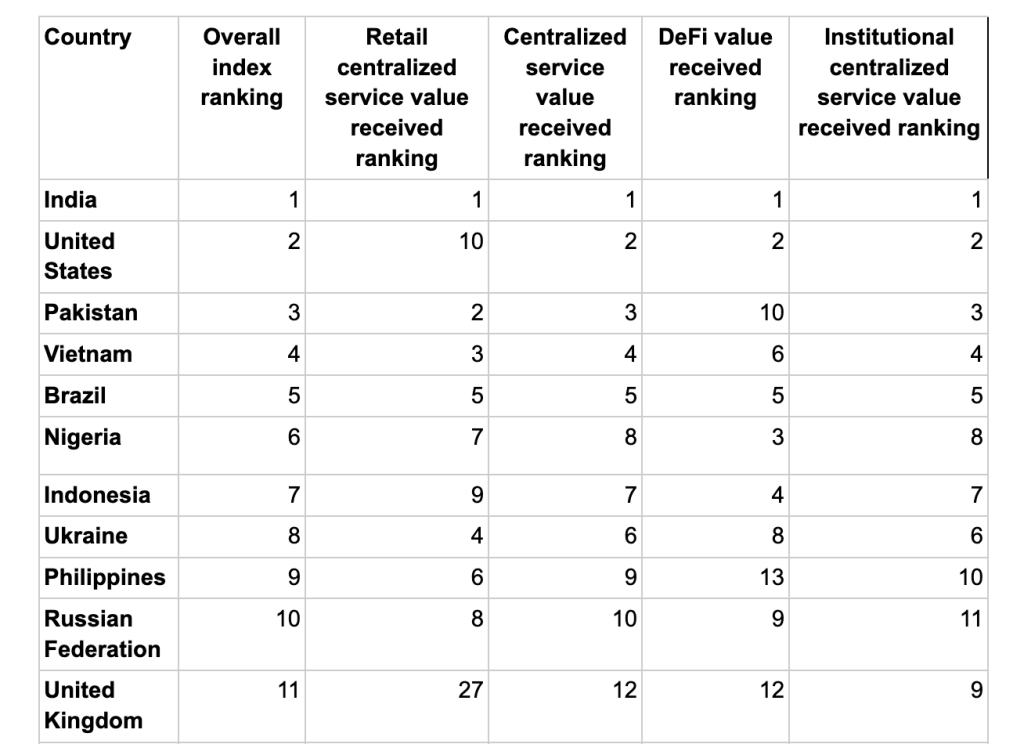
The 2025 Index crowns India as the number one country for crypto adoption, ranking first across all four sub-indices. India’s dominance reflects both widespread grassroots use and growing integration with financial services.

The United States ranks second overall, bolstered by strong institutional participation and the legitimizing effect of regulatory progress. Beyond these leaders, Pakistan (3rd), Vietnam (4th), and Brazil (5th) round out the top five, reflecting a blend of remittance-driven retail usage and rising institutional interest.

Notably, APAC has emerged as the fastest-growing region, with on-chain activity rising 69% year-over-year to $2.36 trillion. Latin America follows with 63% growth, showing the region’s reliance on stablecoins for remittances and inflation hedging.
When adjusting for population size, Eastern Europe stands out. Ukraine, Moldova, and Georgia top the population-adjusted index, reflecting extraordinary levels of activity relative to population. Factors such as war, inflation, and banking restrictions have accelerated crypto’s role as both a hedge and a cross-border transaction tool.

Stablecoins and Bitcoin Dominate On-Ramps

Stablecoins remain at the heart of global crypto adoption. Between June 2024 and June 2025, USDT processed more than $1 trillion per month, while USDC peaked at $3.29 trillion. New entrants like EURC and PYUSD are also growing rapidly, with EURC volumes surging nearly 89% month-over-month as MiCA-compliant euro stablecoins gain traction in Europe.

At the same time, Bitcoin continues to serve as the primary fiat on-ramp, accounting for over $4.6 trillion in inflows—more than double any other category. The United States leads by volume, with South Korea and the European Union trailing behind. These flows confirm that while altcoins and DeFi tokens are important, Bitcoin and stablecoins remain the central gateways into crypto.

A Truly Global Wave

Perhaps the most striking finding of the 2025 Index is that adoption is no longer confined to one region or income level. High-income countries are accelerating institutional rails, while lower- and middle-income nations continue to rely on crypto for remittances, dollar access, and mobile-first finance. This synchronicity suggests crypto adoption is now broad-based and durable, not episodic.

The challenges ahead remain clear: fragmented regulations, fragile infrastructure in low-income countries, and the need for secure on-ramps. Yet the trajectory is undeniable.

With India and the United States setting the pace, and the Global South demonstrating how crypto solves real-world problems, the 2025 Global Adoption Index shows one truth: crypto is no longer an experiment. It is becoming a core feature of the global financial system.


Market Opportunity
Index Cooperative Logo
Index Cooperative Price(INDEX)
$0.5364
$0.5364$0.5364
+5.75%
USD
Index Cooperative (INDEX) Live Price Chart
Disclaimer: The articles reposted on this site are sourced from public platforms and are provided for informational purposes only. They do not necessarily reflect the views of MEXC. All rights remain with the original authors. If you believe any content infringes on third-party rights, please contact service@support.mexc.com for removal. MEXC makes no guarantees regarding the accuracy, completeness, or timeliness of the content and is not responsible for any actions taken based on the information provided. The content does not constitute financial, legal, or other professional advice, nor should it be considered a recommendation or endorsement by MEXC.

You May Also Like

A Netflix ‘KPop Demon Hunters’ Short Film Has Been Rated For Release

A Netflix ‘KPop Demon Hunters’ Short Film Has Been Rated For Release

The post A Netflix ‘KPop Demon Hunters’ Short Film Has Been Rated For Release appeared on BitcoinEthereumNews.com. KPop Demon Hunters Netflix Everyone has wondered what may be the next step for KPop Demon Hunters as an IP, given its record-breaking success on Netflix. Now, the answer may be something exactly no one predicted. According to a new filing with the MPA, something called Debut: A KPop Demon Hunters Story has been rated PG by the ratings body. It’s listed alongside some other films, and this is obviously something that has not been publicly announced. A short film could be well, very short, a few minutes, and likely no more than ten. Even that might be pushing it. Using say, Pixar shorts as a reference, most are between 4 and 8 minutes. The original movie is an hour and 36 minutes. The “Debut” in the title indicates some sort of flashback, perhaps to when HUNTR/X first arrived on the scene before they blew up. Previously, director Maggie Kang has commented about how there were more backstory components that were supposed to be in the film that were cut, but hinted those could be explored in a sequel. But perhaps some may be put into a short here. I very much doubt those scenes were fully produced and simply cut, but perhaps they were finished up for this short film here. When would Debut: KPop Demon Hunters theoretically arrive? I’m not sure the other films on the list are much help. Dead of Winter is out in less than two weeks. Mother Mary does not have a release date. Ne Zha 2 came out earlier this year. I’ve only seen news stories saying The Perfect Gamble was supposed to come out in Q1 2025, but I’ve seen no evidence that it actually has. KPop Demon Hunters Netflix It could be sooner rather than later as Netflix looks to capitalize…
Share
BitcoinEthereumNews2025/09/18 02:23
Bitmine Immersion Technologies (BMNR) stock :soars 5% as $13.4B Crypto Treasury Propels Ethereum Supercycle Vision

Bitmine Immersion Technologies (BMNR) stock :soars 5% as $13.4B Crypto Treasury Propels Ethereum Supercycle Vision

TLDR Bitmine surges 5.18% as $13.4B ETH treasury cements crypto dominance. Bitmine’s $12.6B Ethereum trove fuels bold 5% market ownership goal. Bitmine rebounds strong—ETH hoard drives record treasury valuation. Bitmine’s ETH empire grows to 3M coins, powering stock’s sharp rally. With record ETH and cash reserves, Bitmine solidifies crypto supremacy. Bitmine Immersion Technologies closed 5.18% [...] The post Bitmine Immersion Technologies (BMNR) stock :soars 5% as $13.4B Crypto Treasury Propels Ethereum Supercycle Vision appeared first on CoinCentral.
Share
Coincentral2025/10/14 02:40
Headwind Helps Best Wallet Token

Headwind Helps Best Wallet Token

The post Headwind Helps Best Wallet Token appeared on BitcoinEthereumNews.com. Google has announced the launch of a new open-source protocol called Agent Payments Protocol (AP2) in partnership with Coinbase, the Ethereum Foundation, and 60 other organizations. This allows AI agents to make payments on behalf of users using various methods such as real-time bank transfers, credit and debit cards, and, most importantly, stablecoins. Let’s explore in detail what this could mean for the broader cryptocurrency markets, and also highlight a presale crypto (Best Wallet Token) that could explode as a result of this development. Google’s Push for Stablecoins Agent Payments Protocol (AP2) uses digital contracts known as ‘Intent Mandates’ and ‘Verifiable Credentials’ to ensure that AI agents undertake only those payments authorized by the user. Mandates, by the way, are cryptographically signed, tamper-proof digital contracts that act as verifiable proof of a user’s instruction. For example, let’s say you instruct an AI agent to never spend more than $200 in a single transaction. This instruction is written into an Intent Mandate, which serves as a digital contract. Now, whenever the AI agent tries to make a payment, it must present this mandate as proof of authorization, which will then be verified via the AP2 protocol. Alongside this, Google has also launched the A2A x402 extension to accelerate support for the Web3 ecosystem. This production-ready solution enables agent-based crypto payments and will help reshape the growth of cryptocurrency integration within the AP2 protocol. Google’s inclusion of stablecoins in AP2 is a massive vote of confidence in dollar-pegged cryptocurrencies and a huge step toward making them a mainstream payment option. This widens stablecoin usage beyond trading and speculation, positioning them at the center of the consumption economy. The recent enactment of the GENIUS Act in the U.S. gives stablecoins more structure and legal support. Imagine paying for things like data crawls, per-task…
Share
BitcoinEthereumNews2025/09/18 01:27