Bunni DEX, a cutting-edge decentralized exchange built on Uniswap v4, fell victim to a major security breach on September 2, 2025. Hackers drained an estimated $8.4 million from the platform by exploiting a vulnerability in its custom liquidity management system.Bunni DEX, a cutting-edge decentralized exchange built on Uniswap v4, fell victim to a major security breach on September 2, 2025. Hackers drained an estimated $8.4 million from the platform by exploiting a vulnerability in its custom liquidity management system.

Bunni DEX Loses $8.4 Million in Sophisticated Smart Contract Attack

Bunni DEX Loses $8.4 Million in Sophisticated Smart Contract Attack

The attack targeted Bunni’s innovative Liquidity Distribution Function (LDF), a specialized mechanism the platform uses instead of standard Uniswap protocols. Within hours of detecting the breach, Bunni’s team suspended all smart contract operations across multiple blockchain networks as a safety measure.

How the Attack Unfolded

The exploit centered on Bunni’s custom LDF system, which manages how liquidity gets distributed across different price ranges. This system was designed to boost returns for liquidity providers, but hackers found a way to manipulate it.

Victor Tran, co-founder of KyberNetwork, explained the attack method on social media. The hacker executed trades using very specific amounts that confused Bunni’s rebalancing calculations. These carefully chosen trade sizes caused the system to miscalculate how much each liquidity provider should own from the pool.

By repeating this process multiple times, the attacker gradually withdrew more tokens than they were entitled to. The stolen funds totaled approximately $2.4 million from Ethereum and $6 million from Unichain, Uniswap’s layer-2 network. The hacker then moved all funds to Ethereum using the Across Protocol bridging system.
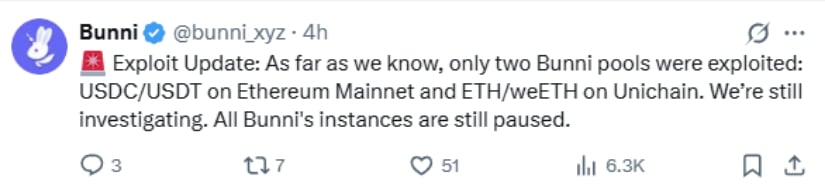
How the Attack Unfolded

Source: @bunni_xyz

Security firm Hacken tracked the stolen assets to specific wallet addresses. The funds included $1.33 million in USDC and $1.04 million in USDT stablecoins, according to blockchain data.

Bunni’s Response and Recovery Efforts

Following the attack, Bunni took immediate action to protect remaining user funds. The team paused all smart contract functions across supported networks, including Ethereum, Base, Arbitrum, and BNB Smart Chain.
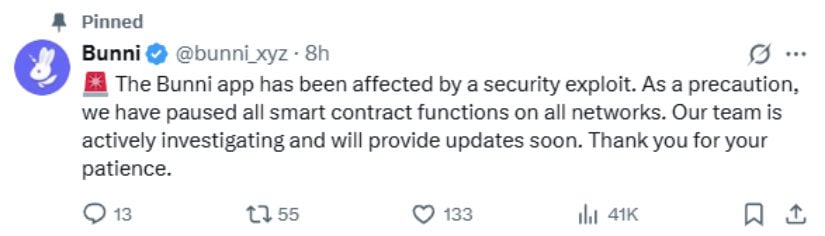
Bunni's Response and Recovery Efforts

Source: @bunni_xyz

Core contributor @Psaul26ix urged users to withdraw their funds immediately. “If you have money on Bunni, remove it ASAP,” they posted on social media.

In an unusual move, Bunni offered the hacker a 10% bounty in exchange for returning the stolen funds. The team sent an on-chain message through the Ethereum network, including contact details for potential negotiations.

Partner protocols moved quickly to reassure users about their safety. Michael Bentley, CEO of Euler Finance, confirmed that his lending protocol remained unaffected despite channeling liquidity through Bunni. Other DeFi platforms monitoring the situation also reported no impact on their operations.

The Rise and Fall of a DeFi Leader

Before the hack, Bunni had established itself as the dominant force in the emerging Uniswap v4 ecosystem. The platform controlled three of the top four positions on HookRank, a ranking system for Uniswap v4 hooks, and processed nearly 59% of all tracked trading volume across these new protocols.

Bunni’s success came from its innovative approach to liquidity provision. The platform’s re-hypothecation hook allowed deposited tokens to earn money in two ways: from trading fees and from lending to other protocols simultaneously. This dual income stream attracted significant liquidity from investors seeking higher returns.

The platform’s flagship ETH-USDC 1.1 pool on Base blockchain generated over $80 million in trading volume during a 30-day period, despite having relatively low total value locked. This efficiency created an annual percentage yield of 2,690% for liquidity providers in that specific pool.

Bunni also introduced Liquidity Density Functions that kept gas costs constant regardless of price movements, solving a major problem with earlier Uniswap versions. The platform automated position management and protected against certain types of MEV attacks that drain value from ordinary users.

Security Challenges in DeFi Innovation

The Bunni incident highlights ongoing security challenges in decentralized finance. The platform had previously undergone security reviews by respected firms including Trail of Bits and Cyfrin. However, it remains unclear whether the exploited vulnerability was identified in those audits or introduced through later code changes.

This attack fits into a troubling pattern of DeFi exploits. August 2025 saw over $163 million stolen across 16 separate incidents, representing a 15% increase from the previous month. The DeFi sector has lost more than $300 million to hacks and scams over the past two months alone.

Security experts note that attackers are becoming more sophisticated, often targeting newer protocols with complex mechanisms. The custom nature of Bunni’s LDF system, while innovative, created an attack surface that standard protocols might not have.

The Uniswap v4 ecosystem, where Bunni operates, remains largely experimental. Only about 32% of v4 liquidity pools use hooks like Bunni’s, and just 8% of swaps flow through these enhanced protocols. This early-stage environment combines high innovation potential with elevated security risks.

Looking Forward

The Bunni exploit serves as a reminder that innovation in decentralized finance comes with significant risks. While the platform pioneered new approaches to liquidity management that generated impressive returns, these same innovations created vulnerabilities that hackers could exploit.

The incident may slow adoption of Uniswap v4 hooks in the short term as developers review security practices. However, the underlying technology continues to show promise, with the Uniswap Foundation committing over $144 million in incentives to support hook development.

For users, the attack reinforces the importance of understanding the risks involved in using cutting-edge DeFi protocols. While higher returns are possible, they often come with increased exposure to smart contract vulnerabilities and other technical risks that traditional finance doesn’t face.


Market Opportunity
Edge Logo
Edge Price(EDGE)
$0.14378
$0.14378$0.14378
-0.71%
USD
Edge (EDGE) Live Price Chart
Disclaimer: The articles reposted on this site are sourced from public platforms and are provided for informational purposes only. They do not necessarily reflect the views of MEXC. All rights remain with the original authors. If you believe any content infringes on third-party rights, please contact service@support.mexc.com for removal. MEXC makes no guarantees regarding the accuracy, completeness, or timeliness of the content and is not responsible for any actions taken based on the information provided. The content does not constitute financial, legal, or other professional advice, nor should it be considered a recommendation or endorsement by MEXC.

You May Also Like

A Netflix ‘KPop Demon Hunters’ Short Film Has Been Rated For Release

A Netflix ‘KPop Demon Hunters’ Short Film Has Been Rated For Release

The post A Netflix ‘KPop Demon Hunters’ Short Film Has Been Rated For Release appeared on BitcoinEthereumNews.com. KPop Demon Hunters Netflix Everyone has wondered what may be the next step for KPop Demon Hunters as an IP, given its record-breaking success on Netflix. Now, the answer may be something exactly no one predicted. According to a new filing with the MPA, something called Debut: A KPop Demon Hunters Story has been rated PG by the ratings body. It’s listed alongside some other films, and this is obviously something that has not been publicly announced. A short film could be well, very short, a few minutes, and likely no more than ten. Even that might be pushing it. Using say, Pixar shorts as a reference, most are between 4 and 8 minutes. The original movie is an hour and 36 minutes. The “Debut” in the title indicates some sort of flashback, perhaps to when HUNTR/X first arrived on the scene before they blew up. Previously, director Maggie Kang has commented about how there were more backstory components that were supposed to be in the film that were cut, but hinted those could be explored in a sequel. But perhaps some may be put into a short here. I very much doubt those scenes were fully produced and simply cut, but perhaps they were finished up for this short film here. When would Debut: KPop Demon Hunters theoretically arrive? I’m not sure the other films on the list are much help. Dead of Winter is out in less than two weeks. Mother Mary does not have a release date. Ne Zha 2 came out earlier this year. I’ve only seen news stories saying The Perfect Gamble was supposed to come out in Q1 2025, but I’ve seen no evidence that it actually has. KPop Demon Hunters Netflix It could be sooner rather than later as Netflix looks to capitalize…
Share
BitcoinEthereumNews2025/09/18 02:23
Bitmine Immersion Technologies (BMNR) stock :soars 5% as $13.4B Crypto Treasury Propels Ethereum Supercycle Vision

Bitmine Immersion Technologies (BMNR) stock :soars 5% as $13.4B Crypto Treasury Propels Ethereum Supercycle Vision

TLDR Bitmine surges 5.18% as $13.4B ETH treasury cements crypto dominance. Bitmine’s $12.6B Ethereum trove fuels bold 5% market ownership goal. Bitmine rebounds strong—ETH hoard drives record treasury valuation. Bitmine’s ETH empire grows to 3M coins, powering stock’s sharp rally. With record ETH and cash reserves, Bitmine solidifies crypto supremacy. Bitmine Immersion Technologies closed 5.18% [...] The post Bitmine Immersion Technologies (BMNR) stock :soars 5% as $13.4B Crypto Treasury Propels Ethereum Supercycle Vision appeared first on CoinCentral.
Share
Coincentral2025/10/14 02:40
Headwind Helps Best Wallet Token

Headwind Helps Best Wallet Token

The post Headwind Helps Best Wallet Token appeared on BitcoinEthereumNews.com. Google has announced the launch of a new open-source protocol called Agent Payments Protocol (AP2) in partnership with Coinbase, the Ethereum Foundation, and 60 other organizations. This allows AI agents to make payments on behalf of users using various methods such as real-time bank transfers, credit and debit cards, and, most importantly, stablecoins. Let’s explore in detail what this could mean for the broader cryptocurrency markets, and also highlight a presale crypto (Best Wallet Token) that could explode as a result of this development. Google’s Push for Stablecoins Agent Payments Protocol (AP2) uses digital contracts known as ‘Intent Mandates’ and ‘Verifiable Credentials’ to ensure that AI agents undertake only those payments authorized by the user. Mandates, by the way, are cryptographically signed, tamper-proof digital contracts that act as verifiable proof of a user’s instruction. For example, let’s say you instruct an AI agent to never spend more than $200 in a single transaction. This instruction is written into an Intent Mandate, which serves as a digital contract. Now, whenever the AI agent tries to make a payment, it must present this mandate as proof of authorization, which will then be verified via the AP2 protocol. Alongside this, Google has also launched the A2A x402 extension to accelerate support for the Web3 ecosystem. This production-ready solution enables agent-based crypto payments and will help reshape the growth of cryptocurrency integration within the AP2 protocol. Google’s inclusion of stablecoins in AP2 is a massive vote of confidence in dollar-pegged cryptocurrencies and a huge step toward making them a mainstream payment option. This widens stablecoin usage beyond trading and speculation, positioning them at the center of the consumption economy. The recent enactment of the GENIUS Act in the U.S. gives stablecoins more structure and legal support. Imagine paying for things like data crawls, per-task…
Share
BitcoinEthereumNews2025/09/18 01:27



