

Bitcoin (BTC) Price Prediction 2026–2030: How High Can BTC Go?
Bitcoin remains the world’s largest cryptocurrency and continues to lead the digital asset market. Its price movements often influence the entire crypto industry, which is why both experienced investors and beginners closely follow Bitcoin price predictions.
As of June 2026, Bitcoin trades at around $60,500 after a volatile month. BTC reached a monthly high of about $74,000 on May 31 before dropping to a monthly low near $58,200 on June 25. These sharp moves highlight both Bitcoin’s growth potential and its price volatility.
Bitcoin also set a new all-time high of $126,198 in October 2025, proving that demand from both retail and institutional investors remains strong despite market corrections.
In this guide, you’ll explore Bitcoin price predictions for 2026–2030, learn what drives BTC’s value, and discover the key factors that could influence its future performance. So, let’s get started!
| Current BTC Price | BTC Price Prediction 2026 | BTC Price Prediction 2030 |
| $60,500 | $100,000 | $270,000 |
What Is Bitcoin (BTC)?
Bitcoin (BTC) is the world’s first cryptocurrency. It launched in 2009 after an anonymous person or group using the name Satoshi Nakamoto published the Bitcoin whitepaper and introduced a new type of digital money. Unlike traditional currencies, Bitcoin does not rely on banks or governments to process transactions. Instead, it runs on a decentralized blockchain that records every transaction on a public ledger.
The Bitcoin network uses a system called Proof-of-Work (PoW). In this process, specialized computers known as miners verify transactions and secure the blockchain. As a reward, miners receive newly created Bitcoin. This mechanism keeps the network secure while preventing anyone from changing past transactions.
One of Bitcoin’s most important features is its fixed supply of 21 million coins. Unlike fiat currencies, which central banks can print in unlimited amounts, Bitcoin has a hard cap built into its code. Many investors see this limited supply as protection against inflation, which has earned Bitcoin the nickname “digital gold.”
Bitcoin plays an even bigger role in the financial world in 2026 than it did just a few years ago. The approval of spot Bitcoin ETFs opened the market to a wider range of investors, including pension funds, asset managers, and public companies. At the same time, more businesses and institutions continue to add Bitcoin to their balance sheets or investment portfolios.
Today, Bitcoin is more than just a cryptocurrency. It has become a global financial asset, a long-term store of value for many investors, and the benchmark that often determines the direction of the entire crypto market.
Bitcoin Key Facts and Tokenomics
Bitcoin’s economic model is one of the main reasons investors consider it a valuable long-term asset. Unlike traditional currencies, Bitcoin has a maximum supply of 21 million coins, making it a scarce digital asset. As of June 2026, more than 20 million BTC are already in circulation, leaving fewer than 1 million coins to be mined.
Bitcoin also follows a built-in monetary policy called the halving. Approximately every four years, the mining reward is cut in half, slowing the rate at which new Bitcoin enters circulation. The latest halving took place in April 2024, reducing the block reward to 3.125 BTC. The next halving is expected around 2028, further decreasing the supply of newly mined coins.
| Metric | Value |
| Maximum Supply | 21 million BTC |
| Circulating Supply (June 2026) | ~20 million BTC |
| Consensus Mechanism | Proof-of-Work (PoW) |
| Current Block Reward | 3.125 BTC |
| Last Halving | April 2024 |
| Next Halving | Expected in 2028 |
What Drives Bitcoin’s Value?
Bitcoin’s price depends on several key factors. Some influence the market for years, while others create short-term volatility.
The main factors include:
- Supply and demand: Bitcoin has a fixed supply of 21 million coins. As demand increases and fewer new coins enter circulation, the price often rises.
- Institutional adoption: Investment from ETFs, asset managers, public companies, and large investors can significantly increase demand.
- Macroeconomic conditions: Interest rates, inflation, global liquidity, and economic uncertainty all affect investor behavior and risk appetite.
- Regulation: New laws, government policies, and crypto-friendly regulations can boost confidence, while restrictive rules may pressure prices.
- Market sentiment: News, social media, investor expectations, and overall market psychology often drive short-term price movements.
- Bitcoin halving: Every four years, the mining reward is cut in half, reducing the supply of new BTC entering the market. Historically, halvings have supported long-term price growth.
Bitcoin Price Today and Recent Performance
As of late June 2026, Bitcoin trades at around $60,000 after a sharp correction from its May highs. During the past month, BTC climbed to nearly $74,000 before falling to around $58,200, highlighting the cryptocurrency’s continued volatility. Despite the recent pullback, Bitcoin remains the largest cryptocurrency by market capitalization, accounting for about 55.6% of the total crypto market.
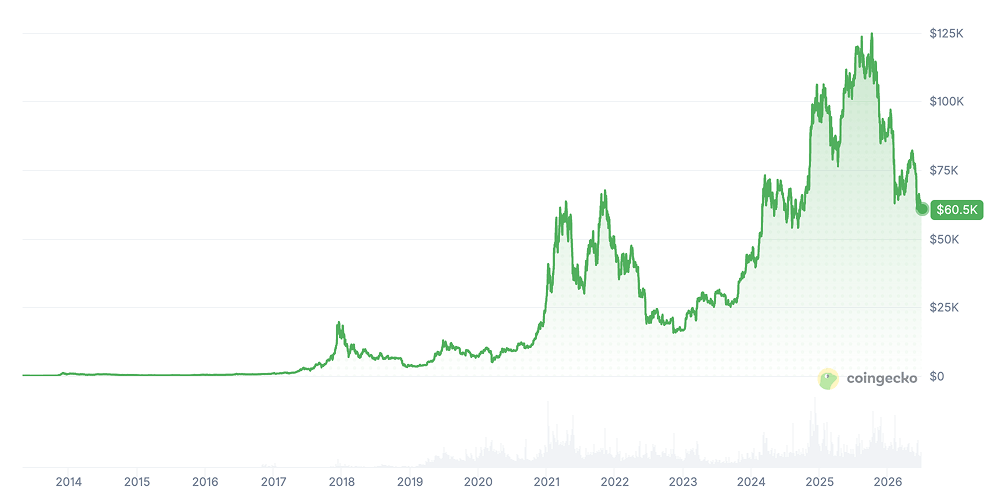
BTC Price Chart, CoinGecko, June 29, 2026
Trading activity also remains strong, with billions of dollars in daily trading volume across global exchanges. Bitcoin continues to attract both retail and institutional investors, although market sentiment has become more cautious following recent ETF outflows and changing expectations for U.S. interest rates.
While Bitcoin is trading well below its all-time high of $126,198, reached in October 2025, it remains one of the best-performing assets of the past decade.
Current BTC Price and Market Cap
As of late June 2026, Bitcoin trades at around $60,000, making it the largest cryptocurrency by market capitalization.
The current circulating supply stands at approximately 20.05 million BTC, meaning more than 95% of the maximum 21 million coins have already been mined. Bitcoin’s market capitalization is close to $1.2 trillion, while its 24-hour trading volume is around $30 billion. The cryptocurrency also maintains a market dominance of roughly 56%, showing that it still accounts for more than half of the total crypto market value.
| Metric | Value (June 2026) |
| Current Price | ~$60,500 |
| Market Capitalization | ~$1.21 trillion |
| 24h Trading Volume | ~$30 billion |
| Circulating Supply | ~20.05 million BTC |
| Maximum Supply | 21 million BTC |
| Bitcoin Dominance | ~56% |
Recent Events Affecting Bitcoin’s Price
Several major events shaped Bitcoin’s price in 2025 and 2026. These events affected investor confidence, market liquidity, and short-term volatility.
First, spot Bitcoin ETF flows became one of the most important price drivers. Strong inflows supported Bitcoin during several rallies, while heavy outflows in 2026 increased selling pressure and weakened sentiment. Citi estimated that ETF flows explained a large share of Bitcoin’s weekly price moves, which shows how important institutional demand has become.
Second, Bitcoin reached a new all-time high of $126,198 in October 2025. This milestone attracted global attention and confirmed that large investors still viewed BTC as a major long-term asset. However, the following correction also reminded beginners that Bitcoin can fall sharply after record highs.
Third, the U.S. Strategic Bitcoin Reserve announcement changed the political narrative around BTC. The U.S. government said it would hold seized Bitcoin as a reserve asset instead of selling it, which strengthened Bitcoin’s store-of-value image.
Fourth, institutional purchases continued to influence the market. Strategy, formerly MicroStrategy, remained the most visible corporate Bitcoin buyer, although concerns around its valuation and funding model added pressure during the 2026 downturn.
Fifth, Federal Reserve policy became a key macro factor. Higher inflation expectations and uncertainty around future rate decisions reduced demand for risk assets, including Bitcoin.
Sixth, U.S. crypto regulation stayed in focus. The CLARITY Act made progress, but delays in the Senate limited the positive impact on market sentiment.
Finally, Binance’s failure to secure a MiCA license before the EU deadline created fresh uncertainty in Europe. Since Binance is the largest crypto exchange, its regulatory setback added pressure to the broader market and reminded investors that exchange access still matters for Bitcoin liquidity.

Bitcoin Price Prediction for 2026
Bitcoin could experience another volatile year in 2026 as investors react to ETF flows, macroeconomic conditions, and institutional demand. Forecasts from leading prediction platforms vary widely, showing that analysts remain divided on how quickly Bitcoin can recover from its current correction. While conservative models expect only modest gains, bullish forecasts suggest Bitcoin could challenge or even surpass its previous all-time high before the end of the year.
Bitcoin Price Forecast June–December 2026
Forecasts for the second half of 2026 highlight two very different market outlooks. DigitalCoinPrice expects Bitcoin to move within a relatively narrow range, gradually rising from around $59,000 in June to approximately $64,200 by December. This model assumes stable market conditions, moderate institutional demand, and limited volatility.
PricePrediction.net presents a much more optimistic scenario. According to its forecast, Bitcoin could climb above $93,000 in September, exceed $125,000 in October, and finish the year between $129,754 and $144,567. This outlook assumes renewed ETF inflows, improving macroeconomic conditions, and stronger investor confidence.
Considering both models, a balanced forecast places Bitcoin in the $70,000–$100,000 range by the end of 2026. This scenario assumes steady demand without requiring another explosive bull market.
Bitcoin Price Prediction End of 2026: Bull and Bear Case
The bull case depends on several positive catalysts. Spot Bitcoin ETFs would need to return to strong net inflows, the Federal Reserve would likely begin lowering interest rates, and regulatory clarity in the United States would continue to improve. At the same time, institutional investors would need to keep accumulating Bitcoin while overall crypto sentiment strengthens. Under these conditions, BTC could finish 2026 between $120,000 and $145,000, closely matching the bullish forecasts from PricePrediction.net.
The bear case assumes the opposite. Continued ETF outflows, weaker economic growth, delayed crypto legislation, and tighter monetary policy could keep pressure on the market. If investor confidence remains weak, Bitcoin may trade close to its current levels and end the year between $58,000 and $65,000, in line with DigitalCoinPrice’s conservative outlook.
Although both scenarios remain possible, the most realistic Bitcoin outlook for the end of 2026 likely falls somewhere in the middle. Much will depend on institutional demand, global liquidity, and whether Bitcoin enters the next stage of its long-term market cycle.
Bitcoin Price History
Bitcoin has experienced one of the most remarkable price journeys in financial history. Since its launch in 2009, it has grown from an experimental digital currency worth almost nothing into a trillion-dollar asset held by millions of investors, public companies, and financial institutions.
For nearly two years after its creation, Bitcoin had little or no market value. In 2011, it reached $1 for the first time, proving that people were willing to buy and trade the new digital currency. Two years later, Bitcoin crossed $1,000, fueled by growing media attention and the first wave of retail investors.
The next major bull market arrived in 2017, when Bitcoin surged to almost $20,000. Although the rally ended with a sharp correction in 2018, it introduced cryptocurrencies to a global audience.
Bitcoin entered another historic cycle in 2020 and 2021 after the third halving reduced the supply of new coins. Institutional investors, corporate treasury purchases, and unprecedented monetary stimulus pushed BTC to a new all-time high of $69,000 in November 2021.
The following year brought one of the largest bear markets in Bitcoin’s history. Rising interest rates, the collapse of several crypto companies, and weaker investor sentiment caused Bitcoin to fall to around $16,000 in late 2022.
The market recovered strongly after the approval of spot Bitcoin ETFs and growing institutional demand. Bitcoin broke above $100,000 for the first time in late 2024, confirming the start of another major bull cycle. The rally continued into 2025, when BTC reached its current all-time high of $126,198 in October.
As of June 2026, Bitcoin trades around $60,000 following a significant market correction. Despite the decline, Bitcoin remains one of the best-performing assets of the past decade and continues to attract long-term investors who believe future halving cycles could drive further growth.
From $0 to ATH: Key Milestones
| Year | Milestone | Approx. Price |
| 2009 | Bitcoin network launched | $0 |
| 2011 | First time above $1 | $1 |
| 2012 | First Bitcoin halving | ~$12 |
| 2013 | First move above $1,000 | ~$1,000 |
| 2016 | Second halving | ~$650 |
| 2017 | First major bull market peak | ~$20,000 |
| 2020 | Third halving | ~$8,700 |
| 2021 | New all-time high | ~$69,000 |
| 2022 | Bear market bottom | ~$16,000 |
| 2024 | Break above $100,000 after ETF-driven rally | >$100,000 |
| Oct. 2025 | Current all-time high | $126,198 |
| Jun. 2026 | Current market price | ~$60,500 |
Bitcoin’s history closely follows its four-year halving cycle. Each halving reduces the supply of newly mined BTC, and every cycle has eventually produced a new all-time high, although past performance does not guarantee future results.
Bitcoin Price Performance by Halving Cycle
Bitcoin has completed four halving cycles, each producing a different level of growth as the market matured.
| Halving Cycle | Halving Date | Price at Halving | Cycle Peak | Approx. Gain |
| Cycle 1 | November 2012 | ~$12 | ~$1,163 (2013) | +9,500% |
| Cycle 2 | July 2016 | ~$650 | ~$19,700 (2017) | +2,900% |
| Cycle 3 | May 2020 | ~$8,700 | ~$69,000 (2021) | +690% |
| Cycle 4* | April 2024 | ~$63,800 | $126,198 (Oct. 2025) | +98%* |
*The fourth halving cycle is still in progress, so its final performance remains unknown.
Historically, each halving has reduced Bitcoin’s inflation rate and strengthened its scarcity. Although percentage gains have become smaller with every cycle as the market has grown, Bitcoin has continued to establish new record highs. The next halving is expected in 2028, and many long-term investors believe it could become another major catalyst for Bitcoin’s next bull market.
Bitcoin Price On-Chain Analysis
Bitcoin’s on-chain data shows a market under pressure, but not necessarily a market in full panic. Several key metrics suggest that short-term sellers remain active, while long-term investors still hold a large share of the supply.
Exchange data gives the first important signal. Binance’s Bitcoin reserves reportedly increased from about 617,000 BTC to 648,600 BTC between late April and early June 2026. Rising exchange reserves can create selling pressure because more coins sit on trading platforms. At the same time, CryptoQuant reported that miners sent 19,560 BTC to Binance on June 26, following an earlier June spike above 23,000 BTC. This shows that miner selling remains an important short-term risk.
Long-term holder behavior looks more mixed. Glassnode reported that Bitcoin traded near $60,000, while the True Market Mean sat around $77,200, meaning BTC traded at roughly a 15% discount to that on-chain level. Short-term holder MVRV improved from 0.81 to 0.90, but it remained below the 1.0 break-even level, which means many recent buyers still held unrealized losses.
Profitability metrics also show stress. Glassnode’s 30-day Realized Profit/Loss Ratio stood near 0.53, confirming that loss-taking still dominated market flows. Coinpedia also highlighted an MVRV-Z Score near 0.41, which places Bitcoin closer to an accumulation zone than an overheated cycle top.
Whale activity adds another layer. Santiment reported that whales offloaded about 21,881 BTC in early June, while large Bitcoin transactions above $100,000 hit 10,095 in one day later that month. This suggests active repositioning by large holders.
Overall, Bitcoin’s on-chain picture remains cautious but not broken. Miner inflows and exchange reserves create downside risk, yet low MVRV readings and stressed profitability metrics may also point to a potential long-term accumulation phase.
On-Chain Indicators and Market Sentiment
On-chain metrics provide a deeper view of Bitcoin’s market health by tracking investor behavior directly on the blockchain. Current data suggests that sentiment remains cautious, although several indicators show the market is moving closer to a potential accumulation zone.
One of the most closely watched metrics is the MVRV Z-Score, which measures whether Bitcoin is overvalued or undervalued relative to its historical cost basis. According to recent Glassnode research, the AVIV Z-Score reached -1.09 before recovering to -1.06, placing Bitcoin in an extreme discount zone compared to its long-term average. Historically, readings below zero have appeared during market bottoms rather than cycle peaks.
The Spent Output Profit Ratio (STH-SOPR) also highlights weak short-term sentiment. Glassnode reported that the STH-SOPR Z-Score fell to -1.86, close to the historical capitulation threshold of -2.0. This indicates that many recent buyers continue selling Bitcoin at a loss, although the market has not yet reached the extreme panic levels seen during previous bear-market bottoms.
Exchange data paints a mixed picture. Glassnode notes that Coinbase Premium remains negative, showing weaker institutional demand in the United States, while Binance continues to hold the largest BTC reserves among centralized exchanges. Meanwhile, more than 95% of short-term holder supply remains underwater, with only 3.3% of short-term supply currently in profit, far below the four-year average of 55%. Despite this weakness, long-term holders continue to control a historically large share of Bitcoin’s circulating supply, suggesting experienced investors are still holding rather than distributing their coins.
Institutional Demand and ETF Flows
Institutional adoption has become one of the strongest drivers of Bitcoin’s price since the approval of U.S. spot Bitcoin ETFs in January 2024. These products have made Bitcoin accessible to pension funds, wealth managers, hedge funds, and other professional investors without requiring direct custody of the asset. Since their launch, U.S. spot Bitcoin ETFs have attracted more than $50 billion in cumulative net inflows, making them one of the most successful ETF launches in financial history.
The market is increasingly dominated by BlackRock’s iShares Bitcoin Trust (IBIT) and Fidelity’s Wise Origin Bitcoin Fund (FBTC). Throughout 2026, these two funds captured the majority of new institutional inflows, often accounting for more than two-thirds of daily ETF purchases. Their scale, liquidity, and reputation have made them the preferred investment vehicles for large asset managers.
Corporate demand remains another important catalyst. Strategy (formerly MicroStrategy) continues to hold the world’s largest corporate Bitcoin treasury, while dozens of other public companies have added BTC to their balance sheets. Together with ETF issuers, corporate buyers now control a significant share of Bitcoin’s circulating supply, reducing the amount of BTC available on the open market.
Government adoption has also entered the conversation. In 2025, the United States announced the creation of a Strategic Bitcoin Reserve, confirming that seized Bitcoin would be retained rather than liquidated. While the reserve does not involve active market purchases, the announcement reinforced Bitcoin’s growing role as a strategic reserve asset.
Looking further ahead, institutional demand could become even more significant. According to ARK Invest’s Big Ideas 2026 report, Bitcoin’s market capitalization could reach $16 trillion by 2030, driven by ETF adoption, corporate treasuries, sovereign demand, and Bitcoin’s expanding role as digital gold. Such a valuation would imply a Bitcoin price of more than $700,000 per coin.
Bitcoin Technical Analysis
According to the latest monthly technical analysis from Investing.com, Bitcoin currently shows a Strong Sell signal. Technical indicators remain bearish despite several long-term trend indicators continuing to point upward. Overall, the market reflects cautious sentiment as Bitcoin trades well below its 2025 all-time high.
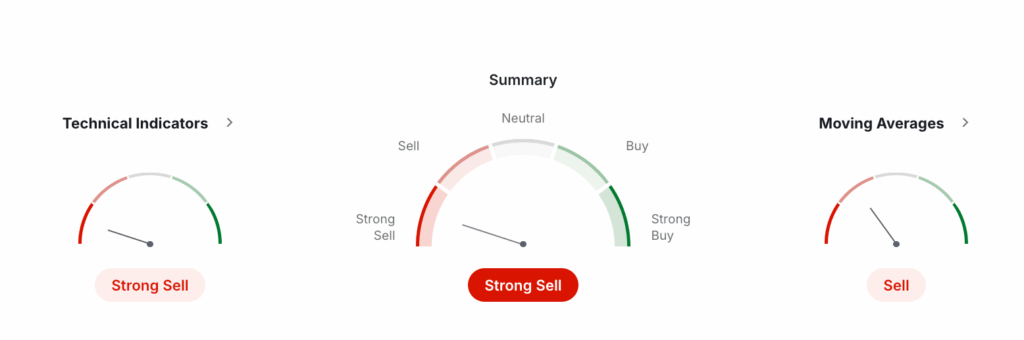
Investing, June 29, 2026
Key Support and Resistance Levels
Pivot points highlight the most important price zones where Bitcoin could find support or face renewed selling pressure.
The Classic Pivot Point stands at $76,327, which acts as the market’s primary equilibrium level. A sustained move above this price would strengthen bullish momentum, while trading below it keeps sellers in control.
Current support levels are:
- S1: $69,863
- S2: $66,067
- S3: $59,603
The $59,600–$60,000 area represents the strongest support zone and closely aligns with Bitcoin’s recent trading range. A break below this level could expose BTC to further downside.
Key resistance levels include:
- R1: $80,123
- R2: $86,587
- R3: $90,383
A breakout above $80,000 would improve the short-term outlook and could open the path toward the mid-$80,000 range.
Fibonacci pivot levels reinforce this analysis. They identify major support near $66,067 and resistance around $80,246 and $82,668, creating an important resistance cluster between $80,000 and $86,500. This zone will likely determine whether Bitcoin begins a sustained recovery or remains in consolidation.
Moving Averages and Oscillators
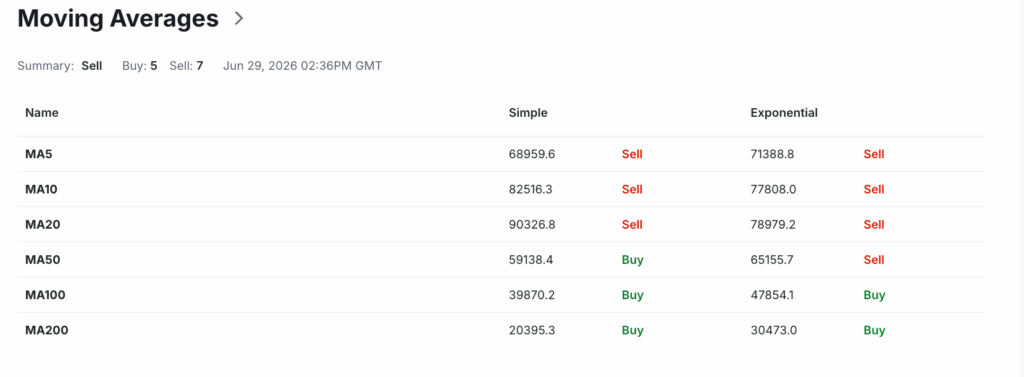
Investing, June 29, 2026
Monthly data from Investing continues to show short-term weakness but long-term strength. Short-term moving averages (MA5, MA10, and MA20) all generate Sell signals because Bitcoin remains below its recent trend levels. In contrast, the MA100 and MA200 continue to signal Buy, confirming that the broader long-term trend remains positive despite recent volatility. Overall, moving averages generate 5 Buy signals and 7 Sell signals, resulting in a Sell rating.
Oscillators also point to cautious market sentiment. RSI (14) stands at 40.78, indicating weak momentum without reaching oversold territory. MACD (12,26) remains one of the few bullish indicators with a Buy signal, while StochRSI is deeply oversold at 0.00, suggesting that selling pressure may be becoming exhausted. However, indicators such as CCI (-118.70), ROC (-36.76), Williams %R (-57.35), and the Ultimate Oscillator (33.58) all continue to signal Sell. Overall, Bitcoin’s technical picture remains bearish in the short term, although several long-term indicators suggest the broader uptrend is still intact.
Bitcoin Price Prediction 2026–2030
| Year | Minimum Price | Maximum Price | Average Price | Price Change |
| 2026 | $56,977 | $144,567 | $100,000 | +65% |
| 2027 | $61,519 | $206,553 | $130,000 | +115% |
| 2028 | $70,261 | $289,986 | $180,000 | +200% |
| 2029 | $94,877 | $351,724 | $220,000 | +265% |
| 2030 | $109,632 | $434,504 | $270,000 | +345% |
Bitcoin Price Prediction 2026
- According to DigitalCoinPrice, Bitcoin could trade between $58,989 (-2%) and $64,206 (+6%) in 2026, suggesting limited upside and a consolidation phase near the current $60,000 level.
- PricePrediction.net is far more bullish, forecasting BTC between $56,977 (-6%) and $144,567 (+140%).
- Telegaon also expects stronger momentum, placing Bitcoin between $78,402 (+30%) and $132,026 (+120%).
Bitcoin Price Prediction 2027
- DigitalCoinPrice expects Bitcoin to move between $61,519 (+2%) and $82,480 (+36%) in 2027.
- PricePrediction.net gives a wider and higher range, from $92,111 (+55%) to $144,854 (+140%).
- Telegaon remains the most bullish source, forecasting BTC between $133,125 (+120%) and $206,553 (+240%).
Bitcoin Price Prediction 2028
Bitcoin price prediction 2028 is especially important because 2028 is the next Bitcoin halving year. Historically, halvings reduce the rate of new BTC issuance and have often preceded the strongest phases of previous bull markets. While past performance never guarantees future returns, the event is expected to be one of the biggest long-term catalysts for Bitcoin.
- DigitalCoinPrice forecasts BTC between $70,261 (+17%) and $99,453 (+65%).
- PricePrediction.net sees a stronger cycle, with Bitcoin ranging from $101,917 (+70%) to $174,370 (+190%).
- Telegaon gives the most aggressive forecast, placing BTC between $207,536 (+240%) and $289,986 (+380%).
Bitcoin Price Prediction 2029
- DigitalCoinPrice predicts Bitcoin between $94,877 (+60%) and $112,119 (+85%).
- PricePrediction.net projects a much higher range of $166,820 (+180%) to $244,839 (+310%).
- Telegaon is even more bullish, estimating BTC between $291,841 (+380%) and $351,724 (+480%).
Bitcoin Price Prediction 2030
- DigitalCoinPrice expects Bitcoin to reach $109,632 (+85%) to $135,665 (+125%) by 2030.
- PricePrediction.net forecasts a range between $181,663 (+205%) and $248,523 (+310%).
- Telegaon offers the most optimistic outlook, placing BTC between $352,330 (+480%) and $434,504 (+630%).
Supporting the long-term bull case, ARK Invest stated in May 2026 that Bitcoin could eventually reach a $16 trillion market capitalization, highlighting continued institutional conviction in the asset’s long-term potential.
Bitcoin Long-Term Price Prediction 2030–2040
While short-term Bitcoin forecasts vary widely, long-term projections become even more dependent on global adoption, regulation, institutional investment, and macroeconomic conditions. By the 2030s, Bitcoin will go through an additional halving cycle, further reducing the rate of new supply. If demand continues to grow while supply remains increasingly scarce, many analysts believe BTC could establish itself as a global store of value alongside gold. However, investors should remember that long-term forecasts remain speculative and are heavily influenced by future technological, economic, and regulatory developments.
Bitcoin Price Prediction 2035
DigitalCoinPrice remains relatively conservative, forecasting Bitcoin between $162,177 (+170%) and $165,505 (+180%) based on its long-term model extending into the mid-2030s.
PricePrediction.net expects significantly stronger appreciation. Its 2035 forecast places Bitcoin between $357,578 (+500%) and $442,186 (+630%), reflecting continued institutional adoption and increasing demand for scarce digital assets.
Telegaon offers the most optimistic outlook, projecting Bitcoin between $672,424 (+1,000%) and $753,123 (+1,150%). Such valuations assume Bitcoin becomes one of the world’s dominant reserve assets and attracts substantial institutional capital over the next decade.
Bitcoin Price Prediction 2040
DigitalCoinPrice forecasts Bitcoin trading between $162,177 (+170%) and $167,823 (+180%) by 2040, suggesting a mature market with slower long-term appreciation.
Telegaon remains highly bullish, estimating Bitcoin between $904,543 (+1,400%) and $981,512 (+1,520%). This scenario assumes widespread global adoption, continued institutional demand, and Bitcoin evolving into a mainstream store of value across both public and private markets.
Will Bitcoin Reach $1 Million?
A Bitcoin price of $1 million is no longer considered an unrealistic long-term scenario by several prominent market participants. Cathie Wood of ARK Invest has repeatedly argued that continued institutional adoption and Bitcoin’s role as digital gold could eventually support a seven-figure valuation. Michael Saylor has also maintained that Bitcoin’s fixed supply gives it the potential to absorb a meaningful share of global wealth over time.
Current forecast models remain more conservative. Even Telegaon’s 2040 estimate tops out below $1 million at approximately $981,512, although it comes remarkably close. Reaching $1 million would require Bitcoin’s market capitalization to exceed $20 trillion, meaning continued adoption by governments, corporations, financial institutions, and retail investors. While such a valuation cannot be ruled out over the coming decades, it would likely require Bitcoin to become one of the world’s largest global financial assets rather than simply another investment.
Expert and Analyst Bitcoin Price Targets
The latest Bitcoin predictions from major institutions show a wide gap between cautious 2026 targets and highly bullish long-term forecasts. This range reflects the current market environment: Bitcoin is under pressure in 2026, but many analysts still expect institutional adoption to support higher prices over time.
ARK Invest remains one of the most bullish institutional voices. In 2026, ARK repeated that Bitcoin could reach $300,000 to $1.5 million by 2030, depending on ETF adoption, corporate treasury demand, sovereign interest, and Bitcoin’s role as digital gold. CoinDesk also reported ARK’s May 2026 view that Bitcoin’s market cap could reach $16 trillion by 2030.
Citi became more cautious in March 2026. The bank lowered its 12-month Bitcoin target from $143,000 to $112,000, citing slower U.S. crypto legislation, weaker ETF expectations, and softer market activity. However, Citi still kept a bullish scenario of $165,000 if investor demand improves.
JPMorgan’s model remains more optimistic. Its analysts argued that Bitcoin could reach $170,000 within six to twelve months because BTC looked undervalued compared with gold on a volatility-adjusted basis.
Galaxy Digital gives a mixed view. The firm said 2026 remains difficult to forecast, but it still sees Bitcoin reaching $250,000 by the end of 2027 if adoption continues.
VanEck focuses on the long term rather than short-term timing. Its January 2026 research projected a $2.9 million Bitcoin valuation by 2050 under its base-case long-term model.
Institutional Forecasts
Institutional forecasts for Bitcoin differ significantly because each firm uses different assumptions about ETF demand, monetary policy, and global adoption. While short-term targets became more conservative during the 2026 correction, most institutions remain bullish over the long term.
| Institution | Price Target | Timeline | Basis |
| ARK Invest | $300,000–$1.5 million | 2030 | Institutional adoption, sovereign demand, ETF growth, digital gold thesis |
| Standard Chartered | $100,000 | End of 2026 | ETF inflows recover, Strategy resumes buying, macro stabilization |
| Bernstein | $150,000 | End of 2026 | Elongated Bitcoin cycle, institutional demand, ETF accumulation |
| Citigroup | $112,000 (Base)$165,000 (Bull) | 12 months | Regulatory progress, ETF demand, improving market sentiment |
| JPMorgan | $170,000 | 6–12 months | Bitcoin undervalued relative to gold on a volatility-adjusted basis |
| Bitcoin Suisse | $150,000–$180,000 | 2026 | Fed easing, improving liquidity, institutional adoption |
| Galaxy Digital | $250,000 | End of 2027 | Continued ETF growth and corporate treasury demand |
| VanEck | $2.9 million | 2050 | Long-term capital market assumptions, reserve asset adoption |
Although the price targets vary widely, every institution expects Bitcoin’s long-term performance to depend primarily on institutional adoption, ETF inflows, and the continued reduction of available supply after future halving events.
What Analysts Say: Bull vs Bear Scenarios
| Bull Case | Bear Case |
| ARK Invest believes ETF adoption, sovereign accumulation, and institutional investment could push Bitcoin toward a multi-hundred-thousand-dollar valuation by 2030. | Standard Chartered warned that persistent ETF outflows and weak macroeconomic conditions could delay Bitcoin’s recovery despite its positive long-term outlook. |
| Bernstein argues Bitcoin has already established a market bottom and expects institutional demand, particularly from Strategy and spot ETFs, to drive the next rally. | Citi believes slower regulatory progress and weaker institutional inflows could limit Bitcoin’s upside until market conditions improve. |
| Bitcoin Suisse expects lower interest rates and improving liquidity to support new all-time highs as investor risk appetite returns. | Some macro analysts warn that prolonged high interest rates, recession risks, or tighter financial conditions could continue reducing demand for speculative assets such as Bitcoin. |
| Michael Saylor maintains that Bitcoin’s fixed supply gives it the potential to become one of the world’s largest stores of value over the coming decades. | Several analysts also point to regulatory uncertainty and continued ETF redemptions as the biggest risks that could postpone the next bull market. |
The consensus among institutional analysts remains constructive despite recent volatility. Most expect Bitcoin to recover over time, but they also agree that the pace of ETF inflows, monetary policy, and global adoption will determine whether the next major rally begins in 2026 or later.
Should You Buy Bitcoin in 2026?
Whether Bitcoin is a good investment in 2026 depends on your financial goals, risk tolerance, and investment horizon. Bitcoin remains the largest cryptocurrency and continues to attract institutional investors, governments, and public companies. However, it is also a highly volatile asset that can experience sharp price swings over short periods.
The current market presents both opportunities and risks. On one hand, Bitcoin continues to benefit from growing institutional adoption, expanding ETF participation, and its limited supply of 21 million coins. On the other hand, investors still face macroeconomic uncertainty, changing regulations, and periods of significant market volatility.
For long-term investors, Bitcoin may serve as a portfolio diversification tool and a potential hedge against currency debasement. However, beginners should avoid investing more than they can afford to lose and should consider building a position gradually instead of trying to time the market.
Bullish Case for BTC
Several factors support a positive long-term outlook for Bitcoin. One of the biggest catalysts is the continued growth of spot Bitcoin ETFs, which have attracted tens of billions of dollars since launching in 2024. These investment products make Bitcoin easier to access for pension funds, asset managers, and other institutional investors.
The next Bitcoin halving, expected in 2028, could become another important catalyst. Historically, every halving has reduced the supply of newly mined BTC and has eventually been followed by a major bull market.
Institutional adoption also continues to expand. Companies such as Strategy maintain large Bitcoin holdings, while major asset managers like BlackRock and Fidelity continue offering spot Bitcoin ETFs. In addition, the creation of the U.S. Strategic Bitcoin Reserve strengthened Bitcoin’s position as a strategic digital asset. Regulatory progress, including the advancement of the CLARITY Act, could further increase investor confidence by providing clearer rules for the crypto industry.
Bearish Risks to Consider
Despite its long-term potential, Bitcoin remains a high-risk investment. Regulatory uncertainty continues to be one of the biggest concerns. Although some countries have adopted crypto-friendly policies, stricter regulations or outright restrictions could reduce demand and slow adoption.
Macroeconomic conditions also play a major role. Higher interest rates, persistent inflation, or a global recession could push investors toward safer assets and reduce demand for cryptocurrencies. At the same time, continued ETF outflows may increase selling pressure and weaken market sentiment.
Bitcoin also faces several long-term challenges. Advances in quantum computing could eventually require major security upgrades, although most experts believe this risk remains years away. The market also remains vulnerable to manipulation by large holders, commonly known as whales, whose transactions can trigger sharp price swings.
Finally, governments around the world continue developing central bank digital currencies (CBDCs). While CBDCs are fundamentally different from Bitcoin because they are centralized, their wider adoption could influence how digital payments evolve and compete for public attention. Investors should carefully weigh these risks alongside Bitcoin’s long-term growth potential before making an investment decision.
How to Buy Bitcoin
StealthEX allows you to swap Bitcoin quickly and privately. You do not need to create an account. The platform supports more than 2,000 cryptocurrencies and works with direct wallet-to-wallet transfers.
Just follow these steps:
- Choose the crypto pair and enter the amount (for example, ETH to BTC).
- Click the “Start Exchange” button.
- Enter your Bitcoin wallet address.
- Send the funds to the provided deposit address.
- Receive BTC directly in your wallet.
That’s it. The entire process usually takes only a few minutes and does not require registration.
Frequently Asked Questions
What Is the Bitcoin Price Prediction for 2026?
Bitcoin price predictions for 2026 vary significantly depending on the forecasting model. DigitalCoinPrice expects BTC to trade between $58,989 and $64,206, suggesting a year of gradual growth. PricePrediction.net is much more optimistic, forecasting a range of $56,977 to $144,567, while Telegaon projects $78,402 to $132,026. A balanced outlook places Bitcoin between $70,000 and $100,000 by the end of 2026 if institutional demand remains strong and macroeconomic conditions improve.
How High Can Bitcoin Go in 2030?
Long-term forecasts suggest Bitcoin could reach new all-time highs by 2030. DigitalCoinPrice predicts a maximum price of $135,665, while PricePrediction.net expects BTC to climb as high as $248,523. Telegaon offers the most optimistic forecast at $434,504. Some institutional investors, including ARK Invest, believe Bitcoin could eventually trade far above these levels if global adoption continues, although such scenarios depend on sustained institutional demand and favorable market conditions.
Will Bitcoin Go Up in 2026?
Many analysts believe Bitcoin has the potential to recover during 2026, although volatility is likely to remain high. Spot Bitcoin ETFs continue attracting institutional capital, public companies keep adding BTC to their balance sheets, and regulatory clarity in the United States has improved compared to previous years. At the same time, Bitcoin remains well below its October 2025 all-time high, leaving room for recovery if investor confidence strengthens. However, risks such as weaker economic growth, ETF outflows, and higher interest rates could delay the next bull market. Most forecasts remain cautiously optimistic, expecting Bitcoin to finish 2026 above its current price despite continued short-term fluctuations.
What Will Bitcoin Be Worth in 2030?
No one can predict Bitcoin’s future price with certainty, but most long-term forecasts remain positive. Current models project Bitcoin between $109,632 and $434,504 by 2030, depending on the source. Conservative forecasts assume moderate adoption and slower market growth, while bullish scenarios expect stronger ETF inflows, institutional investment, and another successful halving cycle. If Bitcoin continues gaining acceptance as a global store of value, its long-term upside could exceed today’s mainstream forecasts.
How Much Will Bitcoin Be Worth in 2040?
Forecasts for 2040 remain highly speculative because they depend on future adoption, regulation, and global economic conditions. DigitalCoinPrice estimates Bitcoin could trade between $162,177 and $167,823, while Telegaon projects a much higher range of $904,543 to $981,512. Some analysts also believe Bitcoin could eventually surpass $1 million, although reaching that level would likely require widespread institutional, corporate, and sovereign adoption.
Is Bitcoin a Good Investment in 2026?
Bitcoin may be a suitable investment for people with a long-term perspective and a high tolerance for risk. It benefits from a limited supply, growing institutional adoption, and increasing acceptance as a store of value. However, Bitcoin remains highly volatile, and large price corrections can occur without warning. Investors should only invest money they can afford to lose, diversify their portfolios, and avoid making decisions based solely on short-term market movements.
Where Is Bitcoin Headed?
Bitcoin’s short-term direction depends largely on ETF flows, interest rate decisions, and overall investor sentiment. By the end of 2026, many analysts expect BTC to recover if institutional demand strengthens and macroeconomic conditions improve. Looking further ahead, the 2028 Bitcoin halving could become the next major catalyst, as previous halving cycles have often preceded new all-time highs. Beyond 2030, Bitcoin’s future will depend on global adoption by institutions, corporations, governments, and retail investors. If demand continues to increase while Bitcoin’s supply remains limited, many analysts believe the long-term trend will remain positive despite periods of significant volatility.
Follow us on Medium, X, Telegram, YouTube, and Publish0x to stay updated about the latest news on StealthEX.io and the rest of the crypto world.
Don’t forget to do your own research before buying any crypto. The views and opinions expressed in this article are solely those of the author.
Bitcoin Bitcoin price prediction BTC crypto price prediction price analysisThe post Bitcoin (BTC) Price Prediction 2026–2030: How High Can BTC Go? first appeared on StealthEX.


You May Also Like

Bitget launches global trading league merging crypto and traditional markets

France will not give up on attacking philosophy, says Deschamps


