Gold Price Plummets Below $5,100 as Resilient US Dollar Gains Momentum
BitcoinWorld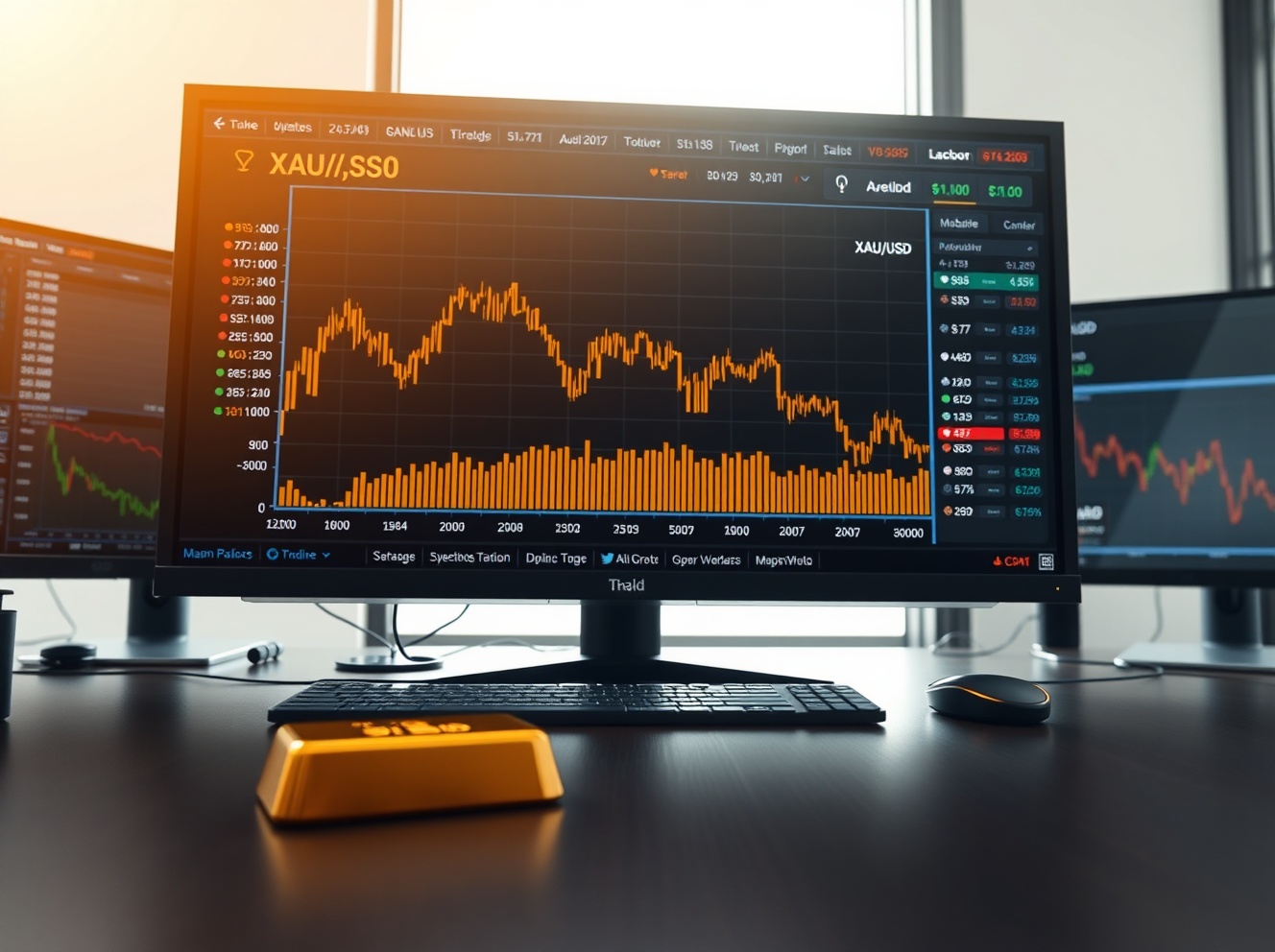
Gold Price Plummets Below $5,100 as Resilient US Dollar Gains Momentum
In a significant market shift, the spot price of gold has slumped decisively below the $5,100 per ounce threshold, a move primarily driven by a pronounced strengthening of the US Dollar across global foreign exchange markets. This development, observed in early 2025, underscores the powerful and often inverse relationship between the world’s primary reserve currency and the traditional safe-haven asset. Consequently, investors and analysts are closely scrutinizing macroeconomic indicators and central bank policies to gauge the trajectory of both assets.
Gold Price Breakdown and Key Market Drivers
The recent decline in the gold price represents a continuation of pressure seen throughout the latter part of 2024. Market data shows a clear correlation: as the US Dollar Index (DXY), which measures the dollar against a basket of six major currencies, climbs, dollar-denominated commodities like gold typically become more expensive for holders of other currencies. This dynamic suppresses international demand. Furthermore, rising US Treasury yields, often a byproduct of hawkish Federal Reserve rhetoric or strong economic data, reduce the relative appeal of non-yielding assets like gold.
Several concrete factors are contributing to the dollar’s current resilience:
- Relative Economic Strength: The US economy continues to demonstrate robust performance compared to peers in Europe and Asia, attracting capital flows.
- Monetary Policy Divergence: The Federal Reserve maintains a stance focused on price stability, while other major central banks may be considering or implementing rate cuts.
- Geopolitical Demand for Liquidity: Periods of global uncertainty can increase demand for the world’s most liquid currency, the US dollar, paradoxically pressuring gold in the short term.
Historical Context of the Dollar-Gold Relationship
Historically, the inverse correlation between the US dollar and gold is a well-established market axiom. For instance, during the bull market for gold in the early 2000s, the dollar was in a prolonged period of weakness. Conversely, the strong dollar period of the mid-2010s coincided with a multi-year consolidation in gold prices. The current environment echoes past cycles where expectations for higher-for-longer US interest rates bolster the dollar’s yield advantage.
Analysts from major financial institutions, including insights referenced from Bloomberg and Reuters market summaries, note that real yields—adjusted for inflation—are a critical metric. When real yields on US government bonds rise, the opportunity cost of holding gold increases, making it less attractive. Recent data suggests this fundamental pressure is a primary driver behind the sell-off.
Expert Analysis on Market Sentiment
Market strategists emphasize that while the dollar is a dominant short-term driver, gold’s long-term fundamentals remain supported by other factors. Central bank demand for gold as a reserve asset, particularly from institutions in emerging markets, has reached record levels in recent years, providing a structural floor for prices. Additionally, gold retains its role as a hedge against systemic financial risk and prolonged inflation, which may resurge as a theme later in the economic cycle.
Technical Analysis and Key Price Levels
From a charting perspective, the breach below $5,100 is a technically significant event. This level had previously acted as a support zone, and its failure has triggered automated selling and shifted market psychology. Traders are now watching the next major support levels, which could be found around $5,000 and $4,950 per ounce. Resistance on any rebound is likely to be encountered near the $5,150-$5,200 range, which represents the recent breakdown point.
The following table summarizes the key price dynamics:
| Asset | Current Trend | Primary Driver | Market Sentiment |
|---|---|---|---|
| Gold (XAU/USD) | Bearish | Strong US Dollar, Rising Yields | Cautious to Negative |
| US Dollar Index (DXY) | Bullish | Fed Policy, Economic Strength | Positive |
Broader Impact on Commodities and Markets
The slump in gold has a ripple effect across related financial markets. Mining equities, as represented by indices like the NYSE Arca Gold BUGS Index, often exhibit leveraged moves relative to the underlying metal and have faced pronounced selling pressure. Similarly, other dollar-quoted commodities, such as silver and copper, also experience headwinds from a robust greenback, though their individual supply-demand dynamics play a larger role.
For retail and institutional portfolios, this environment necessitates a review of asset allocation. The traditional 60/40 stock-bond portfolio may see different performance characteristics when both the dollar is strong and safe-haven assets are under pressure. Investors are increasingly looking at currency-hedged instruments or assets in stronger local economies to navigate this climate.
Conclusion
The gold price slump below $5,100 serves as a stark reminder of the US dollar’s enduring influence on global commodity markets. While the short-term trend for gold appears challenged by macroeconomic forces favoring the dollar, the metal’s long-term role as a diversifier and store of value remains intact. Market participants will monitor upcoming US inflation data, Federal Reserve meeting minutes, and global growth indicators for signals of the next major shift in this critical financial relationship. The current price action highlights the importance of understanding the interconnected drivers of currency strength and commodity valuation in a complex global economy.
FAQs
Q1: Why does a stronger US Dollar cause gold prices to fall?
A stronger US Dollar makes gold more expensive for buyers using other currencies, which can reduce global demand and put downward pressure on its dollar-denominated price.
Q2: Is gold still a good investment when the dollar is strong?
Gold’s investment case is multi-faceted. While a strong dollar presents a headwind, gold can still serve as a portfolio diversifier, a hedge against unforeseen geopolitical risk, and a long-term store of value outside the fiat currency system.
Q3: What other factors influence the gold price besides the US Dollar?
Key factors include real interest rates, global central bank demand, mine production levels, jewelry and industrial demand, and broader market risk sentiment during times of crisis.
Q4: How do rising interest rates affect gold?
Rising interest rates, particularly in the US, increase the opportunity cost of holding gold because it pays no yield. They also typically strengthen the US dollar, creating a dual headwind for the metal.
Q5: What are the key support levels to watch for gold after breaking $5,100?
Technical analysts often watch round-number psychological levels like $5,000 per ounce, as well as areas where the price has found support in the past, such as $4,950. A break below these could signal further downside.
This post Gold Price Plummets Below $5,100 as Resilient US Dollar Gains Momentum first appeared on BitcoinWorld.


You May Also Like

NZD/USD Price Forecast: Rangebound trading between 0.5870 and 0.5930

Solana Price Prediction: Bounce to $89 or Drop Toward $30