Bitcoin’s Four-Year Cycle May Be Ending, Fidelity Research Suggests
TLDR:
- Fidelity data shows Bitcoin volatility hitting record lows even months after the 2025 price peak near $126,000.
- Public companies and ETFs now hold nearly 12% of Bitcoin supply, signaling major institutional accumulation.
- Bitcoin’s MVRV ratio has stayed near 2x realized value this cycle, far below peaks seen in past bull markets.
- Fidelity’s profit-to-volatility ratio has remained above 0.015 since 2023, marking the longest stability period.
Bitcoin’s market behavior may be entering a new phase, according to recent research from Fidelity Digital Assets.
The firm argues that long-standing boom-and-bust cycles could weaken as institutional demand reshapes the market. Data shows volatility hitting record lows even months after Bitcoin reached new price highs.
The question now is whether the classic four-year Bitcoin cycle still defines the crypto market.
Bitcoin Volatility Trends Challenge the Classic Four-Year Cycle
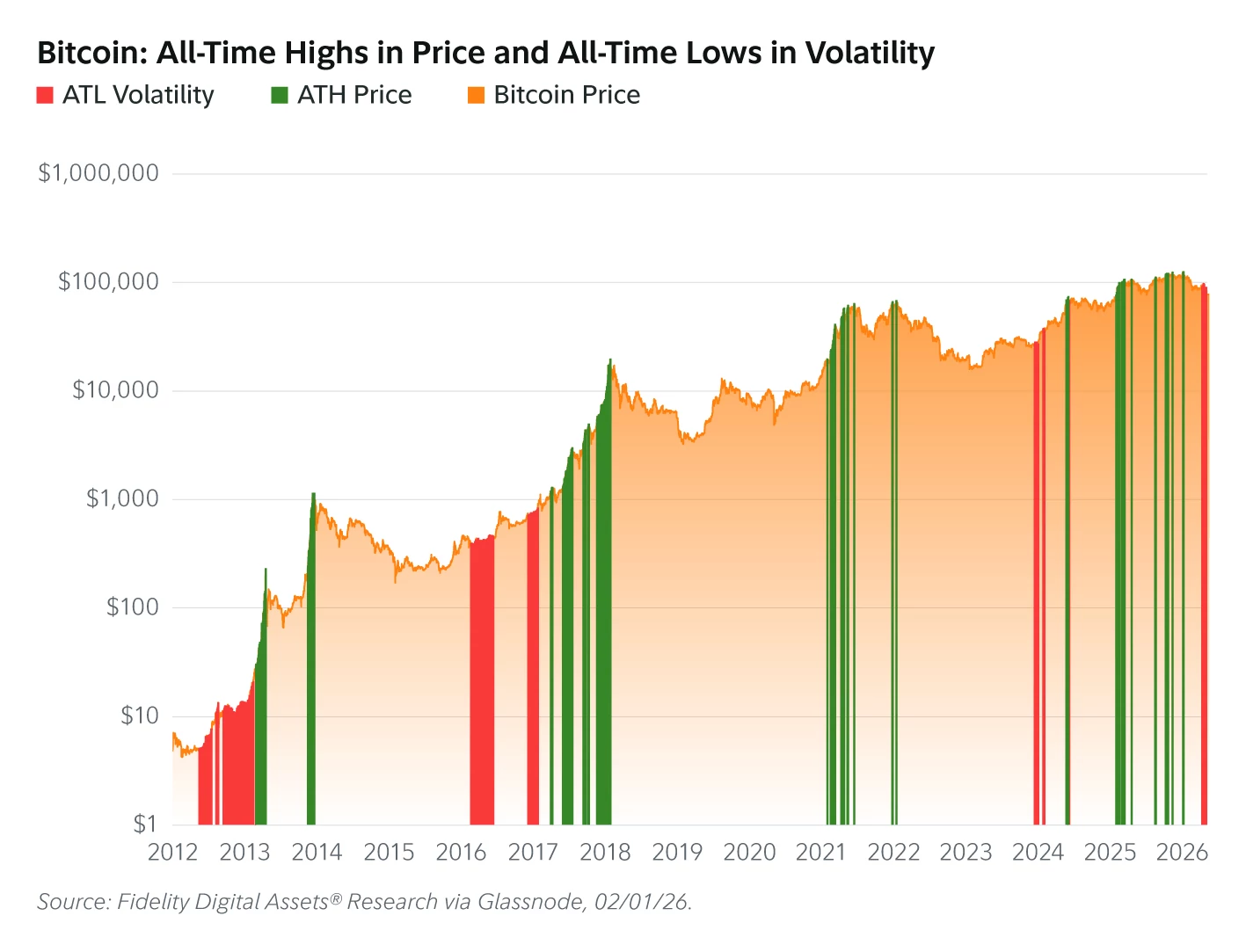
Bitcoin reached a market capitalization near $2.5 trillion during its October 2025 peak. Prices climbed above $126,000 during that rally.
However, volatility moved in the opposite direction. One-year realized volatility recorded 17 new all-time lows in January 2026.
 Source: Fidelity Digital Assets
According to Fidelity Digital Assets research, this pattern differs sharply from previous cycles. Historically, volatility surged as Bitcoin approached market peaks.
The current trend suggests a shift toward a larger and more liquid market. Fidelity compared Bitcoin’s growth to large-cap technology companies reaching maturity.
The firm notes that Bitcoin’s market size has expanded rapidly across cycles. The asset is now twice as large as its 2021 peak valuation.
It also stands nearly ten times larger than the 2017 cycle peak. Compared with 2013, Bitcoin’s market capitalization has expanded more than 200-fold.
Fidelity’s data shows volatility began declining in late 2023. At the time, Bitcoin traded near $27,000 before starting its latest rally.
Institutional Demand Reshapes Bitcoin Market Structure
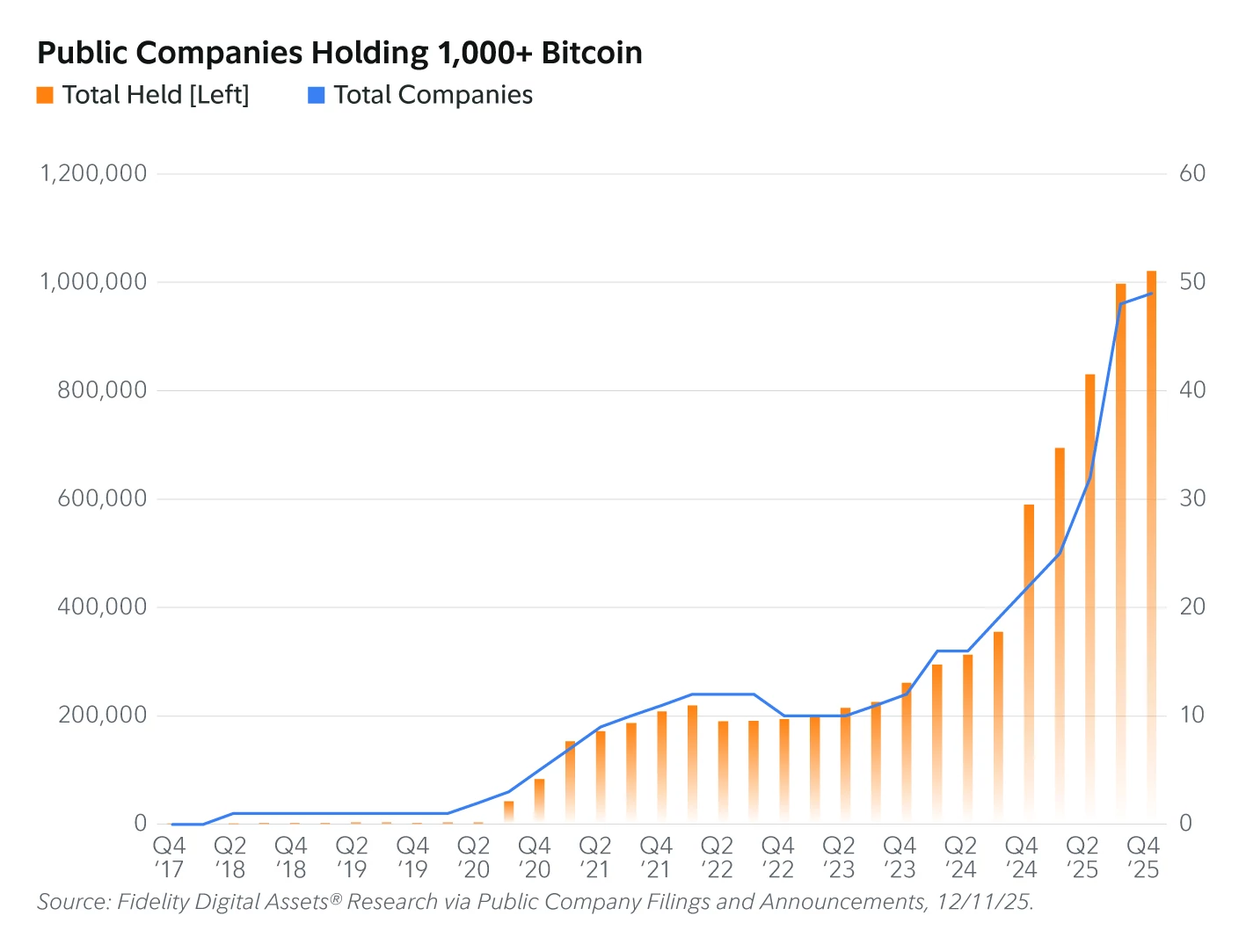
Demand patterns have changed significantly as institutions enter the market. Public companies and exchange-traded products now hold a growing share of supply.
According to Fidelity Digital Assets, 49 public companies hold more than 1,000 Bitcoin each. Combined holdings exceed one million BTC.
 Source: Fidelity Digital Assets
That amount represents more than five percent of Bitcoin’s circulating supply. The cohort has steadily increased holdings since early 2020.
Exchange-traded products have accelerated institutional accumulation. Spot Bitcoin ETPs launched in the United States in January 2024.
By January 2026, those vehicles collectively held nearly 1.3 million Bitcoin. This equals roughly 6.4 percent of the circulating supply.
Fidelity reported that the leading Bitcoin ETF surpassed $75 billion in assets within two years. Gold’s GLD ETF required almost seven years to reach that milestone.
On-chain metrics also suggest a calmer market cycle. Bitcoin’s market value to realized value ratio has remained near two throughout the current bull market.
Earlier cycles saw sharper expansions. The ratio reached six during 2013 and four during both the 2017 and 2021 cycles.
Fidelity estimates that reaching a ratio of four again would imply a $4.5 trillion Bitcoin market cap. That level corresponds to roughly $225,000 per coin.
The firm also introduced a “Profit to Volatility Ratio” metric. It compares profitable addresses with realized volatility.
That ratio has remained above 0.015 since late 2023. Fidelity describes this period as the longest stretch of stability in Bitcoin’s history.
The post Bitcoin’s Four-Year Cycle May Be Ending, Fidelity Research Suggests appeared first on Blockonomi.


You May Also Like

Beyond Cleaning: What Else You Must Check Before Moving Out

Justice Department has 'gone off the rails' for Trump's 'pretzel logic': analysis