Oil Surges to $119 a Barrel as G7 Moves to Release Emergency Reserves
TLDR
- Brent crude and WTI both hit $119.50 a barrel on Monday before pulling back, their highest levels since mid-2022.
- Israel struck Iran’s oil facilities over the weekend, while Iran attacked oil infrastructure in neighboring Gulf countries.
- Iran blocked the Strait of Hormuz, a shipping lane for roughly 20% of the world’s oil supply.
- G7 finance ministers are meeting Monday to discuss a joint release of emergency oil reserves.
- U.S. gasoline futures surged over 10%, pushing prices close to four-year highs above $3.00 a gallon.
Oil prices exploded higher on Monday after Israeli strikes hit Iranian oil facilities for the first time since the conflict began in early March. The attack pushed Brent crude and West Texas Intermediate futures both to an intraday high of $119.50 a barrel, levels not seen since mid-2022.
By midday, Brent was trading at $106.80 a barrel and WTI at $102.79, after coming off those overnight peaks. The pullback came after a Financial Times report that G7 finance ministers would meet Monday to discuss releasing emergency petroleum reserves.
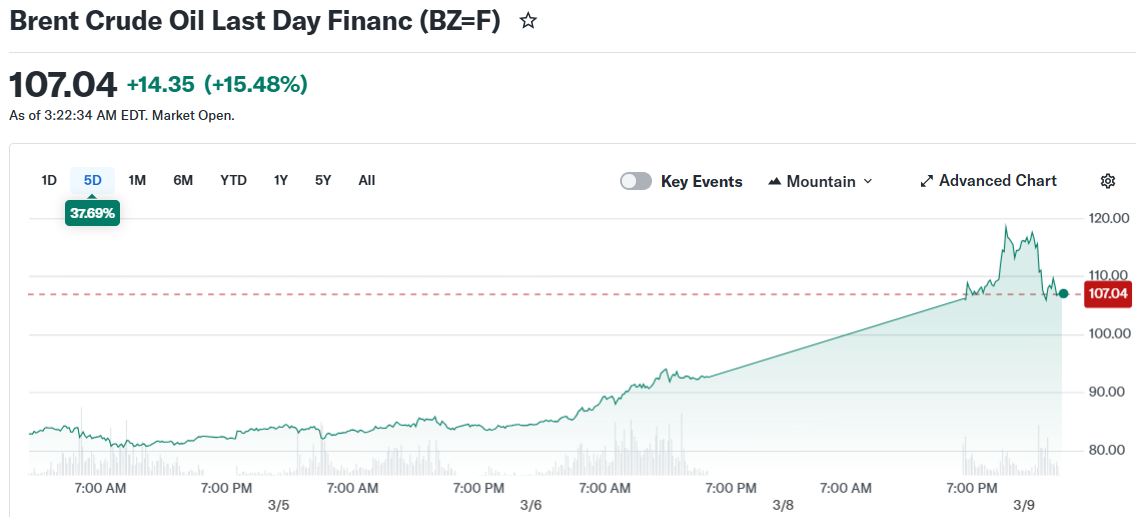 Brent Crude Oil Last Day Financ (BZ=F)
The meeting is expected to involve coordination with the International Energy Agency. Three G7 members, including the United States, have already expressed support for a joint reserve release.
Oil had surged more than 25% since the Iran conflict began in early March. The weekend escalation pushed prices even higher as markets opened Sunday night.
Israel struck fuel storage facilities in Tehran on Saturday. Iran responded by hitting an oil refinery in Bahrain with drones, according to the Wall Street Journal.
Strait of Hormuz Now Effectively Blocked
Iran also launched attacks on ships passing through the Strait of Hormuz. The strait handles around 20% of global oil consumption, and traffic through it is now described as minimal.
Analysts at OCBC wrote that “tail risks from a sustained Hormuz stoppage remain in play,” comparing the potential scale to the 2022 Russia-Ukraine energy shock.
Kuwait and the UAE both signaled cuts to oil output over the weekend, following Iraq’s production reductions last week. Storage constraints linked to supply disruptions are forcing some producers to scale back.
Saudi Arabia made a rare move by offering crude on spot markets, a sign it is trying to fill supply gaps caused by the conflict.
Trump Warns Prices Will Stay High Short-Term
Trump had previously downplayed rising U.S. gas prices, telling Reuters that the military operation against Iran was his main priority.
U.S. gasoline futures rose more than 10% on Monday, climbing above $3.00 a gallon and nearing their highest point since mid-2022.
Jefferies economist Mohit Kumar said the bombing of Iran’s oil infrastructure “suggests a shift in war strategy,” warning that targeting critical infrastructure raises both civilian and economic costs.
OCBC analysts said in a moderately severe scenario where partial flows resume under military escort, Brent could remain near $100 a barrel through mid-year.
The post Oil Surges to $119 a Barrel as G7 Moves to Release Emergency Reserves appeared first on CoinCentral.


You May Also Like

Why Avalanche’s Broadridge integration fails to stop AVAX’s 10% slide

GBP/JPY Surges as Soaring Oil Prices Threaten Japan’s Fragile Economic Recovery