Tron Has Led Every Blockchain in Daily Active Users for Ten Consecutive Months
The chain most associated with stablecoin transfers quietly outranks Ethereum, Solana, and Bitcoin on the metric that measures actual daily usage, and has done so without interruption since at least May 2025.
What the Data Shows
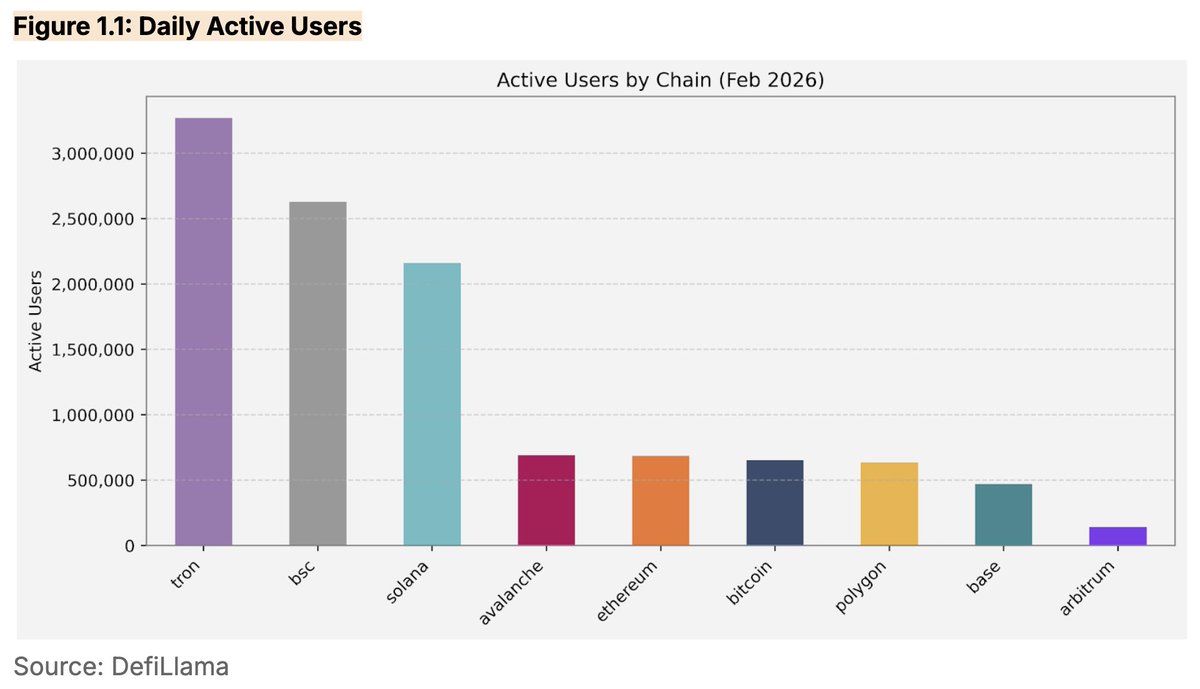
Presto Research’s February 2026 active user data sourced from DefiLlama shows Tron leading all blockchains with approximately 3.2 million daily active users. BNB Smart Chain sits second at roughly 2.6 million. Solana third at approximately 2.15 million. The gap between first and fourth is significant: Avalanche follows at around 700,000, less than a quarter of Tron’s count.
Ethereum, the blockchain with the largest total value locked and the most developed DeFi ecosystem, recorded approximately 670,000 daily active users. That places it fifth, behind Avalanche. Bitcoin sits sixth at roughly 650,000. Polygon seventh at approximately 640,000. Base eighth near 480,000. Arbitrum last among tracked chains at around 150,000.
 Source: https://twitter.com/trondao/status/2031121067582849054
Ten consecutive months at the top is not a statistical anomaly. It is a structural condition.
Why Tron Leads and What It Actually Means
Tron’s daily active user count reflects a specific and concentrated use case: USDT transfers. Tether issues more USDT on Tron than on any other blockchain, and millions of users across emerging markets in Asia, Latin America, and Africa move dollar-denominated value daily through Tron’s low-fee infrastructure. Transaction fees on Tron run fractions of a cent. On Ethereum they can reach several dollars during periods of network congestion.
The Revolut data published yesterday showed Tron accounting for 23% of its crypto transaction volume despite being rarely discussed in Western crypto media. The Latin America data showed stablecoins representing 70% of crypto inflows in Argentina, Colombia, and Brazil. Both datasets describe the same underlying behavior that produces Tron’s active user dominance: ordinary people moving dollars cheaply across borders on infrastructure that works reliably at minimal cost.
Active users on Tron are largely not trading DeFi protocols, minting NFTs, or deploying smart contracts. They are sending USDT. That is a narrower use case than Ethereum or Solana support, but it is a use case with hundreds of millions of potential users globally and a daily necessity rather than a speculative activity.
The Ethereum Gap Nobody Discusses
Ethereum at 670,000 daily active users sits below Avalanche and barely above Bitcoin on a metric where most market commentary would place it far higher. Total value locked, developer activity, and institutional adoption all favor Ethereum significantly over Tron. Daily active users do not.
The divergence reflects a fundamental difference between the chains’ user bases. Ethereum’s users tend to be higher-value, lower-frequency participants. A single Ethereum user might execute one complex DeFi transaction per week. A single Tron user might execute multiple small USDT transfers daily. Active user counts weight frequency of interaction, which systematically favors chains built for cheap, repetitive transactions over chains optimized for complex, high-value ones.
Neither metric captures the full picture alone. Together they describe two different versions of blockchain adoption that coexist without contradicting each other.
The Consistency Is the Story
Any chain can lead a monthly metric once. Leading it for ten consecutive months means the underlying demand is structural rather than cyclical. Tron’s position has held through Bitcoin’s rally above $100,000, through the altcoin correction, through shifting regulatory environments, and through the emergence of Base and Arbitrum as serious Ethereum scaling alternatives.
The chains people talk about most are not the chains most people use most often. That gap has been consistent for at least ten months.
The post Tron Has Led Every Blockchain in Daily Active Users for Ten Consecutive Months appeared first on ETHNews.


You May Also Like

Citi Warns Bitcoin Is More Vulnerable to Quantum Computing Attacks Than Ethereum

Shiba Inu Price Prediction Weakens as AI Token Sector Surges 30% to $19B While Pepeto SHIB and TAO Take Different Paths