Author: Squiffs Compiled by Jia Huan, ChainCatcher Hyperliquid's planned launch of its native stablecoin USDH has become one of the most eye-catching competitions in the DeFi field in recent years, with various institutions and DeFi projects vying for the voting support of validator nodes. However, Haseeb Qureshi, a partner at the crypto investment firm Dragonfly, claims that a "backroom deal" already existed in this competition. He posted on X (formerly Twitter): "I've heard from multiple bidders that all validators are only interested in Native Markets and haven't seriously considered any other parties. It's as if a backroom deal was already in place. The fact that Native Markets' proposal was released shortly after the USDH Request for Proposals (RFP) was published seems to indicate they were tipped off." Following Qureshi's post, CL, an anonymous crypto trader and spokesperson for Hypurrscan, which holds 15% of Hyperliquid's total voting power, publicly expressed support for Native Markets. However, Alex Svanevik, founder of Nansen, which operates The Hypurr Collective, Hyperliquid's largest validator node, strongly refuted Qureshi's accusations. Svanevik responded: “This is untrue. Our team has invested significant effort in reviewing proposals and engaging with bidders to find the best fit for Hyperliquid. I have received numerous private messages and calls from USDH bidders this week. We have been proactively engaging with them.” Native Markets Proposal Over the past week, the competition for USDH issuance has intensified, with DeFi giants including Sky (formerly Maker), Ethena, Paxos, and Agora all submitting formal proposals. Notably, Dragonfly has invested in Agora and Ethena, both of which have also submitted USDH proposals and are currently competing. Haseeb's criticism centers on the Native Markets proposal, which calls for natively minting a stablecoin on the HyperEVM while maintaining compliance with the GENIUS Act and inheriting fiat onramps from its issuer, Bridge (a subsidiary of Stripe). Stripe just announced its upcoming permissionless Layer 1 blockchain Tempo last week, which is expected to simplify the process of onboarding fiat currencies to Hyperliquid, which currently requires an on-chain cross-bridge solution. Native Markets team members include Max Fiege, formerly of Liquity and Barnbridge, and Anish Agnihotri, former president and COO of Uniswap Labs. Unlike other proposals that suggest using most of USDH revenue to repurchase HYPE, Native Markets proposes to use 50% of reserve earnings for Hyperliquid Assistance Fund to repurchase HYPE, while the other 50% is used to reinvest in USDH growth. Competition between Ethena, Sky, and Paxos Paxos quickly submitted a revised proposal last night. The proposal includes a partnership with PayPal to list HYPE on PayPal and Venmo, free fiat on-ramps, $20 million in ecosystem incentives, and an "AF-first incentive structure" where Paxos will not charge any fees until it reaches a TVL milestone. In the latest development in the dispute, Paxos co-founder Bhau Kotecha said he is willing to work with Native Markets. The idea stemmed from a tweet from investor Mike Dudas, who wrote: “Isn’t the most obvious solution for USDH simply a merger of the Native Markets and Paxos proposals? Native Markets handles the front end (Hyperliquid native, deeply integrated into the ecosystem), and Paxos handles the back end (GENIUS Act compliant, multi-billion dollar issuer, PayPal/Venmo distribution channels)?” Meanwhile, the cross-chain version of Tether’s stablecoin, USDT0, announced that it would not participate in the competition. Beyond formal proposals, these protocols are actively seeking support from the Hyperliquid community. Agora's proposal included a public address at X by Jan van Eck, CEO of VanEck, an investment firm with $130 billion in assets. Ethena, on the other hand, took a more humorous approach, parodying lyrics from Eminem's song "Stan" in a playful letter to Hyperliquid founder Jeff Yan. Sky's proposal has also attracted considerable attention, with co-founder Rune Christiansen publishing it in the Hyperliquid Discord group last night. The proposal highlights the successful history of Sky and DAI, promising Hyperliquid a 4.85% annualized yield on all USDH issued on Hyperliquid. Sky may deploy its $8 billion balance sheet on Hyperliquid, as well as provide a $25 million grant to create "Hyperliquid Stars" designed to independently develop DeFi on Hyperliquid. Ethena, a synthetic dollar protocol, launched its own proposal on September 9th. This proposal envisions USDH being 100% backed by USDtb, a stablecoin backed by BlackRock's BUIDL fund. Ethena's proposal also pledges to return "at least 95%" of USDH reserve revenue to the Hyperliquid ecosystem in the form of HYPE purchases and provides "at least $75 million in cash and token incentives to develop the HIP-3 frontend." Sky and Ethena issue the third and fourth largest stablecoins by market capitalization, respectively, behind Circle's USDC and Tether's USDT. Ethena's USDe has a market capitalization of nearly $13 billion, while Sky's DAI has a market capitalization of approximately $5 billion. However, their combined market share is still far less than the two market giants: USDC has a market capitalization of $72 billion and USDT has a market capitalization of $169 billion. As traditional institutions and DeFi projects continue to intensify their competition, HyperEVM builders are focusing on their future mission. Charlie, a contributor to Felix Protocol, told The Defiant: "The real work on the entire USDH scheme will begin at launch, because the real question will be how to scale to $5 billion." He cited a post on X, explaining that for USDH to truly impact Hyperliquid, it needs to focus on more than just yield rebates or HYPE token buybacks. "I wouldn't rule out USDT/USDe/USDC getting in on the action if they see that as a path to winning election. We need to see a clearer path to dismantling USDC's dominance for these USDH proposals to become more attractive." It’s worth noting that while Tether’s subsidiary USDT0 withdrew from the competition earlier today, it’s unclear whether this means Tether has officially withdrawn as well, and Circle has remained silent on the matter so far. Hyperliquid's Growth The growth of perpetual contract exchanges and Layer 1 has been a recurring theme in 2025. Hyperliquid currently accounts for over 35% of all cryptocurrency revenue, with annualized revenue reaching $1.28 billion, 99% of which goes to the Hyperliquid Aid Foundation to repurchase HYPE tokens. Hyperliquid’s Layer 1 blockchain, HyperEVM, has been on a sustained upward trend since its mainnet launch in February, currently ranking as the eighth-largest blockchain with $2.6 billion in total value locked (TVL), compared to just $400 million in TVL at the beginning of 2025. Meanwhile, the HYPE token has been one of the best-performing crypto assets since its launch in November 2024. The token, which debuted with a fully diluted valuation of approximately $3 billion, has surged over 1,700% since its launch, reaching an all-time high of $55.7 overnight.Author: Squiffs Compiled by Jia Huan, ChainCatcher Hyperliquid's planned launch of its native stablecoin USDH has become one of the most eye-catching competitions in the DeFi field in recent years, with various institutions and DeFi projects vying for the voting support of validator nodes. However, Haseeb Qureshi, a partner at the crypto investment firm Dragonfly, claims that a "backroom deal" already existed in this competition. He posted on X (formerly Twitter): "I've heard from multiple bidders that all validators are only interested in Native Markets and haven't seriously considered any other parties. It's as if a backroom deal was already in place. The fact that Native Markets' proposal was released shortly after the USDH Request for Proposals (RFP) was published seems to indicate they were tipped off." Following Qureshi's post, CL, an anonymous crypto trader and spokesperson for Hypurrscan, which holds 15% of Hyperliquid's total voting power, publicly expressed support for Native Markets. However, Alex Svanevik, founder of Nansen, which operates The Hypurr Collective, Hyperliquid's largest validator node, strongly refuted Qureshi's accusations. Svanevik responded: “This is untrue. Our team has invested significant effort in reviewing proposals and engaging with bidders to find the best fit for Hyperliquid. I have received numerous private messages and calls from USDH bidders this week. We have been proactively engaging with them.” Native Markets Proposal Over the past week, the competition for USDH issuance has intensified, with DeFi giants including Sky (formerly Maker), Ethena, Paxos, and Agora all submitting formal proposals. Notably, Dragonfly has invested in Agora and Ethena, both of which have also submitted USDH proposals and are currently competing. Haseeb's criticism centers on the Native Markets proposal, which calls for natively minting a stablecoin on the HyperEVM while maintaining compliance with the GENIUS Act and inheriting fiat onramps from its issuer, Bridge (a subsidiary of Stripe). Stripe just announced its upcoming permissionless Layer 1 blockchain Tempo last week, which is expected to simplify the process of onboarding fiat currencies to Hyperliquid, which currently requires an on-chain cross-bridge solution. Native Markets team members include Max Fiege, formerly of Liquity and Barnbridge, and Anish Agnihotri, former president and COO of Uniswap Labs. Unlike other proposals that suggest using most of USDH revenue to repurchase HYPE, Native Markets proposes to use 50% of reserve earnings for Hyperliquid Assistance Fund to repurchase HYPE, while the other 50% is used to reinvest in USDH growth. Competition between Ethena, Sky, and Paxos Paxos quickly submitted a revised proposal last night. The proposal includes a partnership with PayPal to list HYPE on PayPal and Venmo, free fiat on-ramps, $20 million in ecosystem incentives, and an "AF-first incentive structure" where Paxos will not charge any fees until it reaches a TVL milestone. In the latest development in the dispute, Paxos co-founder Bhau Kotecha said he is willing to work with Native Markets. The idea stemmed from a tweet from investor Mike Dudas, who wrote: “Isn’t the most obvious solution for USDH simply a merger of the Native Markets and Paxos proposals? Native Markets handles the front end (Hyperliquid native, deeply integrated into the ecosystem), and Paxos handles the back end (GENIUS Act compliant, multi-billion dollar issuer, PayPal/Venmo distribution channels)?” Meanwhile, the cross-chain version of Tether’s stablecoin, USDT0, announced that it would not participate in the competition. Beyond formal proposals, these protocols are actively seeking support from the Hyperliquid community. Agora's proposal included a public address at X by Jan van Eck, CEO of VanEck, an investment firm with $130 billion in assets. Ethena, on the other hand, took a more humorous approach, parodying lyrics from Eminem's song "Stan" in a playful letter to Hyperliquid founder Jeff Yan. Sky's proposal has also attracted considerable attention, with co-founder Rune Christiansen publishing it in the Hyperliquid Discord group last night. The proposal highlights the successful history of Sky and DAI, promising Hyperliquid a 4.85% annualized yield on all USDH issued on Hyperliquid. Sky may deploy its $8 billion balance sheet on Hyperliquid, as well as provide a $25 million grant to create "Hyperliquid Stars" designed to independently develop DeFi on Hyperliquid. Ethena, a synthetic dollar protocol, launched its own proposal on September 9th. This proposal envisions USDH being 100% backed by USDtb, a stablecoin backed by BlackRock's BUIDL fund. Ethena's proposal also pledges to return "at least 95%" of USDH reserve revenue to the Hyperliquid ecosystem in the form of HYPE purchases and provides "at least $75 million in cash and token incentives to develop the HIP-3 frontend." Sky and Ethena issue the third and fourth largest stablecoins by market capitalization, respectively, behind Circle's USDC and Tether's USDT. Ethena's USDe has a market capitalization of nearly $13 billion, while Sky's DAI has a market capitalization of approximately $5 billion. However, their combined market share is still far less than the two market giants: USDC has a market capitalization of $72 billion and USDT has a market capitalization of $169 billion. As traditional institutions and DeFi projects continue to intensify their competition, HyperEVM builders are focusing on their future mission. Charlie, a contributor to Felix Protocol, told The Defiant: "The real work on the entire USDH scheme will begin at launch, because the real question will be how to scale to $5 billion." He cited a post on X, explaining that for USDH to truly impact Hyperliquid, it needs to focus on more than just yield rebates or HYPE token buybacks. "I wouldn't rule out USDT/USDe/USDC getting in on the action if they see that as a path to winning election. We need to see a clearer path to dismantling USDC's dominance for these USDH proposals to become more attractive." It’s worth noting that while Tether’s subsidiary USDT0 withdrew from the competition earlier today, it’s unclear whether this means Tether has officially withdrawn as well, and Circle has remained silent on the matter so far. Hyperliquid's Growth The growth of perpetual contract exchanges and Layer 1 has been a recurring theme in 2025. Hyperliquid currently accounts for over 35% of all cryptocurrency revenue, with annualized revenue reaching $1.28 billion, 99% of which goes to the Hyperliquid Aid Foundation to repurchase HYPE tokens. Hyperliquid’s Layer 1 blockchain, HyperEVM, has been on a sustained upward trend since its mainnet launch in February, currently ranking as the eighth-largest blockchain with $2.6 billion in total value locked (TVL), compared to just $400 million in TVL at the beginning of 2025. Meanwhile, the HYPE token has been one of the best-performing crypto assets since its launch in November 2024. The token, which debuted with a fully diluted valuation of approximately $3 billion, has surged over 1,700% since its launch, reaching an all-time high of $55.7 overnight.

Dragonfly Partner: Hype Stablecoin Bidding Exposed to Backroom Manipulation, Native Markets Suspected of Internal Selection

2025/09/11 19:00

Author: Squiffs

Compiled by Jia Huan, ChainCatcher

Hyperliquid's planned launch of its native stablecoin USDH has become one of the most eye-catching competitions in the DeFi field in recent years, with various institutions and DeFi projects vying for the voting support of validator nodes.

However, Haseeb Qureshi, a partner at the crypto investment firm Dragonfly, claims that a "backroom deal" already existed in this competition. He posted on X (formerly Twitter): "I've heard from multiple bidders that all validators are only interested in Native Markets and haven't seriously considered any other parties. It's as if a backroom deal was already in place. The fact that Native Markets' proposal was released shortly after the USDH Request for Proposals (RFP) was published seems to indicate they were tipped off."

Following Qureshi's post, CL, an anonymous crypto trader and spokesperson for Hypurrscan, which holds 15% of Hyperliquid's total voting power, publicly expressed support for Native Markets. However, Alex Svanevik, founder of Nansen, which operates The Hypurr Collective, Hyperliquid's largest validator node, strongly refuted Qureshi's accusations.

Svanevik responded: “This is untrue. Our team has invested significant effort in reviewing proposals and engaging with bidders to find the best fit for Hyperliquid. I have received numerous private messages and calls from USDH bidders this week. We have been proactively engaging with them.”

Native Markets Proposal

Over the past week, the competition for USDH issuance has intensified, with DeFi giants including Sky (formerly Maker), Ethena, Paxos, and Agora all submitting formal proposals. Notably, Dragonfly has invested in Agora and Ethena, both of which have also submitted USDH proposals and are currently competing.

Haseeb's criticism centers on the Native Markets proposal, which calls for natively minting a stablecoin on the HyperEVM while maintaining compliance with the GENIUS Act and inheriting fiat onramps from its issuer, Bridge (a subsidiary of Stripe).

Stripe just announced its upcoming permissionless Layer 1 blockchain Tempo last week, which is expected to simplify the process of onboarding fiat currencies to Hyperliquid, which currently requires an on-chain cross-bridge solution.

Native Markets team members include Max Fiege, formerly of Liquity and Barnbridge, and Anish Agnihotri, former president and COO of Uniswap Labs.

Unlike other proposals that suggest using most of USDH revenue to repurchase HYPE, Native Markets proposes to use 50% of reserve earnings for Hyperliquid Assistance Fund to repurchase HYPE, while the other 50% is used to reinvest in USDH growth.

Competition between Ethena, Sky, and Paxos

Paxos quickly submitted a revised proposal last night. The proposal includes a partnership with PayPal to list HYPE on PayPal and Venmo, free fiat on-ramps, $20 million in ecosystem incentives, and an "AF-first incentive structure" where Paxos will not charge any fees until it reaches a TVL milestone.

In the latest development in the dispute, Paxos co-founder Bhau Kotecha said he is willing to work with Native Markets.

The idea stemmed from a tweet from investor Mike Dudas, who wrote: “Isn’t the most obvious solution for USDH simply a merger of the Native Markets and Paxos proposals? Native Markets handles the front end (Hyperliquid native, deeply integrated into the ecosystem), and Paxos handles the back end (GENIUS Act compliant, multi-billion dollar issuer, PayPal/Venmo distribution channels)?”

Meanwhile, the cross-chain version of Tether’s stablecoin, USDT0, announced that it would not participate in the competition.

Beyond formal proposals, these protocols are actively seeking support from the Hyperliquid community. Agora's proposal included a public address at X by Jan van Eck, CEO of VanEck, an investment firm with $130 billion in assets. Ethena, on the other hand, took a more humorous approach, parodying lyrics from Eminem's song "Stan" in a playful letter to Hyperliquid founder Jeff Yan.

Sky's proposal has also attracted considerable attention, with co-founder Rune Christiansen publishing it in the Hyperliquid Discord group last night. The proposal highlights the successful history of Sky and DAI, promising Hyperliquid a 4.85% annualized yield on all USDH issued on Hyperliquid. Sky may deploy its $8 billion balance sheet on Hyperliquid, as well as provide a $25 million grant to create "Hyperliquid Stars" designed to independently develop DeFi on Hyperliquid.

Ethena, a synthetic dollar protocol, launched its own proposal on September 9th. This proposal envisions USDH being 100% backed by USDtb, a stablecoin backed by BlackRock's BUIDL fund. Ethena's proposal also pledges to return "at least 95%" of USDH reserve revenue to the Hyperliquid ecosystem in the form of HYPE purchases and provides "at least $75 million in cash and token incentives to develop the HIP-3 frontend."

Sky and Ethena issue the third and fourth largest stablecoins by market capitalization, respectively, behind Circle's USDC and Tether's USDT. Ethena's USDe has a market capitalization of nearly $13 billion, while Sky's DAI has a market capitalization of approximately $5 billion. However, their combined market share is still far less than the two market giants: USDC has a market capitalization of $72 billion and USDT has a market capitalization of $169 billion.

As traditional institutions and DeFi projects continue to intensify their competition, HyperEVM builders are focusing on their future mission. Charlie, a contributor to Felix Protocol, told The Defiant: "The real work on the entire USDH scheme will begin at launch, because the real question will be how to scale to $5 billion."

He cited a post on X, explaining that for USDH to truly impact Hyperliquid, it needs to focus on more than just yield rebates or HYPE token buybacks. "I wouldn't rule out USDT/USDe/USDC getting in on the action if they see that as a path to winning election. We need to see a clearer path to dismantling USDC's dominance for these USDH proposals to become more attractive."

It’s worth noting that while Tether’s subsidiary USDT0 withdrew from the competition earlier today, it’s unclear whether this means Tether has officially withdrawn as well, and Circle has remained silent on the matter so far.

Hyperliquid's Growth

The growth of perpetual contract exchanges and Layer 1 has been a recurring theme in 2025.

Hyperliquid currently accounts for over 35% of all cryptocurrency revenue, with annualized revenue reaching $1.28 billion, 99% of which goes to the Hyperliquid Aid Foundation to repurchase HYPE tokens.
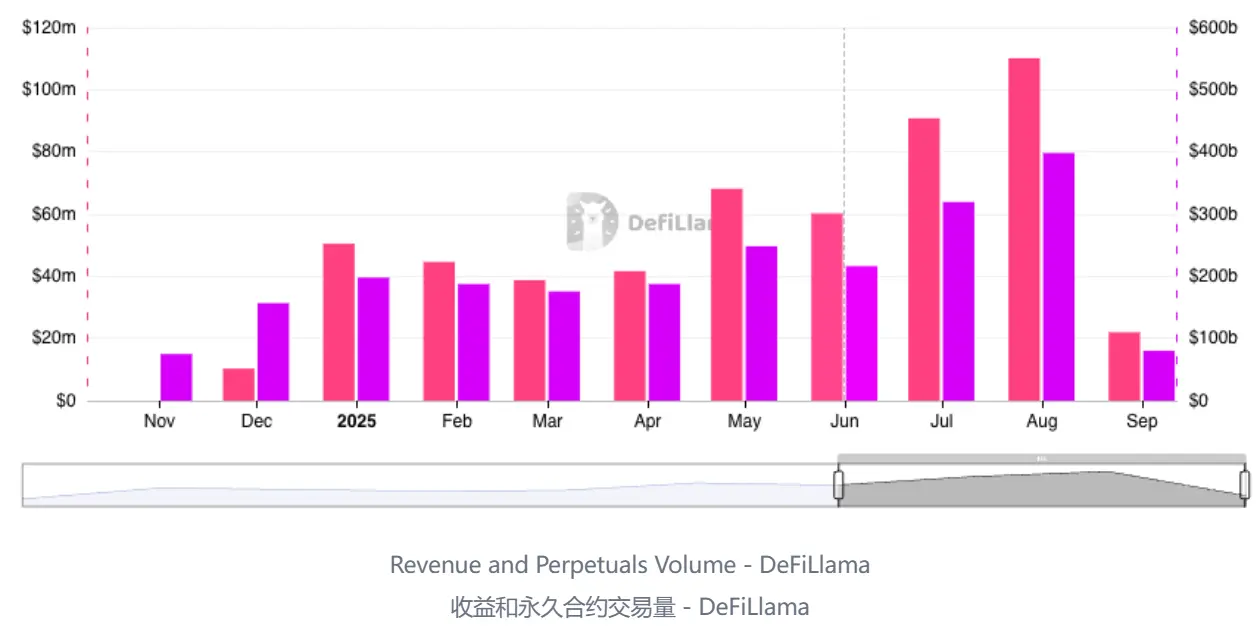
Hyperliquid’s Layer 1 blockchain, HyperEVM, has been on a sustained upward trend since its mainnet launch in February, currently ranking as the eighth-largest blockchain with $2.6 billion in total value locked (TVL), compared to just $400 million in TVL at the beginning of 2025.

Meanwhile, the HYPE token has been one of the best-performing crypto assets since its launch in November 2024. The token, which debuted with a fully diluted valuation of approximately $3 billion, has surged over 1,700% since its launch, reaching an all-time high of $55.7 overnight.


Market Opportunity
Threshold Logo
Threshold Price(T)
$0,010076
$0,010076$0,010076
+0,30%
USD
Threshold (T) Live Price Chart
Disclaimer: The articles reposted on this site are sourced from public platforms and are provided for informational purposes only. They do not necessarily reflect the views of MEXC. All rights remain with the original authors. If you believe any content infringes on third-party rights, please contact service@support.mexc.com for removal. MEXC makes no guarantees regarding the accuracy, completeness, or timeliness of the content and is not responsible for any actions taken based on the information provided. The content does not constitute financial, legal, or other professional advice, nor should it be considered a recommendation or endorsement by MEXC.

You May Also Like

Why The Green Bay Packers Must Take The Cleveland Browns Seriously — As Hard As That Might Be

Why The Green Bay Packers Must Take The Cleveland Browns Seriously — As Hard As That Might Be

The post Why The Green Bay Packers Must Take The Cleveland Browns Seriously — As Hard As That Might Be appeared on BitcoinEthereumNews.com. Jordan Love and the Green Bay Packers are off to a 2-0 start. Getty Images The Green Bay Packers are, once again, one of the NFL’s better teams. The Cleveland Browns are, once again, one of the league’s doormats. It’s why unbeaten Green Bay (2-0) is a 8-point favorite at winless Cleveland (0-2) Sunday according to betmgm.com. The money line is also Green Bay -500. Most expect this to be a Packers’ rout, and it very well could be. But Green Bay knows taking anyone in this league for granted can prove costly. “I think if you look at their roster, the paper, who they have on that team, what they can do, they got a lot of talent and things can turn around quickly for them,” Packers safety Xavier McKinney said. “We just got to kind of keep that in mind and know we not just walking into something and they just going to lay down. That’s not what they going to do.” The Browns certainly haven’t laid down on defense. Far from. Cleveland is allowing an NFL-best 191.5 yards per game. The Browns gave up 141 yards to Cincinnati in Week 1, including just seven in the second half, but still lost, 17-16. Cleveland has given up an NFL-best 45.5 rushing yards per game and just 2.1 rushing yards per attempt. “The biggest thing is our defensive line is much, much improved over last year and I think we’ve got back to our personality,” defensive coordinator Jim Schwartz said recently. “When we play our best, our D-line leads us there as our engine.” The Browns rank third in the league in passing defense, allowing just 146.0 yards per game. Cleveland has also gone 30 straight games without allowing a 300-yard passer, the longest active streak in the NFL.…
Share
BitcoinEthereumNews2025/09/18 00:41
Academic Publishing and Fairness: A Game-Theoretic Model of Peer-Review Bias

Academic Publishing and Fairness: A Game-Theoretic Model of Peer-Review Bias

Exploring how biases in the peer-review system impact researchers' choices, showing how principles of fairness relate to the production of scientific knowledge based on topic importance and hardness.
Share
Hackernoon2025/09/17 23:15
The Role of Reference Points in Achieving Equilibrium Efficiency in Fair and Socially Just Economies

The Role of Reference Points in Achieving Equilibrium Efficiency in Fair and Socially Just Economies

This article explores how a simple change in the reference point can achieve a Pareto-efficient equilibrium in both free and fair economies and those with social justice.
Share
Hackernoon2025/09/17 22:30