This article defines the concept of a free and fair economy by formalizing four core principles of market justice: Anonymity, Local Efficiency, Unproductivity, and Marginality (ALUM).This article defines the concept of a free and fair economy by formalizing four core principles of market justice: Anonymity, Local Efficiency, Unproductivity, and Marginality (ALUM).

The ALUM Principles: How Fairness Shapes a Free Economy

Abstract and 1. Introduction

  1. A free and fair economy: definition, existence and uniqueness

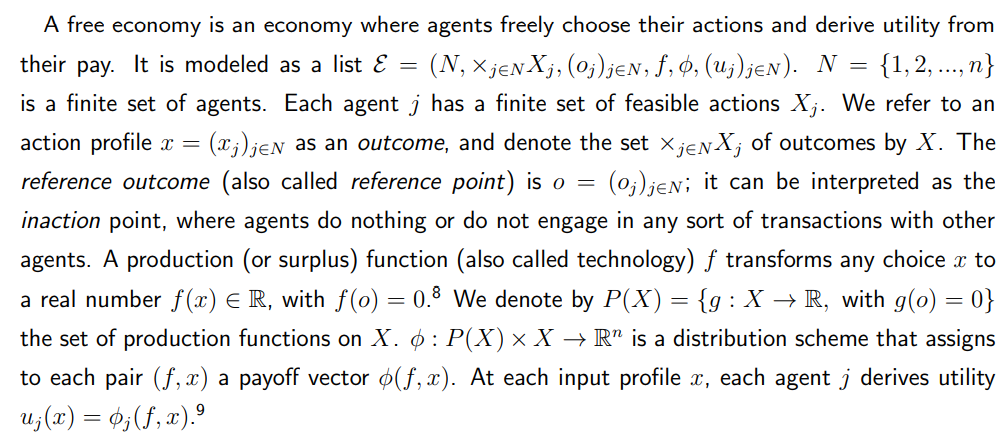
    2.1 A free economy

    2.2 A free and fair economy

  2. Equilibrium existence in a free and fair economy

    3.1 A free and fair economy as a strategic form game

    3.2 Existence of an equilibrium

  3. Equilibrium efficiency in a free and fair economy

  4. A free economy with social justice and inclusion

    5.1 Equilibrium existence and efficiency in a free economy with social justice

    5.2 Choosing a reference point to achieve equilibrium efficiency

  5. Some applications

    6.1 Teamwork: surplus distribution in a firm

    6.2 Contagion and self-enforcing lockdown in a networked economy

    6.3 Bias in academic publishing

    6.4 Exchange economies

  6. Contributions to the closely related literature

  7. Conclusion and References

Appendix

2 A free and fair economy: definition, existence and uniqueness

In this section, we introduce preliminary definitions and the key concepts of the paper. We then show that there exists a unique economy that is free and fair.

2.1 A free economy
2.2 A free and fair economy

\
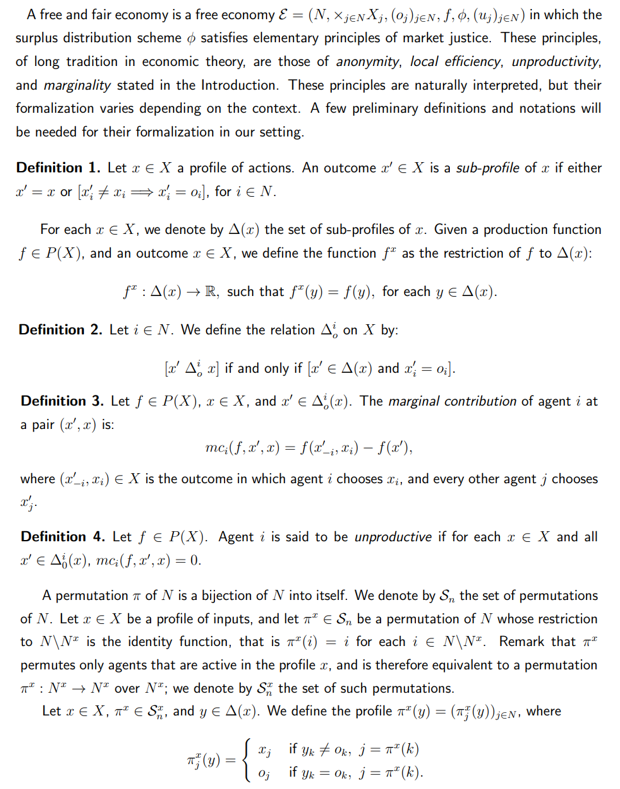
\ \ We now formalize the principles of market justice below.

\ \
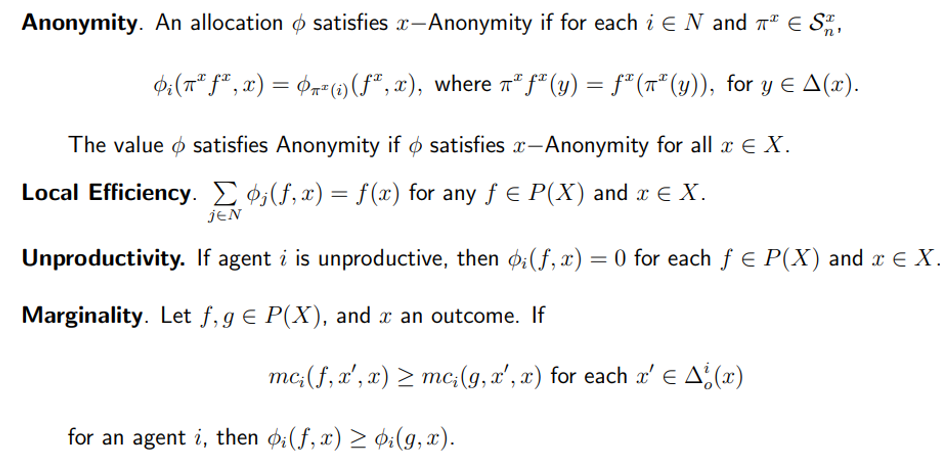
\ \ These axioms are interpreted naturally. Anonymity means that an agent’s pay does not depend on their name. It states that every agent is treated the same way by the allocation rule: if two agents exchange their identities, their payoffs will remain unchanged. An important property that is implied by anonymity is symmetry (or non-favoritism), which means that equally productive agents should receive the same pay. Local efficiency simply requires that the surplus resulting from any input choice be fully shared among productive agents participating in the economy. Unproductivity means that an agent whose marginal contribution is zero at an input profile should get nothing at that profile. Marginality means that, if the adoption of a new technology increases the marginal contribution of an agent, that agent’s pay should not be lower under this new technology relative to the old technology. In other words, more productive agents should not earn less compared to less productive agents. Throughout the paper, we abbreviate the four principles as ALUM.

\ \
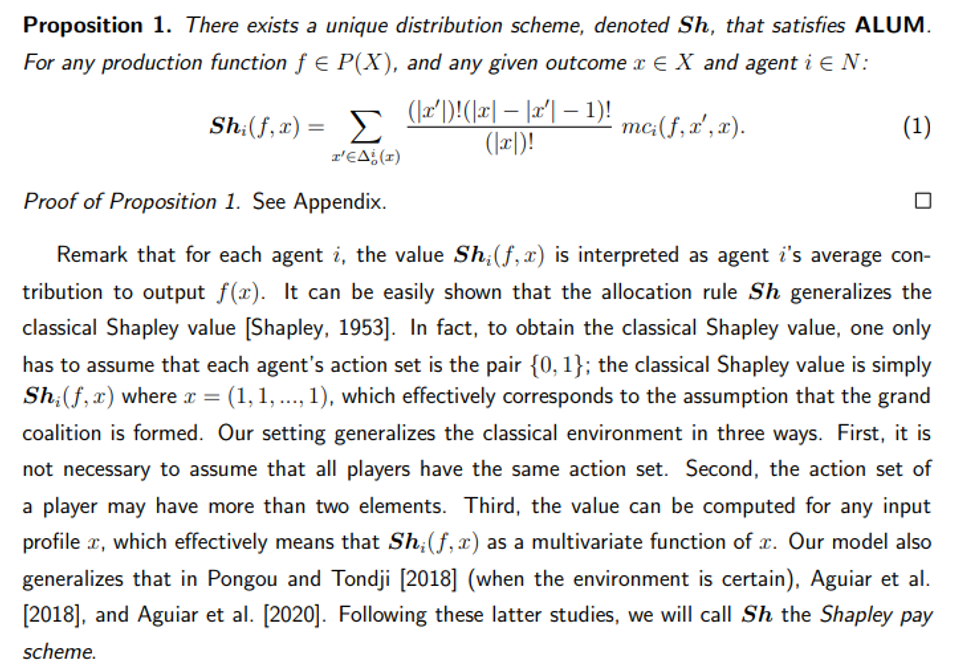
\ \ Below, we illustrate the notion of a free and fair economy, and provide an example of a free economy that is unfair.

\ \
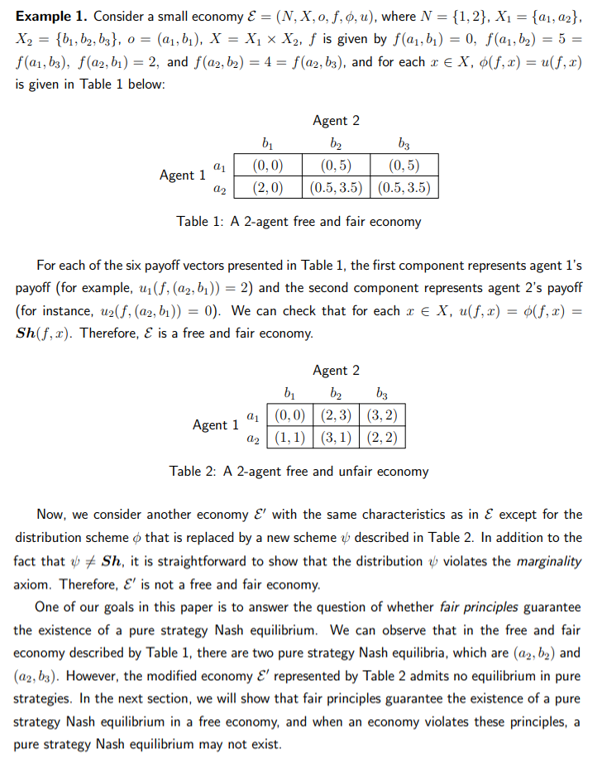
\ \ \

:::info Authors:

(1) Ghislain H. Demeze-Jouatsa, Center for Mathematical Economics, University of Bielefeld (demeze jouatsa@uni-bielefeld.de);

(2) Roland Pongou, Department of Economics, University of Ottawa (rpongou@uottawa.ca);

(3) Jean-Baptiste Tondji, Department of Economics and Finance, The University of Texas Rio Grande Valley (jeanbaptiste.tondji@utrgv.edu).

:::


:::info This paper is available on arxiv under CC BY 4.0 DEED license.

:::

[8] We normalize the surplus at the reference point to 0 for expositional purposes. It is possible that the surplus realized at o is not zero, and in this case, f(x) should be interpreted as net surplus at x, that is, the realized surplus at x minus the realized surplus at o. We assume the reference o to be exogenously determined.


Market Opportunity
AssangeDAO Logo
AssangeDAO Price(JUSTICE)
$0.0000239
$0.0000239$0.0000239
+0.08%
USD
AssangeDAO (JUSTICE) Live Price Chart
Disclaimer: The articles reposted on this site are sourced from public platforms and are provided for informational purposes only. They do not necessarily reflect the views of MEXC. All rights remain with the original authors. If you believe any content infringes on third-party rights, please contact service@support.mexc.com for removal. MEXC makes no guarantees regarding the accuracy, completeness, or timeliness of the content and is not responsible for any actions taken based on the information provided. The content does not constitute financial, legal, or other professional advice, nor should it be considered a recommendation or endorsement by MEXC.

You May Also Like

Gold Hits $3,700 as Sprott’s Wong Says Dollar’s Store-of-Value Crown May Slip

Gold Hits $3,700 as Sprott’s Wong Says Dollar’s Store-of-Value Crown May Slip

The post Gold Hits $3,700 as Sprott’s Wong Says Dollar’s Store-of-Value Crown May Slip appeared on BitcoinEthereumNews.com. Gold is strutting its way into record territory, smashing through $3,700 an ounce Wednesday morning, as Sprott Asset Management strategist Paul Wong says the yellow metal may finally snatch the dollar’s most coveted role: store of value. Wong Warns: Fiscal Dominance Puts U.S. Dollar on Notice, Gold on Top Gold prices eased slightly to $3,678.9 […] Source: https://news.bitcoin.com/gold-hits-3700-as-sprotts-wong-says-dollars-store-of-value-crown-may-slip/
Share
BitcoinEthereumNews2025/09/18 00:33
China Launches Cross-Border QR Code Payment Trial

China Launches Cross-Border QR Code Payment Trial

The post China Launches Cross-Border QR Code Payment Trial appeared on BitcoinEthereumNews.com. Key Points: Main event involves China initiating a cross-border QR code payment trial. Alipay and Ant International are key participants. Impact on financial security and regulatory focus on illicit finance. China’s central bank, led by Deputy Governor Lu Lei, initiated a trial of a unified cross-border QR code payment gateway with Alipay and Ant International as participants. This pilot addresses cross-border fund risks, aiming to enhance financial security amid rising money laundering through digital channels, despite muted crypto market reactions. China’s Cross-Border Payment Gateway Trial with Alipay The trial operation of a unified cross-border QR code payment gateway marks a milestone in China’s financial landscape. Prominent entities such as Alipay and Ant International are at the forefront, participating as the initial institutions in this venture. Lu Lei, Deputy Governor of the People’s Bank of China, highlighted the systemic risks posed by increased cross-border fund flows. Changes are expected in the dynamics of digital transactions, potentially enhancing transaction efficiency while tightening regulations around illicit finance. The initiative underscores China’s commitment to bolstering financial security amidst growing global fund movements. “The scale of cross-border fund flows is expanding, and the frequency is accelerating, providing opportunities for risks such as cross-border money laundering and terrorist financing. Some overseas illegal platforms transfer funds through channels such as virtual currencies and underground banks, creating a ‘resonance’ of risks at home and abroad, posing a challenge to China’s foreign exchange management and financial security.” — Lu Lei, Deputy Governor, People’s Bank of China Bitcoin and Impact of China’s Financial Initiatives Did you know? China’s latest initiative echoes the Payment Connect project of June 2025, furthering real-time cross-boundary remittances and expanding its influence on global financial systems. As of September 17, 2025, Bitcoin (BTC) stands at $115,748.72 with a market cap of $2.31 trillion, showing a 0.97%…
Share
BitcoinEthereumNews2025/09/18 05:28
Zero Knowledge Proof Stage 2 Coin Burns Signal a Possible 7000x Explosion! ETH Slows Down & Pepe Drops

Zero Knowledge Proof Stage 2 Coin Burns Signal a Possible 7000x Explosion! ETH Slows Down & Pepe Drops

Explore how experts are pointing to a possible 7000x rise for Zero Knowledge Proof (ZKP) while ETH slows and Pepe moves sideways, driven by ongoing coin burns and
Share
CoinLive2026/01/19 07:00